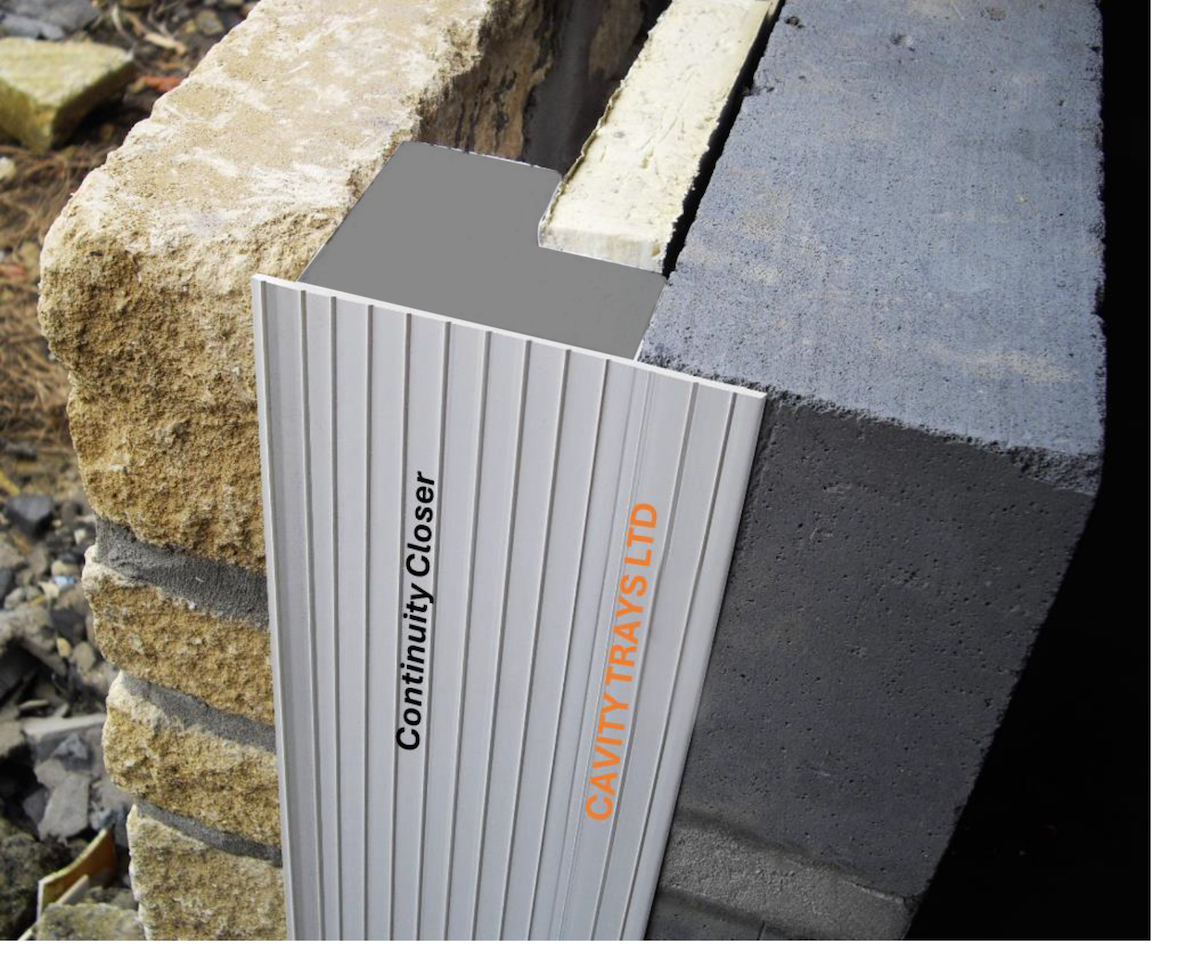
Sometimes, accepted everyday build details can be unsuitable and the designer must consider an alternative way forward. Thermal bridging around window and door openings is easily prevented by incorporating an insulated closer. The reveal is closed, damp is prevented from permeating, and the arrangement is thermally insulated. Sometimes overlooked is the extent by which an exterior skin will saturate and worsen the heat loss path. This challenges the intended thermal wellbeing around an opening and importantly affects a common construction detail.
Whenever a masonry skin becomes saturated with water its conductivity increases. Will a reveal detail that is marginally compliant remain so when the structure is saturated following storm-driven rain? Consider the reveals of a cavity wall door opening. They can be closed either traditionally using DPC, or by using a cavity closer. Most construction authorities/certificates refer to such vertical closing terminating below the sill into the cavity, so any gravitating water can safely discharge out of harm’s way.
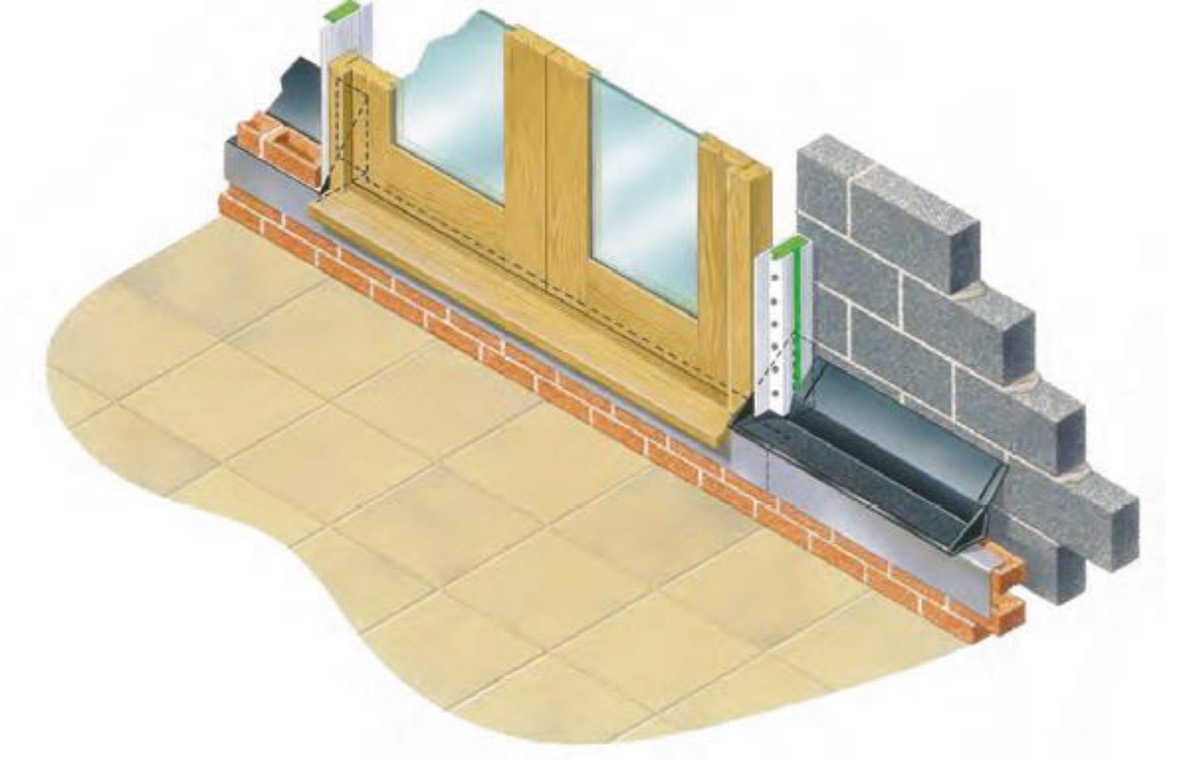
If one looks at Part C of the Building Regulations page 37, section 5.32 states closers must have fins. These are upon the closing face and interrupt capillary ingress, directing water to gravitationally drain, so it discharges at the bottom of the closer – hence the qualification regarding the terminating level. The arrangement works with door openings on the ground floor, as gravitating water can safely downwardly release. But when not at ground level, water can feed into whatever is below.
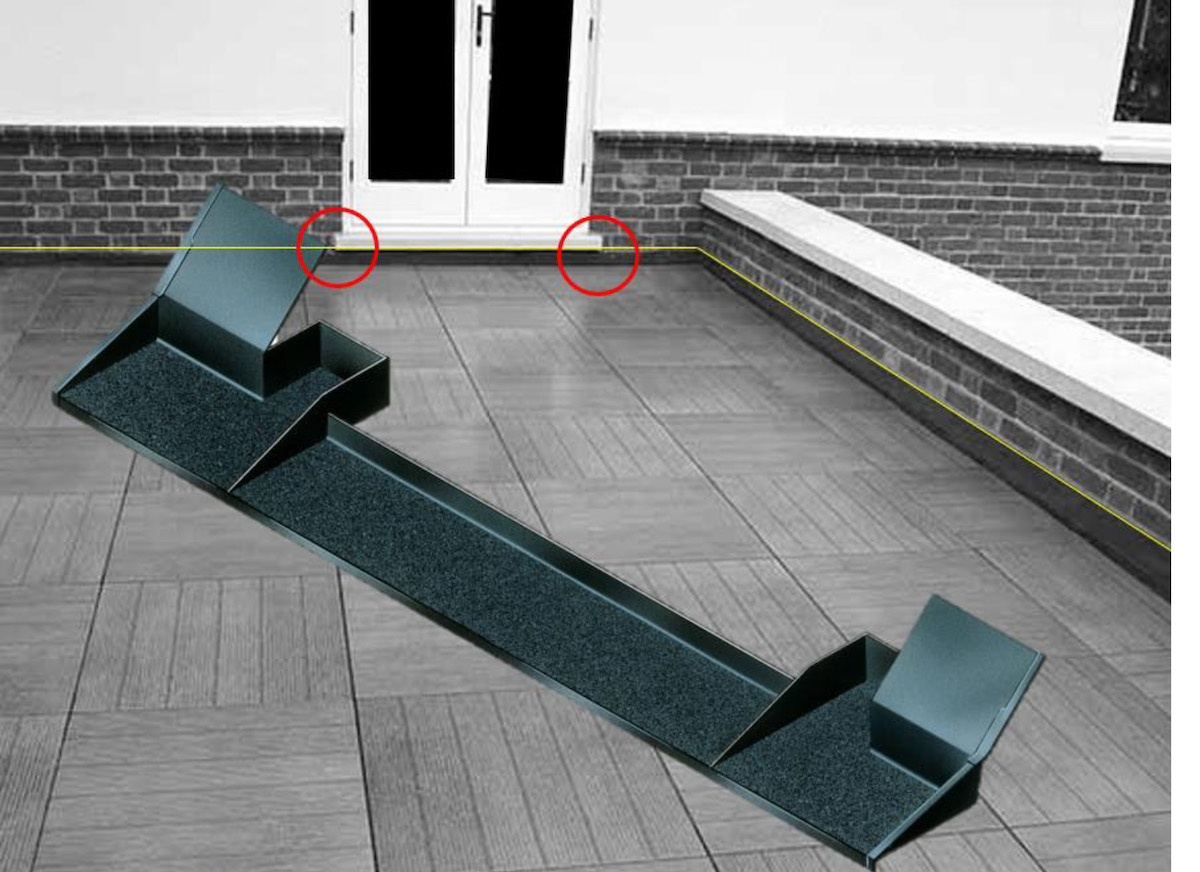
If the external door opening is onto a balcony, terrace or change of level, then underneath there is commonly accommodation. Constructing so that the gravitating water discharging at sill level is safely managed and exits the construction rather than permeates downwardly into it, is essential. One approach is to incorporate a preformed tray that integrates with any adjacent horizontal intersection protection and additionally is shaped to receive and accommodate the vertical closing medium. Draining water is then fed into the protective tray and cannot ingress the structure below.
Returning to the subject of external skin thermal conductivity, it is always variable and influenced by temperature, density and importantly moisture content. When a material becomes wet, the air enclosures/fissures fill with water. A dry brick might have a specific mass of 1600-1900 kg/m³ and thermal conductivity of 0.6-0.7 W/mK, but the same brick when wet can have a thermal conductivity of 0.9-1.2 W/mK – an increase in conductivity approaching 100 per cent. This should be borne in mind when determining the optimum reveal closing arrangement and optimum water penetration protection. Both being necessary to maintain long term thermal and protective compliancy of the building envelope.
Cavity Trays Ltd is based in Somerset and has a proven track record being the long-established cavity tray company in the UK. It manufactures an extensive range of construction solutions for cavity walls.
Cavity Trays
enquiries@cavitytrays.co.uk
www.cavitytrays.co.uk