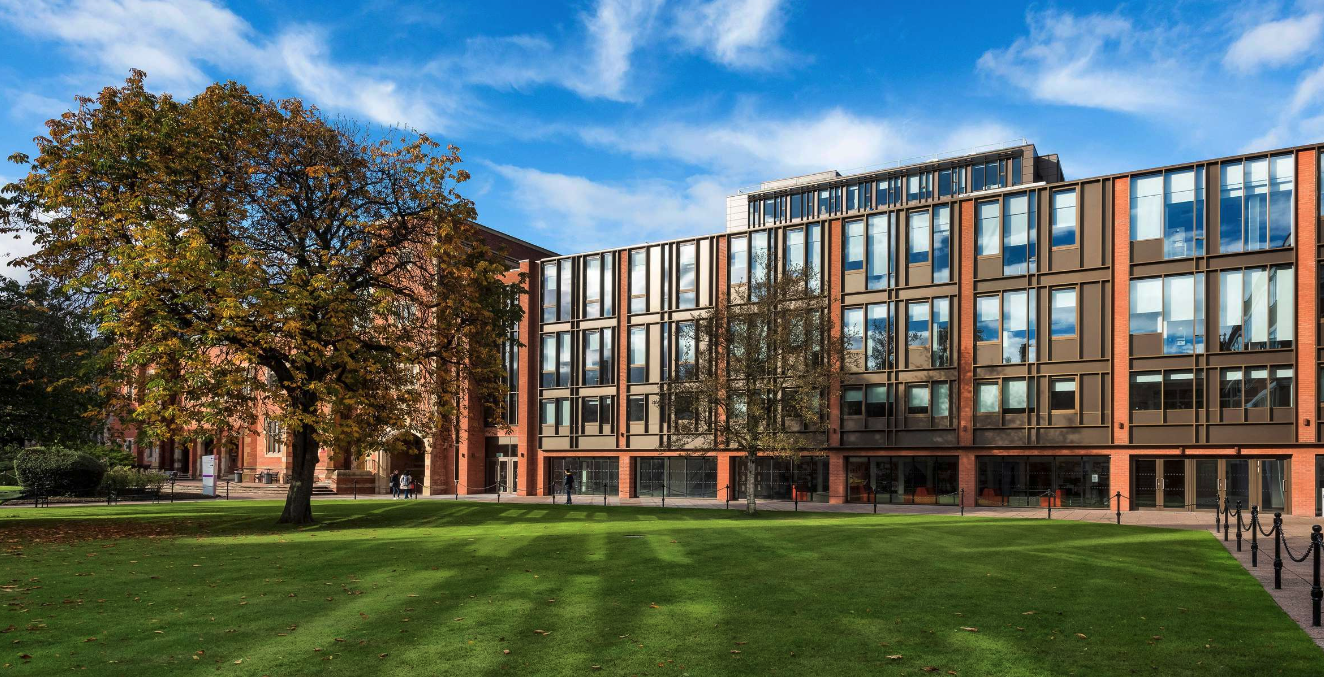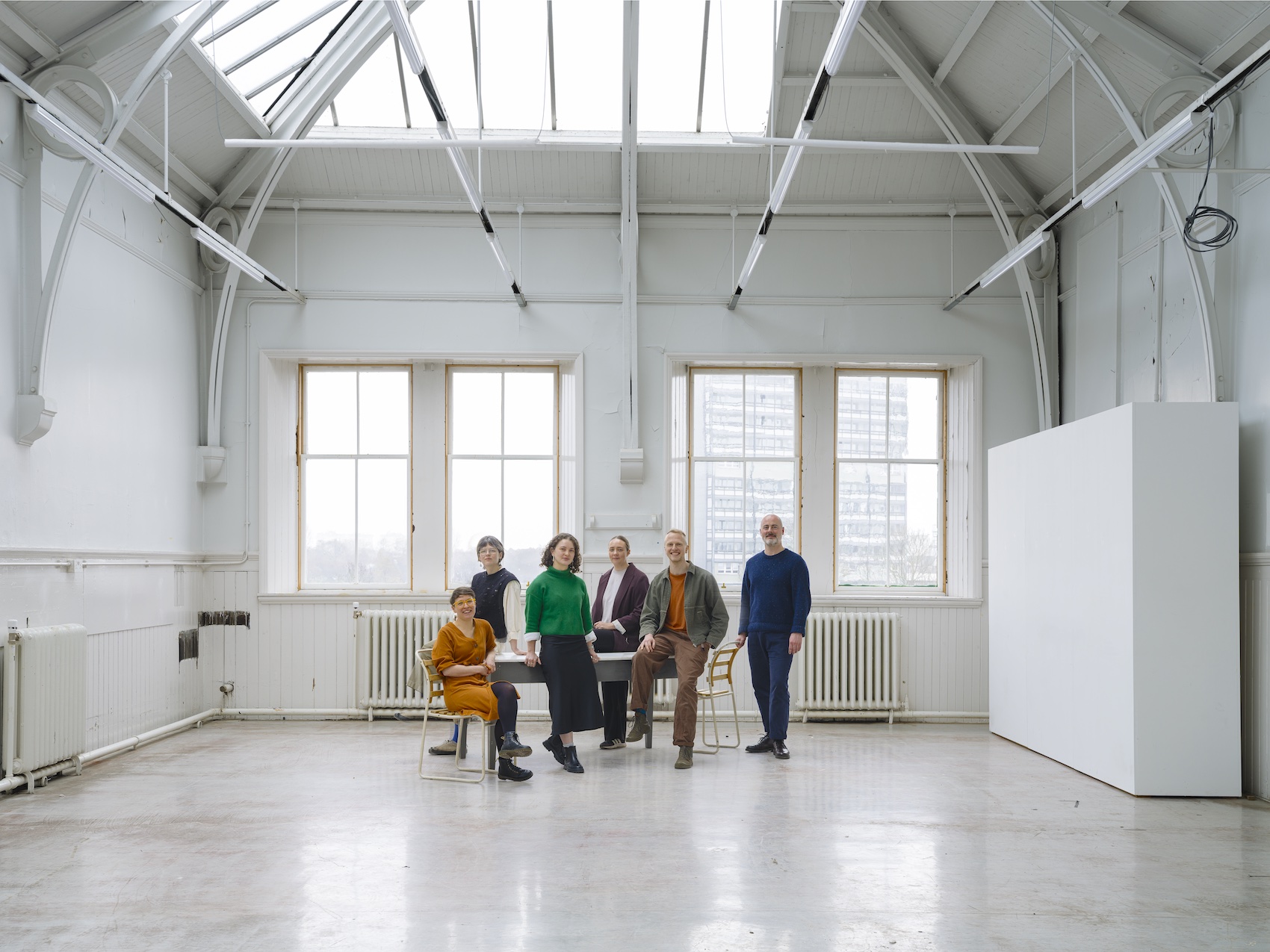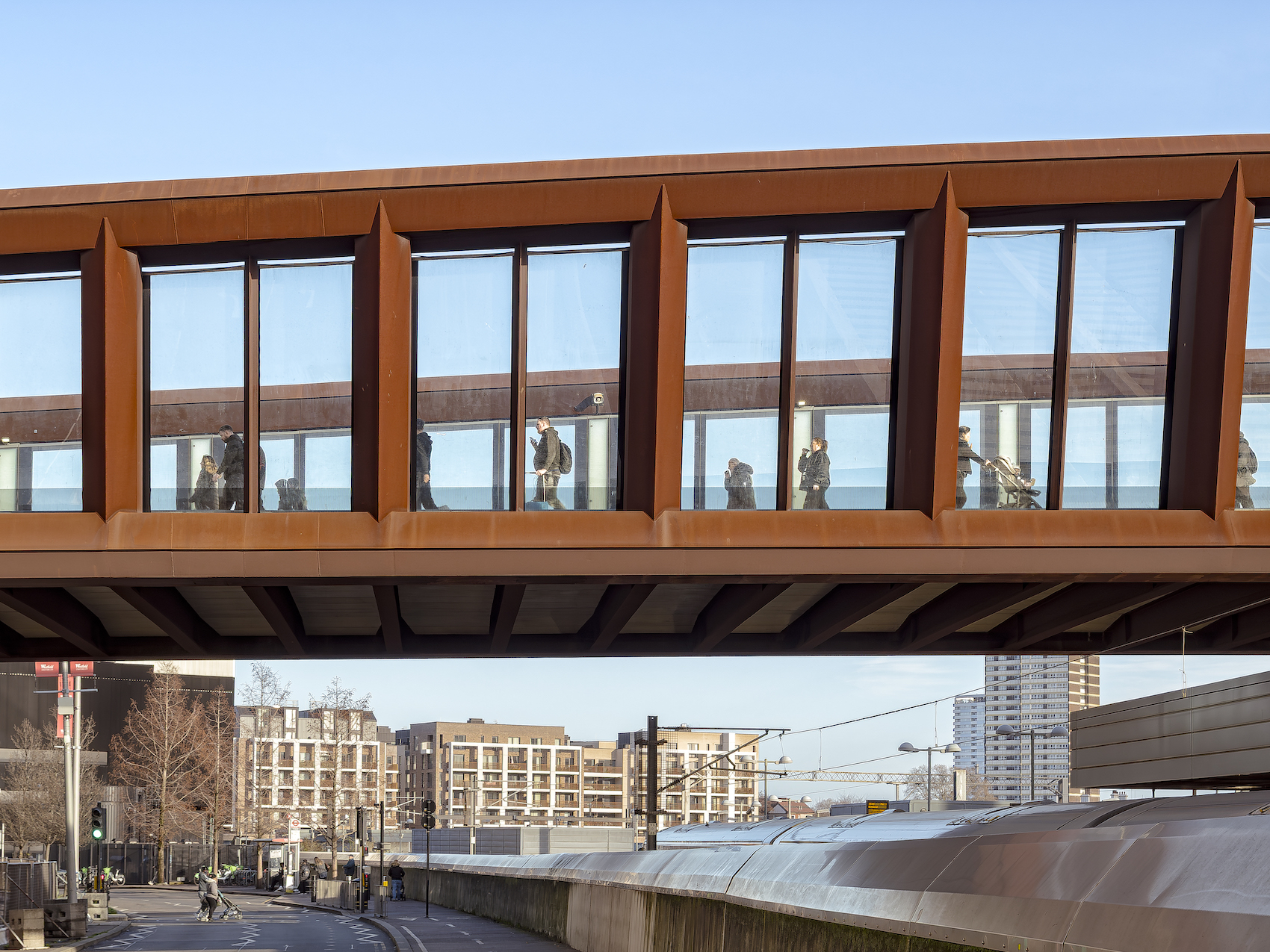
Cindy Walters from Walters & Cohen Architects and Wan Fan, Vice Chair of the Governors at Regent High School, discuss the reworked Camden school, which won the Education Award at the Test of Time Awards 2025, and was a ‘labour of love’ that transformed the community it serves.
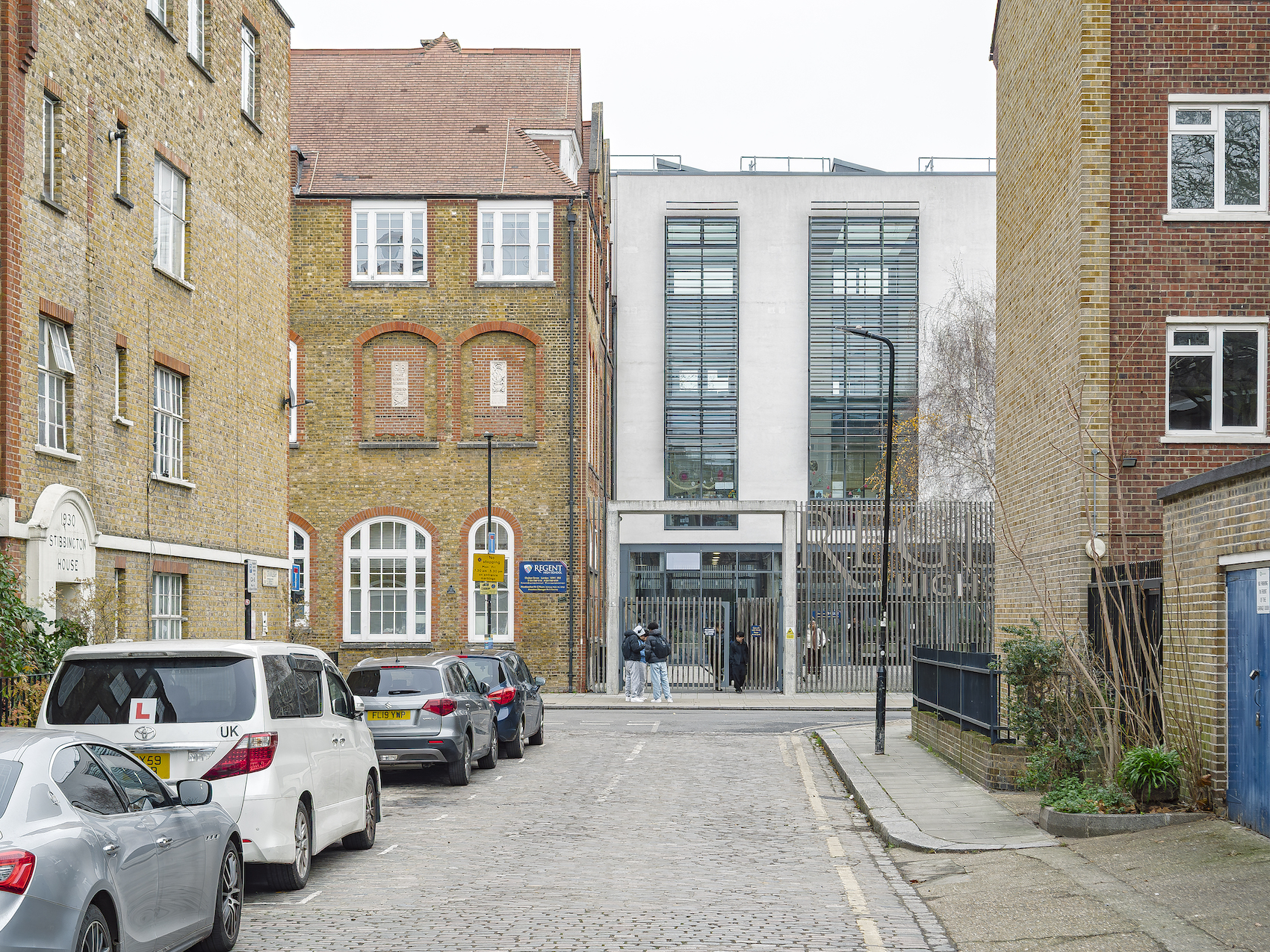
The entrance was moved from its previous location to give the school a more direct relationship with the estates that the majority of students call home.
Regent High School in Somers Town, Camden, is a non-selective co-educational comprehensive that underwent a major transformation as part of the Building Schools for the Future programme. The project integrated new-build elements with refurbished structures to create a coherent, legible school environment that supports learning and community engagement. Public and stakeholder consultation shaped key decisions, including the reorientation of the entrance to better connect with the local community. Facilities, such as a theatre, sports hall, and creative studios, are hired out for civic and cultural events, contributing to local regeneration and generating income for the school.
A triple-height circulation spine – the Arcade – connects old and new buildings and forms the main entrance from Chalton Street, as well as providing passive supervision and supporting student wellbeing by simplifying movement and creating shared space. Orientation and façade treatments manage solar gain, while exposed thermal mass and high insulation levels reduce energy demand. A ground source heat pump, photovoltaic panels, and openable rooflights contribute to low operational carbon.
Designed with adaptability in mind, the building has proven flexible in response to changing needs. During the COVID-19 pandemic, zoning strategies supported safer operation, and additional spaces have since been adapted to support new uses, including a sixth form centre and outdoor café. External spaces, including a MUGA, pond and gardens, have become valuable assets for teaching, biodiversity, and community activities. Regular reconfigurations and light-touch interventions have been made without compromising the original design intent, enabling the school to evolve alongside its expanding role.
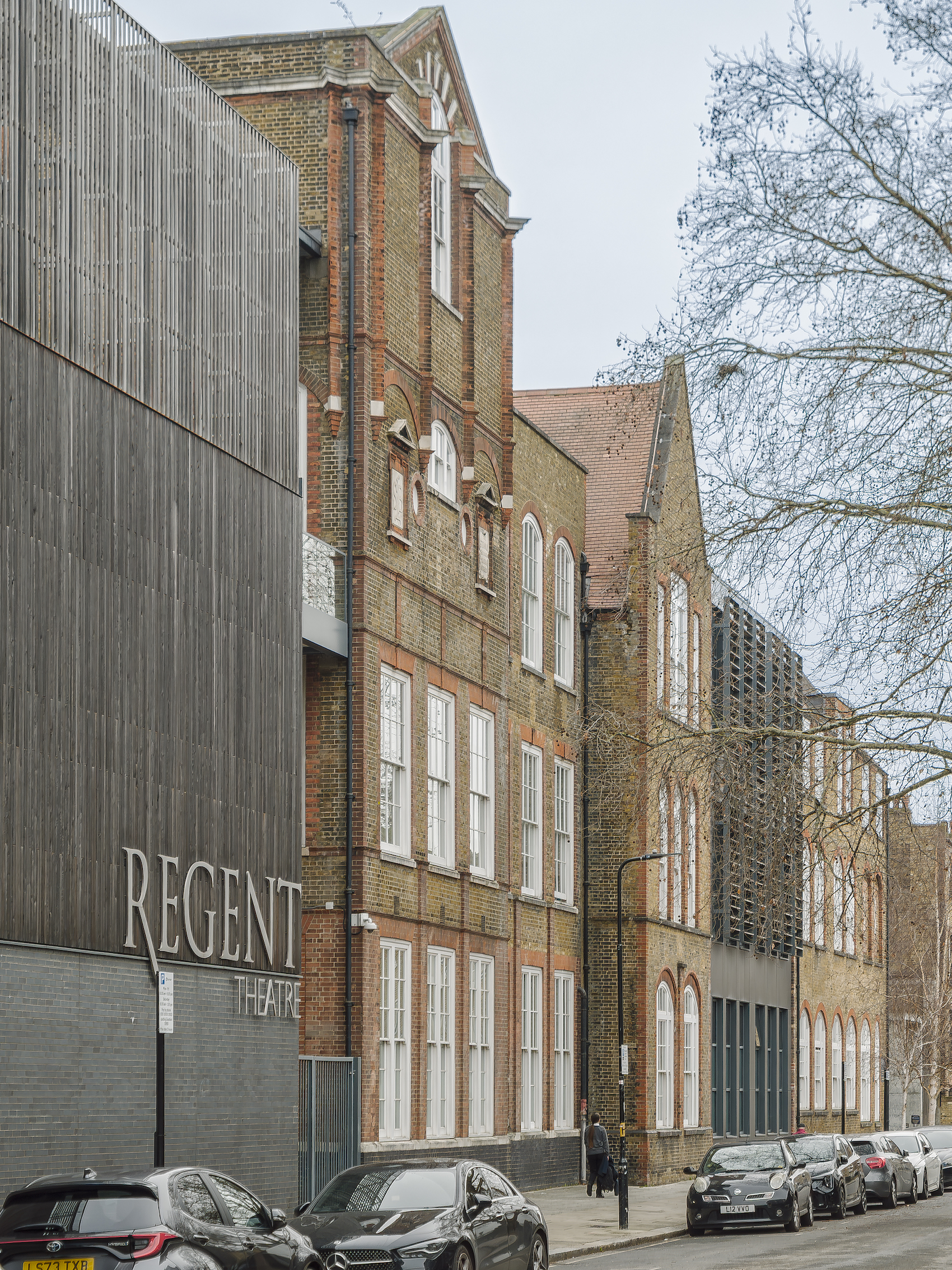
Left: The new theatre has its own street entrance, allowing it to be rented out as an additional revenue stream for the school. The same architectural language was used to replace the central portion of the Victorian Board School, which was in a particularly poor state of repair.
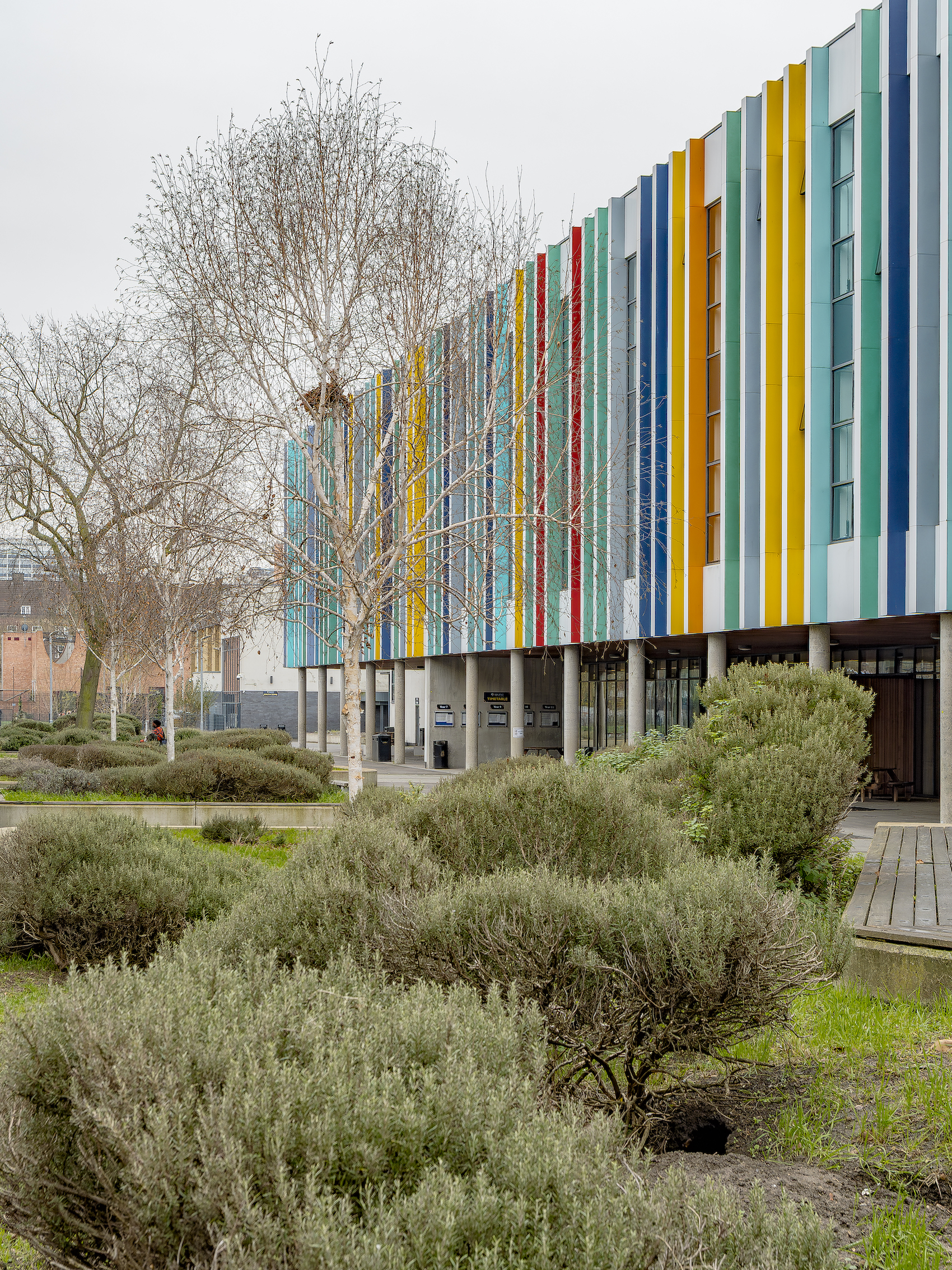
Right: An ongoing strategy of engaging students in the design process included a competition to select the colour scheme for the vertical fins on the façade. The spacing and colours of the winning scheme were based on the notation of Beethoven’s Für Elise.
Cindy Walters This was the last project to get Building Schools for the Future funding, which came from the last Labour government. It slipped through the gates before the funding tap was turned off in about 2010.
Wan Fan Regent High School is a maintained secondary school. It’s set in the heart of Somers Town, an in inner city neighbourhood between Regents Park to the west and Kings Cross St. Pancras to the east. Somers Town itself is home to over 14 social housing estates and falls within 10 per cent of the most deprived areas of the country. We have around 1,100 pupils aged between 11 and 18. More than 75 per cent of our students don’t have English as their first language, and 67 per cent of our pupils receive free school meals. So while the school, the staff and the governors don’t wear disadvantage as a badge, clearly Regent High School is set in an area where there is economic disadvantage. The school is not just a school; it’s a focus point for the community, and very much a frontline for parents and families. Often it’s the first place they go when they have problems.
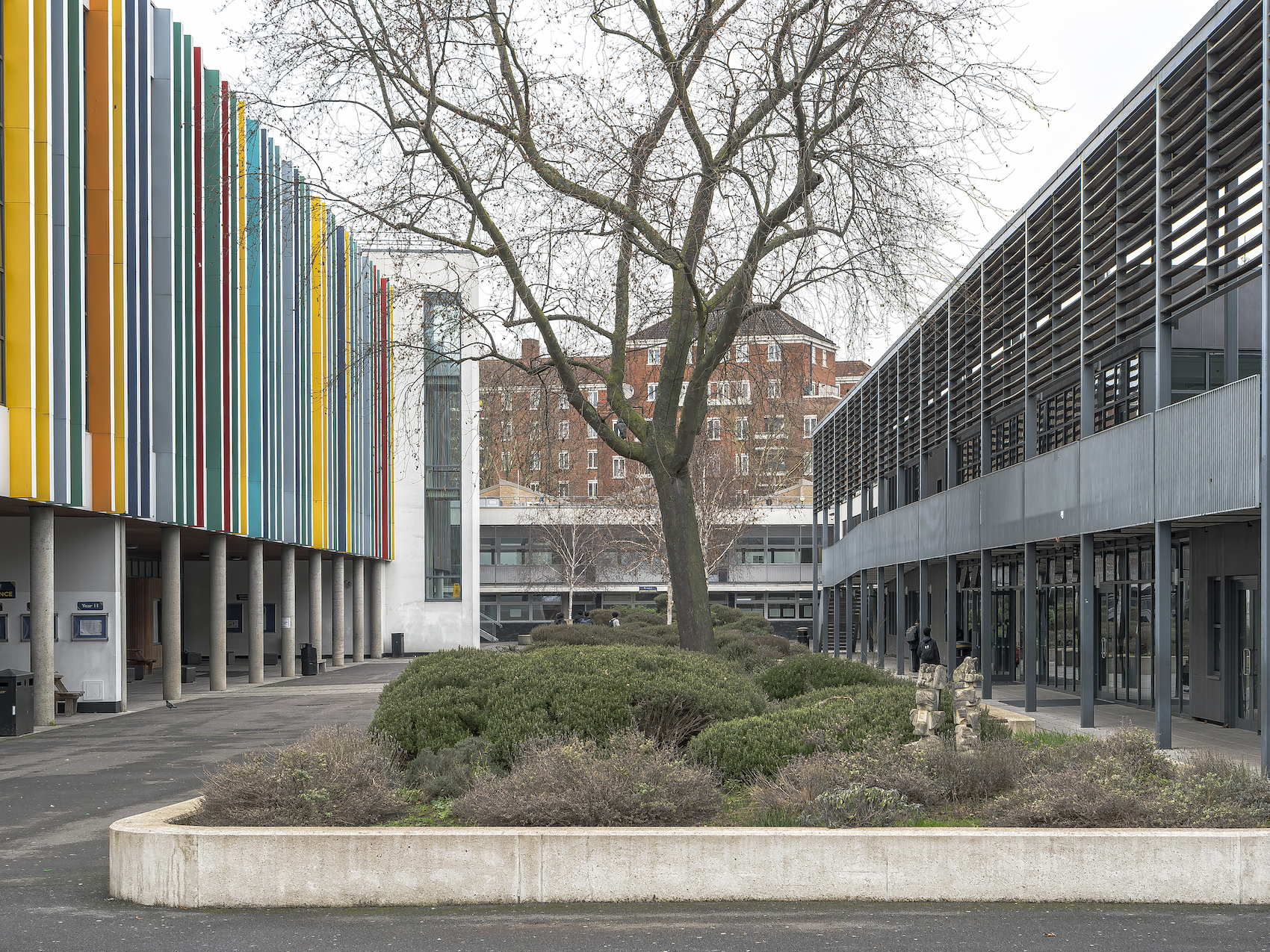
Despite being shoehorned into a tight footprint, the scheme provide as much landscaped space as possible –
a precious commodity in a neighbourhood where many students live in homes with no outdoor space.
Cindy Walters This was a very early example of adaptive reuse. We couldn’t afford to take all the existing buildings down, and neither did we want to. Many of the buildings were in a very poor state and hadn’t had any work done to them for many years. The L-shaped City Learning Centre on the north of the site had been designed quite recently by very good architects, Gollifer Langston, and was in reasonable condition, so we decided to keep it. The entrance to the school was on Charrington Street, but when we did our community consultation, the first thing the community said was, “We don’t come in from Charrington Street. We all live on the Chalton Street side. Could the entrance be on our side of the site?” And we thought that was a perfectly reasonable idea.
Wan Fan Moving an entrance that everyone’s used for many, many years is quite a drastic thing to do. But it was so important, because the whole point about running a community-based school is that it’s supposed to serve the community. And I think that really stands as an important example of how the school and this project was not about taking convenient decisions, but about working out what students and parents needed and wanted, and what was actually best for them.
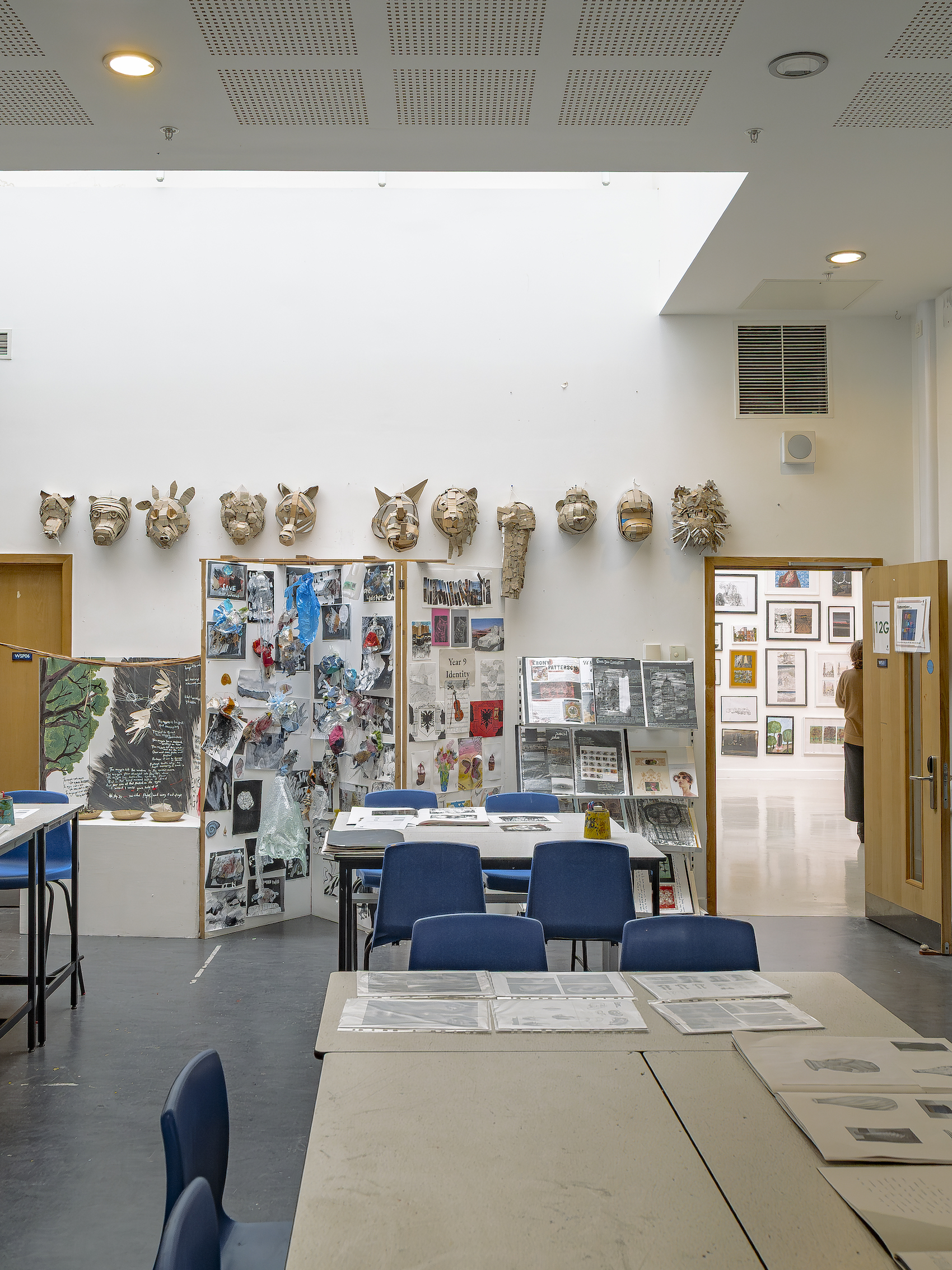
Left: Teaching spaces in both the new and refurbished parts of the building adopt the generous floor-to-ceiling heights inherited from the Victorian Board School.
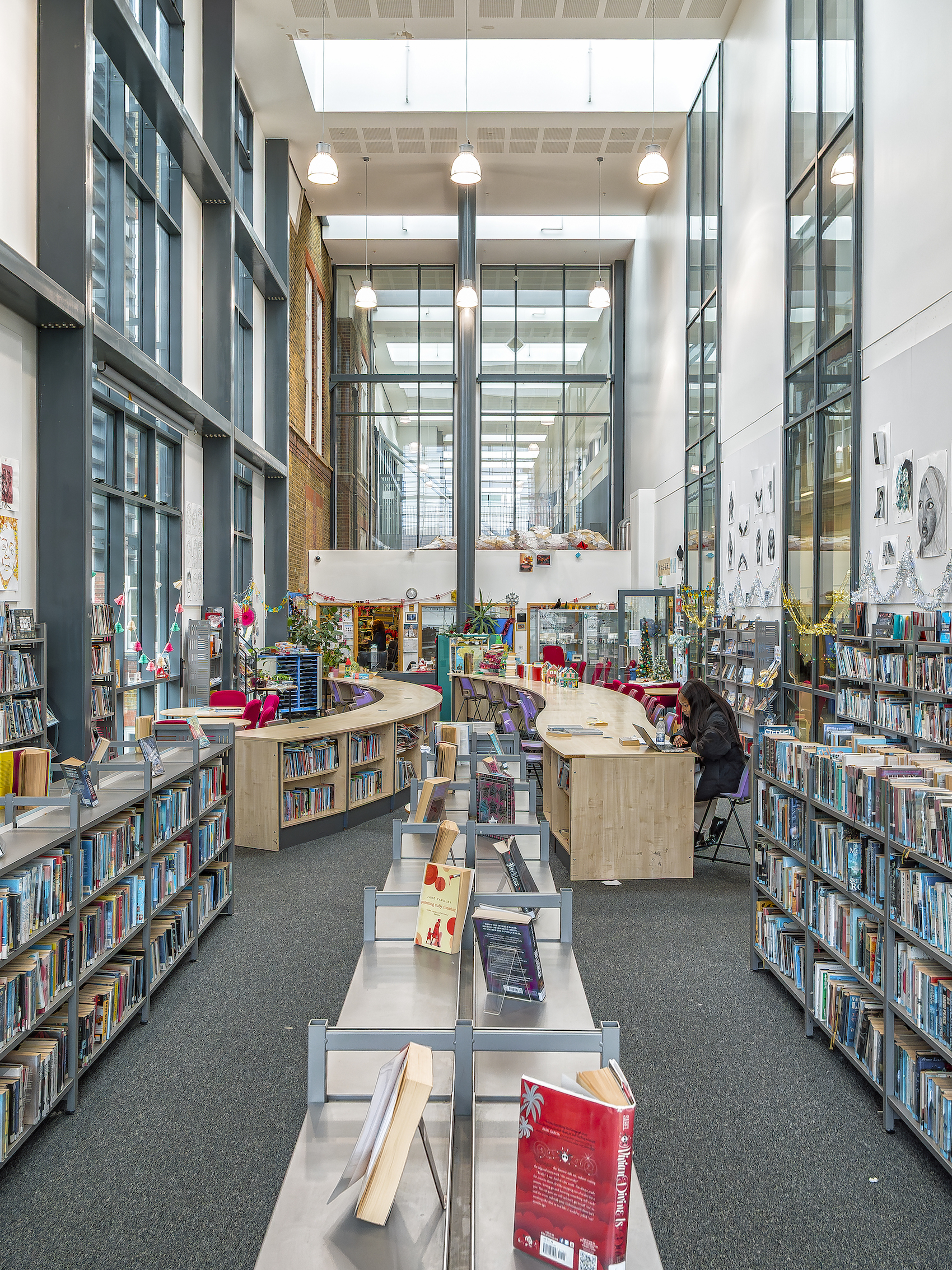
Right: The new library contains facilities for independent study and more than 14,000 texts.
Cindy Walters The school was going through this kind of transformation and reinvention, and part of that was rebranding itself. We undertook a competition with students to choose the colours for the fins on the elevation; both what the colours were and how they were arranged. The winning student came up with a musical notation based on Beethoven’s Für Elise, which then generated the colours and how the colours were placed along that façade. And those colours have made their way into the logo and branding for the school.
Wan Fan Over 10 years ago, outcomes for pupils at the school fell below the government floor standards. The school was issued a notice by the local authority, and a new head teacher was appointed. So the change in building, alongside a change in head teacher, a change in pedagogy, a change in the way the school runs, has had a huge journey over the last decade. And I’m delighted to say that two years ago, the school was rated Good by Ofsted.
Cindy Walters There was a Victorian Board School in the centre of the site, which hadn’t been in use for more than 30 years because it was in a very poor state. In was being employed by Camden Council, as offices. But through the community consultation, it became clear that this building was important to the community as a landmark. It was quite symbolic, even though it wasn’t utilised by the school, so we decided to put it back into use. We inherited, from the Victorians, rather wonderful floor-to- ceiling heights, and we used the upper floor as classrooms, which are generously proportioned spaces. The roof was actually very important because we were able to cover it with photovoltaic panels. The sustainability targets for the site as a whole were particularly high. We have a ground source heat pump, which runs all the way underneath this part of the site. It didn’t work for quite a while because there was a problem with the pump itself, but we managed to get the pump working just as energy prices went through the roof, so that’s ended up being a good saving for the school.
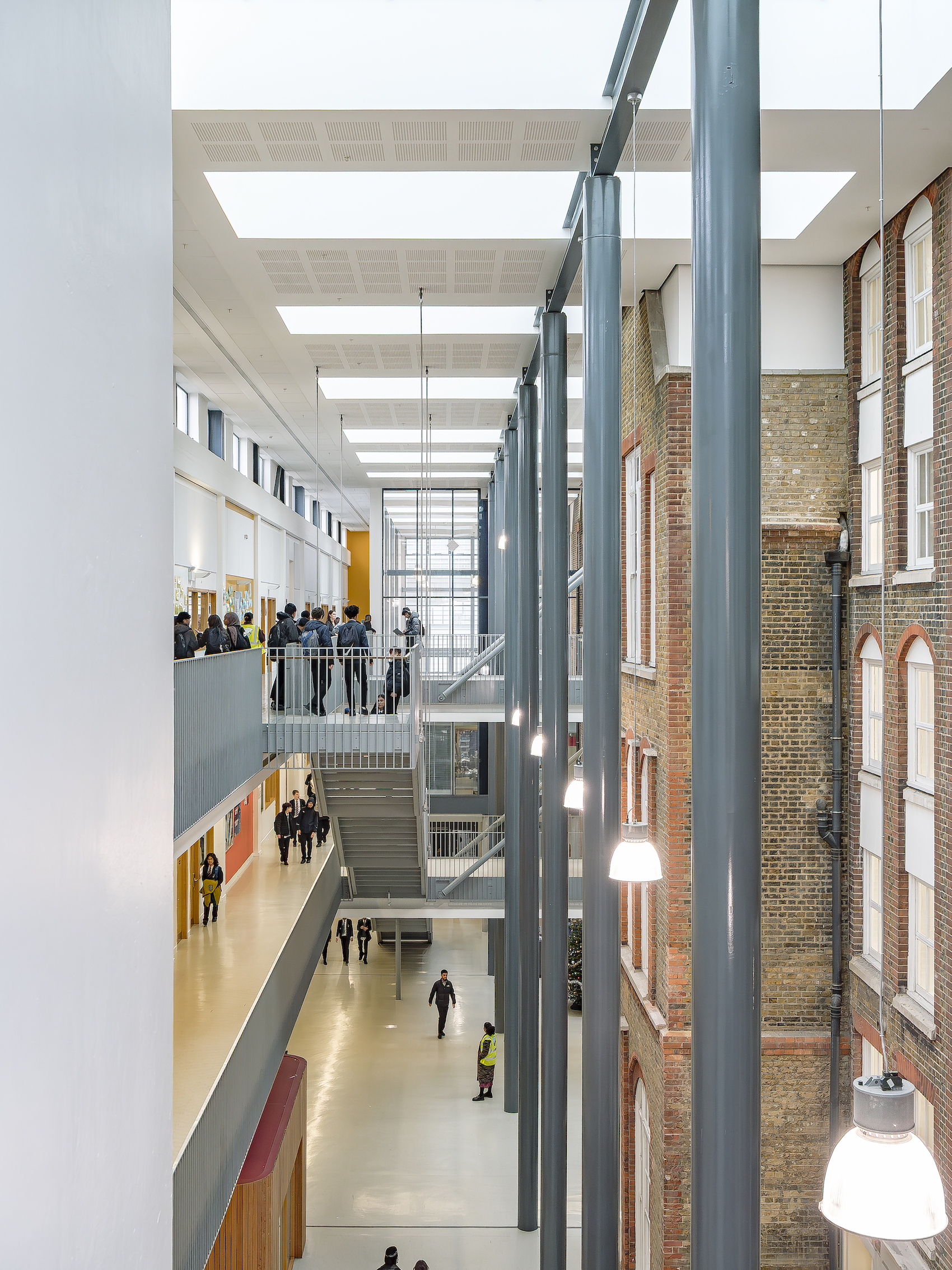
The top-lit three-storey Arcade creates a vibrant, light-drenched circulation and social space between the new and old buildings.
Wan Fan The school had to stay in use – and without any learning disrupted – through 14 phases of construction work. So it was a very complex project to deliver.
Cindy Walters Within the Arcade – this kind of free-flowing space that connects the old and new buildings – we have teaching pods that are used for meetings and specialist teaching. A rather special thing that happens in the changeover between lessons is that the Arcade goes from this quiet cathedral-like space to being noisy and full of young people and full of energy. The upper levels contain new state-of-the-art teaching facilities on one side and the theatre on the other.
Wan Fan The new theatre isn’t just for school plays. It is open to the public and can be rented out, so it generates vital income for the school. It has its own entrance, on Chalton Street, so you can access it separately out of hours.
Cindy Walters It was clear to us that we had to minimise the footprint of the accommodation on the site so that we could maximise the very limited outdoor space. We managed to get proper sports courts down at the far end of the site, and this rather wonderful landscape down the middle, which was designed by Grant Associates and is very much loved and very well used. I’m always struck by how calm it feels in this space. It feels like a bit of an oasis in this very constrained, very busy part of London. The covered space underneath – that leads from the garden into the Arcade – is very important too, because if it’s pouring with rain, that’s really the only place the students can get outside, and it is very well used. It’s also used as a sort of overflow from the dining area when the weather allows.
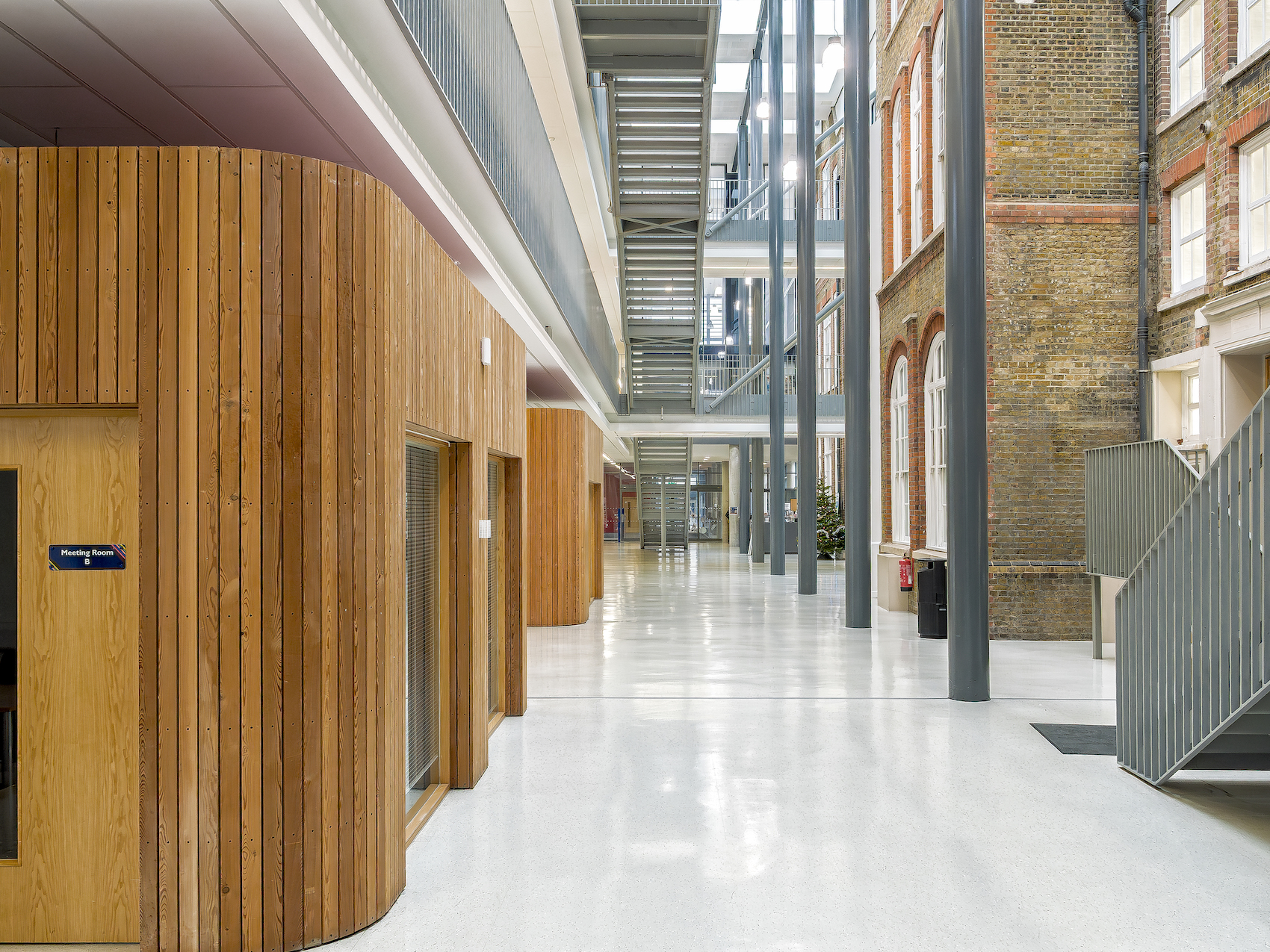
Timber-clad meeting rooms at the base of the triple-height circulation spine.
Wan Fan Most of our students live in the housing estates nearby. That’s the catchment area of the school. So they don’t necessarily have access to lots of curated and maintained outdoor spaces. Of course, London is full of parks and, in theory, a student can go to any park they want in London. But we know that most student don’t venture out that far from the borough. So actually having access every day to this maintained green space in the centre of London, where space is really at a premium, is incredibly important and really special.
Cindy Walters Somers Town has always been a slightly hermetically sealed community, even though it’s slap bang between King’s Cross and Euston stations with Camden Town to the north. But this project has regenerated the area quite substantially. During the pandemic what really struck us was how many students live in multi-generational households, often in quite small spaces. Students tell us that coming to school provides a sense of relief, so it couldn’t be more important as a space.
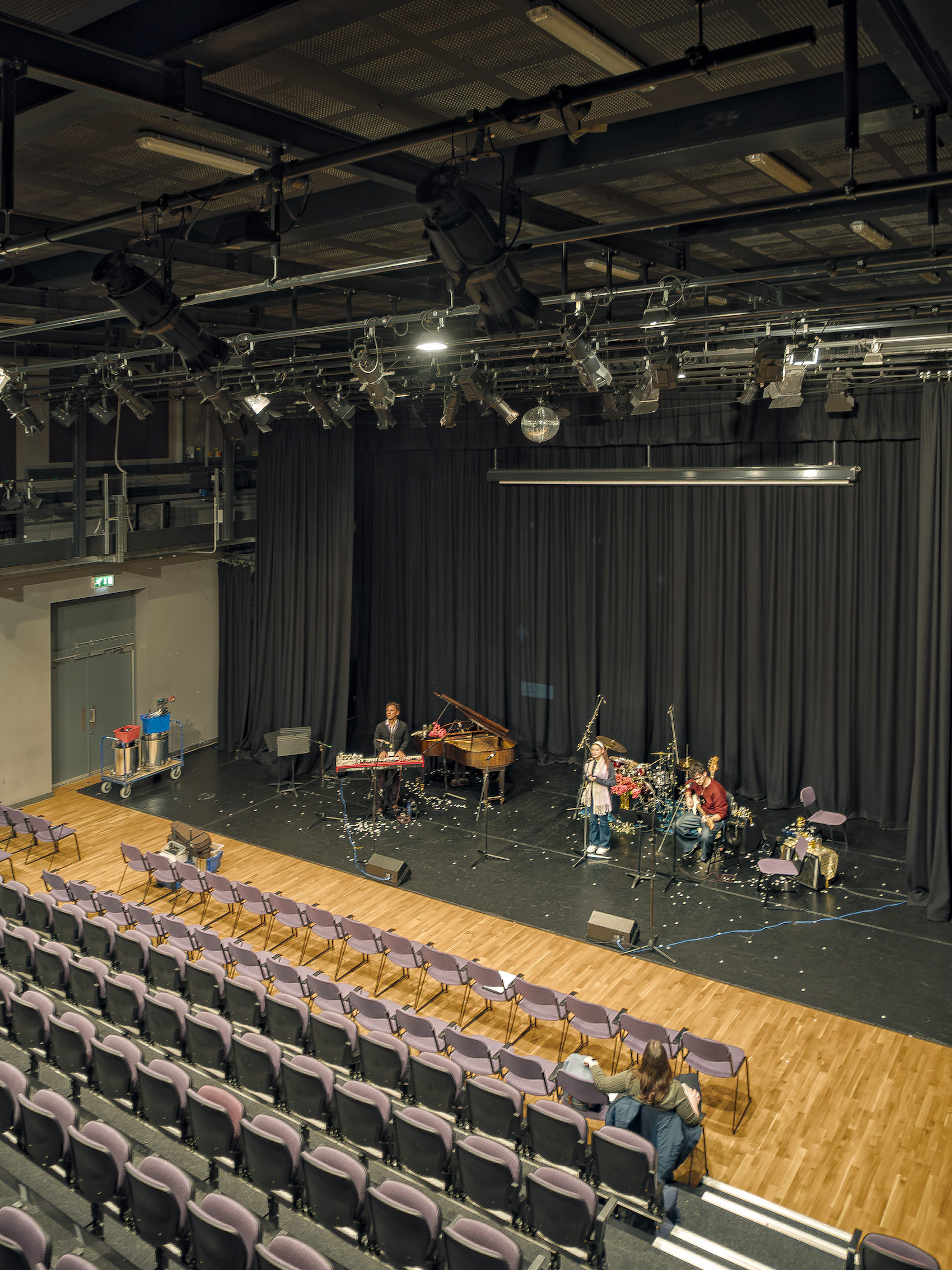
The state-of- the-art theatre serves the community as well as the school, and supports the school’s specialism in the creative arts.
Wan Fan In London as a whole, the number of secondary school places is falling; it’s predicted to fall by about four per cent until 2028. We remain a top choice of parents in the borough, but it is a continuing battle for all secondary schools to attract students, and make the case to parents as to why they should pick one school over another. We’re very fortunate that people still pick Regent High, and one element of that is to do with the building and the site itself. And of course, ultimately more pupils means more funding from the government. And more funding means the school can do more things and offer more benefits to the students.
Cindy Walters I’m a Governor too. Wan and I and all the other Governors are very, very proud to be associated with the school. One thing that strikes me whenever I go there is how incredibly robust it is, how well it has stood up to literally thousands of people passing through. Not only that, but the timber screen to the theatre and the art studios at the end of the site is weathering beautifully and is a pleasing counterpoint to the brickwork of the Victorian building. It was a labour of love and it’s a project that’s very close to our hearts. It reinforces my passionate belief that if you provide environments for learning that are uplifting and inspiring, that’s exactly what they do. And, that we should be putting money into the education estate to allow more of our schools to be places that students really feel they have been invested in. It reaps its own rewards.
Wan Fan Obviously we can’t prove it empirically, but I have been at open days and parents’ evenings where prospective parents and existing parents visit the school, and even though it has been many years now since the project took place, people always comment on the buildings. They always comment on the light. They comment on the freshness and cleanness. Being able to showcase the school makes a huge difference for us. It’s one part of the puzzle of how a parent or pupil decides what school they want to attend. Of course, there’s the piece around pedagogy and teaching, and learning and being safe. But that all takes place within the confines of the school site. I think as governors, we can say quite confidently, that’s made a huge difference in the way that we attract new pupils and parents to the school.
Other finalists in this category:
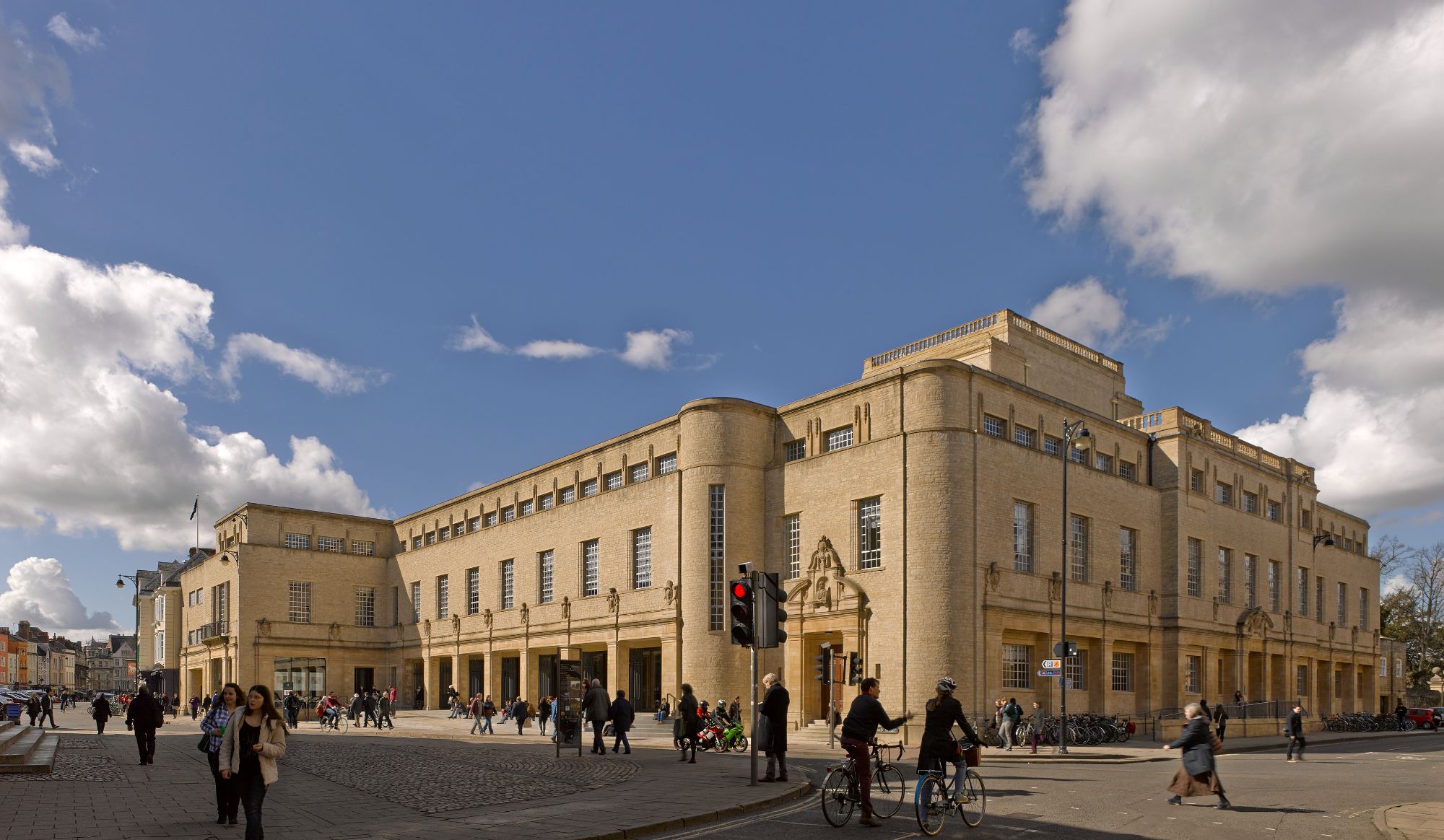
Weston Library by WilkinsonEyre