The Hummingbird Learning Lab has selected a list of longlist of eight practices from the Regenerative Architecture Index to design a demountable learning space that reflects its neuroscience-grounded approach to education and community engagement.
The Hummingbird Learning Lab has been working with the Regenerative Architecture Index to identify an architectural practice to support the next stage in its evolution; the development of a bespoke, demountable learning campus in the small Somerset town of Bruton, where it is currently based.
Grounded in a deep understanding of neuroscience, complex adaptive systems and regenerative design, The Hummingbird Learning Lab rests on a simple conviction: we are failing to equip young people with the skills and ways of being needed to flourish – physically, emotionally, and intellectually. Only by empowering them to forge meaningful connections, contribute purposefully to society, and take agency in their own evolution can they imagine and deliver the complex, interdisciplinary solutions required to meet the challenges of a future that has yet to be created.
A Call for Expressions of Interest was issued to participating practices in the Regenerative Architecture Index, a joint venture between Architecture Today and Architects Declare, that requires practices to share detailed and wide-ranging information demonstrating their track record and commitment to regenerative design and the values exemplified by Hummingbird Labs.
Interested parties were invited to accompany their submission with an image that reflected their initial reaction to the project brief. The images and accompanying text supplied by the longlisted entrants – AHMM; Bindloss Dawes Architects; Invisible Studio with PEARCE+; ritchie*studio; Studio 8FOLD; Studio Bark & alma-nac; Studio Saar and Tezuka Architects – are shown below.
AHMM
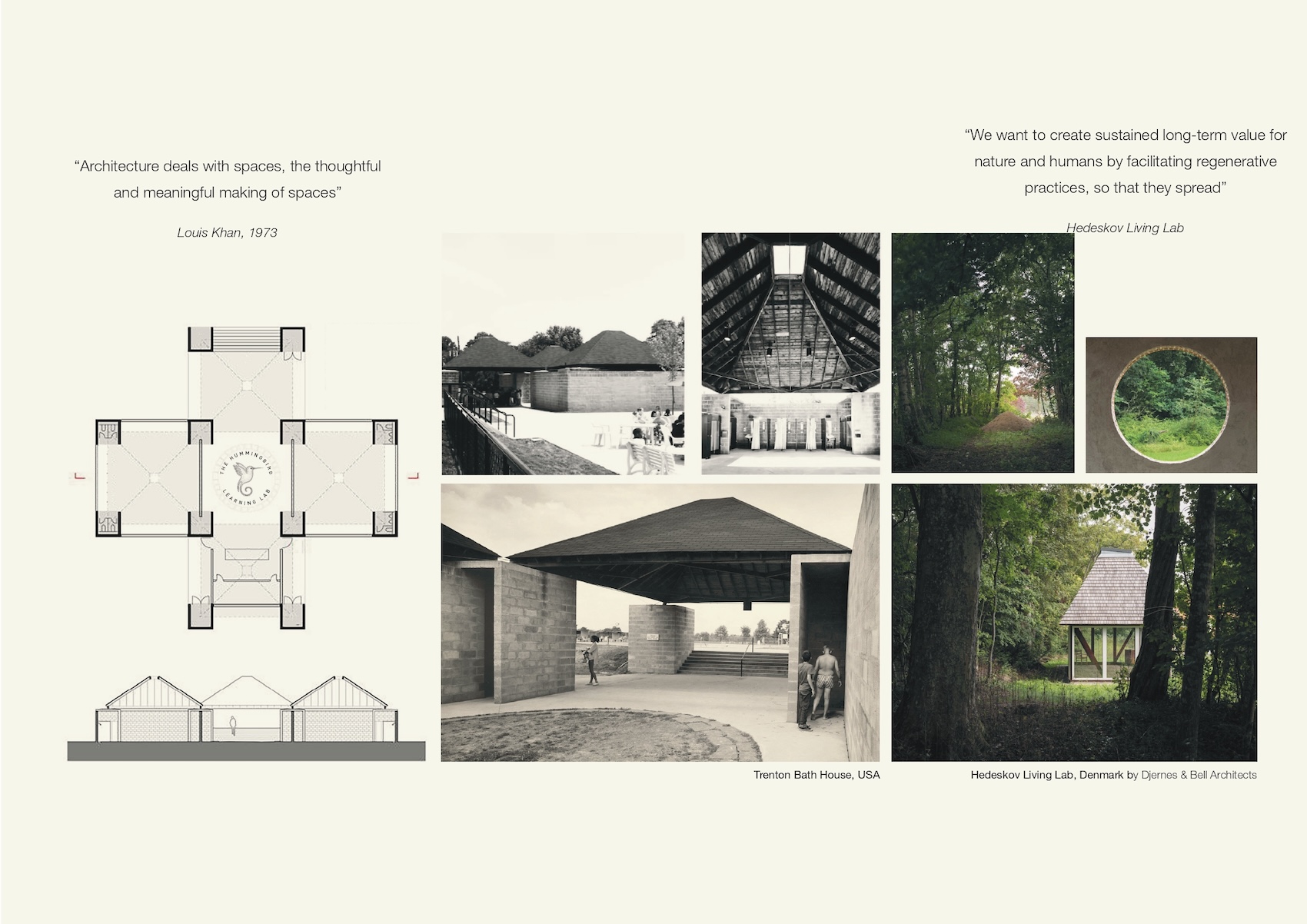
“For us, a project begins with a strategy, not a design solution. Arising from understanding the fundamental drivers of a brief and the parameters, problems and opportunities it represents. We believe this approach resonates with your core values, but to start a conversation. As a precedent – for an idea – Trenton Bath House (by Louis Kahn) is a diagram of simplicity; the arrangement of pyramidal roofs on ‘hollow stones’ creating both the requisite four rooms and so much more. Served and serving spaces are legible, flexibility inherent, opportunity for appropriation abundant. One can imagine this cluster principle – this framework – being able to adapt to different sites/scales/climates; offering enclosed or open space, perhaps seasonally, through using standard component infills available locally. As a precedent – for a material process – the buildings at Hedeskov Living Lab (by Djernes & Bell) are compelling. The project’s new ‘materials culture’ transformed a former school with natural materials that are, predominantly, locally grown and mined. Unique to the renovation of the old school is the project’s focus on combining sustainability with aesthetic, artistic, behavioural and experiential aspects.”
Bindloss Dawes Architects
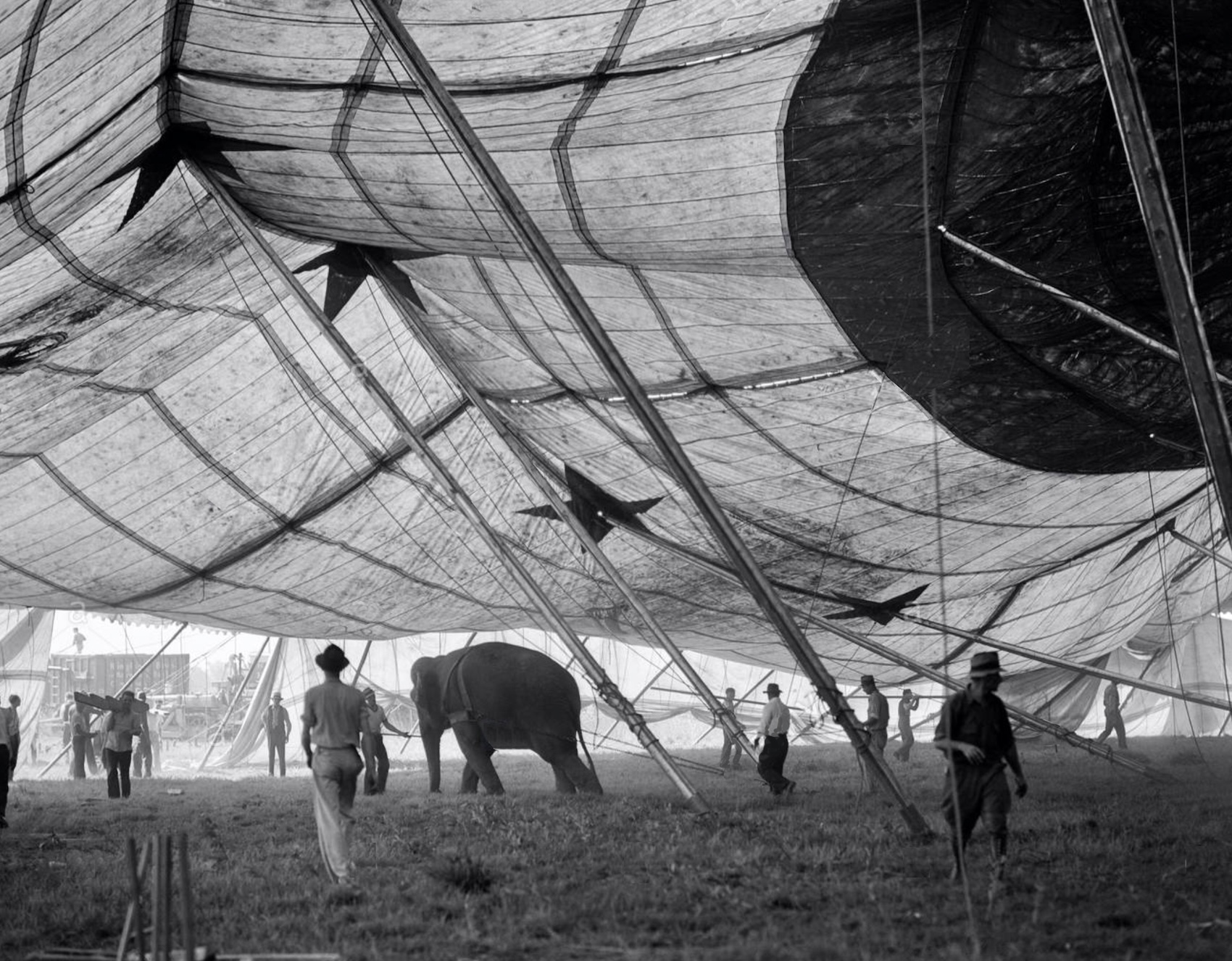
“The photograph of Barnum’s big top being raised is an image of canvasses billowing, elephants straining, and of the crew gathering in anticipation. It captures a moment of collective energy and purposeful construction that resonates deeply with the ambitions of the Hummingbird Learning Lab. The circus tent, designed for travel, rapid assembly and effortless departure, embodies a kind of architectural lightness that touches the ground gently, leaving the landscape; its soil, its ecology, its inhabitants; unharmed. Grass continuing to grow after the circus moves on. This ethos of minimal impact, maximum possibility, and joyful temporariness sits at the heart of the Learning Lab’s vision. Like the big top, the Hummingbird project must shelter a vibrant learning community: up to 150 people in moments of shared inquiry while providing ancillary accommodation that supports experimentation, reflection and movement. The circus tent’s grand span, achieved through ingenuity rather than mass, parallels the brief’s call for adaptable, demountable, regenerative structures. It is a kit-of-parts capable of thriving across climates, phases and futures. Its performative and quality echoes the Lab’s neuroscience-grounded mission to create spaces that nurture curiosity, promote agency and empower young people to discover themselves, others and the wider world. In the image, construction is an event, with the architecture becoming an expression of community, cooperation and wonder. This aligns with the Lab’s aspiration to develop an evolving campus where buildings co-evolve with nature, invite interaction, and inspire new ways of thinking.”
Invisible Studio with PEARCE+
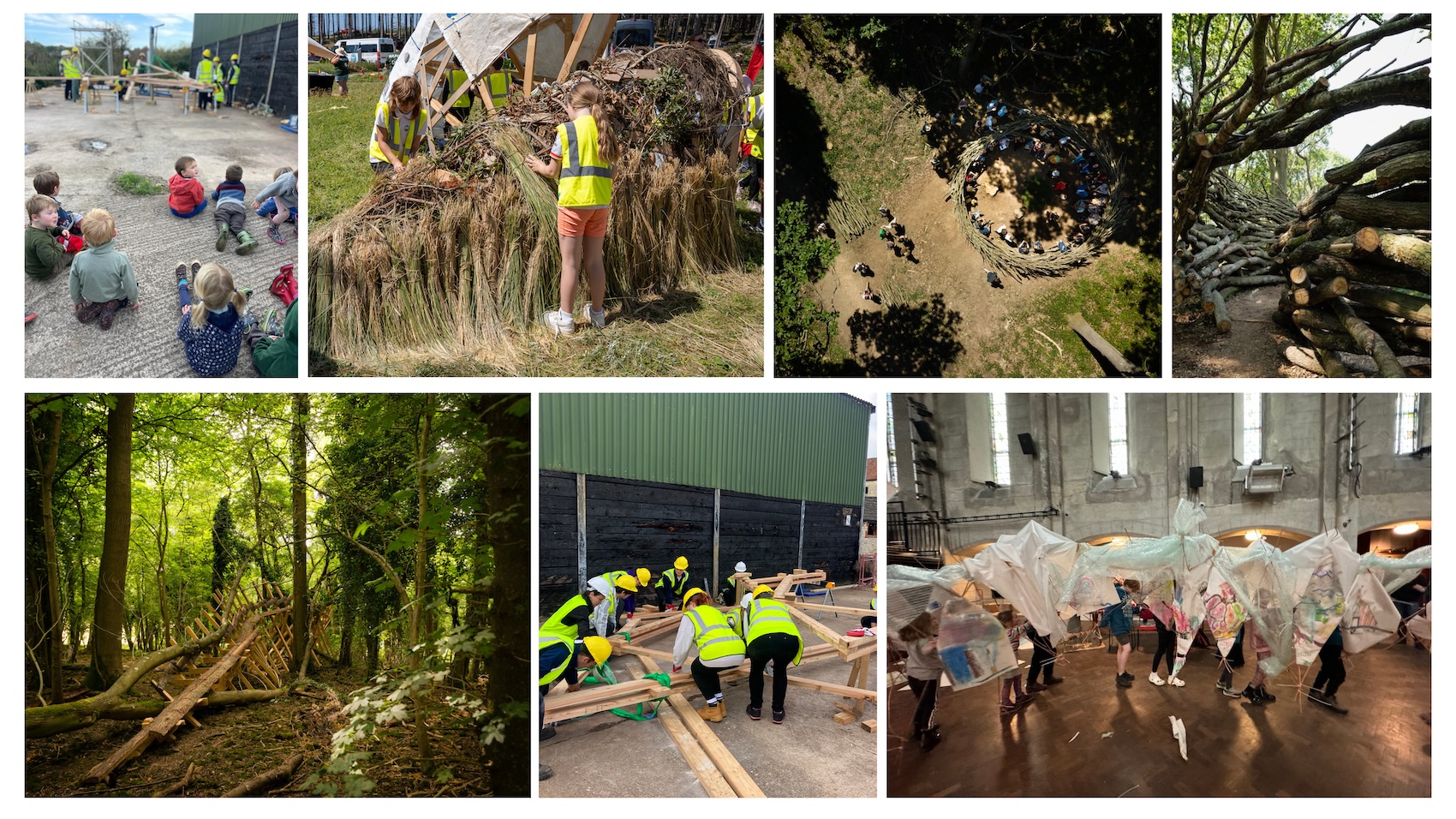
“At this stage in the project we would not wish to put forward a fixed proposal. Instead, we would suggest a series of activities that reflect our working methods, many of which we have carried out in previous projects. These include mapping local material, human and natural resources and territories, carrying out imagination work, and running temporary design and making activities in the landscape with the public to begin the creative process and to understand the setting. We would also consider spending extended time on the site and in the surrounding area, acting as architects and makers in residence. This approach helps us avoid distant helicopter architecture and allows us to meet and work closely with everyone involved in the project.”
ritchie*studio
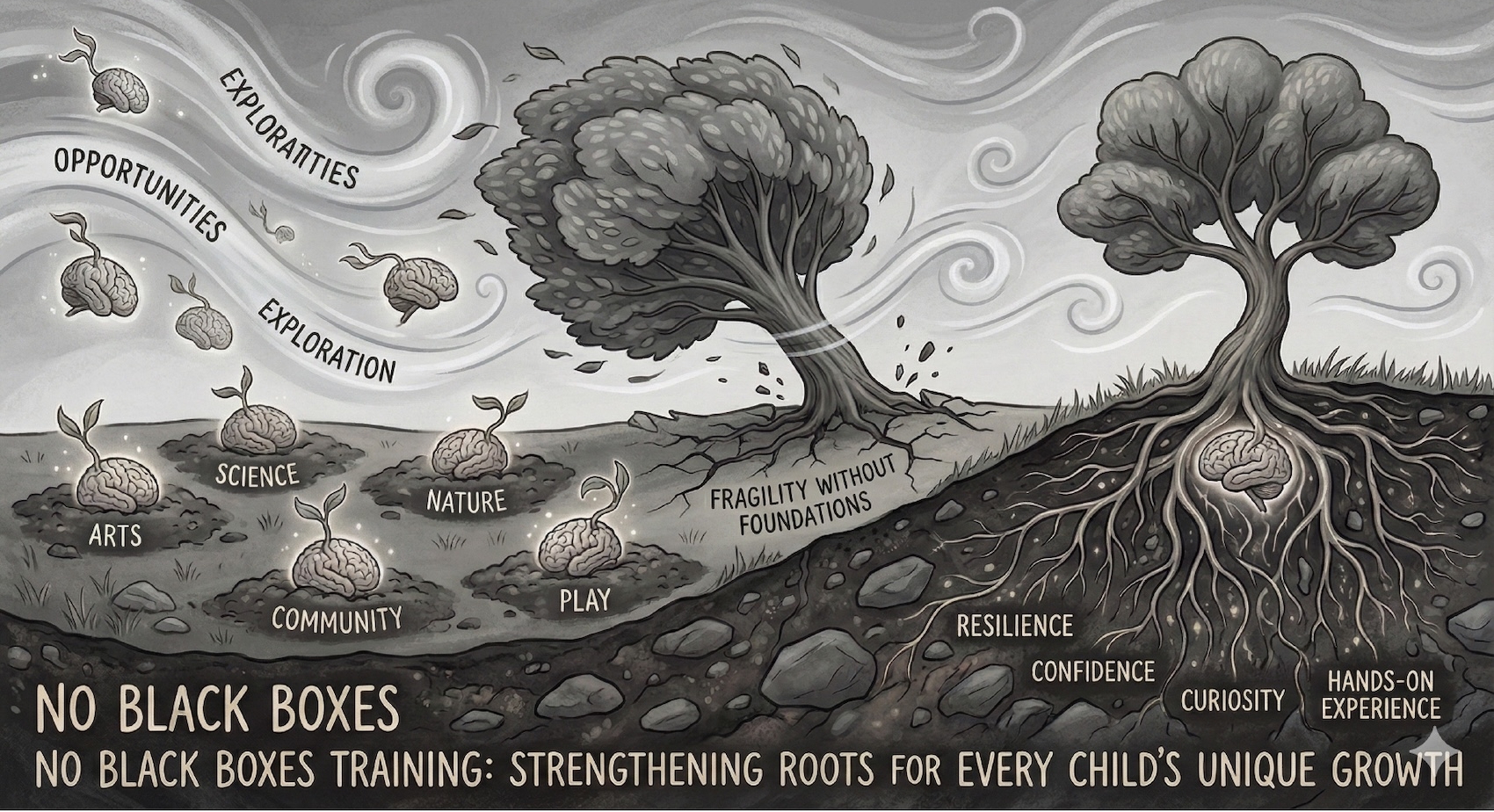
“The image illustrates the philosophy behind our ‘No Black Boxes’ training and how it aligns with Hummingbird’s vision. Brains are represented as seeds, differentiating between resilient brains – nurtured through this new approach to learning – and brains without such opportunities. Each brain-seed can grow into its own unique kind of tree. The message is that we are not trying to shape children into one predetermined form, but to help each become special, rooted in their individual strengths and environment. In principle, the brain-seeds can choose where to grow, but they need nature’s wind to explore different soils. The wind symbolises opportunities and chances to experience different ‘soils,’ environments, skills and perspectives. Every gust represents a new opportunity to explore, research and play. More opportunities create more places for their brain-seed to explore, improving each child’s chance to find soil – a place that truly suits them. Once a brain-seed finds its place, it develops deep, strong roots. These roots – rather than trunk height or canopy size –give resilience. A smaller tree with deep foundations will withstand whatever future climate (or life challenges come its way). Resilience comes from depth, not display. The role of No Black Boxes is to strengthen those roots giving every child the hands-on experiences, curiosity, confidence and resilience needed to grow into the tree that only they can become. The fact that the brain is represented as a seed recalls that humans are part of nature and this connexity is the source of true strength and resilience.”
Studio 8FOLD
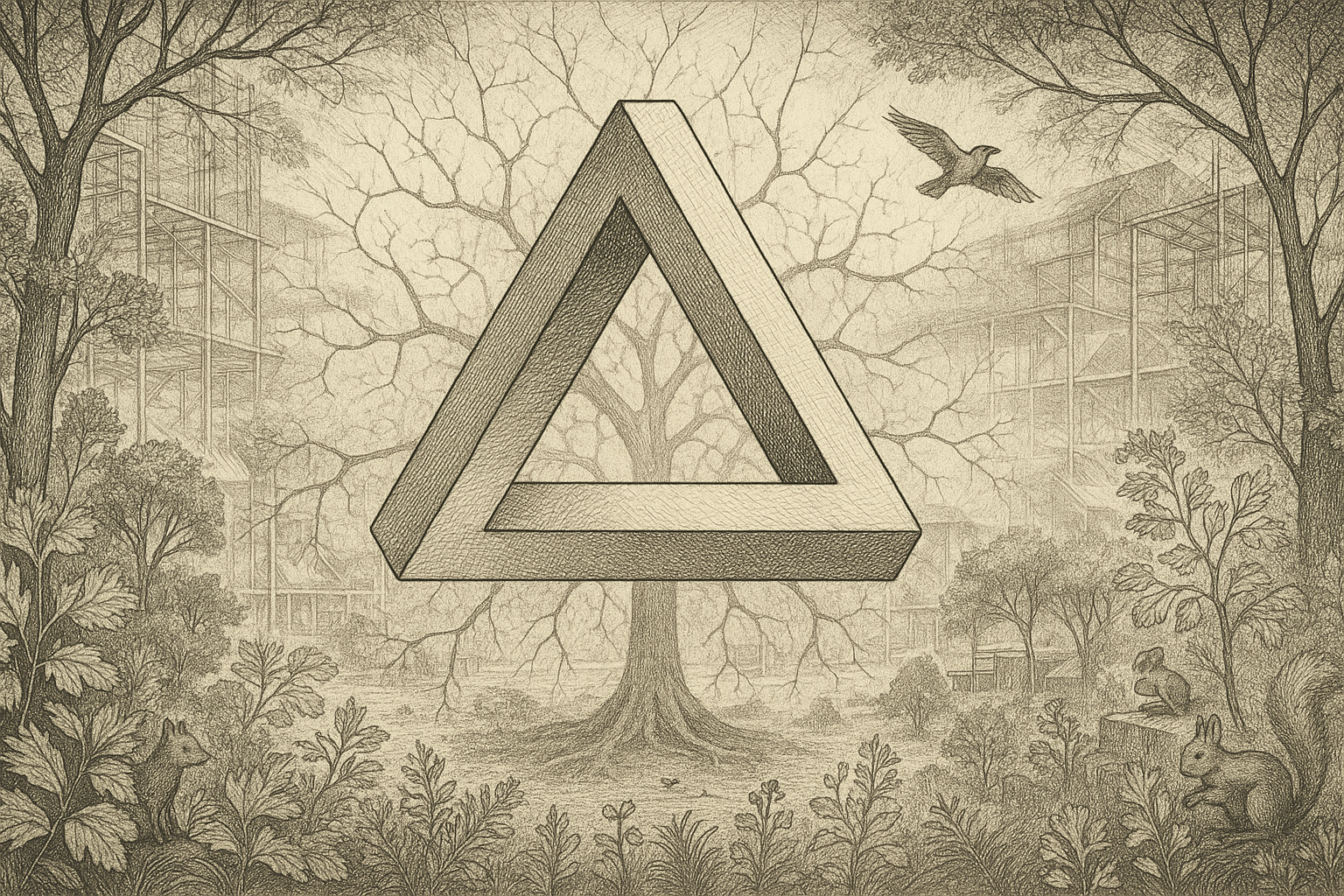
“This image embodies the conceptual foundations of our approach to the Hummingbird Learning Lab brief by expressing learning not as a building, but as a living system — adaptable, interconnected, and shaped by its environment. At its centre is the impossible triangle, a visual paradox that draws directly from the tradition of M.C. Escher. It represents a core neuroscientific idea: that perception, learning, and cognition are shaped by context and meaning. It is simultaneously stable and mutable depending on viewpoint, just as learning environments must be robust yet flexible. The triangle also echoes the regenerative design principle that seemingly fixed problems can be reframed and unlocked when approached through systems thinking. The surrounding landscape merges neuronal branching structures with tree roots and ecological forms, suggesting a parallel between neuroplasticity and ecological resilience. This reinforces the belief – shared both by HLL and Studio 8FOLD – that environments shape the brain, and that architecture has the opportunity to nurture curiosity, wellbeing and agency. The inclusion of subtle wildlife and flora, in a distinctly British ecology, highlights that learning does not occur in isolation from nature. It is relational and sensory. It invites observation, exploration, and inquiry – values at the heart of HLL’s pedagogy. Importantly, the piece obscures traditional architectural form. Instead of proposing a solution prematurely, it depicts a way of thinking: spatial, systemic, flexible. This mirrors our process-driven approach to design — starting with understanding, pattern, and possibility, rather than a pre-determined structure. A response that treats learning as ecosystem rather than enclosure.”
Studio Bark & alma-nac
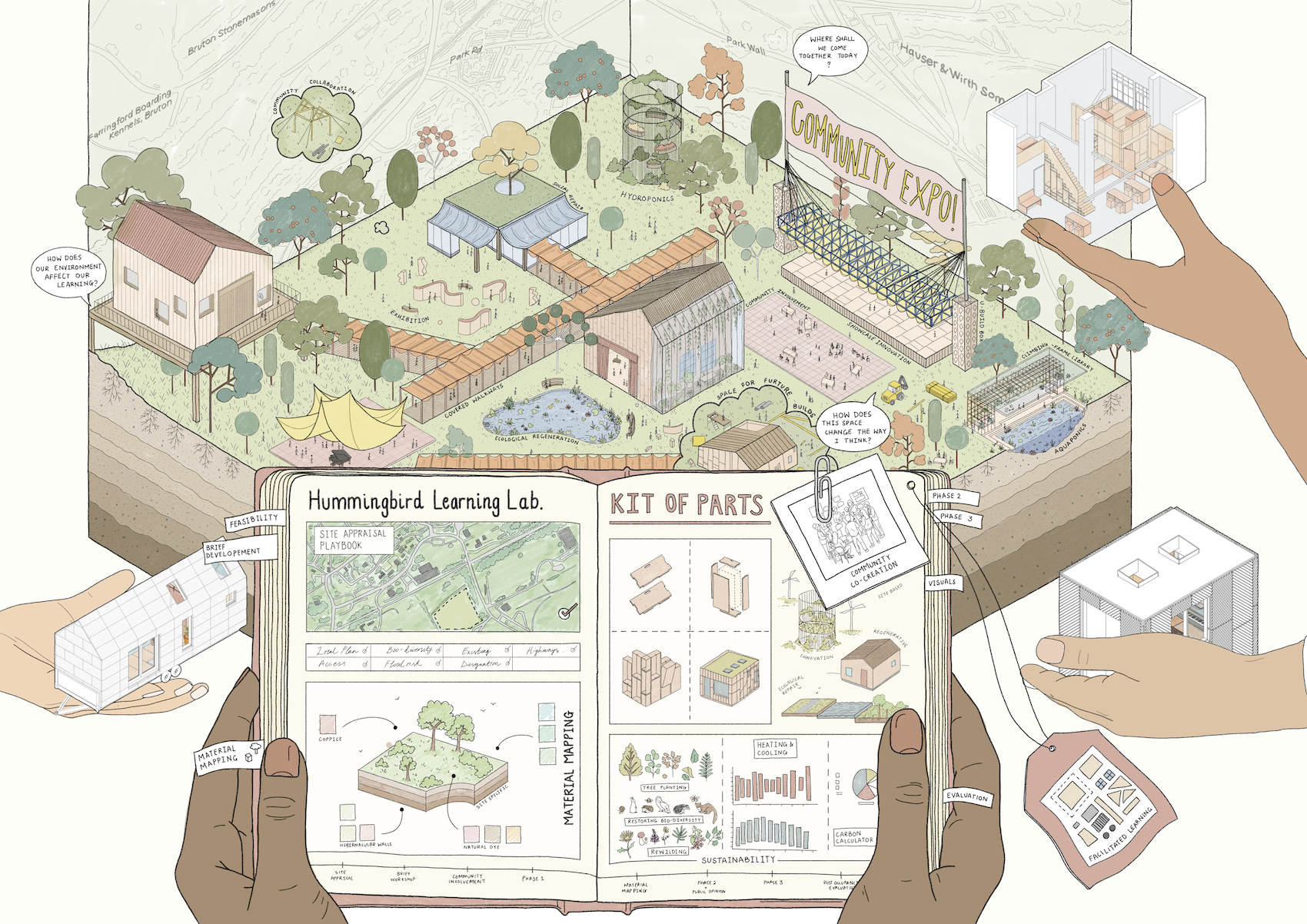
“Welcome to my school! The classrooms aren’t really buildings at all – they’re small timber pavilions scattered like stepping stones in the landscape. Every day they look a little different. Sometimes a wall has shifted to make space for a workshop; sometimes a canopy has been added so we can learn outside when it rains. We call it our ‘kit of parts’. It’s like grown-up Lego, but it teaches us how to build, creating zero waste. Our teachers say the Lab learns as we do. When we study our environment, we walk the site and forage, and sometimes these materials become cladding for the pavilions. When we explore ecosystems, we follow the boardwalks to the ecological restoration area and watch the saplings change with the seasons. The buildings seem to breathe with the landscape – warm in winter, cool in summer – because they’re designed to work with the sun, the wind and the shade of the trees. Sometimes we help rearrange the spaces ourselves. Hands-on workshops with the architects from Studio Bark and alma-nac showed us how the modules can be taken apart and rebuilt, and they’re writing a playbook so that one day new labs can grow in new places. They say the whole campus is an experiment – a place where ideas, buildings and people can all change shape, in a world whose future is as uncertain. To me, it feels like learning in the way it was always meant to be: curious, playful and wide open to the world.”
Studio Saar with Format and Urquhart Hunt
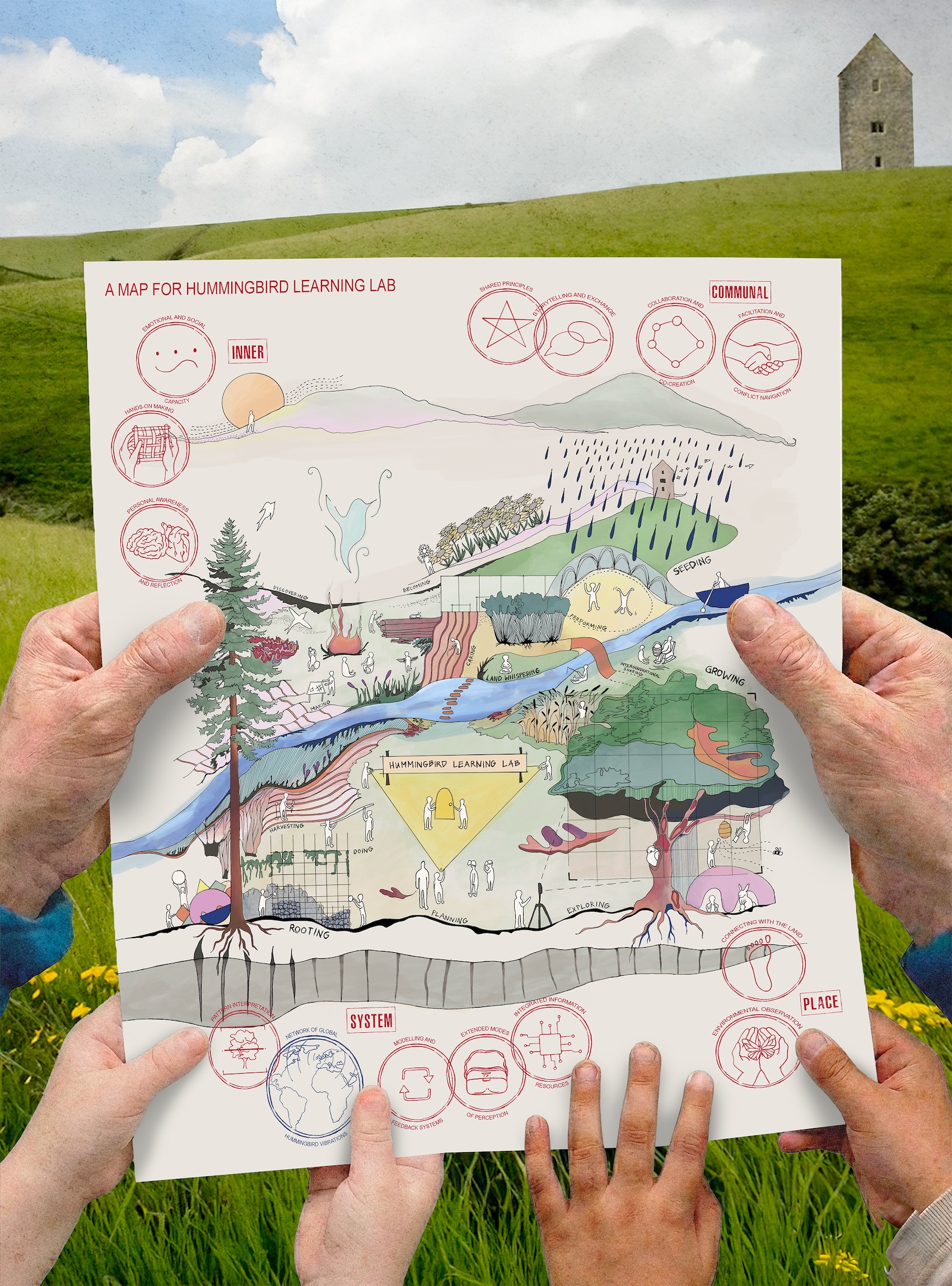
“The accompanying image embeds Hummingbird’s spiral of inquiry in real-world interactions, where children discover themselves, others, and wider socio-ecological systems through active engagement with living processes and imaginaries. Depicted as a map, it tells children’s stories through the seasons and growth cycles of their setting. At the heart of our approach lies discovering genuine cares, that surface and align to create shared purpose, strengthening motivation and inviting meaningful participation. The image captures this moment of convergence: diverse energies and perspectives gather, connecting and beginning to act together. The image also reflects the nestedness of every school within its wider systems. A Hummingbird campus is shaped by its site, watershed, seasons, community rituals, and ecological patterns. For Bruton, the River Brue becomes both boundary and teacher, influencing how structures breathe, adapt and evolve in dialogue with place. Amidst visions of technology-enabled futures, extending our modes of perception and hybrid intelligences, the image gestures towards entangled socio-ecological rhythms, such as harvesting, cooking, and gathering around fire, which reinforce belonging and shared responsibility. Resource stamps collected around the drawing highlight practical and conceptual resources available to stakeholders as they co-create the learning environment, emphasising the project’s growth from a shared toolkit rather than a predetermined architectural answer. These resources are organised as interacting, nested wholes – inner, communal, place, and system, which catalyse iterative spirals of learning, adaptation and inquiry. Ultimately, the drawing invites the first step toward a regenerative learning environment that grows through curiosity, collaboration, and care.”
Tezuka Architects
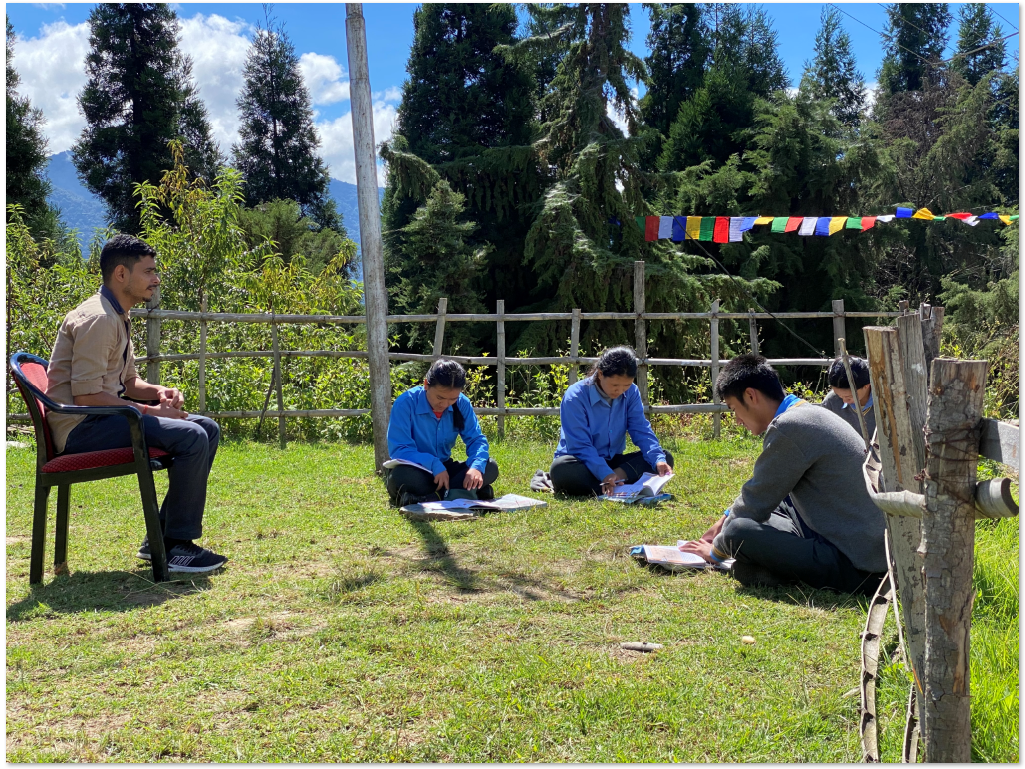
“The brief hints towards a flexible, even modular, structure of lightness. We can draw a hundred sketches to answer this technical question. Or to illustrate the many thoughts towards a shape, that would make the final tangible work of the architect. But that is only the end. Before that, we must listen to Hummingbird Lab’s thoughts and approach to teaching, learning, and what values and approach define their pedagogy. The image submitted was taken at the site of one of our projects. Where is the classroom? One may ask. But here, you will find the origin for the thinking behind the pedagogy, and one that will eventually guide all our design efforts. In this case, a school for sharing. Here, we will greatly value a similar experience of iterative design with the stakeholders. And more important than the tangible, tactile appearance of the architecture, we must understand what the built environment is meant to do.”