Maccreanor Lavington’s 700-hectare City Edge framework proposes the long-term transformation of Dublin’s western industrial lands into five climate-responsive, 15-minute neighbourhoods. AT hears from practice director, Kevin Logan, about the scheme, and how it aligns with the principles of the Regenerative Architecture Index.
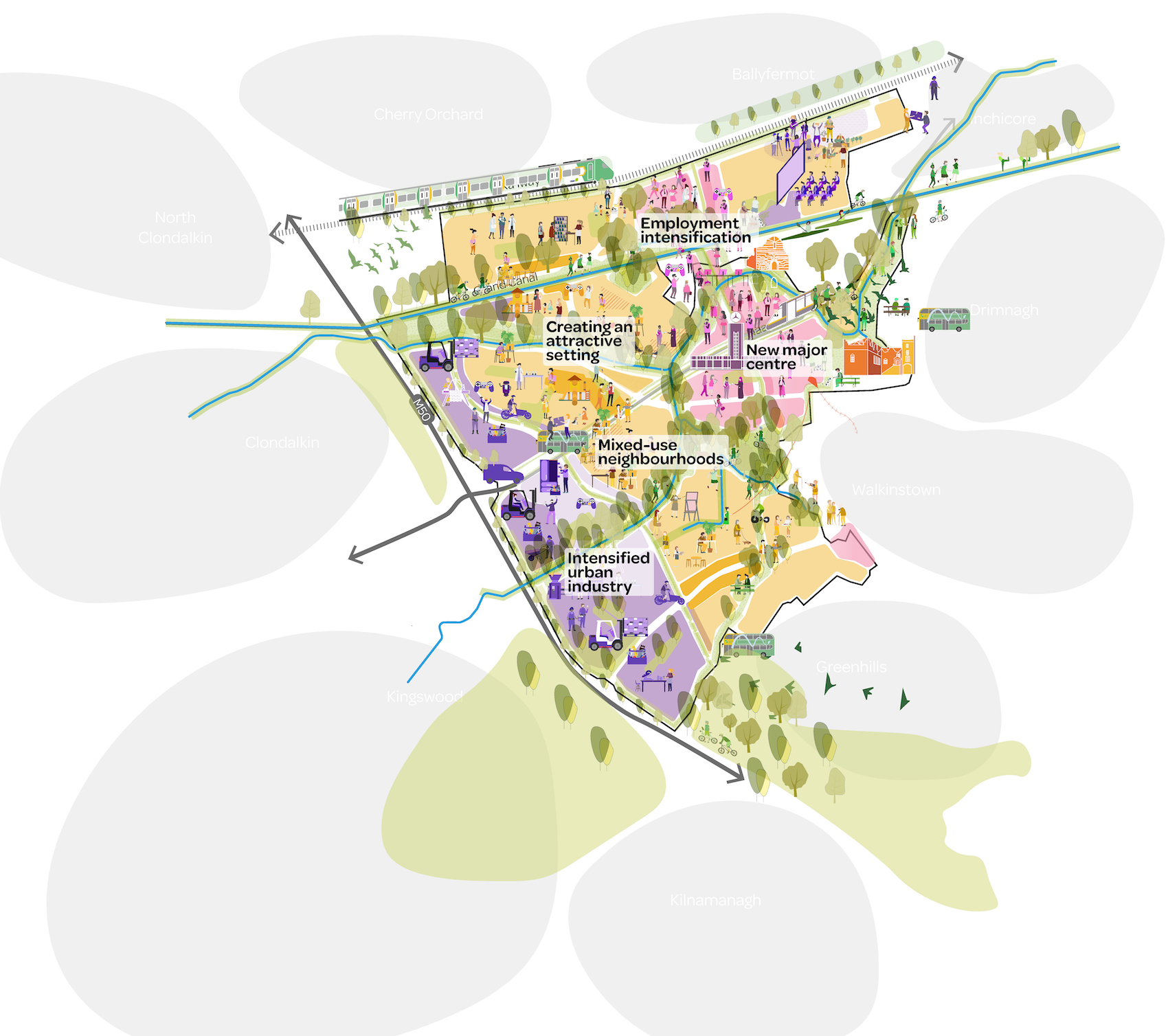
The City Edge Project is a strategic framework to transform some of Dublin’s most under-utilised industrial areas into a new urban quarter on the city’s western edge. With Maccreanor Lavington leading an interdisciplinary team, the 700 hectare scheme is said to deliver one of the most significant regeneration initiatives in Europe; with new parks, waterways, local high streets and community facilities serving up to 40,000 new homes and a population of 75,000 to 85,000.
The site is already well-connected (positioned between the Naas Road, Ballymount and Park West), but with a predominantly industrial character, has a limited contribution to the city’s broader built environment. City Edge seeks to unlock this potential.
Through public consultation and clear sustainable design values, Maccreanor Lavington have put together a Strategic Framework which outlines how the site can evolve into a resilient, mixed-use quarter, structured around five neighbourhoods underpinned by 15 minute city principles – where daily needs are accessible by walking, cycling and public transport. The main objectives are to create a sustainable and an adaptable, climate-responsive city extension, with zero-carbon and zero-waste principles established from day one.
In its early stages, City Edge Project articulates an ambition for reshaping Dublin’s urban expansion with a planning approach that puts people first, whilst confronting Dublin’s contemporary urban challenges of housing demands and a growing climate crisis.
The 15-minute city concept is central to City Edge. How are you translating this into a neighbourhood scale?
The framework establishes 5 new neighbourhoods, each with their own local centre, and one new, major centre. The liveability of each neighbourhood was the primary focus in the design process, the Compact Urbanism ethos. This concept expands beyond housing. A central tenon is that the new neighbourhoods will in essence be car free, and to do this, we need to ensure a car culture is not inadvertently established from the outset. So active travel and public transport, including mass transit, are key to seeding a people focused movement culture. This trickles down to support health and wellbeing, and helps ensure that everyday needs, like social and liability infrastructure, green spaces, and employment hubs, are local and accessible to everyone, meaning citizens can thrive in their new, immediate environment.
‘Climate resilience’ is a recurring objective in the Strategic Framework. How is an environmental strategy being integrated within the scheme?
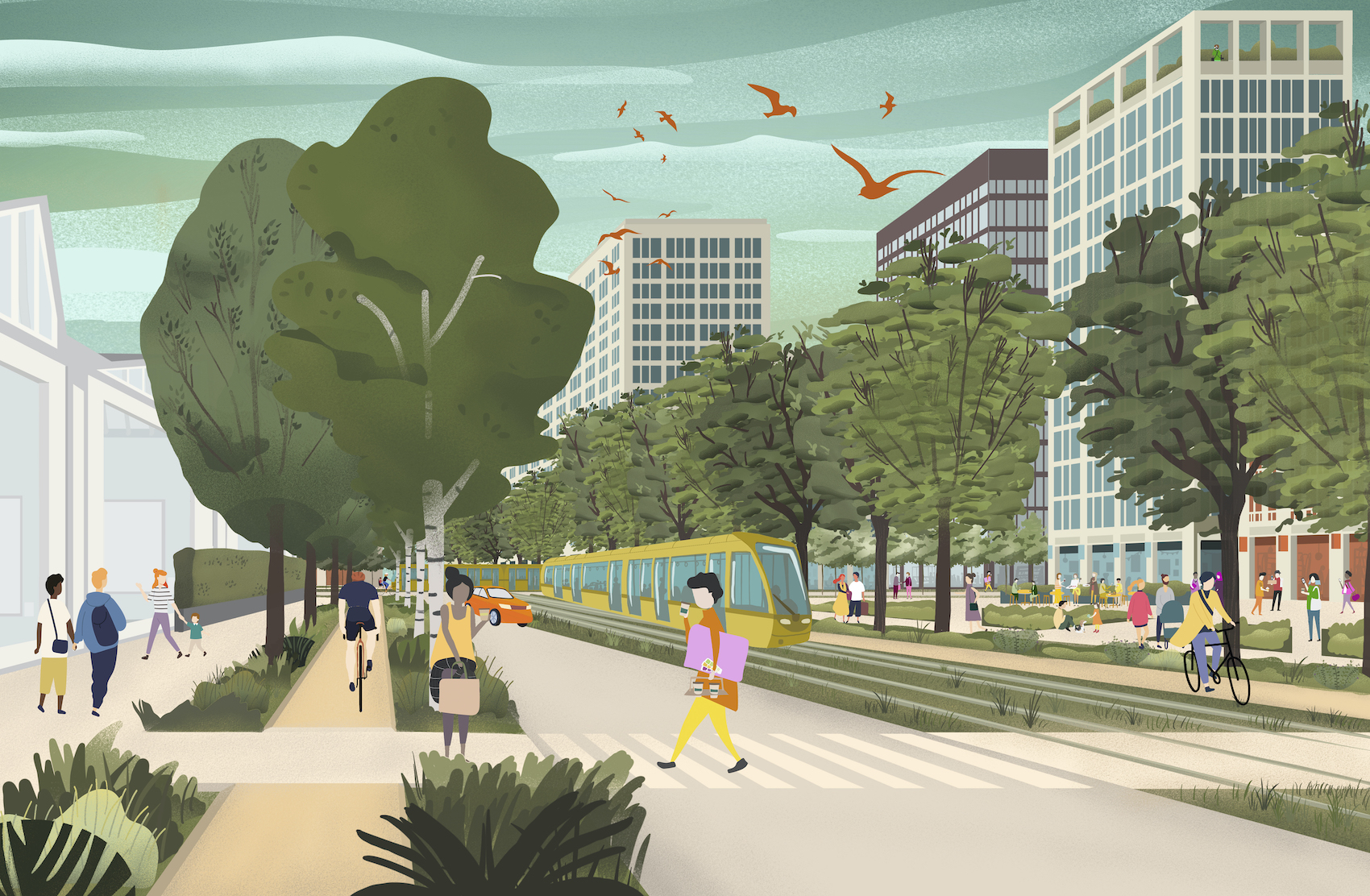
The scale of City Edge allows it to meaningfully influence sustainability at both city and national levels, particularly in supporting renewable energy infrastructure and storage. The existing on-site hydrogen production facility, currently for medical use, has capacity to expand into transport. A sustainable transport plan, developed with the National Transport Authority, Irish Rail and TII, includes a north–south mass-transit link, bus and tram extensions, and strategic walking and cycling routes. Mid-rise, ‘Goldilocks’ density supports viable growth. The Climate Action Plan incorporates on-site generation, waste heat recovery from the sewer network and data centres, and significant biodiversity gains.
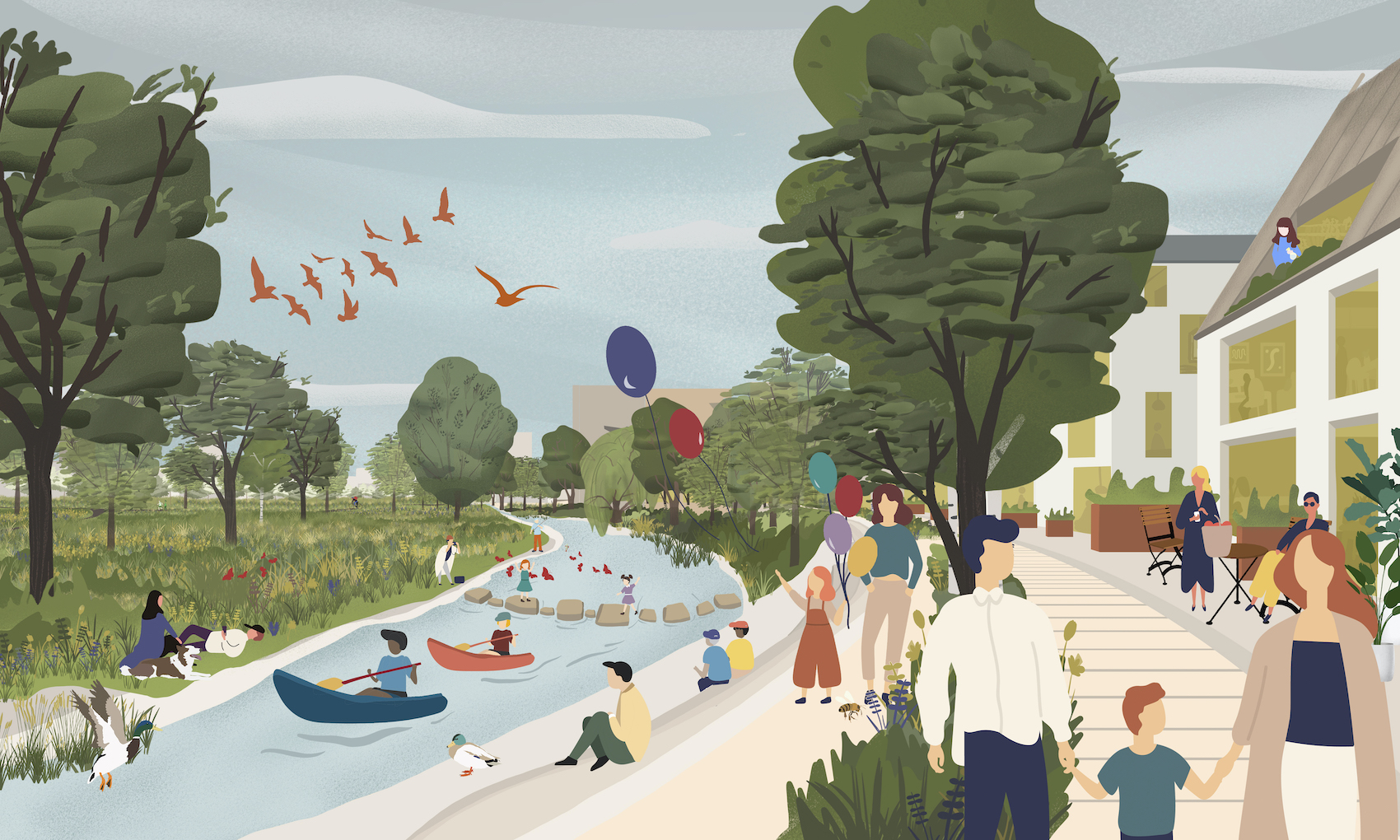
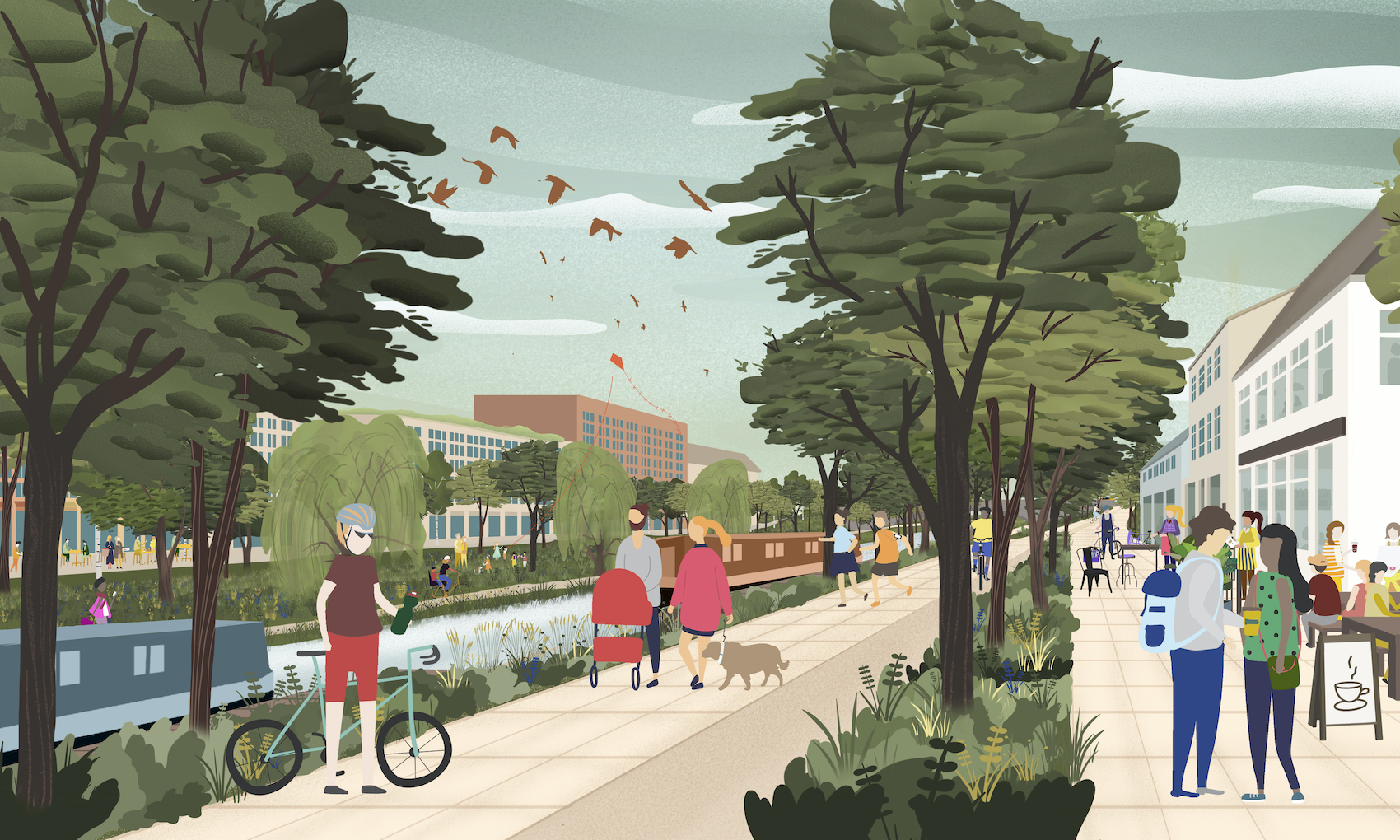
Biodiversity enhancements and urban greening are the backbone to the Framework. The site is currently predominantly hard-standing, and the Framework sets out substantial improvements. The Camac River runs through the site, including some tributaries, and is culverted for much of its length. The Framework proposes to de-culvert and re-naturalise the river, creating new linear green spaces along its length, whilst introducing major new parks. A linear green space is also created along the Grand Canal, and a strategy exists for street greening that goes beyond current policy.
RAI’s ‘Being a good ancestor’ criteria asks architects to think generations ahead. City Edge is inherently long-term, spanning decades of staggered implementation. How have you planned for adaptability in the masterplan and how important is intergenerational thinking in projects today?
The masterplan is conceived as a long-term strategic framework structured through thematic layers rather than a prescriptive, fixed plan. These layers act as a three-dimensional scaffolding, establishing a performance criteria and trajectory for gradual transformation, not a singular ‘big bang’.
The framework is deliberately not overtly spatially specific, rather establishing performance criteria across the layers, and a trajectory. Certain key elements, such as intergenerational living, remain consistent, but adaptability is tested through iterative ‘what if’ scenarios. From the outset, scenario testing, themed workshops and extensive site visits shaped a collective vision based around sponge landscapes and 50% green cover. The framework uncovers hidden waterways and green assets as its structural spine, placing natural systems at the heart of long-term resilience.
It also enables nature-based drainage solutions that alleviate pressure on the existing trunk sewer by managing water at source through roofs, streets and parks.
What lessons from other large-scale regenera<on projects have most influenced your work on City Edge, and why?
Lessons from other large-scale regeneration projects have reinforced the need to move beyond an interdisciplinary model towards a genuinely transdisciplinary way of working. We see strategic planning as an empowering process for a diverse range of direct and indirect actors, establishing a framework for open-ended betterment over time rather than a fixed end-state. Thinking long term is essential if we are to deliver the level of transformation required at a planetary scale.
Siloed thinking limits our capacity to imagine change and often reinforces the status quo; instead, we advocate collaborative thinking ‘in the round’, actively designing out silos and applying a causality-led methodology to understand how decisions ripple across systems.
We view every context as a set of nested, plural entities – social, cultural, environmental and physical – and assess proposals through the differing lenses of multiple actors, recognising that success is rarely singular.
Our evaluation of interventions considers value over time and across multiple currencies: social, environmental, economic and liveability. Importantly, we also try to look at things sideways – to reframe challenges and uncover opportunities where it may not be immediately apparent.