Piers Taylor of Invisible Studio explains how Sydney, a city that always feels as though it is making itself in the present tense, gave him the lenses through which he still views the world.
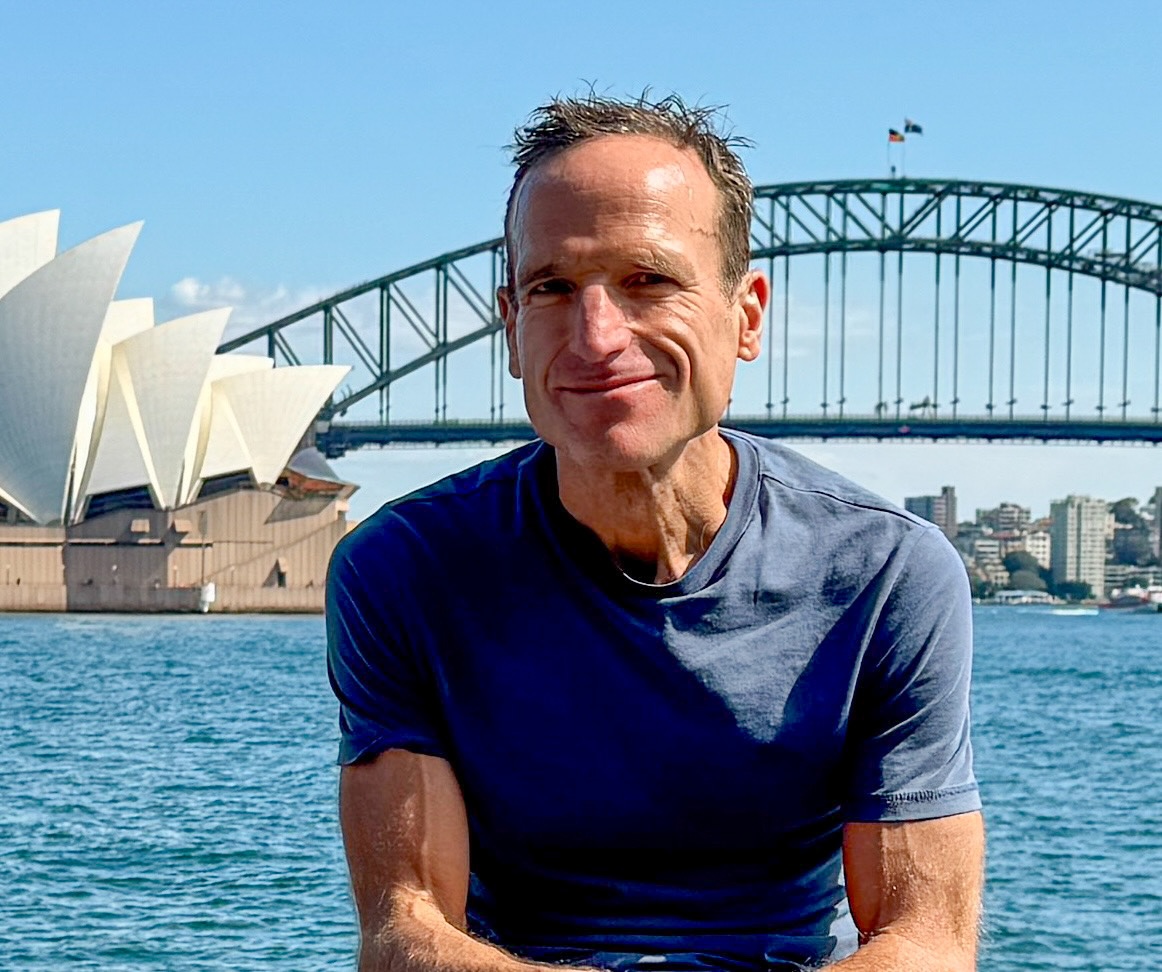
Piers Taylor with Sydney Opera House and Sydney Harbour Bridge in the background. Ever present views of water give the city legibility and clarity.
Sydney was the first place that made me understand that cities could be shaped by climate, topography, and light just as much as by culture and history. When I arrived there in 1990, it felt like stepping into a new world – not just geographically distant from the Britain I had grown up in, but conceptually so. The brilliance of the southern hemisphere sun, the nearness of ocean and bushland, the sheer looseness of its social fabric: Sydney suggested alternative possibilities for living, making, and thinking. It opened a way of being in the world that has never left me.
Sydney is a city in which nature is not a backdrop but the primary ordering force. Its harbour is not a picturesque accessory but the central civic theatre – shaping movement, orientation, climate, and daily rhythms. The city is carved into peninsulas and ridges, with water continually in view; one is always aware of the wide Pacific beyond, and the vastness of the continent behind. That geographic clarity gives the city an extraordinary legibility. It is possible to know where you are at all times, because the land itself tells you.
This legibility extends into the grain of the city. The dense inner suburbs – Paddington, Darlinghurst, Newtown, Balmain, Glebe – form one of the world’s great walkable urban landscapes. The terraced streets climb and fall across sandstone ridges, responding not to an imposed grid but to topography. These terraces, modest in scale and repetitive in form, generate civic richness through density and proximity rather than architectural display. Their narrow plots, deep plans, and shared party walls create microclimates of shade and breeze. Streets are both public rooms and social corridors. It is urbanism built not from grand statements but from accumulated, quiet intelligence.
Architecturally, Sydney taught me that restraint could be radical. The work of Glenn Murcutt, which I encountered as a student, was transformative: buildings as instruments for climate, tuned to the angles of the sun, the direction of prevailing winds, the fall of rain. Lightweight structures raised lightly on the ground; verandas and sliding screens modulating air and shade; buildings conceived not as inert objects but as responsive systems. Murcutt’s architecture argued — in its methods as much as its aesthetics – that the land should set the terms of construction.
Equally revelatory was the example of Richard Leplastrier: a way of living that was inseparable from its environment, where architecture was not a fixed product but an evolving conversation with the world around it. From him came a different idea of the architect altogether – not as an author of singular, finished works, but as someone immersed in place, attentive to seasons, culture, and community.
What made these lessons powerful was that they were embedded in the everyday environment of the city. Sydney’s public life is inseparable from its landscape: swimming before work, walking to dinner, cycling to university, meeting friends under jacarandas in spring. The city’s civic infrastructure is informal yet extraordinary. Beaches, coastal walks, harbour parks, and bushland reserves form an open-access commons that is deeply democratic. To swim at Bronte at dawn or run on the cliffs between Bondi and Clovelly is to participate in the city’s public realm as directly as sitting in its libraries or lecture theatres.
There is also something about Sydney’s optimism – a cultural looseness that comes partly from its distance from older centres of power. In the Britain I left behind in the late 1980s, London felt heavy, tired, and inward-looking. Sydney in contrast was adventurous, outward-facing, and unencumbered. Its relative remoteness has produced not isolation but experimentation. Cultural influence arrives slowly, is translated locally, and is often made better by the process. Things are tested in practice, not theory. The city always feels like it is being made in the present tense.
My ties to Sydney are more than professional or intellectual. My parents met there; my grandparents lived there; two of my four children now call it home, and a third intends to. I return often, and each time the city feels both familiar and renewed. The skyline shifts but the essentials remain: the harbour glittering with afternoon light, the jacaranda bloom in November, the scent of eucalyptus after rain, the rhythms of walking and swimming and being outside that shape life more than any formal plan.
Sydney taught me that architecture is not just the production of buildings. It is the organisation of life, the tuning of shelter to climate, the shaping of civic relationships, the framing of horizon and landscape. Sydney gave me the lenses through which I still see – and it remains, for me, a city of expansive possibility, where the world seems to open outward rather than close in.