Watch the AT webinar, in partnership with Vectorworks, exploring how AI and digital tools are reshaping architectural practice, from heritage and design workflows to collaboration, visualisation and manufacturing.
As AI moves rapidly from experimentation to application, architects are being forced to rethink how projects are conceived, developed and delivered. The question is no longer whether to engage with AI, but how to do so meaningfully. Where does human judgment sit in an AI-enabled workflow? How can practices integrate new tools without losing authorship, rigour or design intent? And what role can data, automation and visualisation play in shaping more informed, efficient and sustainable outcomes?
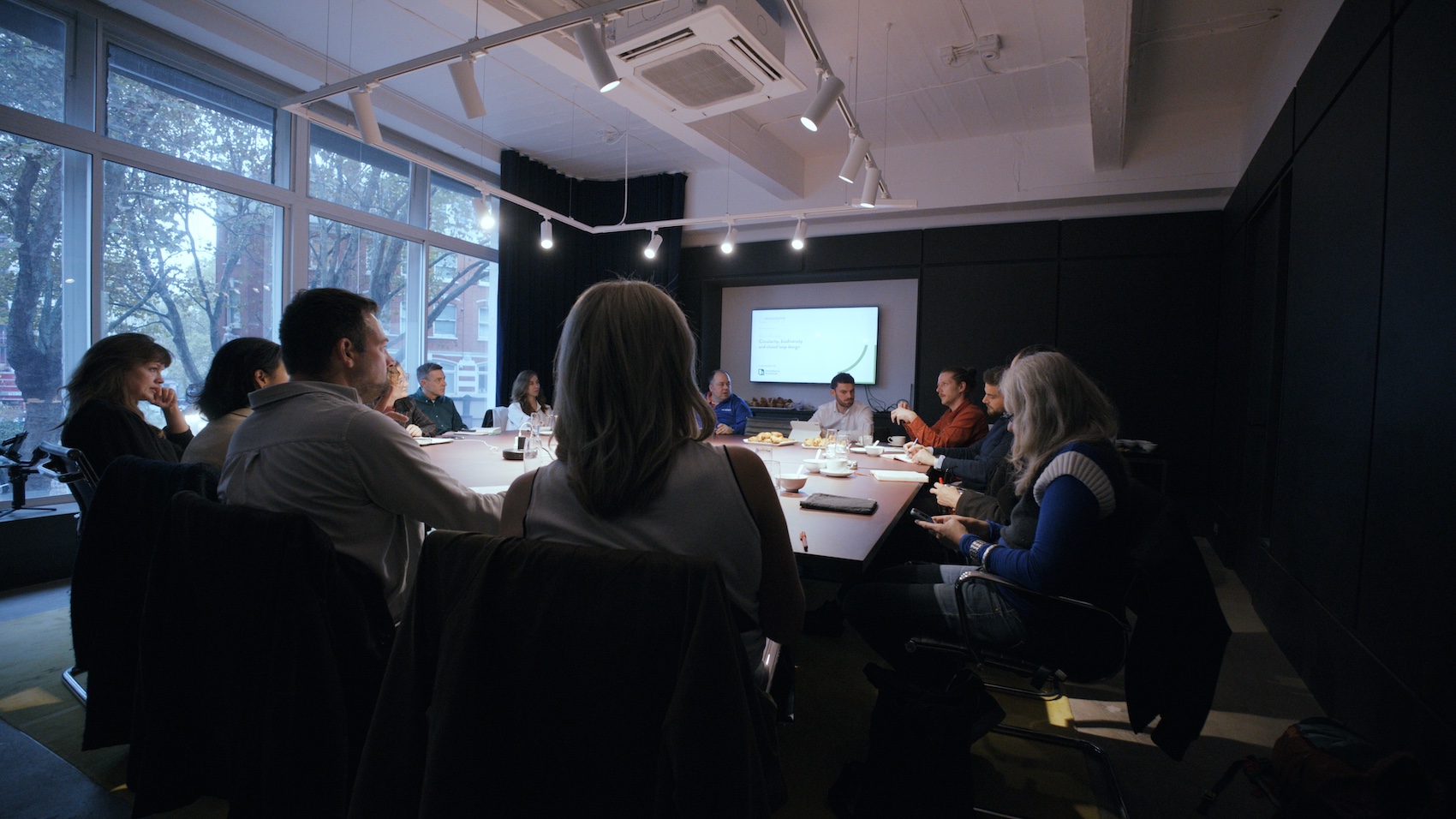
These questions and more were explored in this AT webinar, supported by Vectorworks. Chaired by Architecture Today’s Jason Sayer, the session brought together Damien Blower, Principal and Head of Heritage at Stedman Blower; Renee Dobré, Architect and Design Computation Team Leader at NBBJ; Luis M Ruiz, Lead Product Specialist at Vectorworks; and Eva Magnisali, Founder and CEO of DataForm Lab.
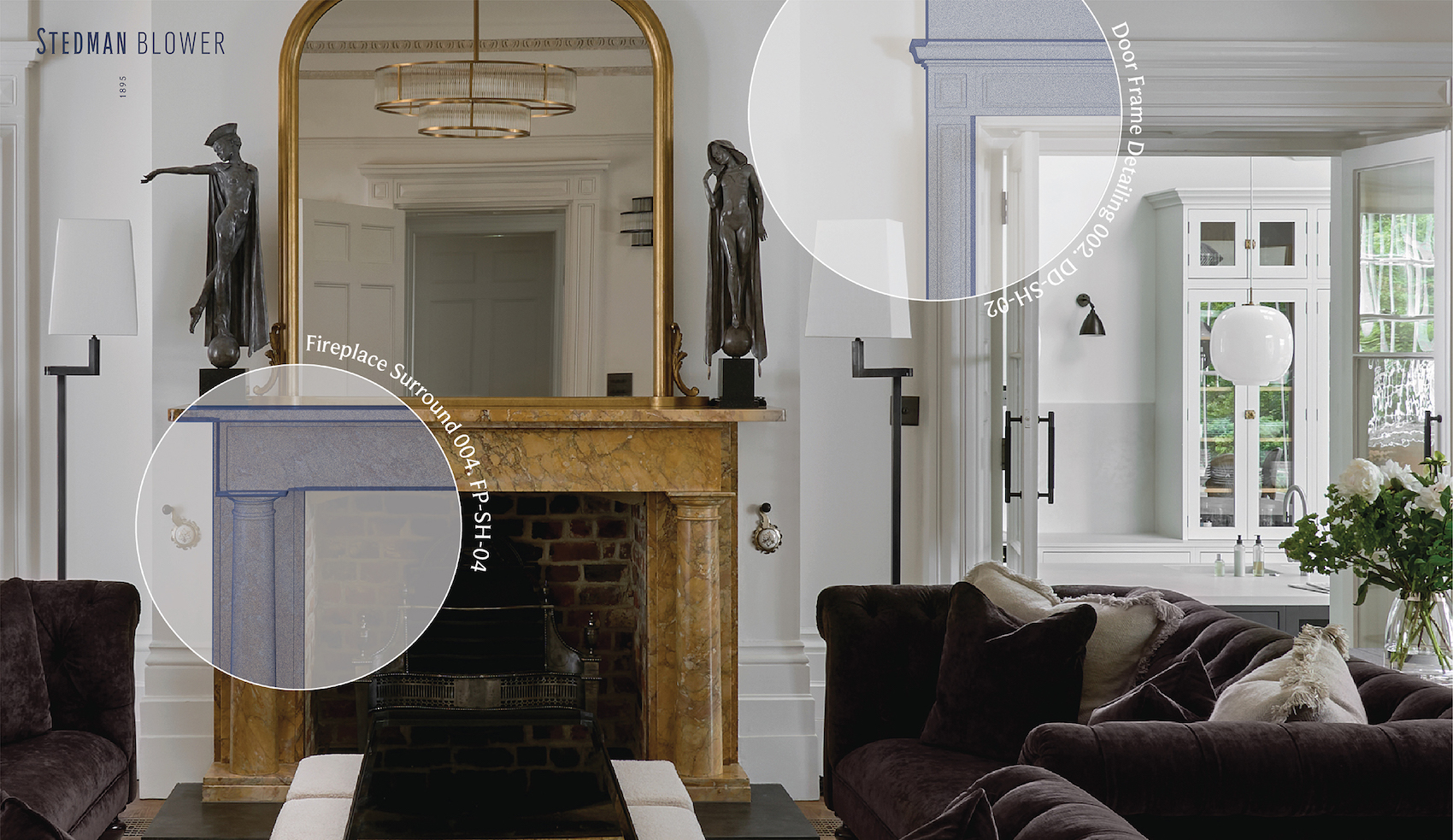
Design context and future readiness. Part of the Stedman Blower design process is creating ‘digital twins’ by scanning architectural objects in each project and building a working digital library. AI can only process the data it can access, so digitising archival details in a usable format is part of preparing for the future.
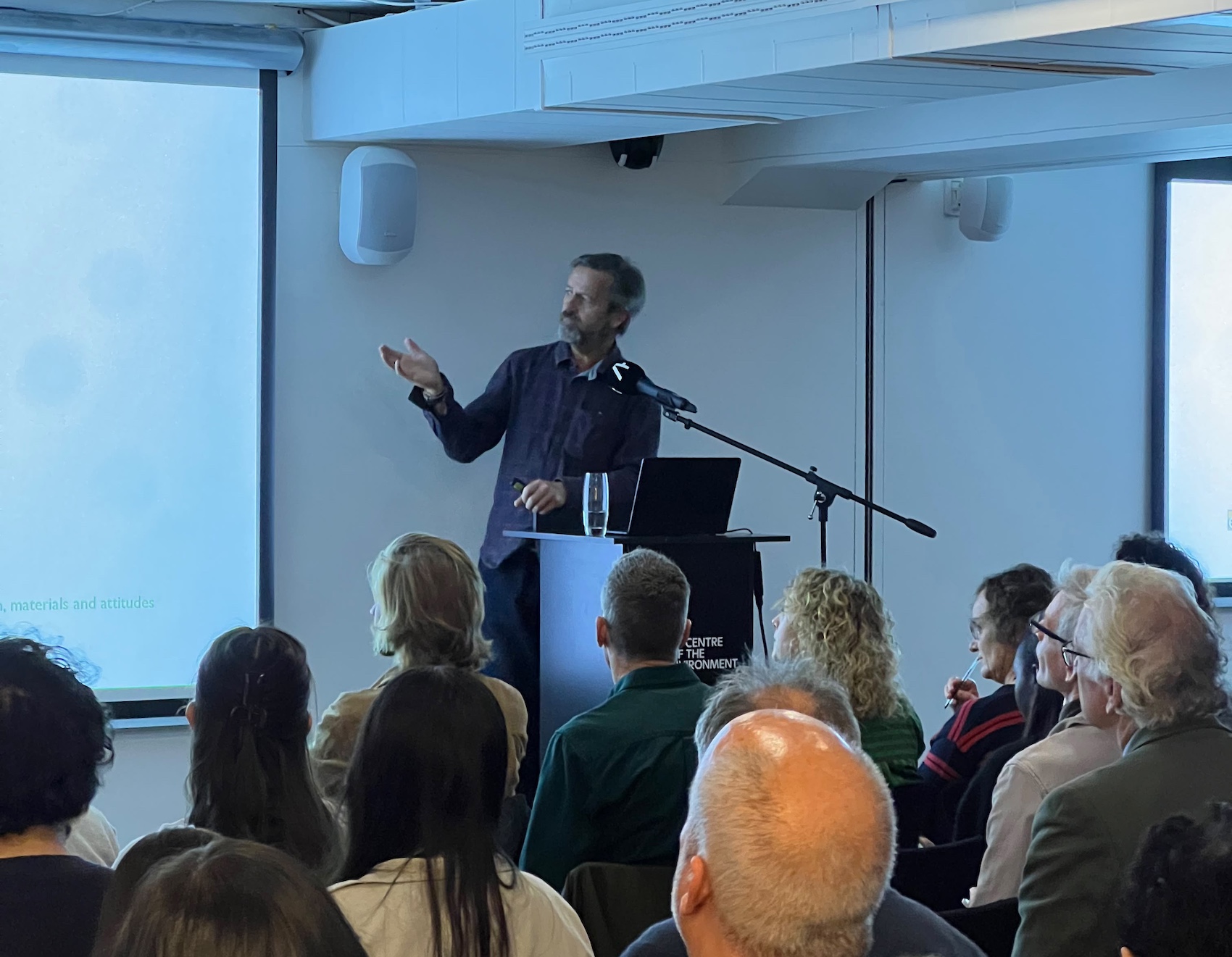
Opening the session, Damien Blower set out a philosophical framework for understanding AI’s role in practice, positioning it within a longer history of human engagement with non-biological intelligence. “AI is probably the most important invention since the invention of God,” he said, arguing that both concepts represent forms of synthetic intelligence that shape human behaviour and storytelling.
For Blower, architecture remains fundamentally a narrative discipline. “When people ask me what I do, I say I tell stories,” he explained, emphasising that creativity and authorship lie not in the generation of form alone, but in the interpretation and communication of meaning.
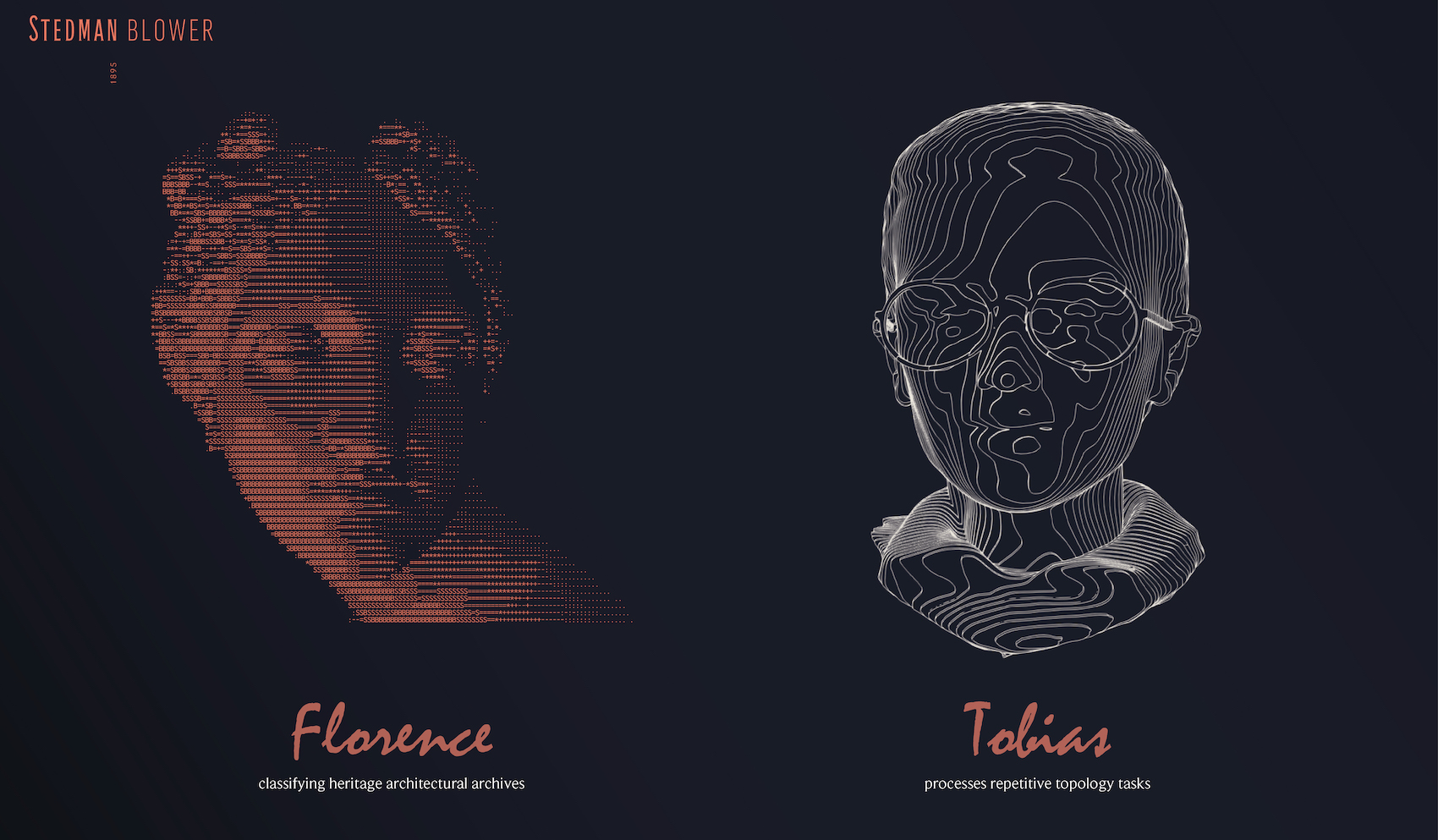
New members of the Stedman Blower team include ‘Florence’ and ‘Tobias’. Florence classifies data using AI trained on heritage drawings running on local machines to keep data secure. Tobias is a custom tool that was written with the help of AI, and dramatically reduces the processing time of surveyor’s measurements.
Within this framework, AI becomes a tool to support, rather than replace, human creativity. At Stedman Blower, this has led to the development of ‘synthetic employees’ trained on the practice’s own archive and data. “It’s not about replacing our staff, it’s the absolute opposite,” he noted. “It’s about enhancing and catapulting the human-level skills that our staff possess.”
By automating repetitive tasks such as survey processing and archival management, these systems free up time for higher-level design thinking. “These tools are just taking away the lower-level work that enable us to do more human-level work,” he said, linking AI directly to the practice’s ability to produce richer, more considered architectural narratives.
Blower concluded with a call for architects to take ownership of AI’s future. “We, the creatives, have an obligation to tell stories that emancipate our best human selves from the drudgery of work,” he argued, framing AI as an opportunity to redefine the value of architectural practice.

A conceptual commercial project for an NBBJ client, using AI enhanced tools to iterate on initial design studies (render: NBBJ).
Renee Dobré shifted the discussion from theory to application, focusing on how AI is transforming day-to-day workflows within practice. “The question is no longer ‘should we be doing this?’” she said. “The new question is how do we actually make this happen?”
Drawing on research across UK practices, Dobré highlighted a rapid shift towards adoption, with clear AI policies becoming the norm. However, she cautioned that many teams are still using AI ineffectively. “The debate is over,” she noted. “The question now is whether you’re doing it well or you’re just doing it.”
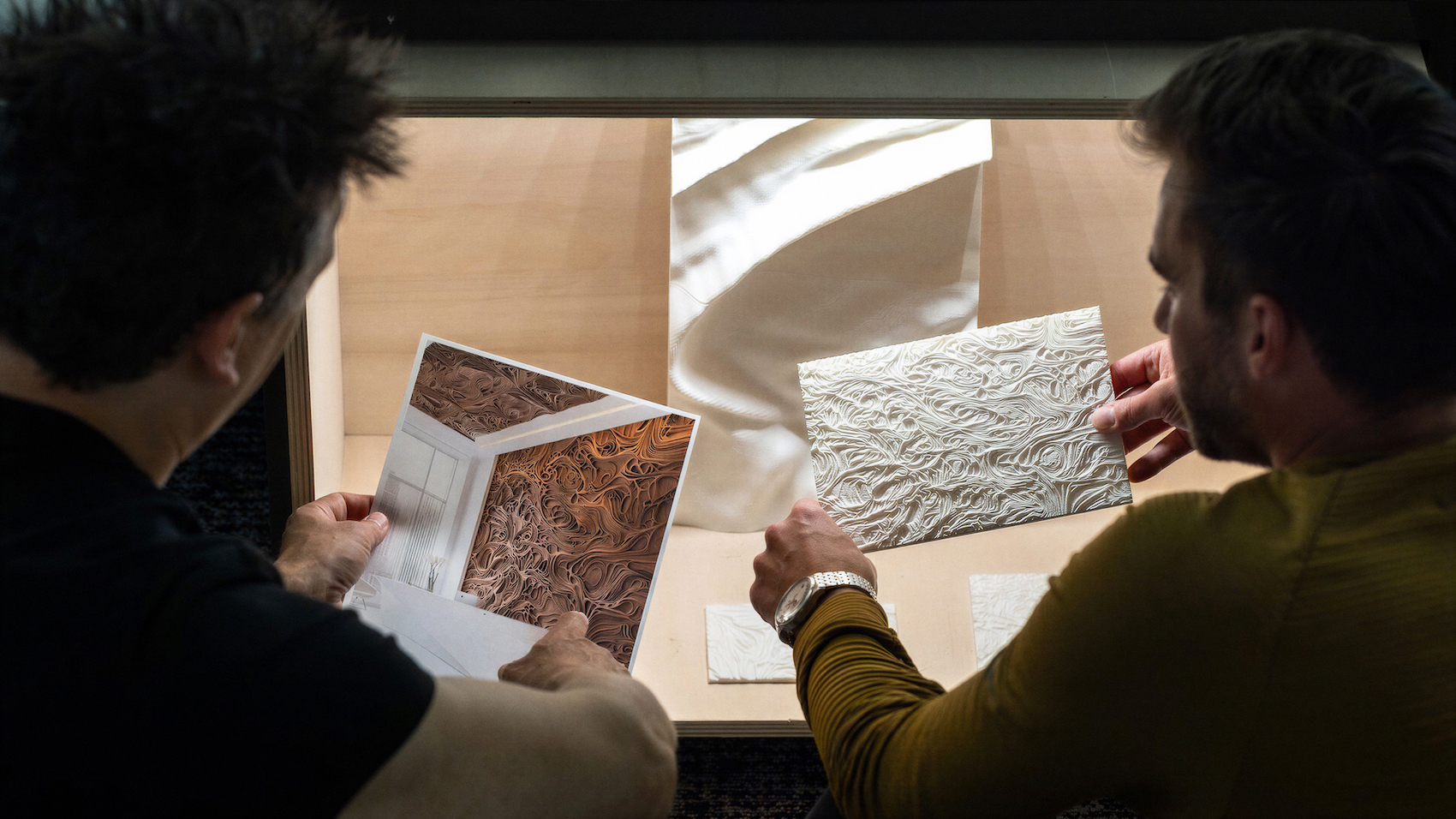
Designers in NBBJ’s studio utilising 2D to 3D AI workflows to turn conceptual designs into physical prototyping – reclaiming the art of craft with technology (photo: Sean Airhart).
Central to her argument is a move away from isolated tools towards integrated workflows. “You’re not replacing the process,” she explained. “You’re compressing the parts that don’t require your judgment, so you have more time for the parts that do.” Examples ranged from rapid design iteration using image generation to automated regulatory analysis and knowledge retrieval systems. In each case, the value lies not in the output itself, but in the speed and breadth of exploration it enables. “The value isn’t the final image,” she said. “It’s the variations explored before we got there.”
Dobré also emphasised the importance of organisational change. Barriers such as lack of time, confidence and knowledge-sharing structures continue to limit adoption. “Knowledge that stays in your head walks straight out the door,” she observed, calling for practices to document and share workflows systematically. Her conclusion was clear: “AI won’t be replacing architects. It’s going to give us time to be better ones.”
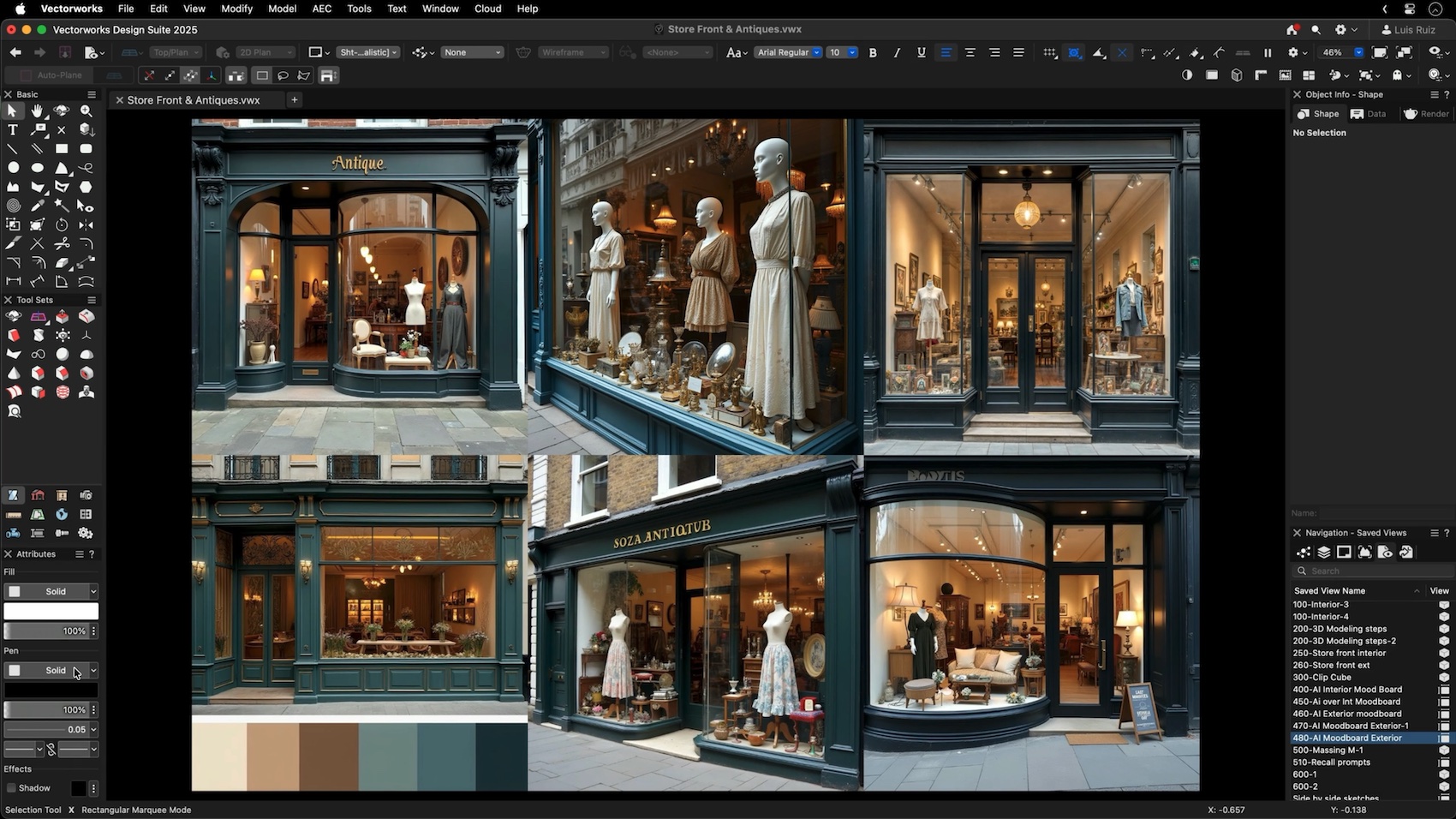
Exterior store front concepts. Vectorworks’ integrated AI tools include the AI Visualizer that converts 3D models, sketches, or 2D linework into high-quality renderings using text prompts, and AI Assistant, which is designed to speed up design iterations, renderings, and software learning.
Luis M Ruiz focused on the integration of AI within BIM and visualisation tools, demonstrating how platforms such as Vectorworks are enabling new forms of design exploration and communication. At the core of this approach is the ability to translate models into multiple visual outputs in real time. “Whatever you have on your screen you can generate different AI visualisations,” he explained, ranging from photorealistic renders to sketch-style images.
This capability fundamentally changes how architects develop and present ideas. Rather than producing a single, fixed representation, designers can iterate rapidly across multiple options and levels of detail. “You don’t always get the one single image from the beginning,” Ruiz noted. “You can make another pass and use that as your base so you get a better image.”
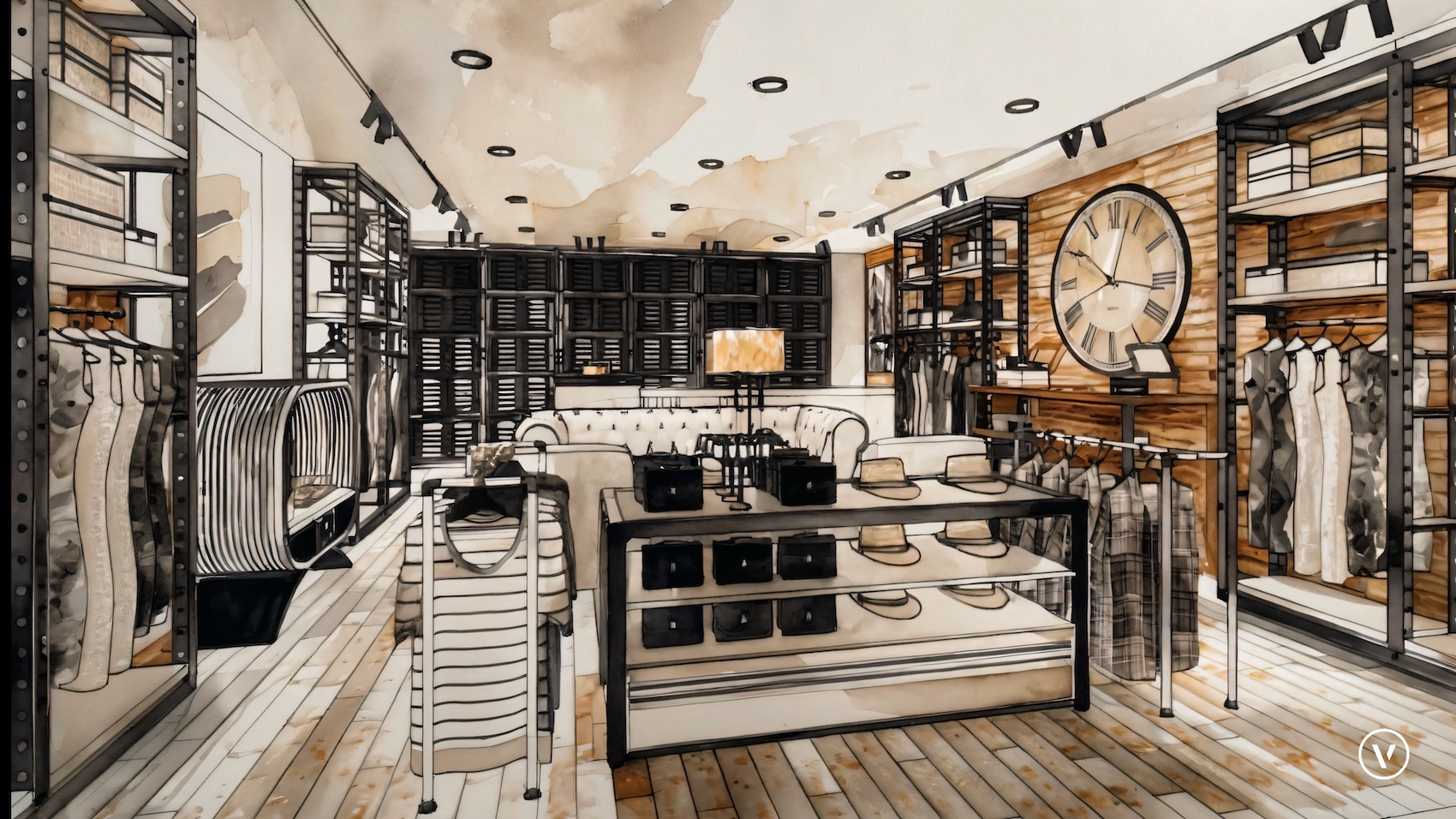
Store interior sketch. Vectorworks’ AI tools tools run on cloud services, removing the need for high-end local hardware for rendering.
AI also enhances communication with clients by making proposals more immersive and accessible. By generating richer visualisations and contextual environments, architects can move beyond abstract drawings towards more intuitive, experiential representations.
Crucially, Ruiz stressed that the quality of output depends on the quality of input. “The easiest thing is to describe the project step by step,” he said, likening prompts to instructions given between architects in a studio environment. Beyond images, AI can generate materials, textures and even contextual environments, enabling designers to build more complete and convincing models. “Why don’t we just create it inside?” he asked, highlighting the shift from sourcing assets externally to generating them within the design environment.
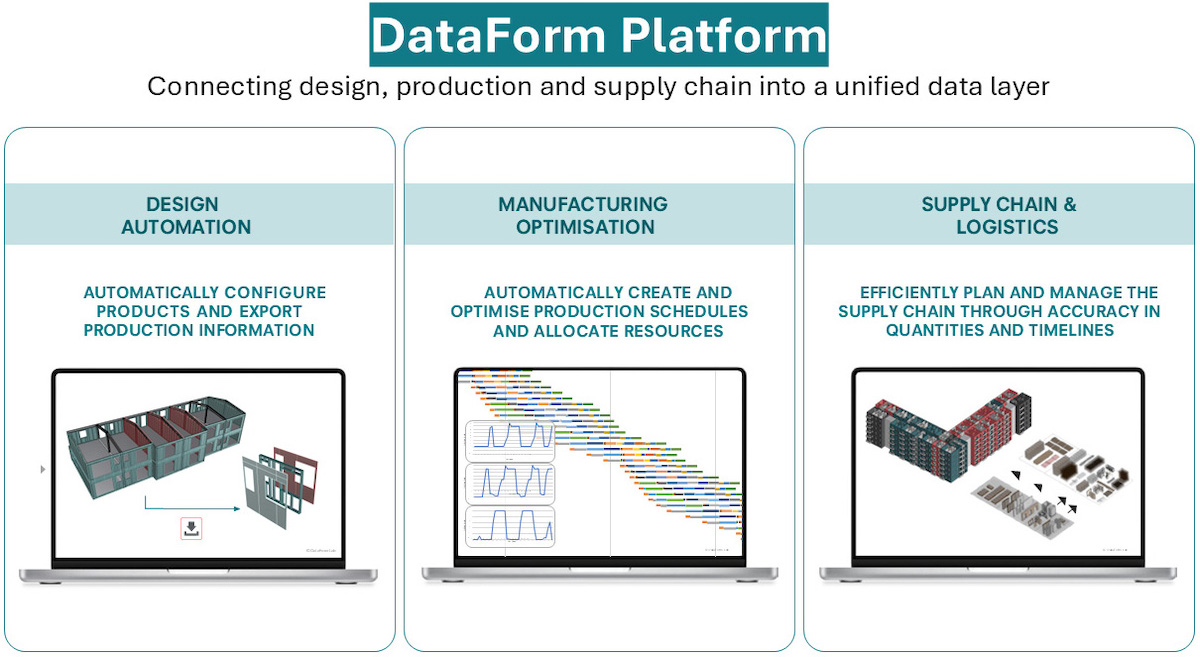
The DataForm Platform seamlessly connects design-to-manufacturing automation, production scheduling optimisation, and supply chain planning. This helps offsite manufacturers scale sustainably and meet the complex challenges of modern construction.
Closing the session, Eva Magnisali expanded the discussion to a systems level, focusing on the role of AI in offsite construction and manufacturing. She began by addressing a longstanding challenge in the industry: the disconnect between design and production. “Every building is still custom-designed and disconnected from how the factories operate,” she observed.
At DataForm Lab, AI is used to bridge this gap by linking design directly to manufacturing processes. “We’re not just interested in doing things faster,” she said. “We want to do them more intelligently as well.” This involves generating production information, optimising design for manufacturing constraints, and simulating factory operations through digital twins. The impact is significant. “What used to take between four to twelve weeks now takes minutes,” she noted, pointing to time savings of over 90 per cent.
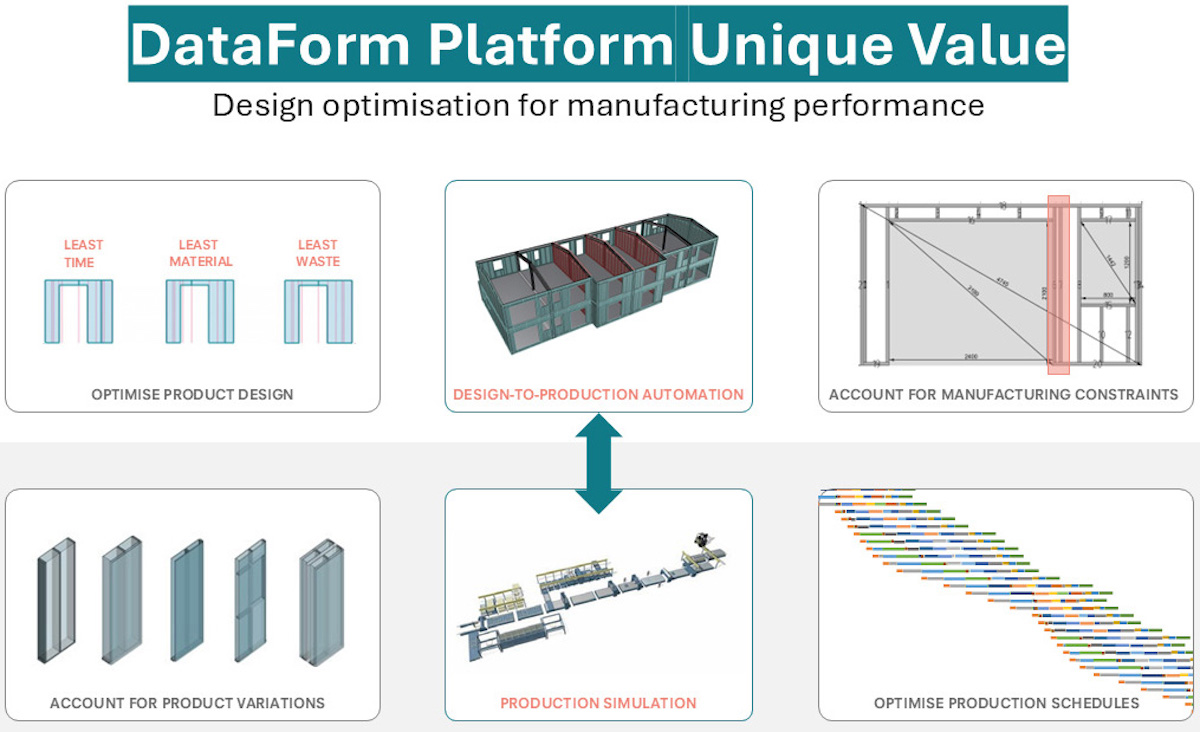
DataForm Platform provides a holistic approach to workflow automation, optimising design for manufacturing performance and production scheduling for design variations.
However, Magnisali emphasised that the real value lies in data. “We want to think of data as an asset,” she said, advocating for structured data systems that enable predictive and prescriptive analysis. By combining AI with structured data, practices can move beyond optimisation towards scenario testing and strategic decision-making. “We can stress test [the system] against different scenarios,” she explained, enabling teams to evaluate design, production and logistics simultaneously.