With education estates under increasing pressure to do more with less, this roundtable discussion, hosted by AT in partnership with IKO, explored how more intelligent approaches to procurement, manufacture and retrofit can help future-proof the next generation of schools, colleges and universities.
In association with

Round table participants
Claire Barton
Partner, Haverstock
Caroline Mayes
Director, Stride Treglown
Craig Cullimore
Chair, ADP
Lorna Taverner
Head of Architecture and Technical Design, Willmott Dixon
Adam Eaton
Director, Trigon Fire Safety Engineering
Steven Jenkins
Director, Head of Education, Europe, AECOM
Diane Brazier
Director of Estates and Facilities, Orchard Hill Academy Trust
Crawford Wright
Head of Architecture and Design, Department for Education (DfE)
Ben Parker
Divisional Manager for National Accounts, IKO
Marcus Lee
Sales Director, IKO
Isabel Allen
Editor, Architecture Today
In 2026, education buildings are being delivered against a backdrop of sustained cost and inflationary pressures, acute skills shortages, and an increasingly complex regulatory landscape. Further compounding these factors are protracted planning processes, evolving educational design standards, and the frequent need to realise projects on live, operational sites with limited working windows. Against this context, how can architects and the wider construction industry not only win work, but deliver quality, confidence, and long-term value for clients, students and communities? Where do the most significant challenges and opportunities lie across design, manufacturing and supply chains? And as budgets and carbon targets further sharpen, how important will retrofit, refurbishment and future-proofing become in shaping the next cycle of education projects?
These questions and more were explored at a round table discussion hosted by Architecture Today in partnership with IKO at The Building Centre in London. Chosen for their diverse perspectives and experience, the round table participants included architects, engineers and construction consultants, as well as a contractor, education masterplanner, educational estate director, client, and manufacturer.

Crawford Wright, John Ramshaw (AT Technical Editor reporting), and Isabel Allen.
Balancing ambition, budgets and delivery realities
Opening the discussion, Crawford Wright set out the scale and complexity of the challenge facing the Department for Education. With around 20,000 schools across England and finite public funding, the question is not simply how much to invest, but how to achieve the greatest long-term benefit. “We have nearly three billion pounds over five years,” he said. “For any country, that’s a lot of money. The question is how wisely we invest it to achieve maximum impact.”
This has prompted a shift in emphasis away from purely new build towards renewal and refurbishment, with the aim of raising standards across the estate as a whole rather than delivering isolated exemplars. Wright described the ambition as ensuring that every school can provide high-quality learning environments, with access to daylight, fresh air and nature, regardless of when it was built.
For architects, however, translating these ambitions into reality is rarely straightforward. Claire Barton described the pressures facing design teams working within tight regulatory and financial constraints. “We’re under this nightmare of compliance, this nightmare of cost, this nightmare of programme,” she said. “We’re trying desperately to weave ambition and wellbeing and pride into those buildings, and that’s immensely difficult.” Caroline Mayes agreed, noting that even well-resourced practices struggle to maintain design quality under such conditions. “The constraints at every turn are the most difficult thing to work with,” she said. “Just squeezing that bit of joy out of emerging designs is an uphill battle, and that has an impact on retaining talented people.”
Yet despite these pressures, there was consensus that public-sector education buildings can still achieve high levels of design quality. Craig Cullimore pointed out that many state-funded schools now benefit from clearer spatial standards than some independent schools operating under tighter financial constraints. “In some ways, mainstream schools are better designed and more money is spent on them than some independent schools,” he observed.

Lorna Taverner.
Frameworks, standardisation and the evolving role of architects
Much of this change has been driven by the evolution of the Department for Education’s design standards and frameworks, which aim to provide consistency while improving overall outcomes. Cullimore welcomed recent revisions that encourage more varied building forms and better integration of landscape. “Moving away from big superblocks is great,” he said. “It gives us the opportunity to create better relationships between buildings and external spaces.”
At the same time, the increasing use of standardised components and platform approaches has altered the role of architects. Lorna Taverner explained that contractors are developing repeatable construction systems to improve efficiency and manage risk. “We have platforms which define how classrooms and structural grids are delivered in response to the DfE standards,” she said. “The idea is that the fundamentals are resolved, allowing teams to focus on the aspects that really add value.”
While this approach can improve delivery certainty, it also raises questions about the balance between standardisation and creativity. Barton emphasised the importance of ensuring that efficiency does not come at the expense of architectural quality. “The best architects still need to be working in this sector,” she said. “When constraints are most difficult, that’s when you need the best people.”
Steven Jenkins noted that large multidisciplinary firms increasingly act as integrators, bringing together specialist expertise from smaller practices and consultants. “A lot of innovation comes from SMEs,” he said. “Our role is often to bring those ideas together and deliver them within the constraints of the programme.” This collaborative model reflects the growing complexity of education projects, where success depends on integrating design, engineering, construction and operational considerations from the outset.

Diane Brazier.
Retrofit, reuse and the growing importance of existing buildings
If standardisation is reshaping new-build delivery, retrofit is emerging as an equally important frontier. Wright highlighted the scale of opportunity within the existing estate, arguing that older buildings should be viewed as assets rather than liabilities. “We have some fantastic buildings,” he said. “The question is how to transform those in a limited way that delivers the right outcomes, rather than assuming they need complete replacement.”
The architects echoed this view, describing some of their most successful projects as adaptive reuse schemes. Barton pointed to the transformation of Victorian school buildings, whose robust construction and generous spatial qualities lend themselves to adaptation. “They’re all different, which is part of their beauty,” she said. “With the right approach, they can be reconfigured to work incredibly well.”
Cullimore described similar experiences converting non-educational buildings into schools, including former police stations and industrial structures. “Those projects keep staff engaged because they involve problem-solving and creativity,” he said. However, retrofit brings its own technical and regulatory challenges. Adam Eaton explained that fire safety requirements have evolved significantly in recent years, making it harder to demonstrate compliance in older buildings. “You can’t always meet current standards exactly,” he said. “It’s about understanding what is reasonable, appropriate and safe.” This requires careful judgement and early engagement between design teams, fire engineers and clients, particularly where buildings were not originally designed for educational use.


Marcus Lee and Craig Cullimore.
Clients, capability and the realities of managing school estates
From the client perspective, Diane Brazier described the increasing complexity of managing education estates, particularly for multi-academy trusts responsible for diverse building portfolios. “When I started, we had three people managing ten schools,” she said. “We were a facilities team, not an estates team. We had to bring in technical advisors to help develop an estate strategy because we simply didn’t have the capacity internally.”
This reliance on external expertise reflects the changing nature of education provision, with trusts now responsible for buildings that must accommodate a wide range of learning needs. Brazier described how SEND (Special Educational Needs and Disabilities) facilities require highly specialised environments, with accessible layouts, sensory spaces and carefully designed circulation. “The buildings have to work for very different groups,” she said. “They need to support learning, independence and access to the community.”
At the same time, many schools lack the resources to manage construction projects effectively. Wright acknowledged the uneven distribution of expertise across the sector, with some trusts possessing sophisticated estates teams while others have limited capacity. “You have a very diverse system,” he said. “Some organisations have strong skills, others have very little.”

Caroline Mayes and Steven Jenkins.
Landscape, wellbeing and the role of external environments
One area where policy changes are beginning to have a visible impact is landscape design. Wright emphasised the importance of integrating external spaces into school design, describing landscape as a fundamental component of educational environments. “Bringing nature into schools is one of the most effective ways of improving quality,” he said.
The architects welcomed this renewed emphasis, noting that previous frameworks often prioritised efficiency over environmental quality. Barton argued that landscape had frequently been treated as an afterthought. “It was often just leftover space,” she said. “There wasn’t much opportunity for meaningful design.” Recent revisions to design standards are intended to address this, encouraging more varied and usable external environments. Cullimore described this as an opportunity to rethink how schools are organised. “Landscape should be part of the masterplan from the start,” he said. “It’s essential to creating good learning environments.”

Diane Brazier, Caroline Mayes, Steven Jenkins, Claire Barton, and Marcus Lee.
Fire, sustainability and the growing complexity of technical integration
As education buildings evolve to meet sustainability targets, the interaction between environmental and safety requirements is becoming increasingly complex. Eaton highlighted the challenges associated with integrating features such as photovoltaic panels and green roofs within fire safety strategies. “These elements can affect everything,” he said. “They influence building layout, materials and compliance.”
Marcus Lee stressed the importance of early engagement between manufacturers and design teams to resolve such issues effectively. “The earlier those conversations happen, the better the outcome,” he said. Ben Parker agreed, noting that clearer performance requirements help manufacturers develop appropriate solutions. “Performance specifications allow us to understand what’s needed and support the project more effectively,” he said. However, participants acknowledged that changing guidance and evolving standards can create uncertainty, particularly where multiple technical requirements interact.

Marcus Lee, Ben Parker, and Adam Eaton.
Procurement, programme pressures and the importance of time
If there was one issue that united everyone in the room, it was the impact of programme pressures on design quality. Barton argued that compressed design timelines limit opportunities for innovation and careful decision-making. “There simply isn’t enough time,” she said. “The most important decisions are being made under enormous pressure.”
Wright recognised this challenge but noted that programme constraints reflect broader pressures within the construction process. “There’s always a push to deliver projects faster,” he said. Standardisation and digital tools may offer part of the solution. Jenkins described how digital processes and repeatable design elements can improve efficiency while allowing teams to focus on higher-value aspects of projects. “There’s no benefit in redesigning standard components every time,” Wright added. “Standardising those elements allows us to focus on what really matters.”
Collaboration, consistency and the path forward
As the discussion drew to a close, participants reflected on the importance of collaboration across disciplines. Lee emphasised the role of manufacturers in supporting better outcomes. “We need to be involved earlier,” he said. “That helps ensure the right solutions are in place from the start.” Parker highlighted the value of clearer performance specifications in aligning expectations across project teams.
More broadly, there was agreement that improving education buildings requires coordinated effort across the entire supply chain, from government and clients to designers, contractors and manufacturers. Despite the challenges, Wright expressed optimism about the future. “We are making progress,” he said. “The standards are improving, and there is a growing recognition of what good education environments should be.”
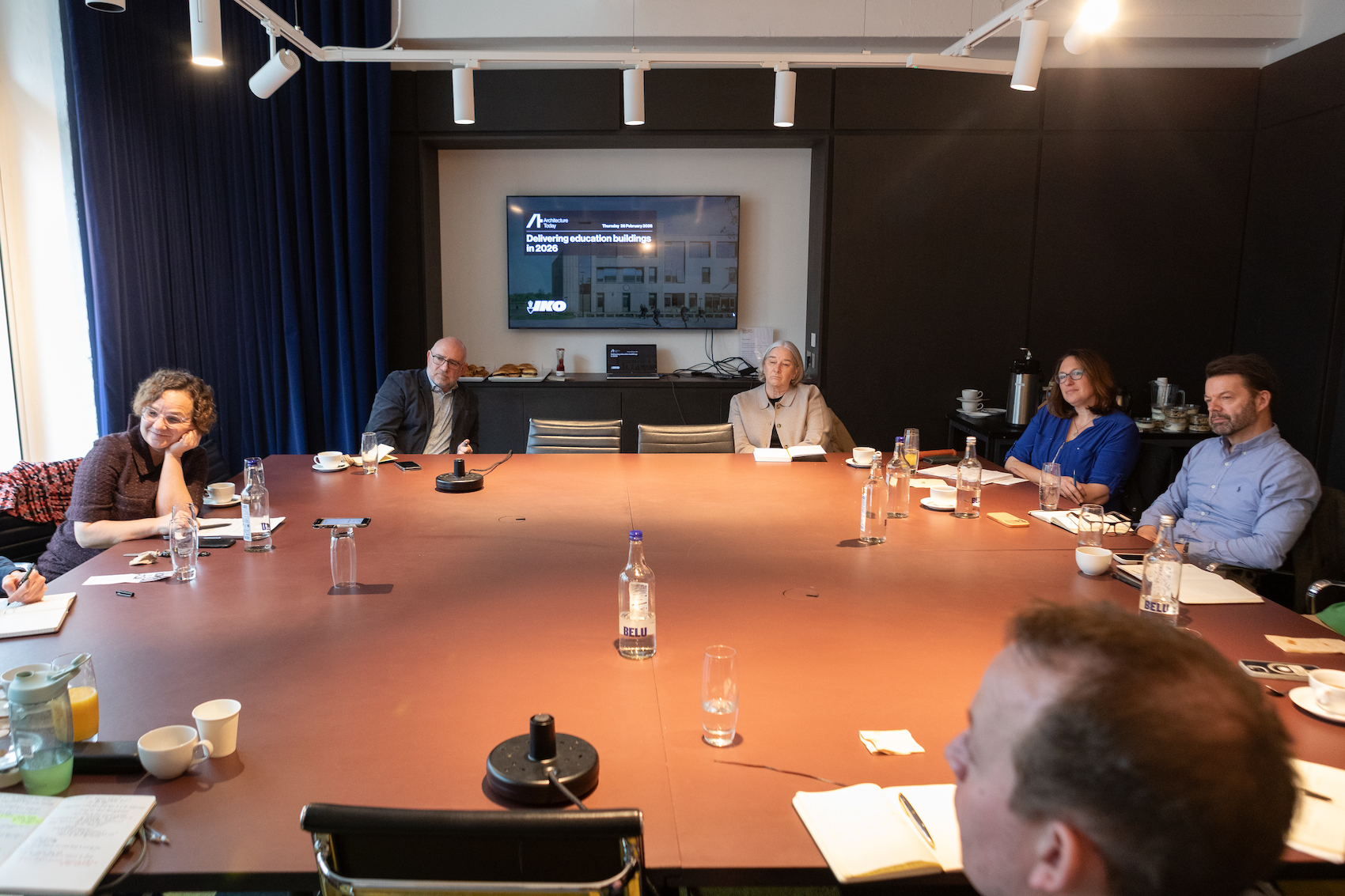
Isabel Allen, Craig Cullimore, Diane Brazier, Caroline Mayes, and Steven Jenkins.
Delivering lasting value in a complex landscape
Despite a myriad of pressures in the education sector, the discussion indicated that the construction industry is adapting and developing new approaches to standardisation, reuse and collaboration that can deliver better outcomes over time. If there was one consistent message, it was that quality depends not only on design, but on the structures and processes that support it. By aligning standards, improving collaboration and investing in long-term thinking, the sector has the opportunity to create education environments that are not only efficient and compliant, but inspiring, resilient and capable of supporting future generations.