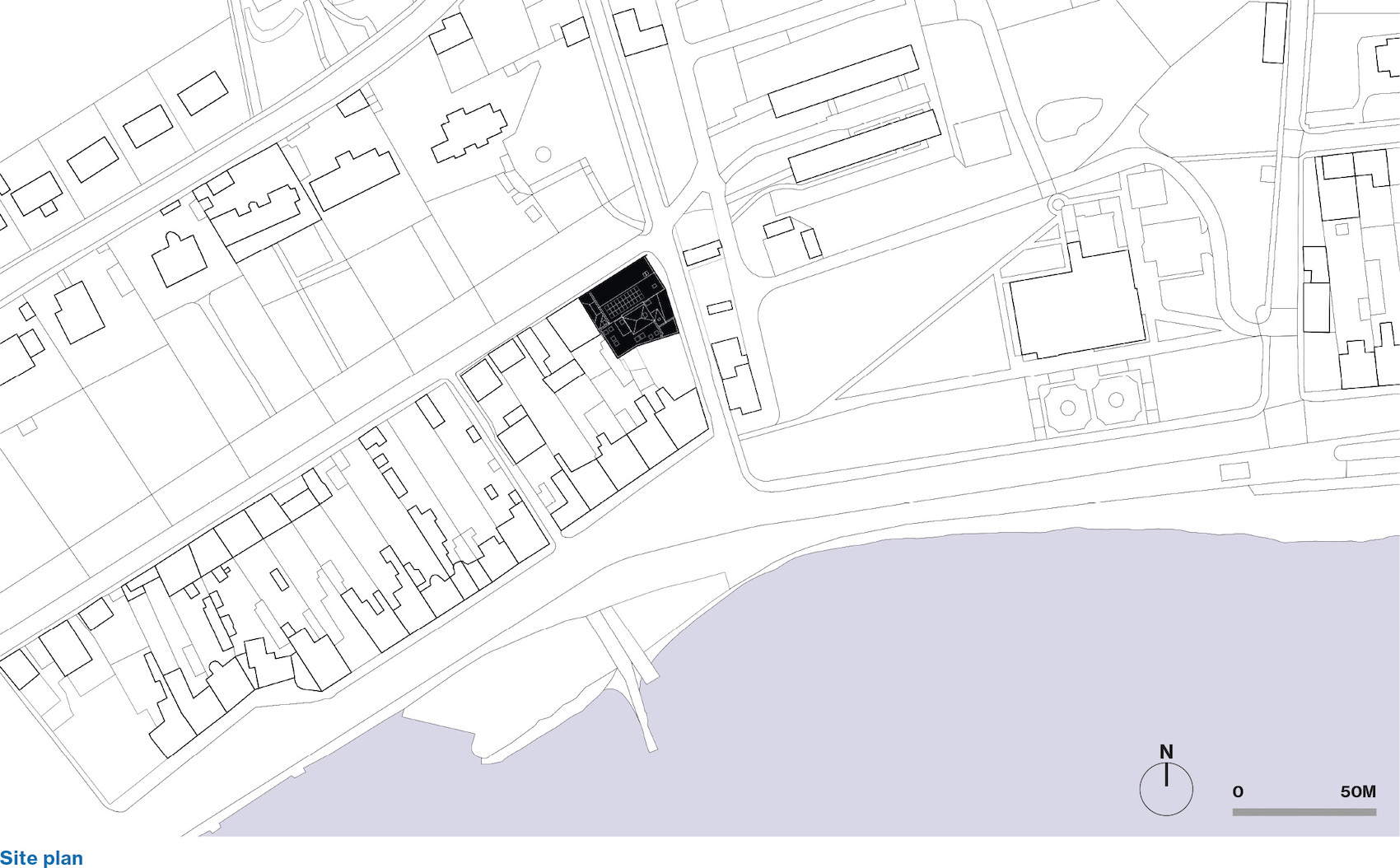
O’Donnell Brown has worked with local campaigners to transform a neglected 19th-century town hall on the Scottish island of Cumbrae into a thriving centre for community life.
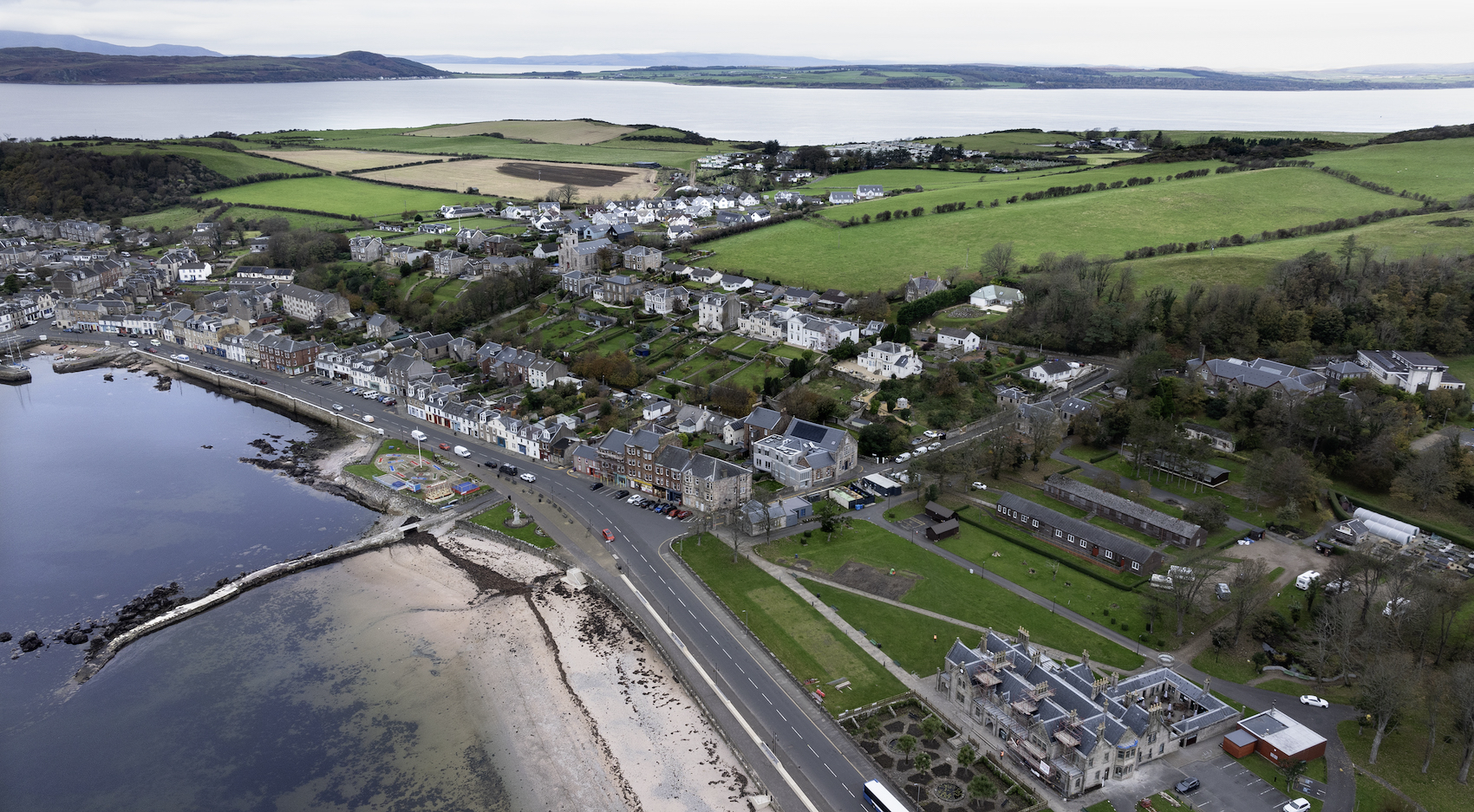
The day began badly, with a sky that was as grey as bricks and bucketing rain. Weather that flattens colour and mood. Crossing the Firth of Clyde, rain streaked the windows and the horizon was dissolved into a single tone. Somewhere on the very short ferry between the mainland and the island the light changed. As I arrived, the clouds thinned, the sky lifted, and some welcome January sun edged its way through.
The story that unfolded during my visit was a version of Millport thick with memory. From recollections of the promenade and summer activities, to the building’s direct connection to furtive teenage misdeeds: of sitting on the tiled wall – retained in the redevelopment – and hiding and hanging out with friends in the public toilets. These are the rituals of growing up by the sea. Today, different kinds of rituals are underway at the Town Hall. Inside, the beginners Bridge Club is learning how to play, reclaiming tables and habits that had been permanently displaced. The building is open, alive, and gently testing what it might now become.
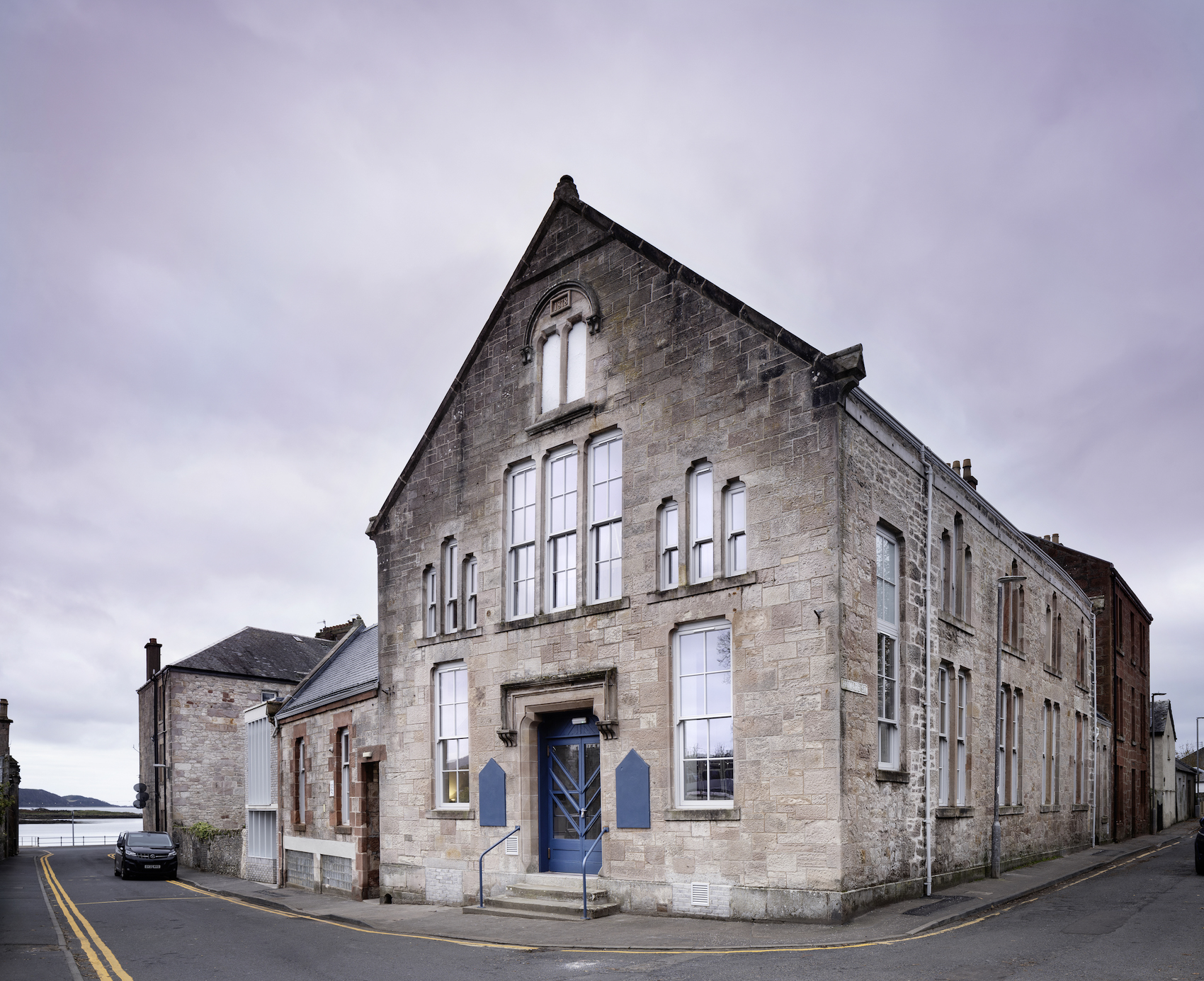
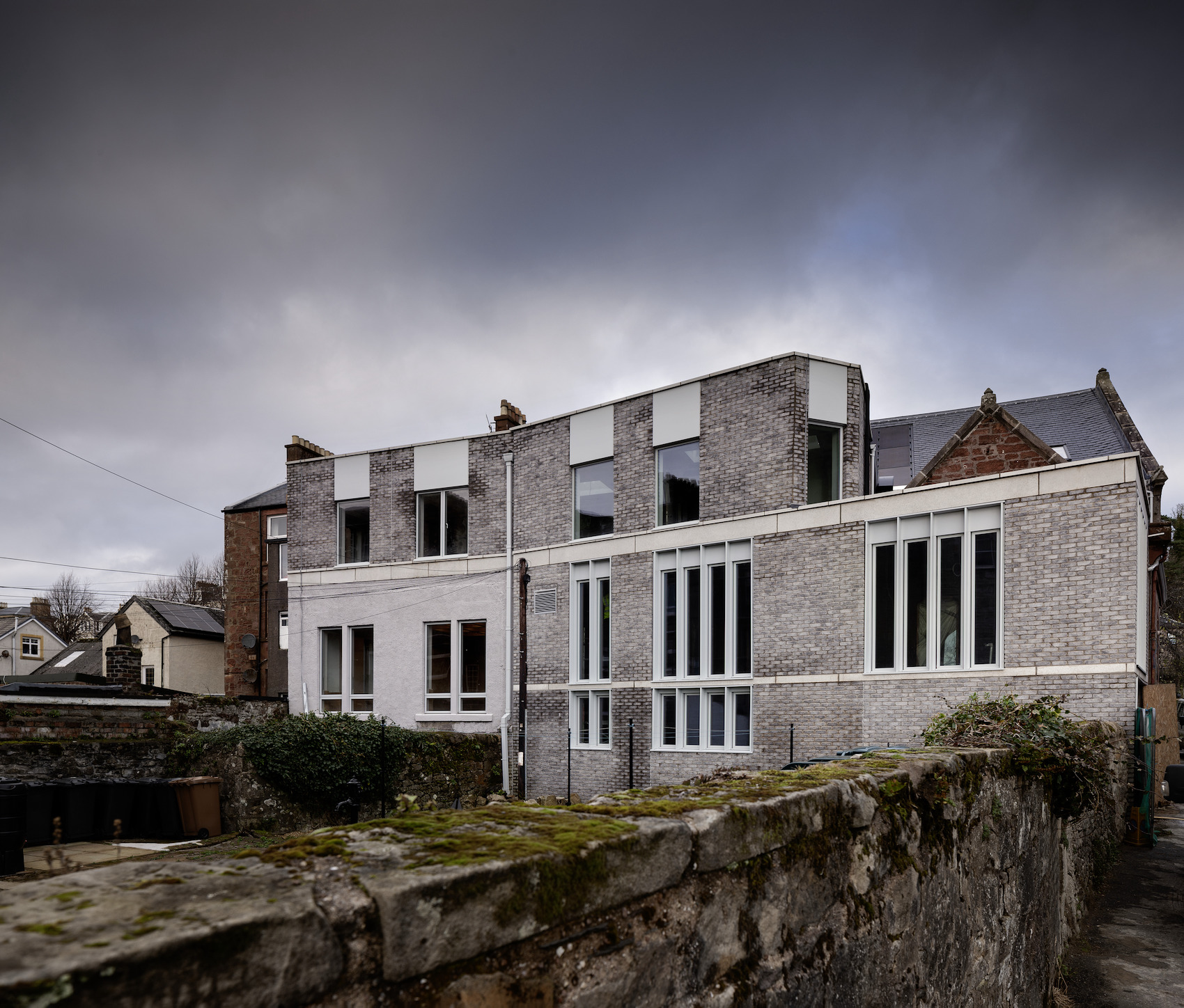
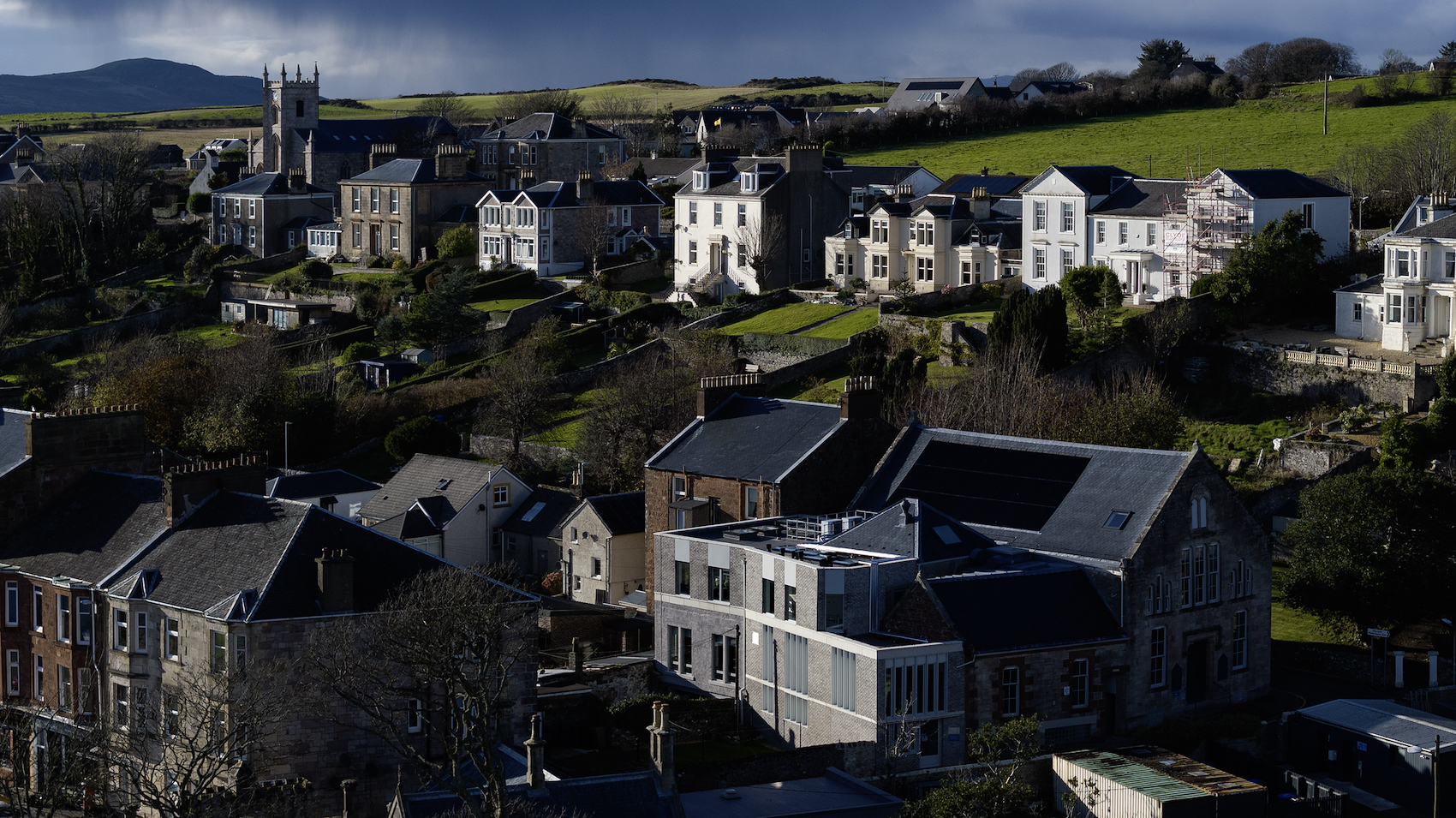
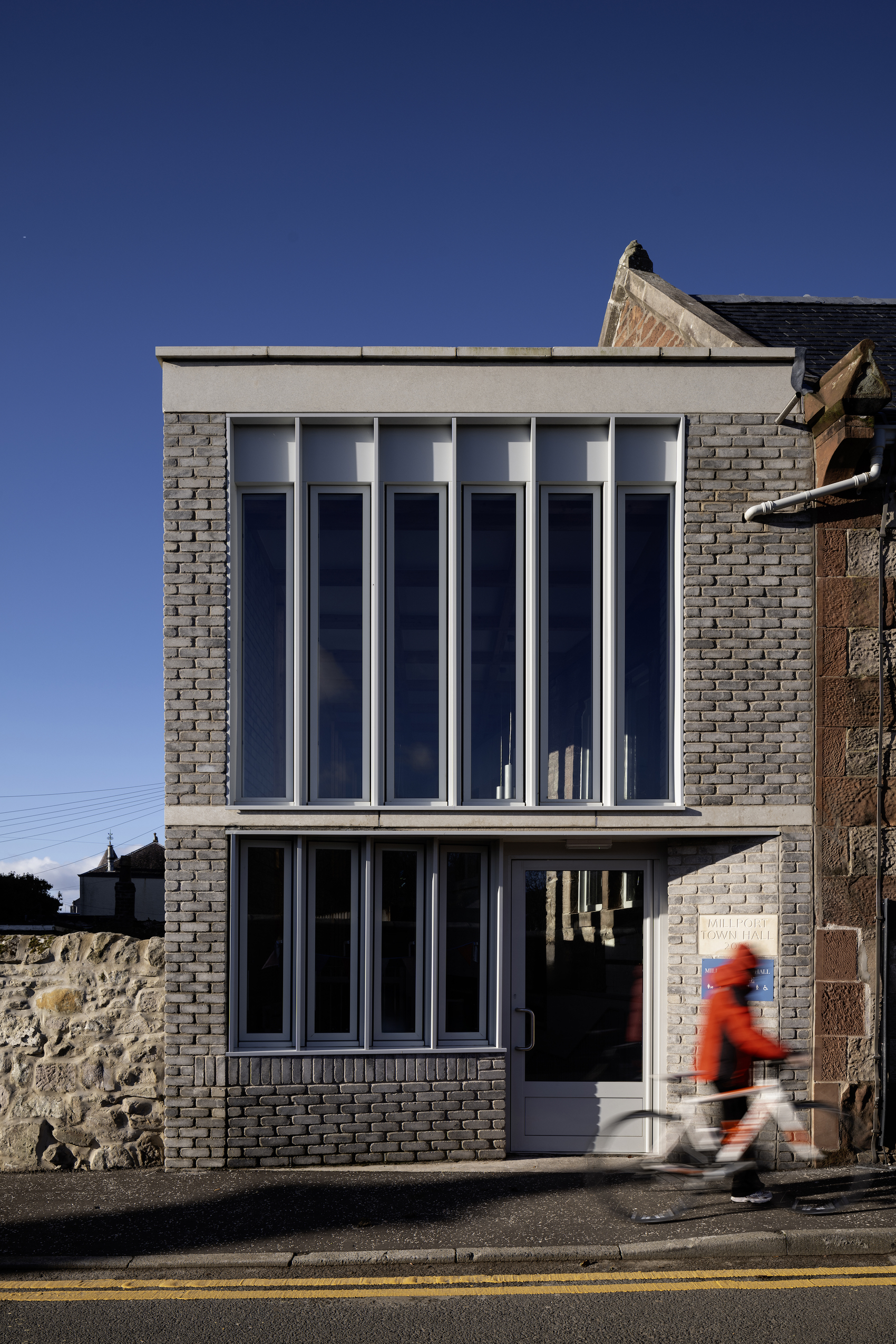
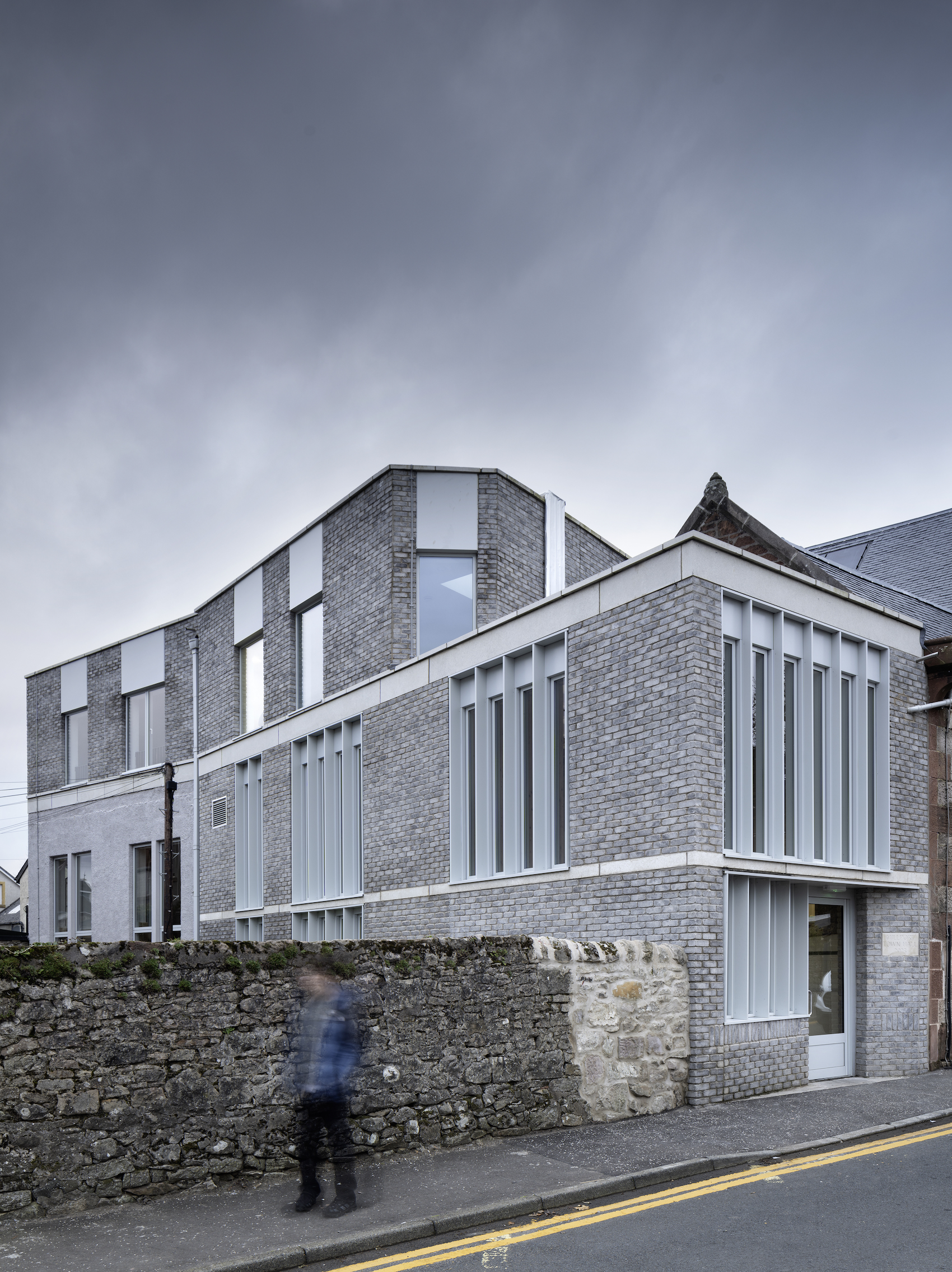
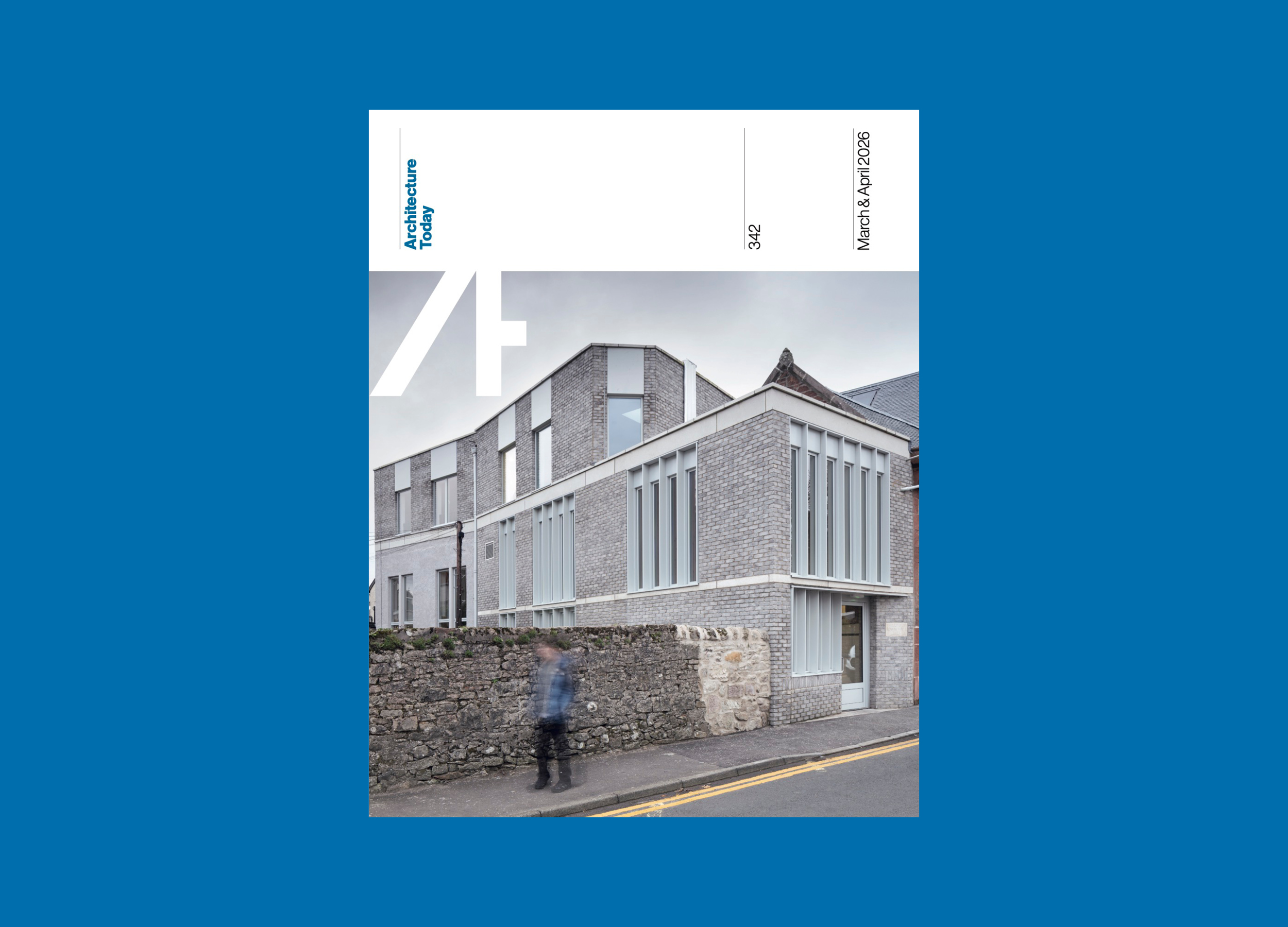
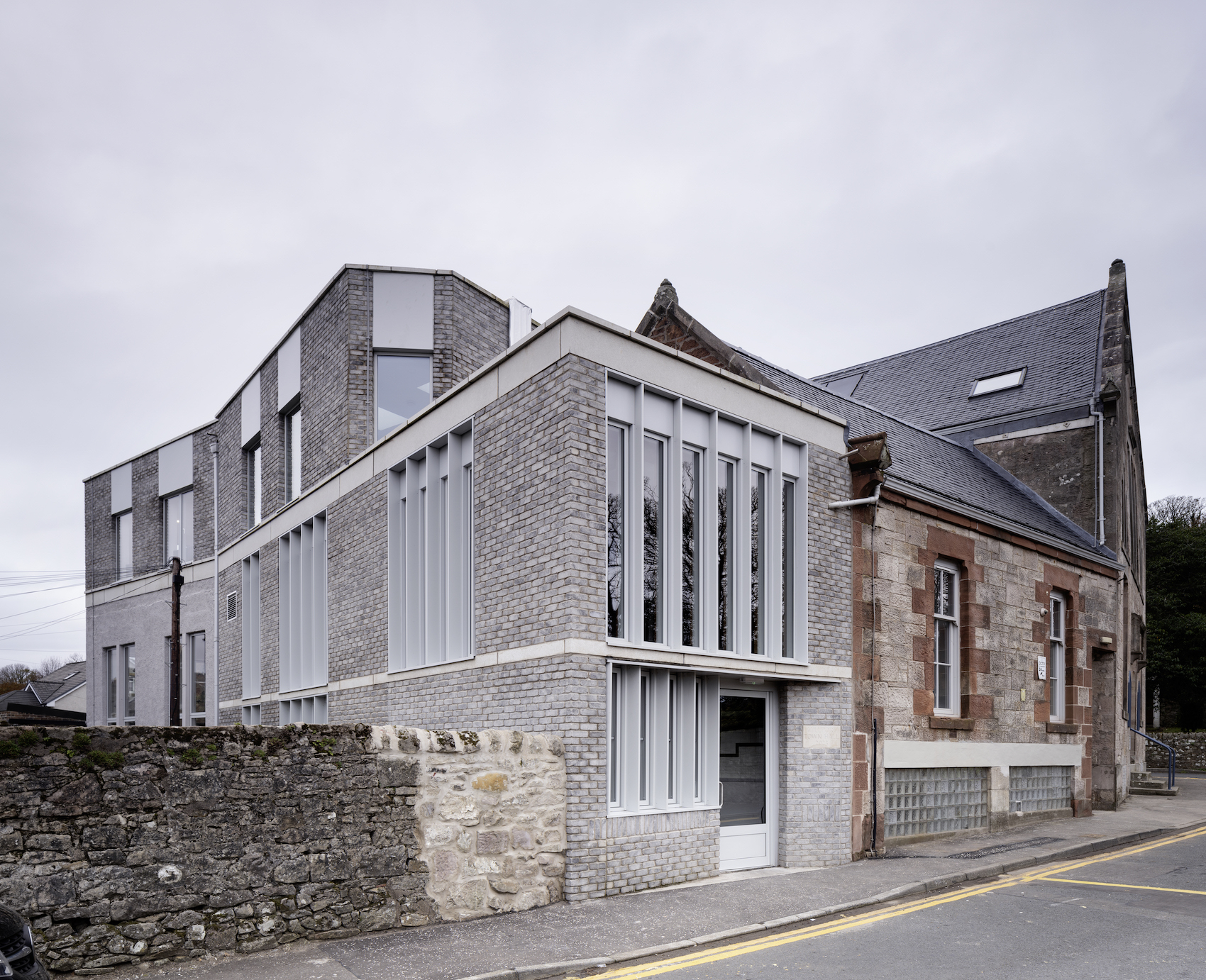
The building as it is today. The choice of materials and colours moves toward sea-toned blues and sandstone hues, away from the rusts and reds that once dominated the façade.
Millport Town Hall reopened in October 2025, with a story far longer and far more precarious than a simple reopening date suggests. The Town Hall first opened in 1878. For generations, it was at the centre of community life on the island, a role it shared with nearby venues. It has lived many lives. A significant conversion turned the building into a cinema, and for many of those who later drove the campaign to save it, that is the dominant memory: a darkened hall, windows permanently sealed, the joy of the space hidden behind dropped ceilings, blackout and projection. Water ingress and long-term neglect steadily eroded what had once been a blossoming civic building. Closure followed in 2012, with limited use thereafter for occasional large public events. The building was deemed unsafe, riddled with leaks, a liability rather than an asset to its owner-operator, North Ayrshire Council. Then in 2018 local residents, Angie McCallam and her partner John McNeilly, began to ask what could be done to rescue a building quietly slipping from managed decline to at serious risk of demolition.
There was plenty of vision and bundles of ambition, but no money. What they did have was conversation. Public meetings, led by Angie, asked simple but fundamental questions: What could this be? What does the island need? How do we make this self-sufficient? The brief – as many of the best briefs are – was not written in isolation but built through dialogue, through meetings and discussions, through observing and reimagining the Town Hall other than it then appeared.
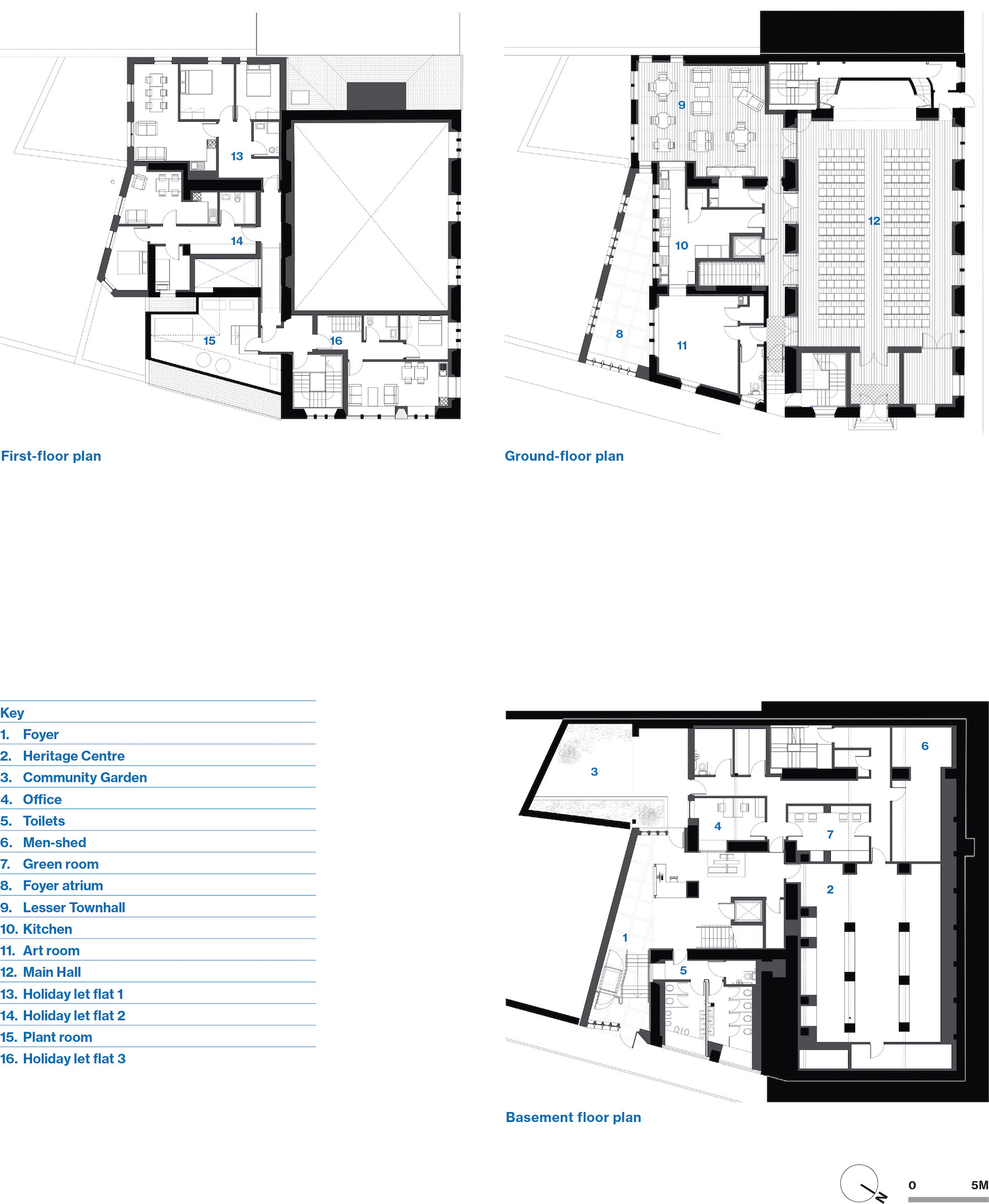
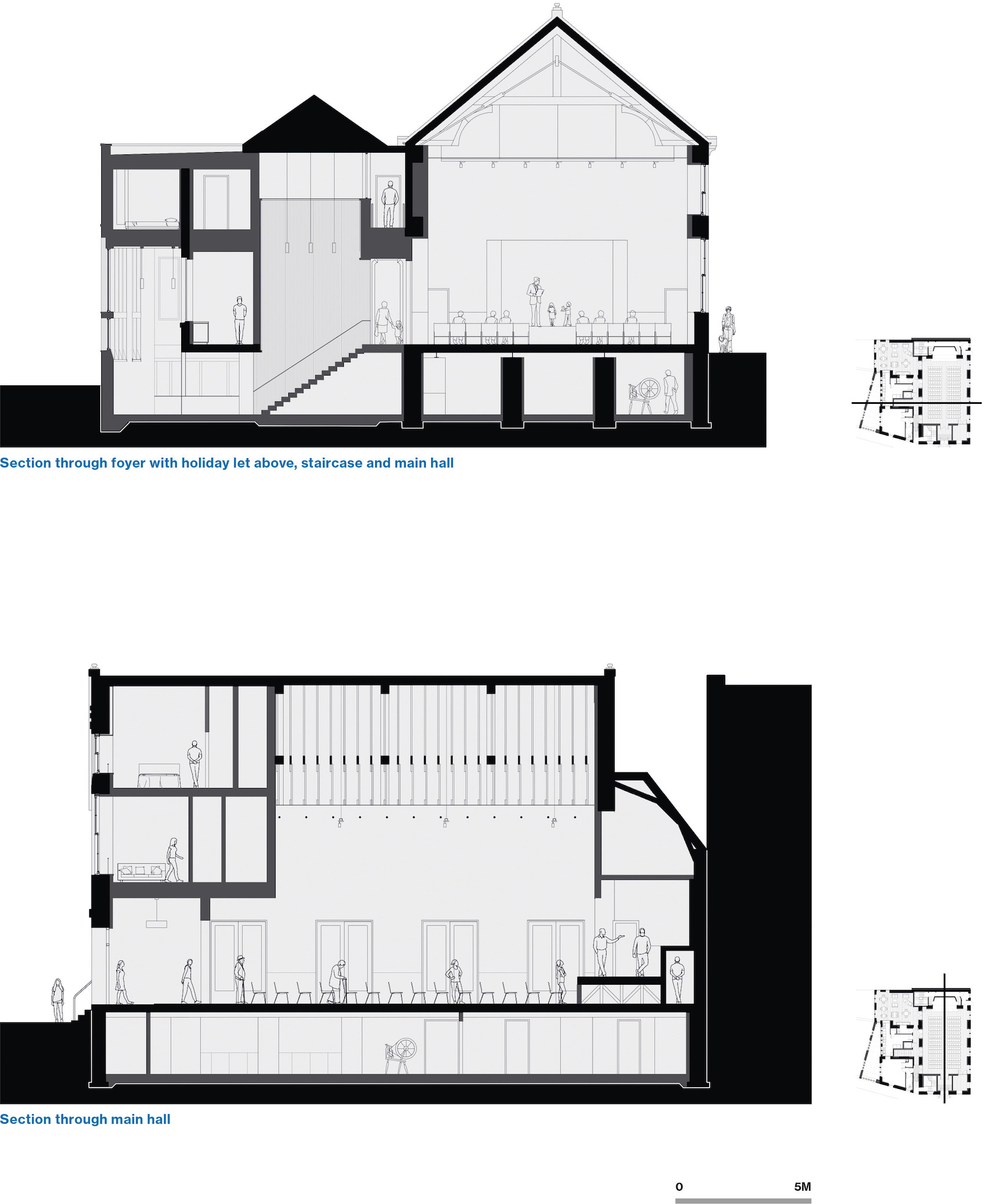
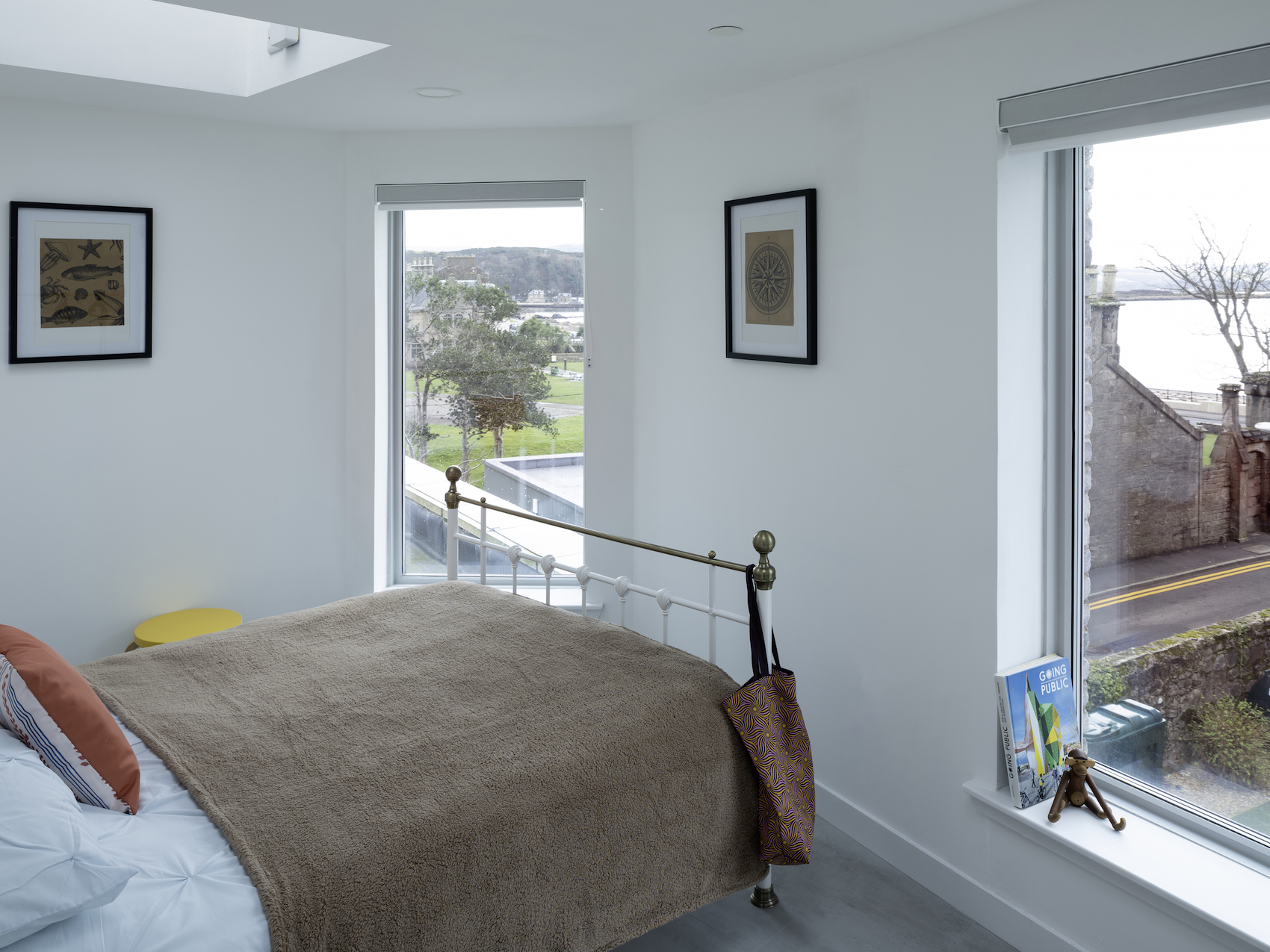
There was an understanding early on that good intentions would not be enough. The building had to make money. That clarity became the backbone of everything that followed. Unlocking the project is the inclusion of holiday-let flats, providing a sustainable financial base, a long-term income stream that could support the community and cultural uses below. This mixture of social ambition and economic realism brought the initial funders, and importantly the local authority, on board. The first flat emerged almost accidentally, carved out of the old projector room, with further options spinning out from that initial move. Co-location should allow for the sort of longevity that community spaces often struggle to maintain on room hires alone. The flats are light, airy and genuine, furnished with a mixture of donations and robust new pieces, and managed by a community member with a long history of running seaside rentals; someone who understands the rhythms of holiday use and the expectations of visitors. There is nothing glossy or anonymous about them. They feel like part of the building’s extended life rather than a bolt-on revenue stream.
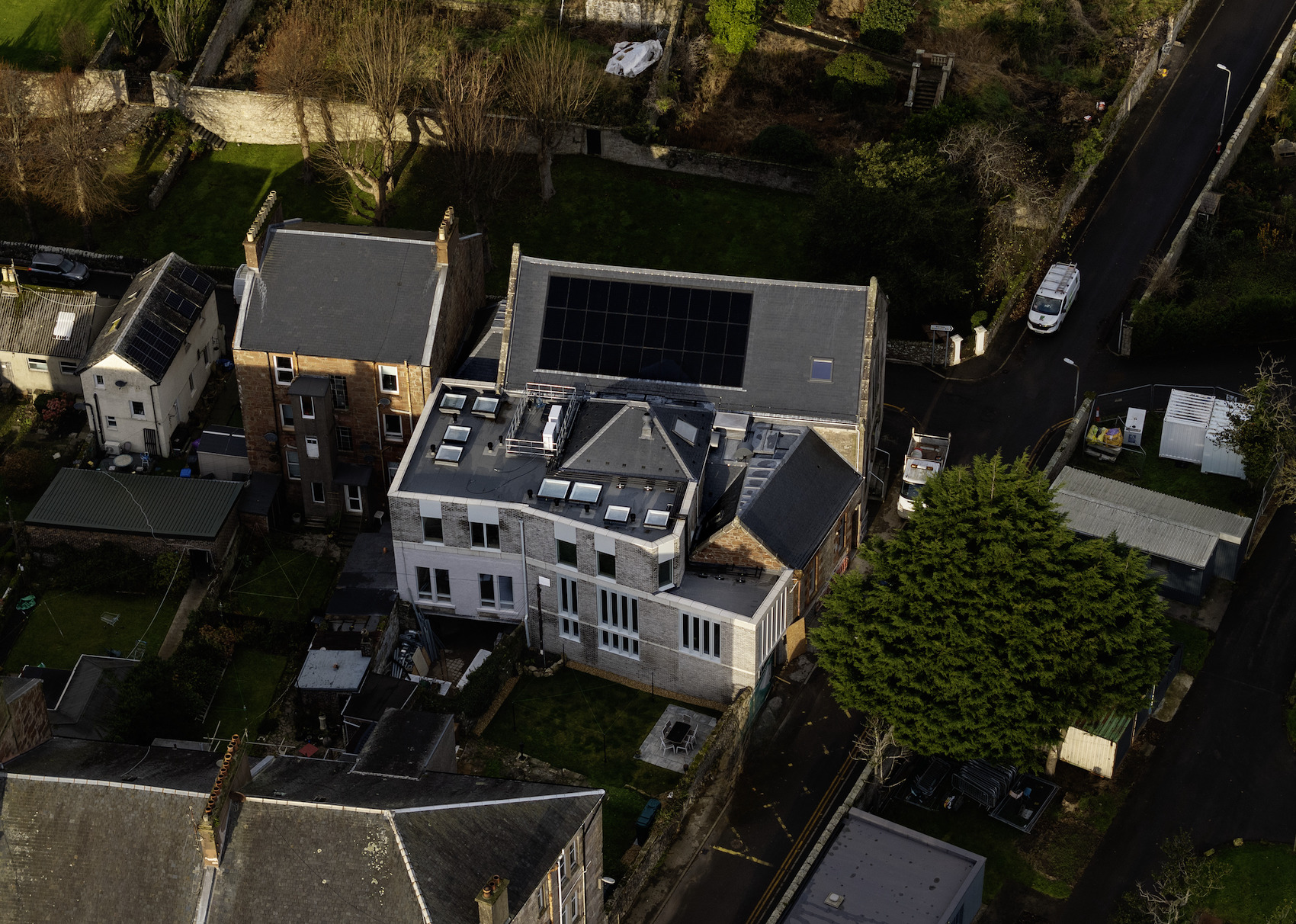
The extension is modest but decisive, wrapping around the original structure, celebrating the central hall and making it centre stage.
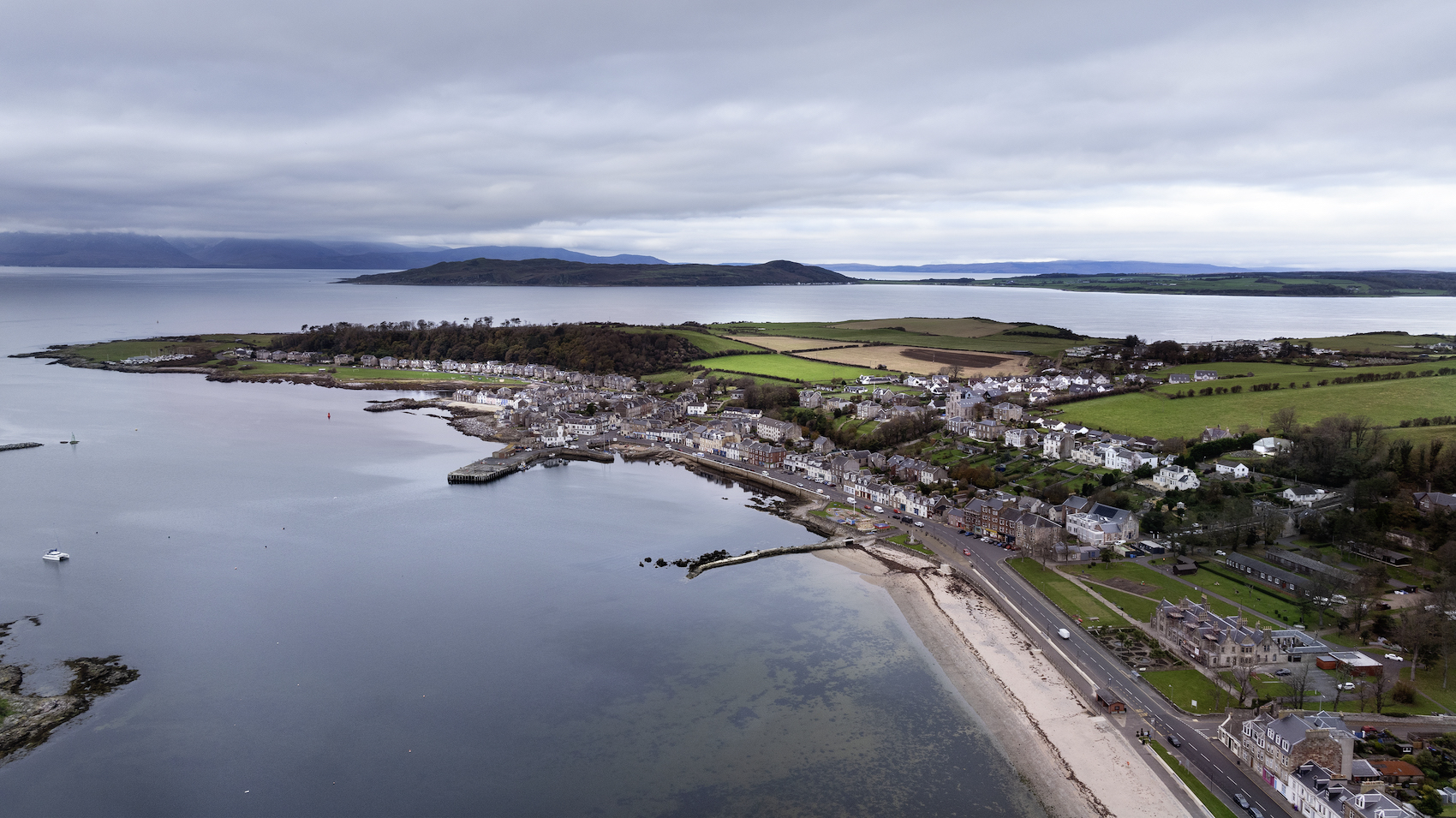
A small island, Cumbrae was described to me as a “place for retirees, and a place people return to”; those who spent childhood summers here as holidaymakers, those who grew up on the island and moved away, and day trippers from Largs or Glasgow. The Town Hall carries all of that history. It was the cinema, the focal point of holidays. Saturday cartoons packed the hall with children, horror double bills on Wednesdays and Fridays created queues down the street. ‘The boy from Tunnock’ came down to run a Summer Show with competitions ranging from Glamorous Grannies to Knock Knees, from garden shows to visiting acts. Winter belonged to the community: youth clubs, Burns suppers, ceilidhs, badminton, and Tarts and Tramps dances – a blast from a different time.
This layered memory matters deeply to the community client, and it shows in how the building was briefed and how the architecture feels. There has always been a strong link on the island to music and theatre, and this translated into a clear insistence on proper backstage facilities, a green room, spaces that could genuinely support gigs and performances rather than merely accommodate them.
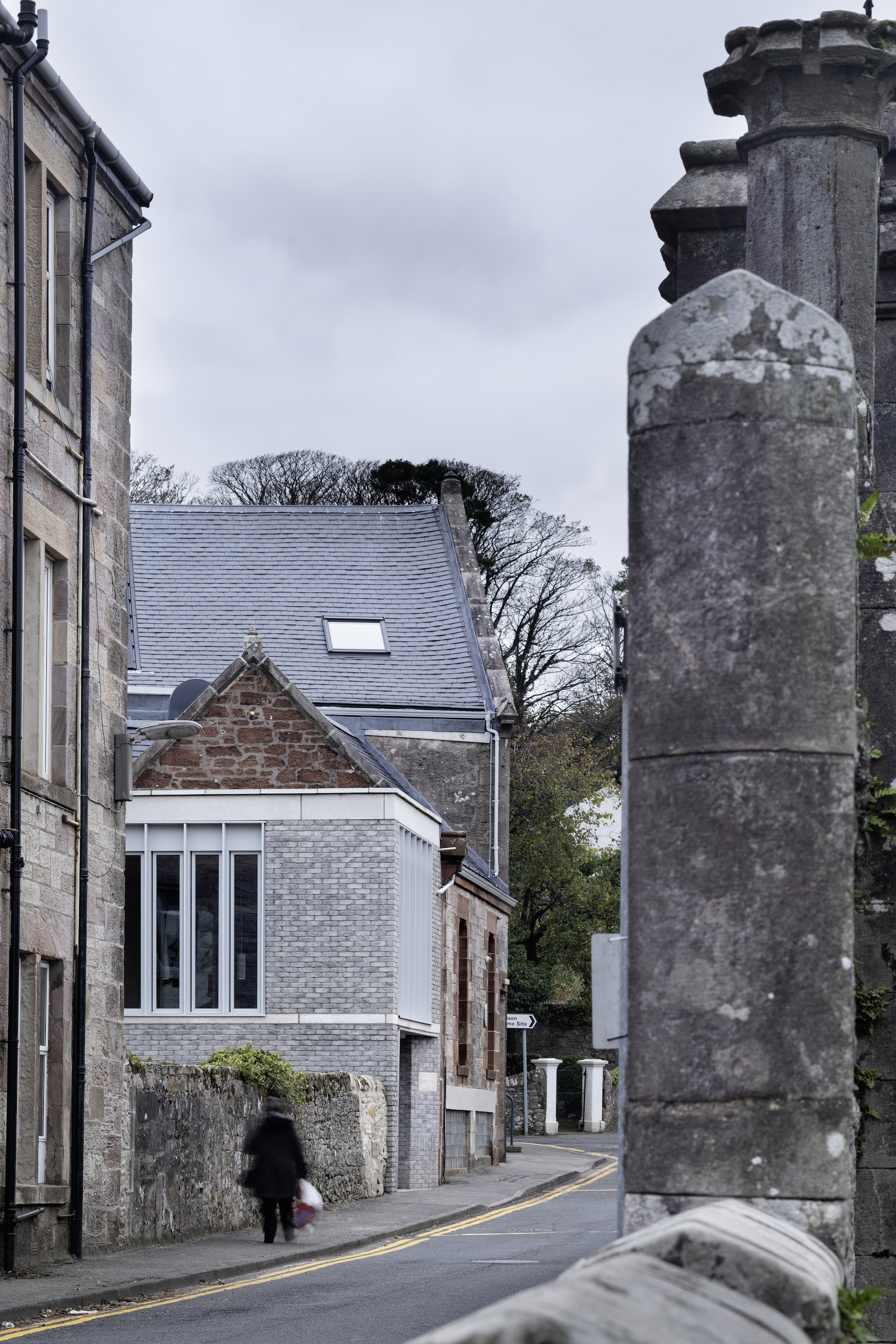
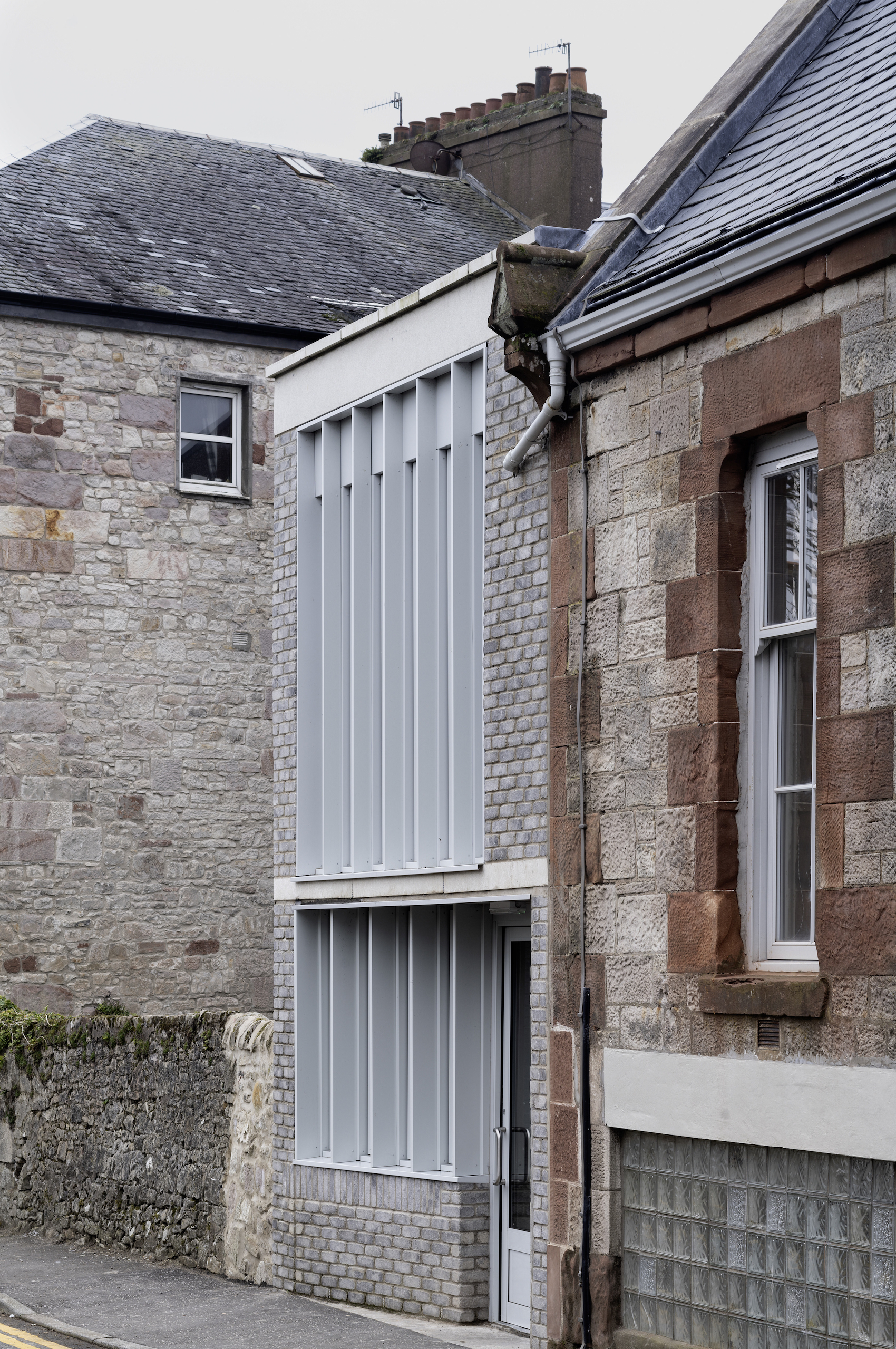
The new entrance has been deliberately recessed, sinking back to support rather than compete.
One of the most significant spatial moves is almost invisible. The ground floor, once dead space tucked underground and largely unusable, now forms the beginnings of a new visitor attraction: a museum bringing together stories of the island, summers long gone, and a collection of artefacts from the building itself. Light and sound have been rethought throughout. Where the cinema conversion had turned the hall into a sealed box, the renovation restores brightness and acoustic flexibility, allowing the space to shift character as needed.
Level changes have been handled with particular care. The new extension unlocks the plan while maintaining and improving accessibility. Platform lifts sit alongside processional stairs, ensuring that everyone shares the same experience of movement through the building. The journey from street to hall is coherent and inclusive. The extension itself is modest but decisive. A timber frame with brick infill, it houses two of the three new flats as well as the Sitting Room or Lesser Town Hall. It also provides the new stair and the sequence that leads visitors from the street, down to reception and the heritage spaces, and up into the main community spaces. The extension wraps around the old structure, celebrating the central hall and making it centre stage. The new entrance is deliberately recessive, sinking back to support rather than compete.
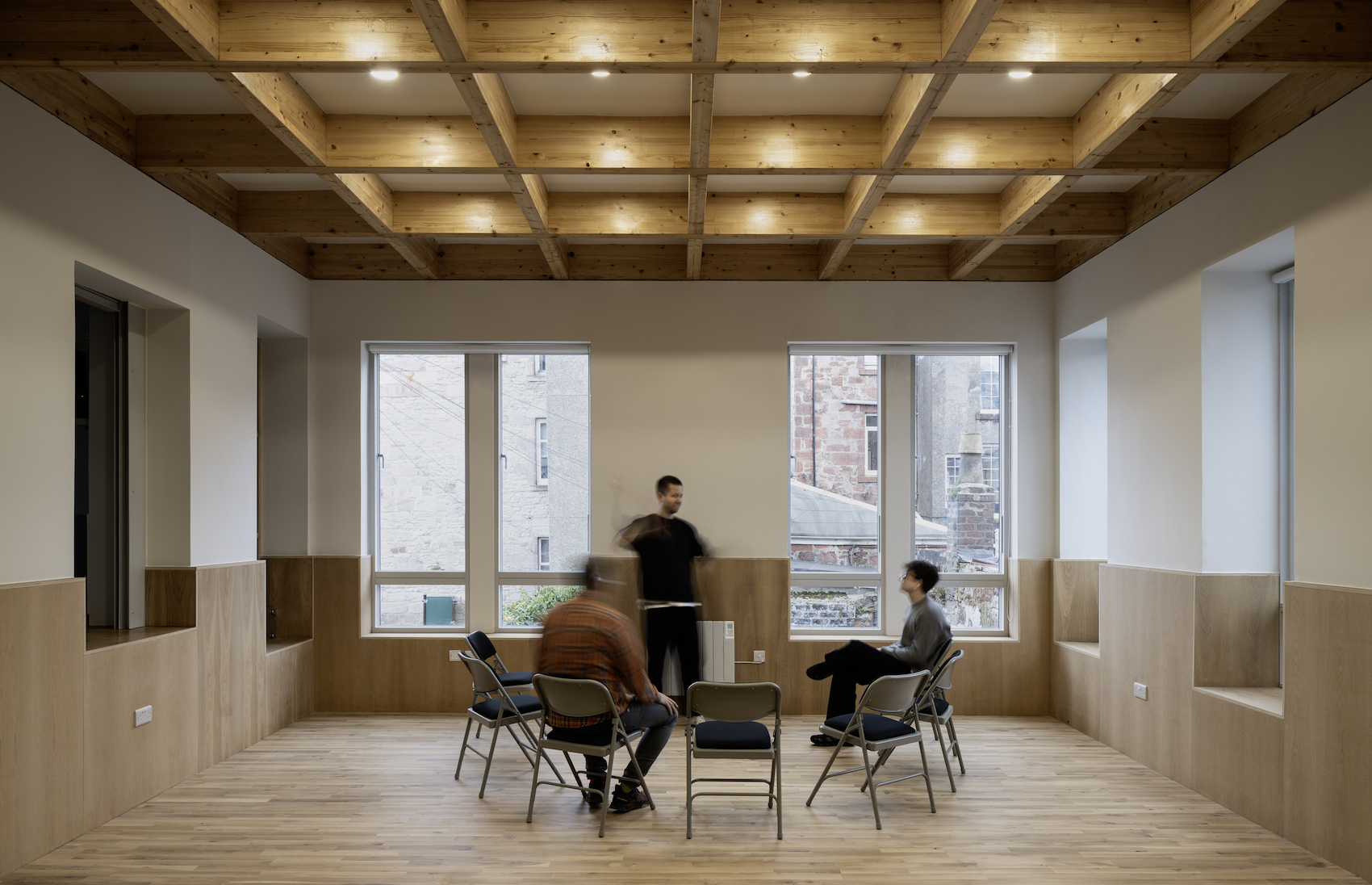
The timber waffle ceiling in the Sitting Room or Lesser Town Hall adds warmth and texture without fuss.
The choice of materials and colours reinforces this attitude. The client-led palette moves toward sea-toned blues and sandstone hues, away from the rusts and reds that once dominated the façade. On a grey day, the new brick echoes the sky; on a brighter one, it softens into something warmer. Little touches accumulate. Angie’s daughter carved the entrance plaque, which confidently announces ‘Millport Town Hall 2023’, the date of the planned completion, confusing visitors and quietly commemorating the project’s many challenges they have overcome.
The challenges themselves were not trivial. Between 2018 and completion, nearly 150 funding applications were made, around half successful. They ranged from grants worth a few hundred pounds to millions from major capital awards from bodies including the Scottish Government and the National Lottery. Local fundraising was equally important. Bake sales, Easter bonnet competitions, kayaking, cycling and horse rides around the island all played their part. Buy-a-brick schemes and Community garden pledges expanded the circle of people invested in the outcome. Past holidaymakers, including actor Bill Paterson, were tracked down to record support videos and lend their voices.
Like many projects in the 2020–2022 period, costs spiralled to over £4m under the combined pressures of Brexit and pandemic material price increases and general inflation. There were many moments of doubt. Should we continue? Should we be here? How do we keep the vision intact as figures climb? Conversation carried the project through. Just as discussion had shaped it from the start, so too did the designers and community together find savings and tweak the proposals to maintain the vision.
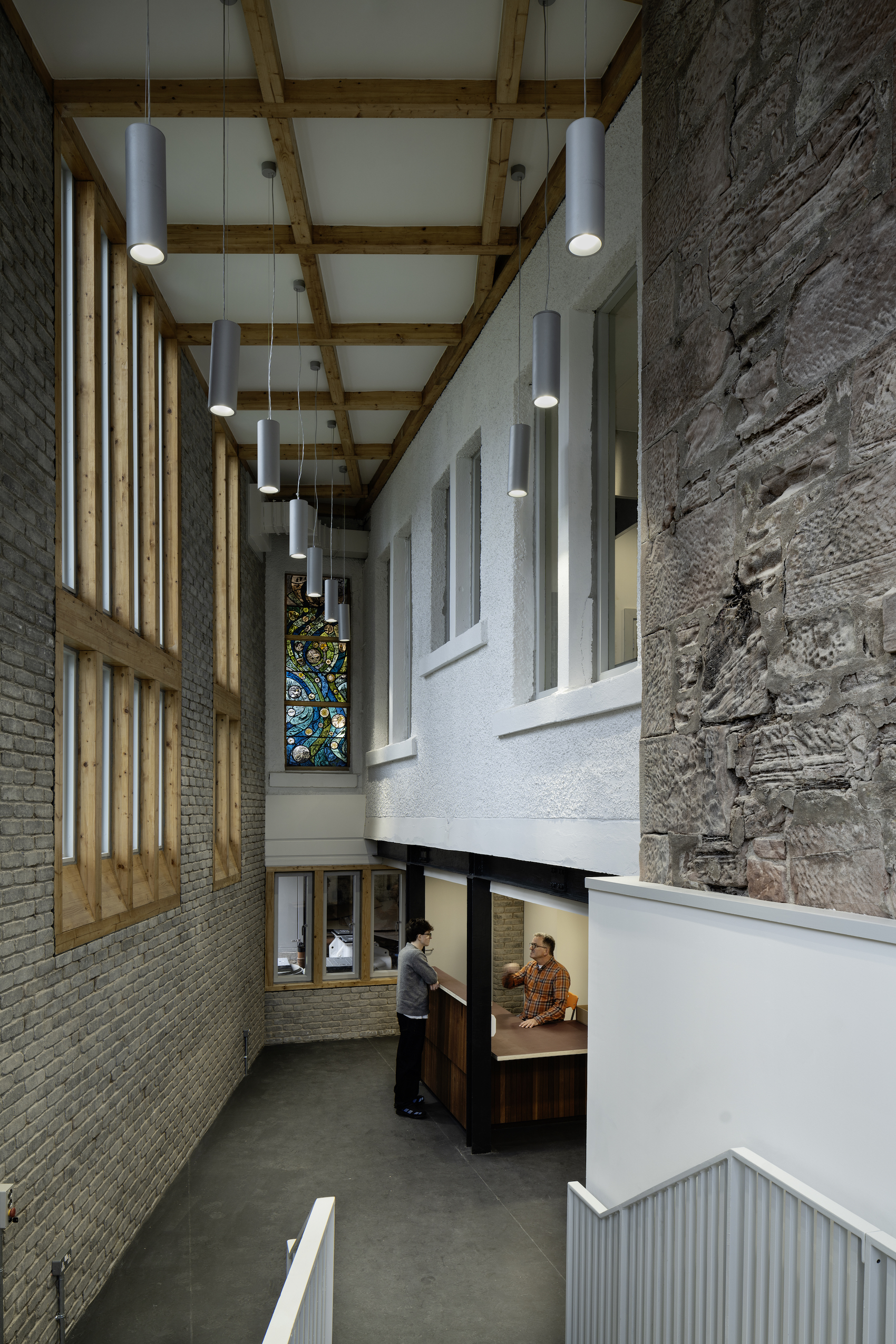
Left: A stained- glass window designed by a local resident catches the light in the double- height foyer.
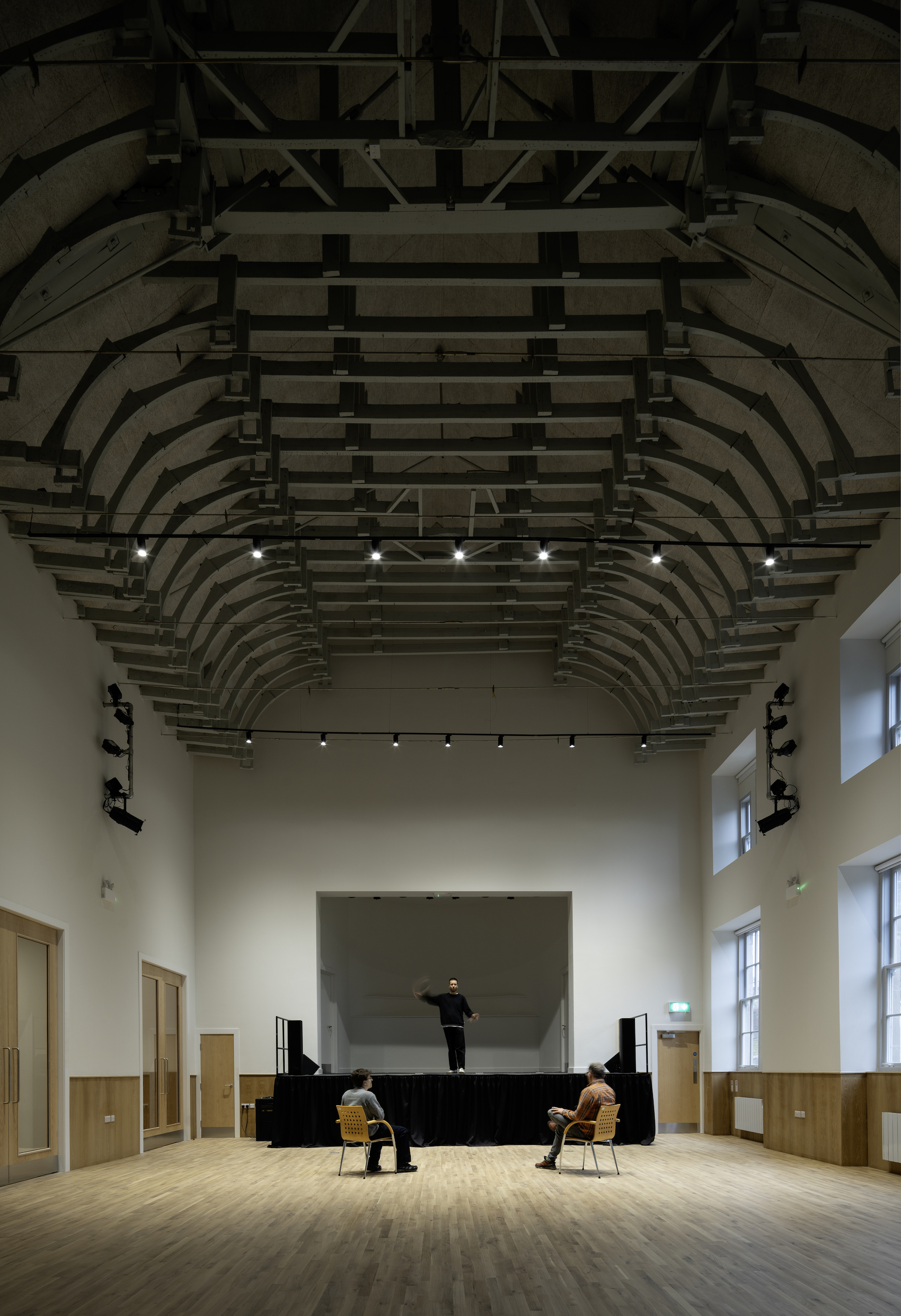
Right: The original trusses in the main hall have been uncovered and strengthened.
Sustainability has been approached with a similar pragmatism. The aim was to do the most with the least. Solar panels and air source heat pumps introduce new energy generation, while the old building itself has been given a ‘new coat’: improving insulation, repairing fabric, giving it a chance to perform properly for the first time in decades. The goal is longevity rather than technological showmanship.
At the time of my visit, the building is still in a phase of testing and experimentation. What will it be in five or ten years? The board of trustees are actively probing capacity, exploring how far their new spaces can stretch without losing the core purpose. Community groups that were displaced to other spaces in 2012 are trickling back in. The Bridge Club, Boys Brigade, Guides: familiar names, familiar patterns, returning to a building that once defined their weekly calendars.
There are plans still to come. The Community Garden will be the next expansion, extending reach beyond the building’s walls. The design has been consciously made to evolve and adapt to allow spaces to be reconfigured and reimagined. Rather than a fixed monument this is a working piece of community and cultural infrastructure.
What strikes me most is how deeply people-centred the whole endeavour has been. The building is full of touches that speak of a deep care from all involved. A stained-glass window designed by a local resident catches the light in the double-height foyer. Rooms are named with domestic familiarity: the Snug, the Sitting Room. The timber waffle ceiling in this Sitting Room adds warmth and texture without fuss, whilst uncovering the original trusses in the main hall – now strengthened for the future – creates a new experience even for people who have been coming to the building for many decades. There is no attempt at a total architecture, no overarching aesthetic that demands obedience. Instead, the building allows difference, memory and adaptation to coexist. Patches of old tiles remain on walls and floors throughout, original brick fireplaces now hover above the processional staircase. A patchwork of old and new characterises this gentle redevelopment and extension.
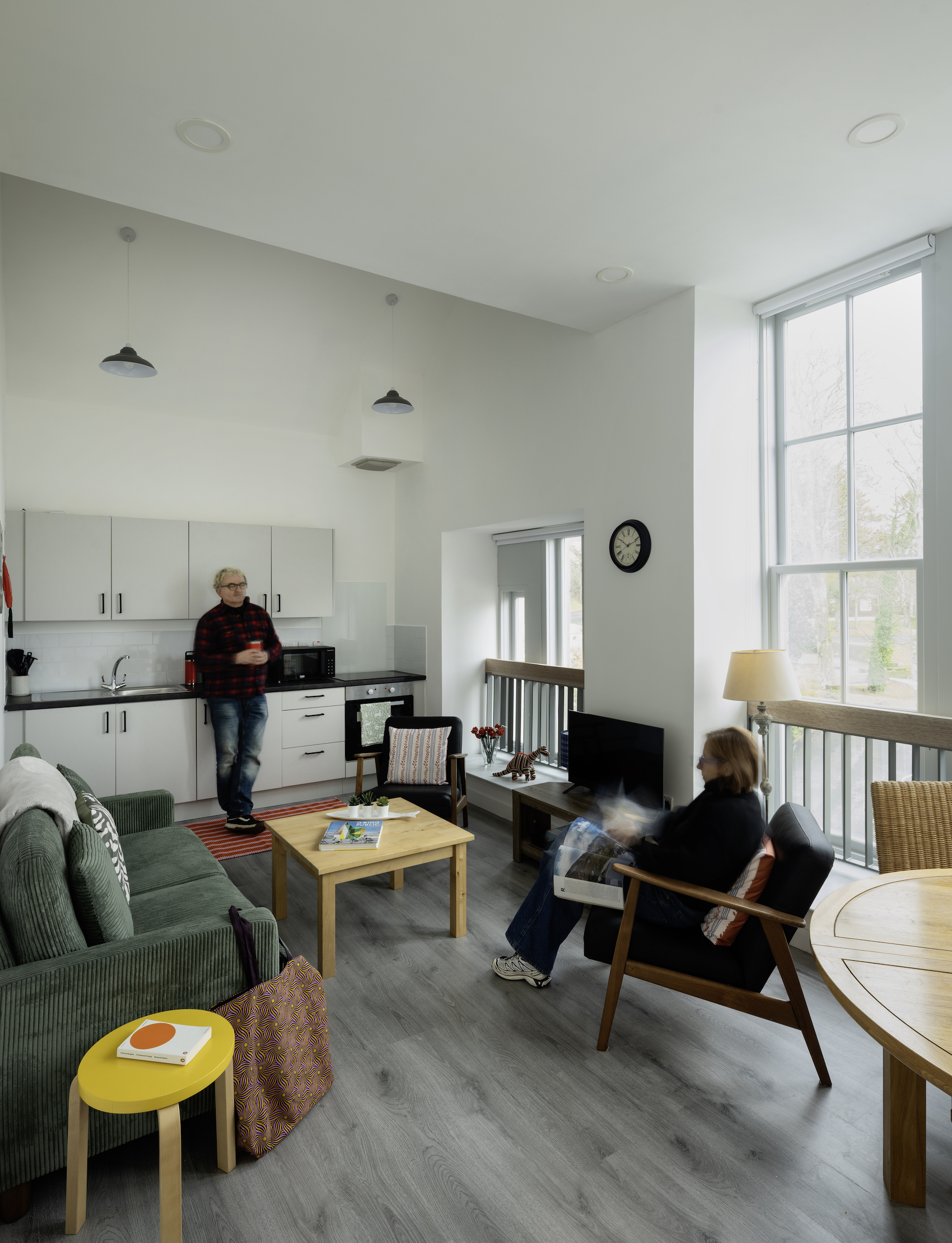
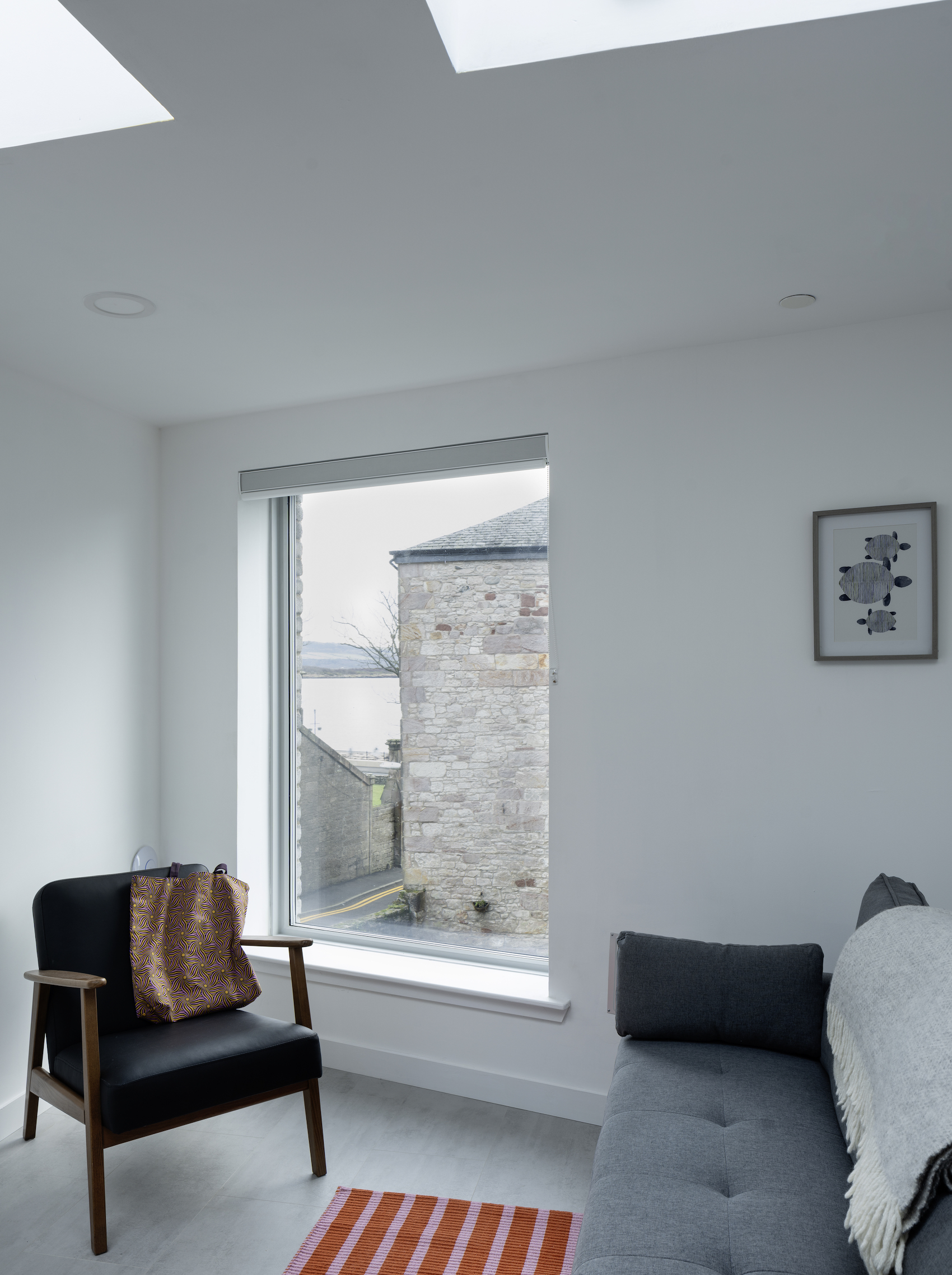
The inclusion of two holiday-let flats supports the project’s community and cultural uses with a long-term income stream.
In architectural terms, it eschews ego and flash. The joy that was once hidden in the blacked-out cinema is now on open display, quietly and confidently. It tells a simple story: of a community that refused to let its centre disappear, of conversations that turned into bricks and lifts and light, of making money, not as an end in itself but as a means to extend care.
Perhaps the most important measure of success is also the simplest. The community like it. They are delighted. “It’s wonderful,” I am told, more than once, without hesitation or qualification. That satisfaction is palpable as you move through the spaces, as you watch people reacquaint themselves with corners and sea views, as you sense the building settling back into daily use.
This is exactly the kind of architecture I love. Light, people-centred, grounded in its place and its stories. It does not shout about its cleverness. It listens. It holds together past and present without nostalgia, and it looks forward without anxiety. Standing in the Town Hall it is hard not to feel that the building has done what it was always meant to do: bring people together, in weather good and bad, and give them somewhere to belong.
Credits
Client
Millport Town Hall Charity
Architect
O’DonnellBrown
Structural and civil engineer
Design Engineering Workshop
QS
Allied Surveyors
Main contractor
McLaughlin Construction
Additional images