The European Technical Assessment (ETA) for the EJOT CROSSFIX façade substructure system is not only crucial in helping to demonstrate that facades meet compliance standards, but also key to faster, lower-risk project delivery. Jon Knaggs, Technical Manager for Industrial Lightweight Construction at EJOT UK, explains why.
In association with

CROSSFIX’s ability to accommodate secret-fix and through-fix cladding is demonstrated here in the Climate Innovation District project. Here, the CROSSFIX Konsole bracket secured vertical rails.
The choice of fastening and framing systems is vital to the delivery of higher performing, better quality building facades. Due to the complexity of facades, however, there is no single stamp of approval available to independently declare that a proposed design that combines multiple BS or EN certified products will work with any degree of certainty.
As a result, the design of multi-layered rainscreen – or rear-ventilated façade – systems requires both a thorough review of the individual components and an assessment or testing under a scheme that considers the complete system’s performance.
Why the ETA carries weight
European Technical Assessments (ETAs) play a major role by providing independent, documented evaluation of the performance characteristics of a construction product or system.
Each ETA is underpinned by a Declaration of Performance (DoP) and a European Assessment Document (EAD), the latter acting as a custom rulebook that defines exactly how the manufacturer must assess the system within set application parameters. The result is a vetted, independently verified engineering baseline rather than a blanket approval for use on any specific building.
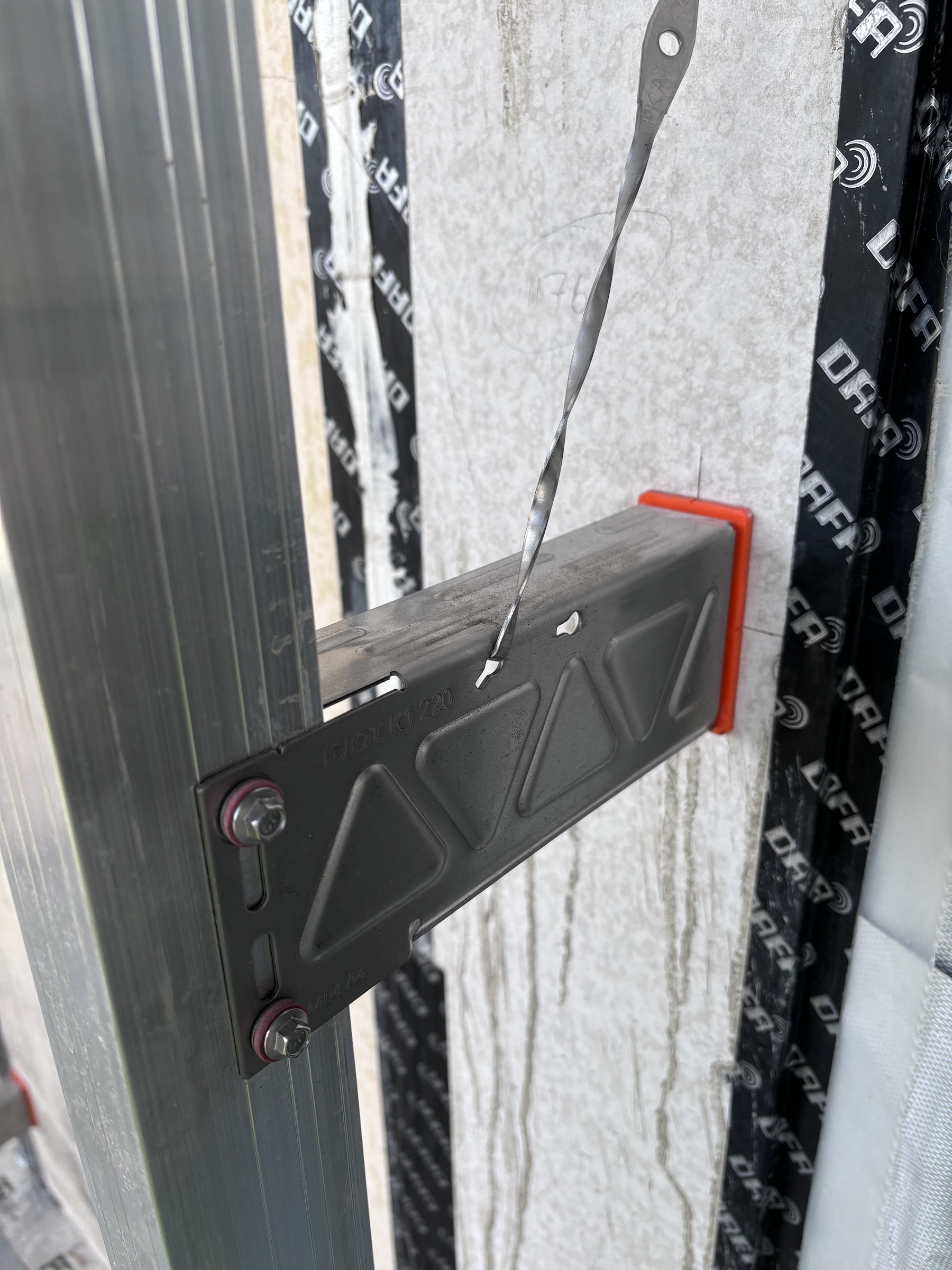
The Konsole is the core component of the EJOT CROSSFIX system, engineered for use with both vertical and horizontal rails and incorporating a thermal stop to minimise thermal bridging.
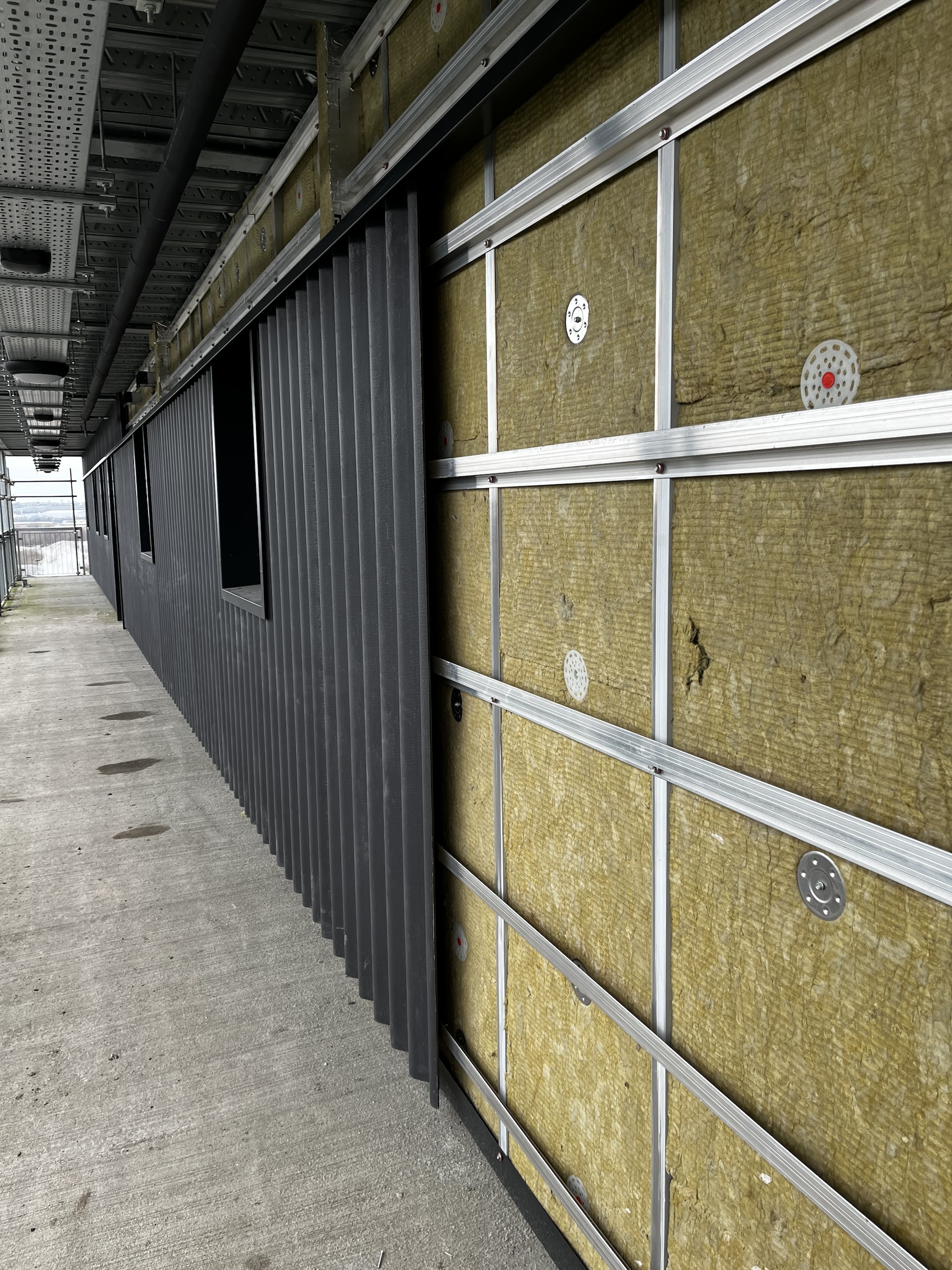
CROSSFIX is a complete system including the Konsole bracket, rails, anchors and fixings to offer consistent performance throughout the façade.
What the EJOT CROSSFIX ETA proves
As ETAs vary widely in depth, the level of detail included within them is significantly important. CROSSFIX is a complete stainless steel façade substructure system supported by an ETA (ETA-21/0756) which assesses the kit as a whole, not just the individual parts. Crucially, its performance is assessed at system level.
Wind loading
Under EAD 090034-00-0404, the EAD specifically for a ‘kit composed by subframe and fixings for fastening cladding and external wall elements’, the system’s wind resistance is calculated from the independently tested resistances of every component, then validated by a load test on the fully assembled kit rather than on isolated parts. For that validation, the complete assembly is mounted on a rig exactly as installed, then subjected to uniformly distributed wind suction and pressure applied in defined steps until significant irreversible deformation occurs.
The weakest configuration is chosen deliberately, so the figure reflects a worst case scenario rather than a best one.
Fire design
The CROSSFIX system is classified Euroclass A1 to EN 13501-1, the highest non-combustible rating, with no contribution to fire from wall through bracket to rail. For a building reviewed against the Building Safety Act, a non-combustible substructure removes one more variable from a fire-safety perspective.
Auditable scrutiny
Behind the figures sits a conformity system called AVCP (Assessment and Verification of Constancy of Performance) System 2+, under which a notified third-party body carries out continuing surveillance of factory production control. As a result, it is a clear way to answer a question that the Gateway process implicitly asks: how do you know the product delivered to site matches the one that was tested?
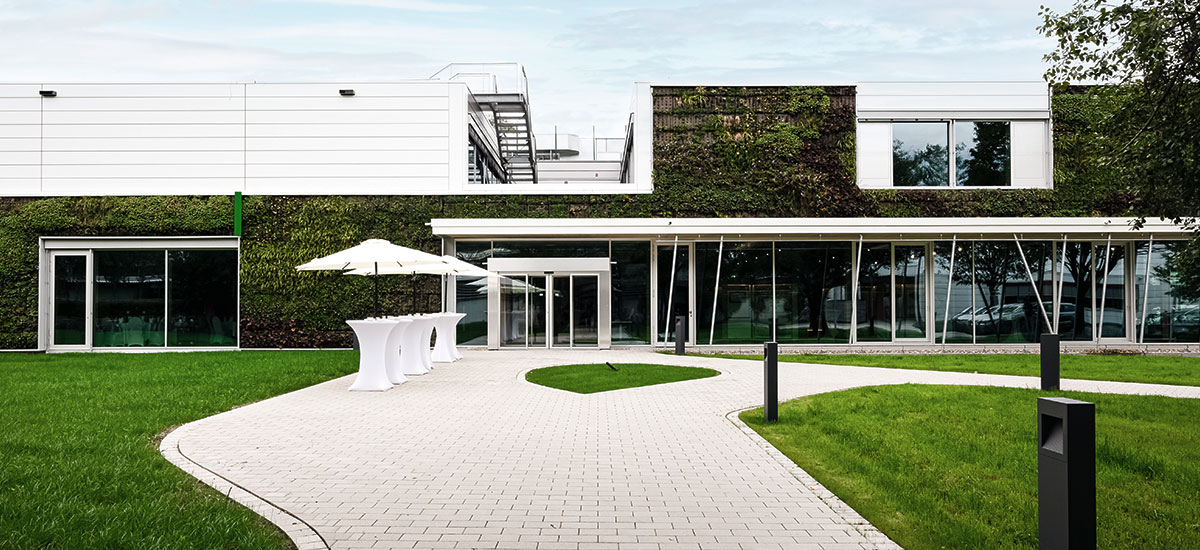
CROSSFIX can also be used to create facades with living walls, as demonstrated at the EJOT TEC CENTRE in Bad Laasphe, Germany. Here, a vertical support profile was mounted onto the horizontal CROSSFIX substructure to create a robust framework required to hold the plant pockets securely in place.
Material characteristics
The ETA also confirms that the CROSSFIX brackets are stainless steel A2 or A4 with 6063-T66 aluminium profiles, assessed for a working life of at least 25 years under the stated installation conditions, with the real service life of the stainless system in normal use expected to be considerably longer.
Designing out risk before Gateway 2
For project teams to leverage the maximum benefit from CROSSFIX’s robust ETA, EJOT provides support from the concept stage to ensure it can be correctly applied.
To satisfy evidence demands of Gateway 2, for example, EJOT’s engineering team can produce a preliminary dimensioning on a representative reference area of a project. This generates a traceable calculation package that evidences material requirements and gives designers early, defensible confirmation of bracket type, spacing and feasibility. It supports the project structural engineer’s analysis rather than replacing it, which keeps responsibilities clear under the Building Safety Act.
That same engineering depth extends to the substructure anchoring fixing, which must be verified separately. Drawing on more than 60 ETA assessments across its fastening range, EJOT can specify and prove the anchor’s performance in concrete, masonry, steel, timber or otherwise, closing a gap that teams often leave open. An assumed anchor is exactly the kind of missing evidence that triggers a Gateway 2 query. CROSSFIX’S ETA also supports compliance with NHBC Standards for warranty-backed residential work.
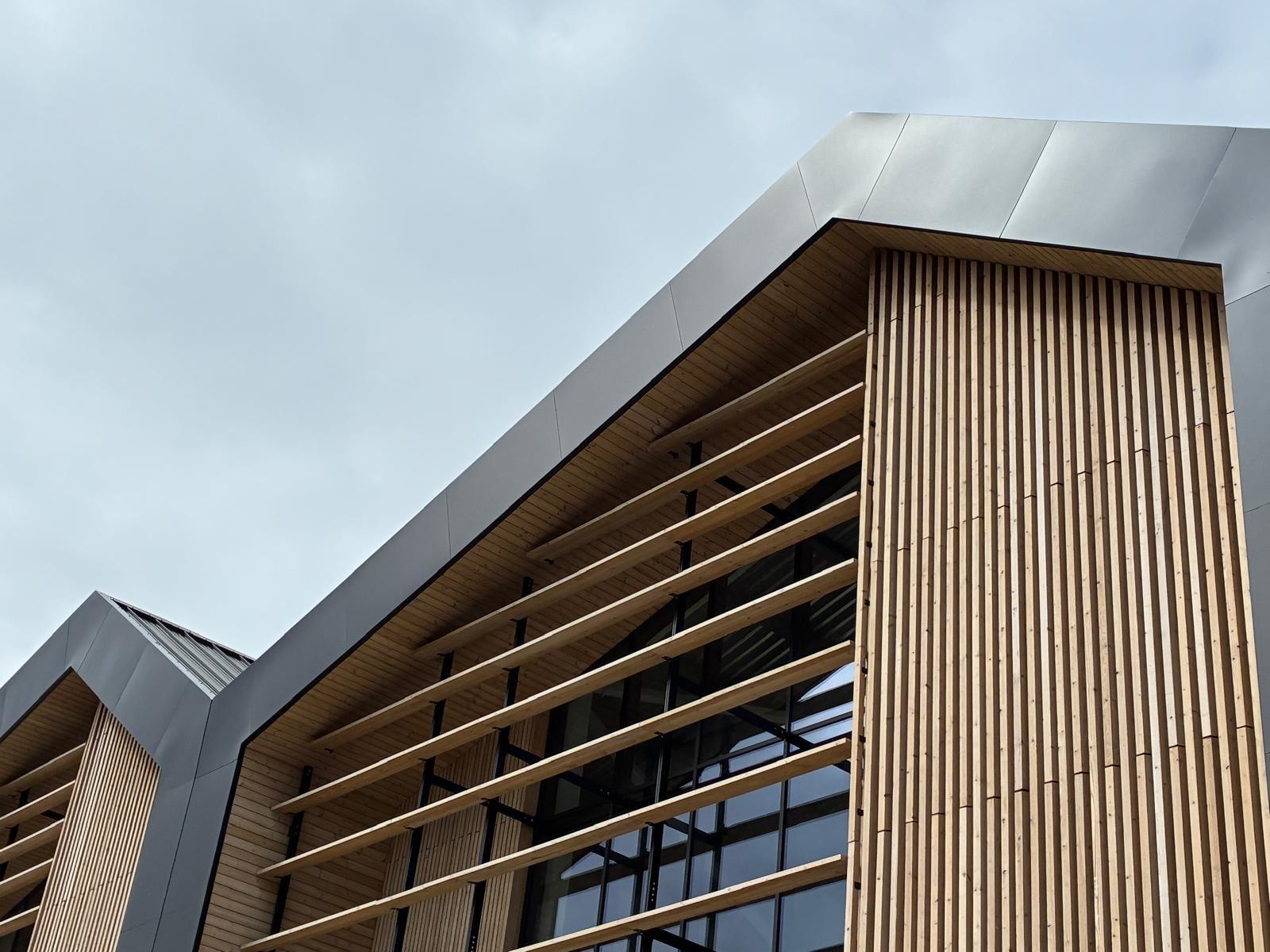
In this project in Oxfordshire, EJOT CROSSFIX was used to ensure timber cladding could continue from the recessed façade wall into the overhanging soffits.
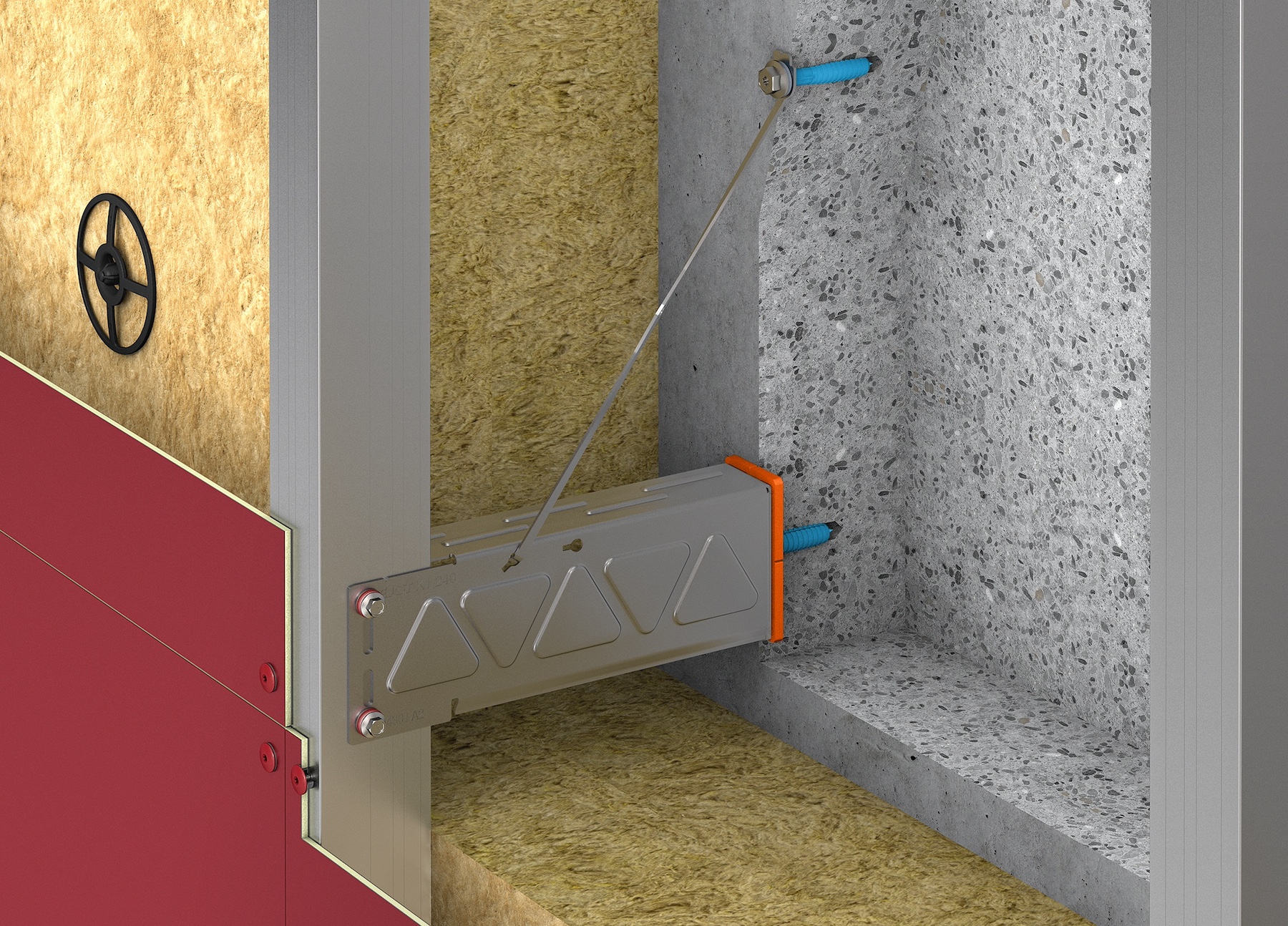
The EJOT CROSSFIX substructure is a complete package comprising stainless steel components for creating robust, highly sustainable rear ventilated facades.
Efficiency by design
The contribution that CROSSFIX can make to improving efficiency in compliance, however, is not the only way the system aligns well with a changing construction sector. The system can also streamline the design and installation processes due to its innovative design.
For example, the system’s core ‘Konsole’ bracket works with both vertical and horizontal profiles, so one bracket family spanning 40 to 400 mm of protrusion covers different elevations. Fewer component types means simpler design with reduced risk of the wrong bracket reaching site. The optional ‘Powerkey’, fitted to fixed-point brackets, more than doubles fixed-point resistance in the assessed vertical system while also providing tolerance compensation, twisting up to two revolutions to take up anchor inaccuracies.
Coupled with enhanced thermal performance, reflected in CROSSFIX holding Passive House Institute certification, and excellent environmental credentials in respect of low embodied carbon as demonstrated in its Environmental Product Declaration (EPD), the overall result for design teams is a single substructure system that answers structural, fire, thermal and sustainability questions from one manufacturer.

EJOT CROSSFIX was used to create the façades of the Apollo Nivy office building in Bratislava, help to create diverse visual elements characterised by varying heights in the horizontal panel stripes and a dynamic rhythm of projecting and recessed features.
Find out more about EJOT CROSSFIX: www.ejot.co.uk/CROSSFIX