International
Standing the test of time: Secure Sanand
Jonny Buckland of Studio Saar and Ananya Singhal of Secure Metres and Studio Saar explain how the Secure Sanand campus – winner of the International Award at the Test of Time Awards 2025 – has shaped its company culture and allowed employees and ecology to thrive.
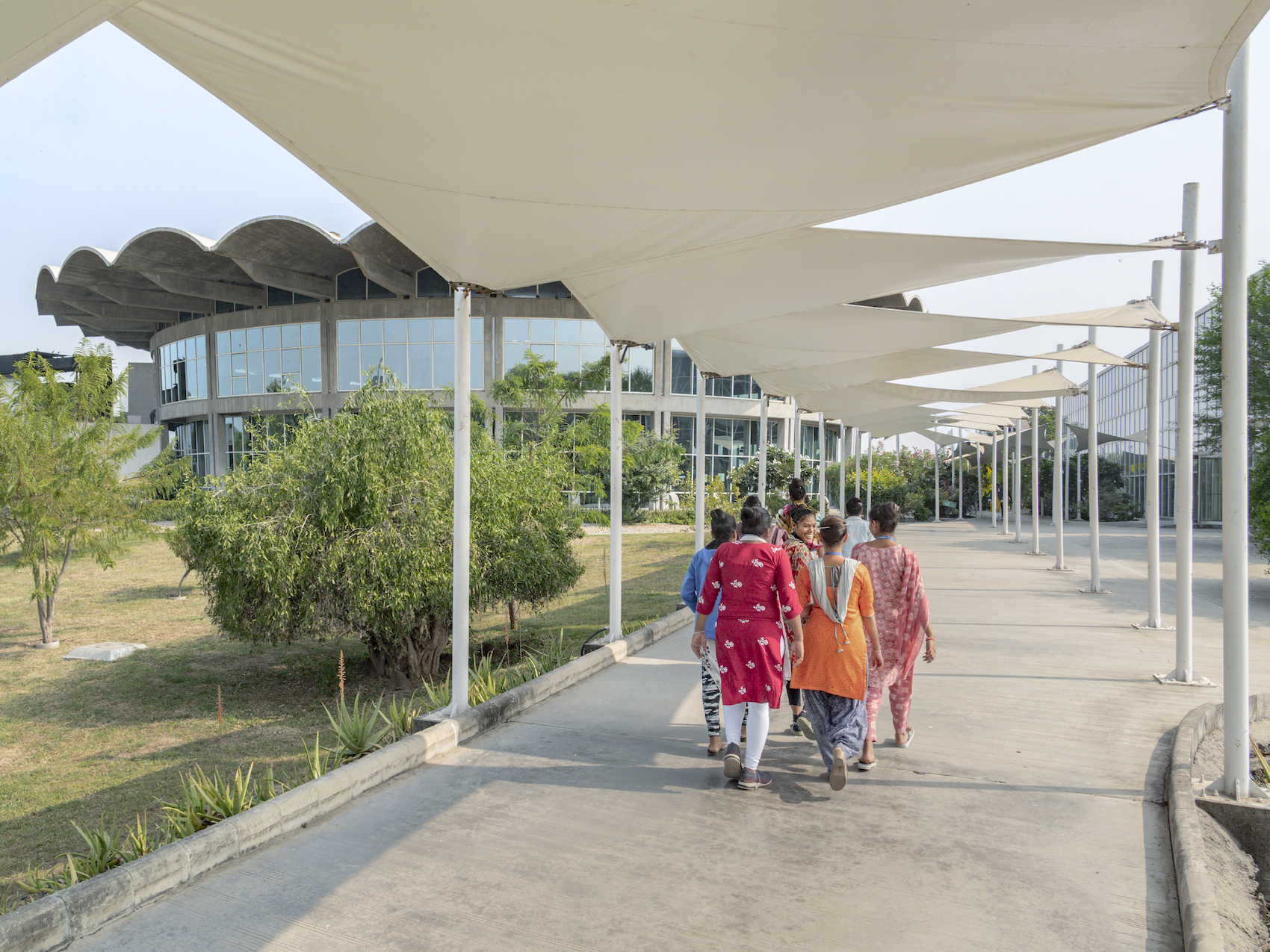
Secure Sanand, an industrial campus in Gujarat, India, designed by Studio Saar for Secure Meters, was designed in response to the client’s brief for a clean and efficient industrial environment that also promoted employee wellbeing, with natural light, flexible layouts, and local materials to create a distinct sense of place.
It comprises three buildings: an arrival centre; a high-tech, dust-free manufacturing facility that operates efficiently with minimal artificial lighting; and the Doshi Building, a social hub that hosts a range of functions, including dining and exercise, as well as exhibitions and events for staff and the wider community.
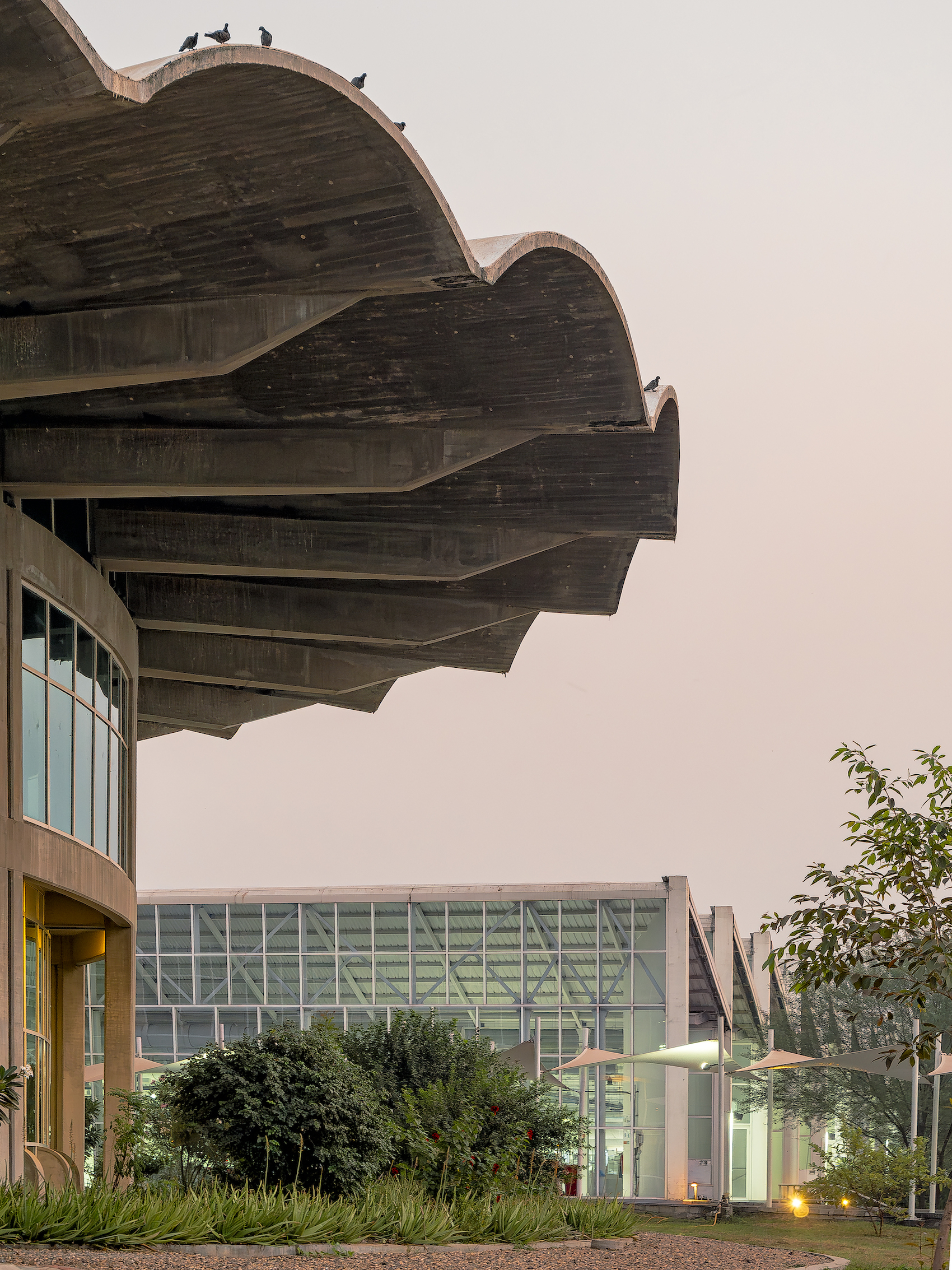
The overhanging eaves of the Doshi Building contrast with the factory’s lightweight sawtooth roof.
Passive strategies to reduce operational energy demands include solar shading, thermal mass, and natural ventilation. Rainwater harvesting, groundwater recharge, seasonal landscaping, and more than 2,000 new trees contribute to local biodiversity and climate resilience. A district energy plant captures waste heat from nearby industry, supplying heating and cooling to the campus. These measures helped Secure Sanand achieve IGBC Platinum and subsequently Platinum+ certification, aligning the scheme with multiple UN Sustainable Development Goals.
A worker-centric design approach, uncommon in Indian industrial contexts, informed all aspects of the scheme, supported by governance structures that give employees a say in the campus’s ongoing evolution. Employee feedback consistently highlights pride and satisfaction, demonstrating the value of investing in communal infrastructure within industrial settings.
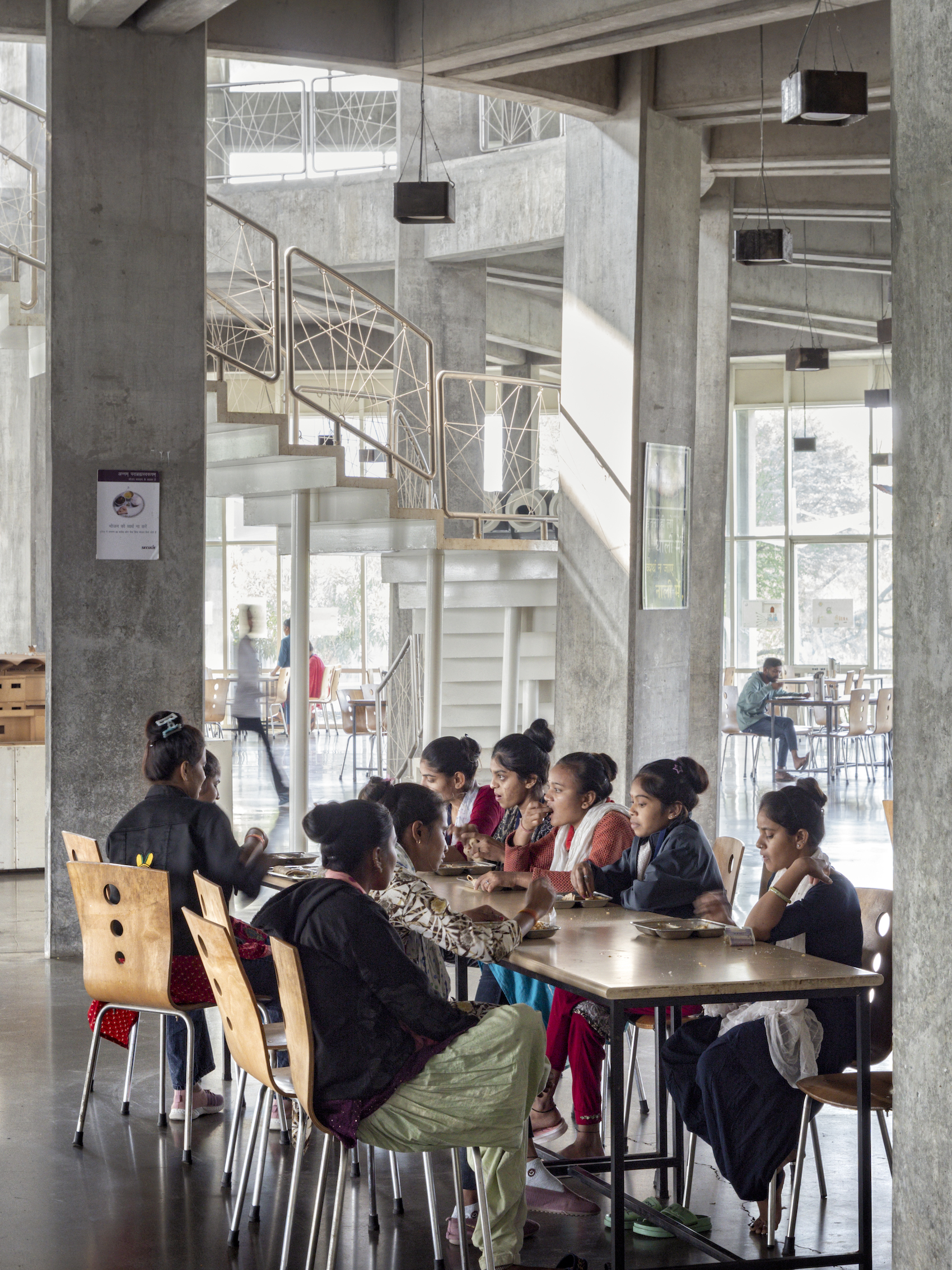
Forming the beating heart of the complex, the Doshi Building serves as a canteen, leisure centre and social hub.
Ananya Singhal Secure is an electronics and energy monitoring multinational company based out of India. We are trying to help our clients and customers save energy and reduce carbon. We originally founded in Udaipur, which is the City of Lakes in Rajasthan. It’s a 500-year-old city with brilliant architecture, and since its founding, Secure has always wanted to have amazing workplaces that reflect the quality of the built environment that is available in the incredibly diverse world that we live in. As a family-owned and family-managed business, our mandate is to grow a responsible and sustainable business that enables the people and life around us to thrive, and that will endure for generations. The goal we gave to Studio Saar was to design a place that celebrated the act of making and the people who make our meters for us. At the same time, we wanted to make sure that it was industry-leading when it came to how it managed energy, water and waste.
Jonny Buckland The factory is in a new industrial area just outside Ahmedabad, a city of five million people. The site had existing water features. Over the last 20 years of development, as lots of new factories have arrived, the tendency has been to displace and canalise the water. So one of the driving forces right from the get-go was to really understand the landscape and these water bodies, as well as the flow of water on the site.
Ananya Singhal The lakes ebb and flow with the monsoons. During the monsoons they completely fill up and actually absorb some of the water runoff from the rest of the site.
Jonny Buckland Rather than cutting and filling and levelling out the site, the focus was to create the lakes as a way of keeping the water bodies that are there, but also building up from the existing topography. So now, as you enter and leave the arrival building, you cross the lakes to get to the main factory and the canteen space. The lakes are allowed to flood at different times of the year through the monsoon, which also supports the biodiversity and bird life that’s around the site.
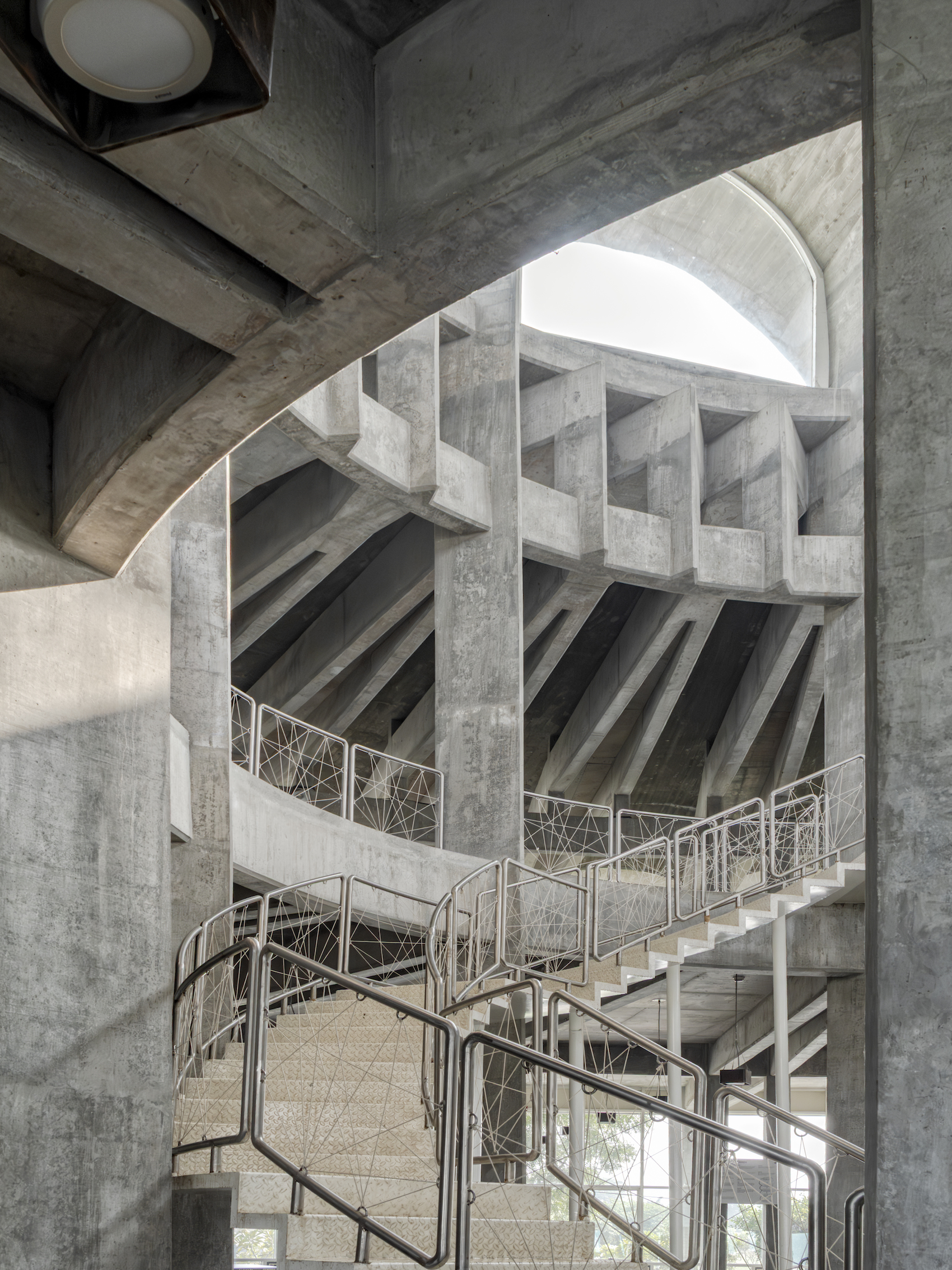
Left: The Doshi Building’s central stairwell. Designed to be both playful and inspiring, ‘dancing’ columns and radiating beams are animated by ever-changing shadow and light.
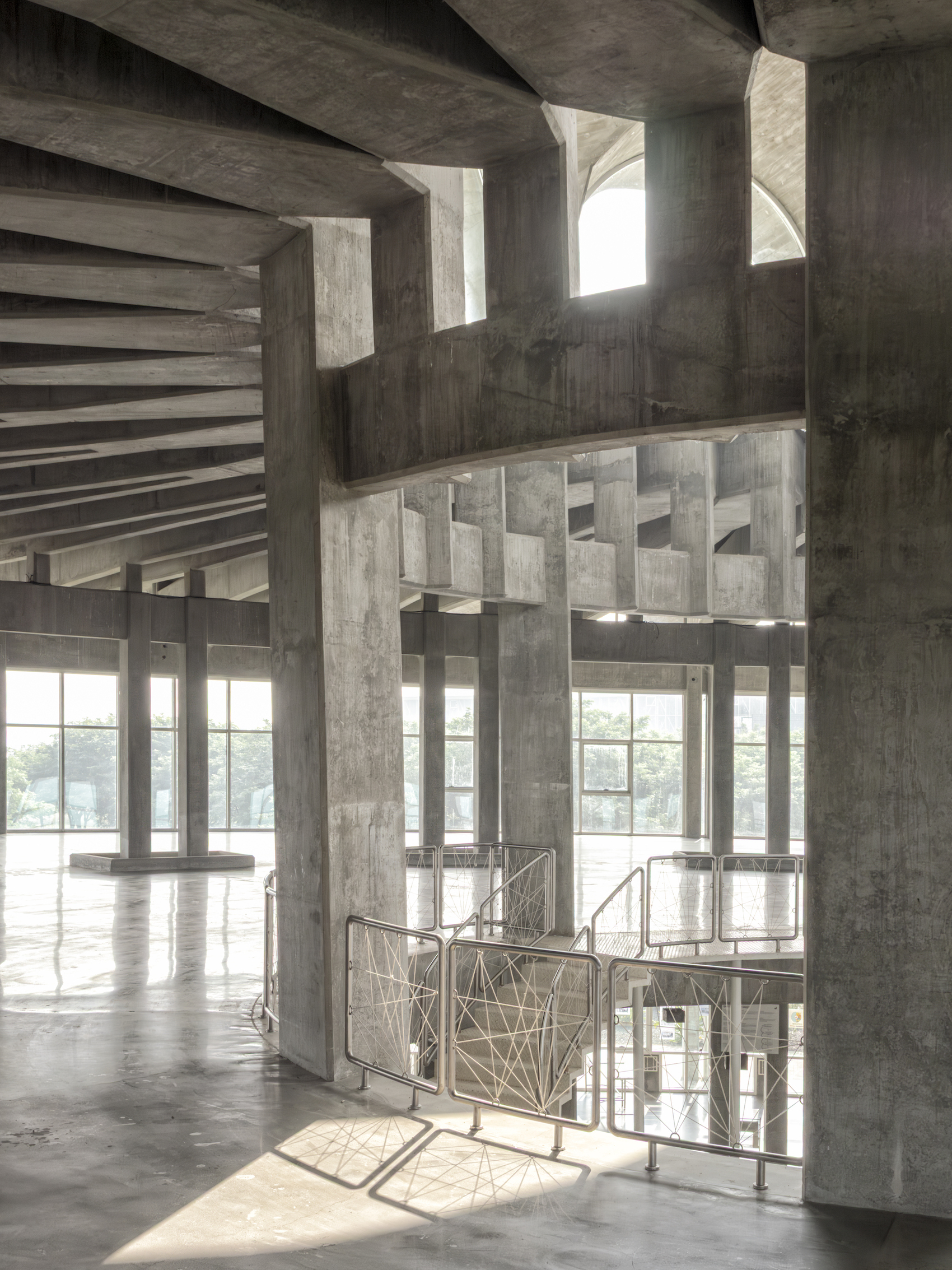
Right: The concrete columns are tilted by around two-and-a-half degrees for more structural efficiency, but also as a conscious departure from the pared back, highly rational language of the adjacent factory.
Ananya Singhal In 2025, India, and especially this part of India, faced its greatest ever monsoons, and in particular it faced a couple of days of flash flooding. Our facility was the only facility that was able to run through that period. The industrial site itself was under water, as was the substation, but because of the very clear water management moves that we’d made, our site continued to function through that period.
Jonny Buckland Secure employees and the team planted up the floodable area with trees and shrubs. It’s really great the way the employees of Secure came together; team-building exercises really allowed that land to come to life.
Ananya Singhal When we took over the site, it had been rice paddies for a very long time, and it was already converted into industrial land with the government’s intention to create industry here. We went to the government with a plan of building on less than 30 per cent of the site for the factory itself, and then using the rest either for employee engagement, training development, or for returning it to biodiversity and ecology. There were trees existing on site, but we didn’t uproot any of them or change their locations. Instead, we planted thousands of trees, plants, and shrubs, which are native to this region. This made the site as biodiverse as possible, and also helped to deal with the droughts that affect this region every once in a while, as well as the flood surges that happen during the monsoons.
Jonny Buckland The buildings sit in contrast to typical factories in this industrial area, which are usually artificially-lit warehouses and air-conditioned boxes. Each of the three buildings in the masterplan has a unique identity that responds to a different aspect of Secure’s needs.
Ananya Singhal The entrance building is an oval-shaped structure on the northwestern side of the site. Then we have a circular building: the Doshi Building, which is also the canteen, cafeteria and recreational area for all members of the team. The big L-shaped building is the main factory itself, and to the southwest is the utility building where we have our effluent treatment, our water, our backup electricity generation, and our main electrical panels coming in. One of the key drivers for us as a client, as well as an architectural practice, was to re-engage the people who are at the factory with their surroundings. This led us to set the entire factory far back from the entrance, and enable people to walk up and down from the entrance to the factory itself. Interestingly, 90 per cent of the people coming into the site come in company-managed buses, which run on biodiesel. This walk gives them a certain amount of time to come into the site and get ready for work – and to shed the work culture and get ready for home as they walk back.
Jonny Buckland A key goal was to source material that was as local as possible to the site. We had around 90 per cent of material coming from within 200 kilometres, with very specialist items coming from overseas in terms
of machinery and equipment.
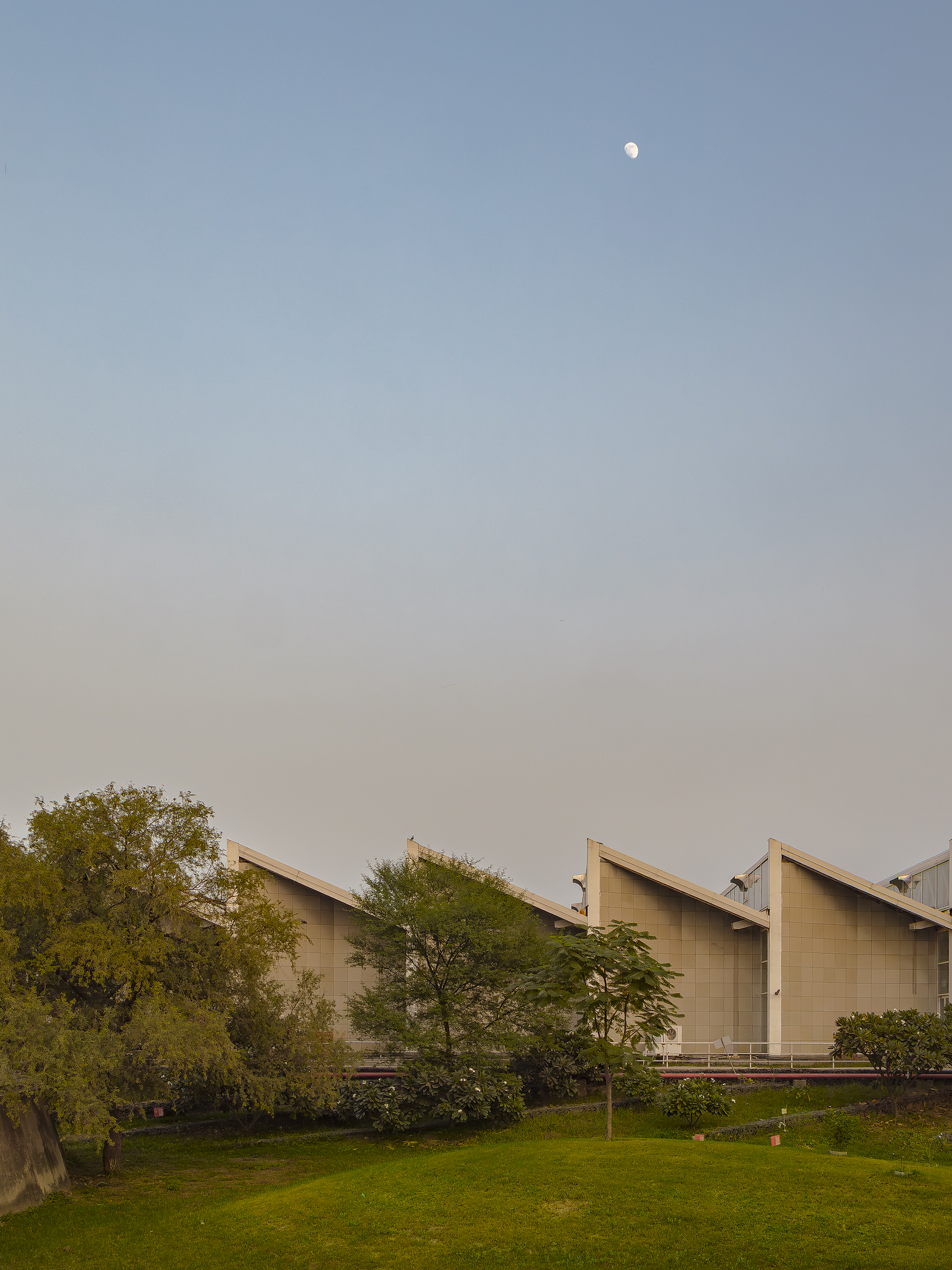
The sawtooth roof gives the factory a striking silhouette.
Ananya Singhal One of the challenges was to develop an open- plan building that allowed manufacturing of the electronics to be as infinitely adjustable as possible. There is a huge economic benefit in being able to morph the factory production lines freely without encumbrance of structure. So we were asked to create a 125-metre by 40-metre clear span structure.
At the same time, we knew that we didn’t want to build a shed which didn’t have natural light, and we wanted a sense of grandeur. So we decided to create this beautiful sawtooth structure that had a dual purpose. First, was to bring north light into each and every corner of the building, and second was to create an incline plane for solar lighting and energy. Every worker can get a constant reminder of the greenery just outside. For the vast majority of the first two shifts of the day, the whole factory does not need any artificial lighting. It’s only ever used at night or late in the evenings in the winters.
We worked closely with our structural engineer to create a very slim, trim and clean structure that utilised the geometry of the site to deliver a building which ended up being more cost effective than constructing a simple concrete frame structure, which is what we would have done historically. Electronics factories require an incredibly well-controlled thermal environment and humidity environment, and we innovated with our HVAC engineers to create this dual air strategy where we are directly delivering 26 degrees temperature air at 60 per cent humidity to the production line, where it’s needed. Our products can actually be produced with zero defects in those environments, and it also means you have the most comfortable environment for the people working.
This allowed us to create a stack effect, which takes the warmer air from above, while the even warmer air, which is sitting within the northlight area, becomes an additional insulating layer for the building. The HVAC, the fire management, etc – everything is visible for everyone to see – and actually that’s the ornament of this entire building. The ornament of the building is what makes it work.
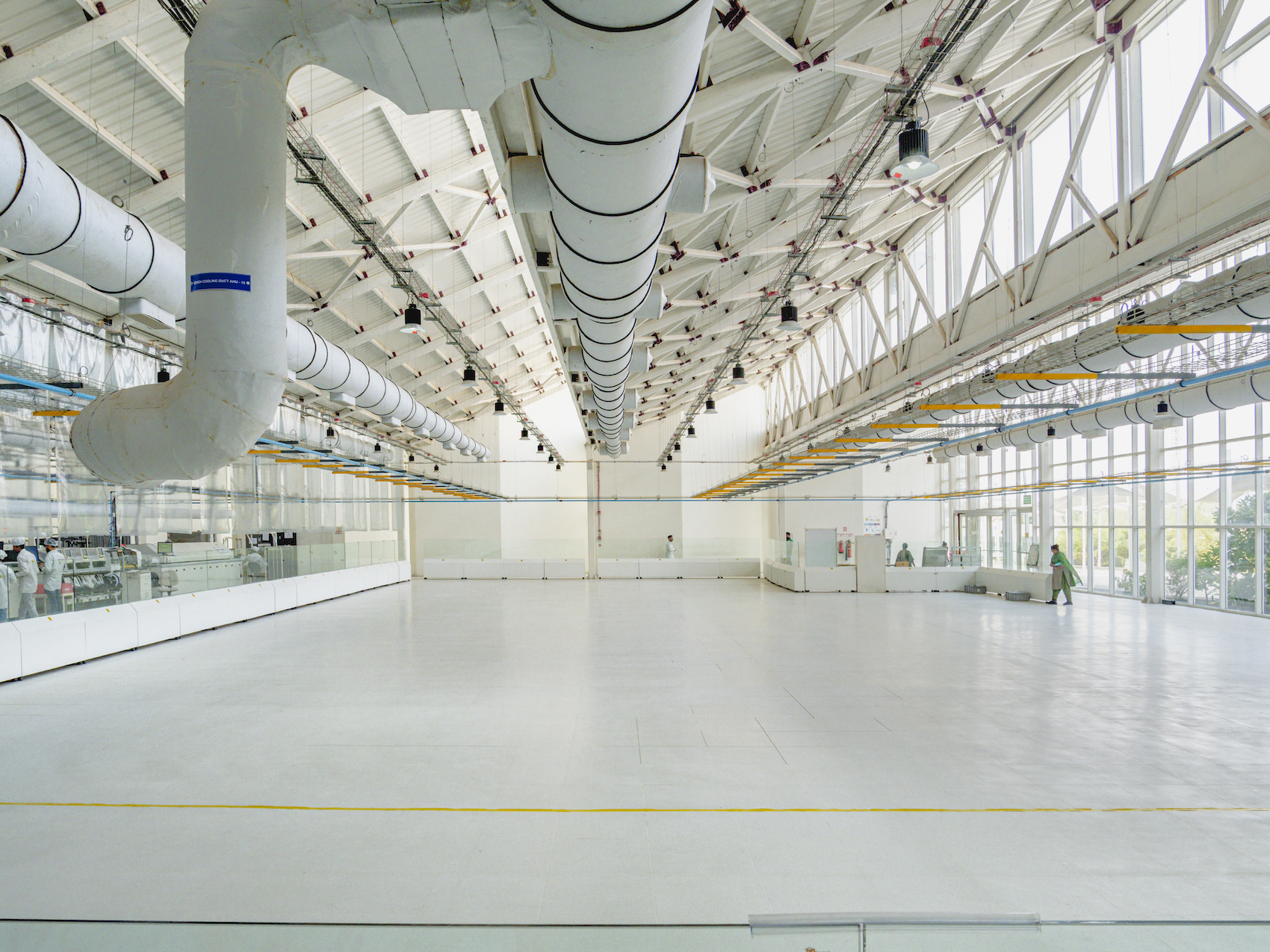
Column-free space enables flexible, efficient factory layouts, while generous glazing optimises natural light and views. An area of unused space by the entrance allows for future expansion.
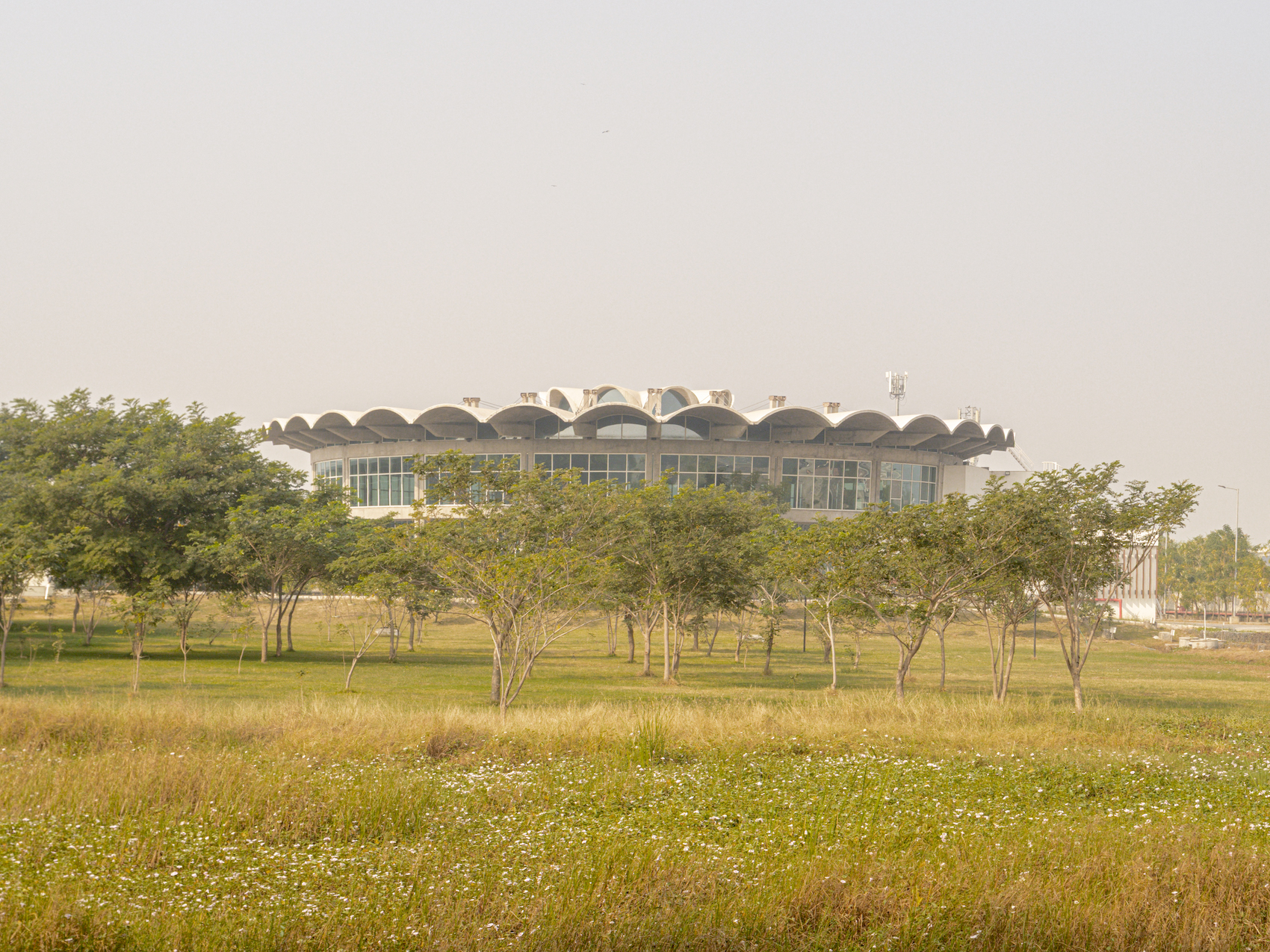
Jonny Buckland The vision for the Doshi Building was to provide space for relaxation, eating, meeting, and leisure. It’s a two-storey building with this curved, cantilevered, shaded concrete roof, with a circulation atrium at its heart, and an almost 360 degree view out over the landscape. On one side there is reforested land, which is for future development of the factory if it’s needed. On the other, you have a view to the entrance of the factory and the lakes. It has a radial plan with a service block to the north. There’s an elliptical roof, which allows for larger overhangs to the east and to the west to deal with the lower angle of the sun in the morning and evening.
Ananya Singhal We wanted a place for the people who work on the site to get a complete break from the discipline of working in the factory. And therefore, it was really critical to find a way of celebrating their recreational and off-time by almost creating a cathedral for them to play sport in, celebrate social and communal functions, and eat their food on a daily basis. This roof became a symbol of that, with the playful vaults coming together and creating these beams and columns that actually dance about through the whole building.
The columns are tilted by about two-and-a-half degrees for more structural efficiency, but also to continuously, and very clearly, break the disciplines that are visible in the sawtooth factory. The engineering of this was very interesting, with the shell structures and the post-tensioning that took place to create these large overhangs. The overhangs on the east and west side are about 8.5 metres, and now as the trees on the site are growing taller and taller, it’s created this beautiful environment where you don’t actually get direct sunlight entering into the canteen other than in a filtered fashion through a whole bunch of leaves. The vaults converge to a point, and there was a lot of confusion regarding how this would be built. We had to create mock-ups of the formwork, so we could explain to the contractors how they might proceed in creating the vaults. Once we had shown this to them, this set of formwork was repeated eight times to deliver the whole building.
Jonny Buckland It’s also quite fun to note that the structural engineer for the project has been approached a number of times with clients wishing for an exact replica of this building for their own campuses.
Ananya Singhal The Doshi Building is more than just a canteen. It’s the beating heart and soul for the Sanand factory. It’s where we play games: there’s a badminton facility; there’s table tennis; there’s a gym. During the pandemic, it was also residential – there were around 120 people living on the site, and we created these three-metre by three-metre private bays where people could sleep and rest. We also host tournaments and all our community events. It is the place where everyone comes to relax and unwind either during their workday or before and after their workday. It is a truly joyful space, which is a good counterpoint to the incredibly disciplined space of the factory. It’s a great example of architecture helping to define the culture of a company. The site has resulted in a lot of very happy employees. We are lucky – or privileged – that, in comparison to all the other companies in the Sanand area, we have a much lower employee turnover rate. People like coming here. People like working here. Parts of the site have become Instagram points where people want to come and take photographs. We’ve also had a couple of times where people have wanted to come into the Doshi Building to take wedding photos or pre-wedding photos. It’s a happy community supported by great architecture.
Other finalists in this category:

East Village masterplan, Calgary, Canada by Broadway Malyan