A near-verbatim recitation of the great New York apartments of yesteryear, Robert A. M. Stern’s ‘Limestone Jesus’ heralded a major architectural trend and delivered one of the most commercially successful condominium developments in the history of the city.
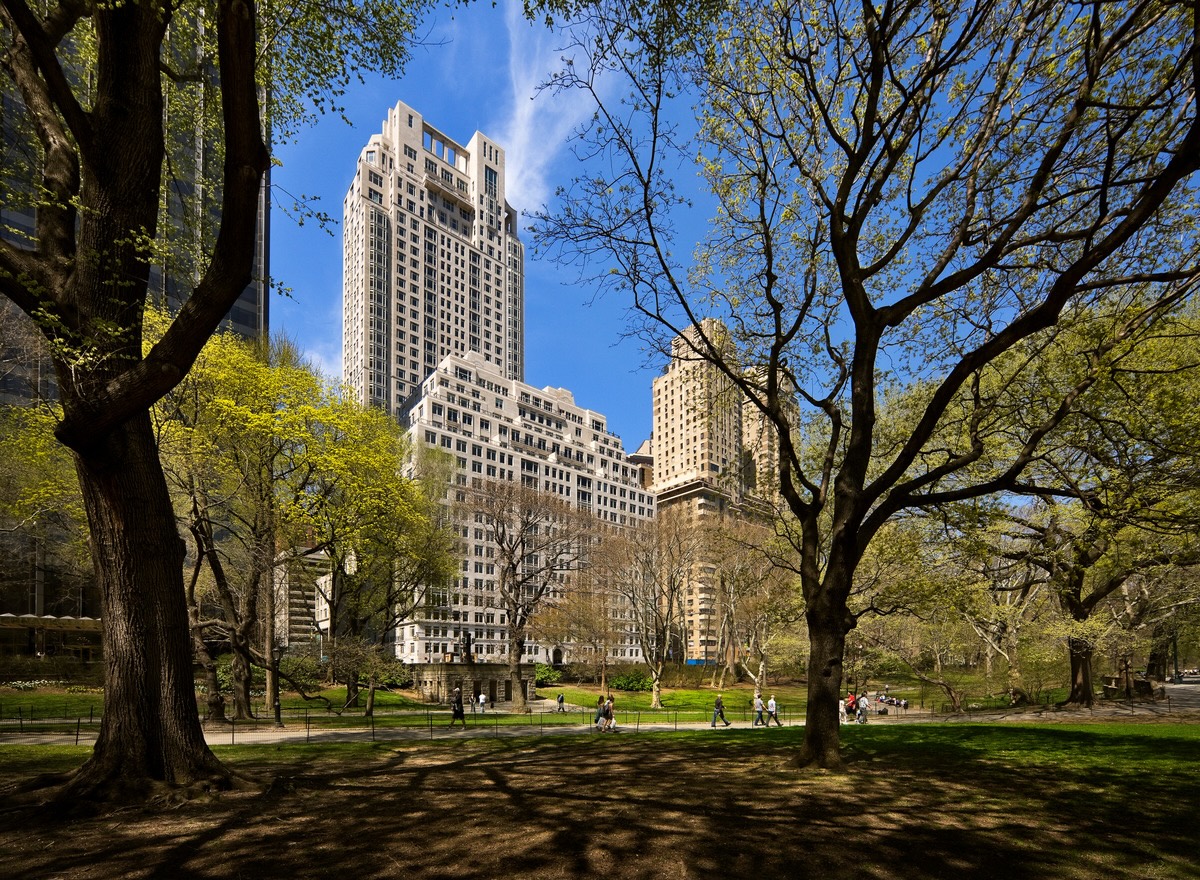
The setback terraces atop the park-fronting block – as well as the asymmetrical penthouse and loggia that cap the high-rise – give 15 CPW a castle-in-a-cloud romanticism. Its greatest asset urbanistically is its immediate visual dynamism, a composition far more satisfying than that of the solid slabs that had become the norm in residential high-rise construction. days of the Ford Foundation Building of 1967 (photo: Peter Aaron/Otto).
You really don’t know what you got till it’s gone. When Robert A.M. Stern died this past November, architecture lost not only one of its true institutional champions and most prolific practitioners: it lost, irretrievably, the immense wealth of knowledge and the synthetic imagination of an individual who appeared to know everything (and nearly everybody) of importance in the design world. As a curator, author and academic, Stern could connect the dots between buildings, eras, and the architects that defined them with dazzling insight and originality; as an architect himself, he could harness that same intellectual machinery to build practically anything he wanted. That much he proved pretty definitively in 2008, with the debut of one of his signature projects.
The realtors call it Limestone Jesus. The apartment tower at 15 Central Park West has been one of the most commercially successful condominium developments in the history of New York: the building has racked $2 billion in sales since its completion, with buyers and sellers including bold-face names like Sting and Denzel Washington. As if that weren’t triumph enough, the tower proved to be the beginning of a major architectural trend which is even now changing the face of America’s largest city. Today, uptown and down, some of New York’s most sought-after new residential addresses bear the clear imprimatur of Stern’s design.
From the very start, the stakes were high. Just a couple blocks up from Columbus Circle—the literal centre point of New York, from which distances to the city are measured—the proposed building from the storied Zeckendorf development company was to sit on something like hallowed ground. Beginning in 1926, the site on Central Park between 61st and 62nd Streets had been home to the Mayflower Hotel, a stately eclectic-style edifice from celebrated prewar architect Emery Roth. Though largely stripped of its decorative exterior during an early-1980s renovation, the building remained a much-loved landmark to many Upper West Siders, as well as home to a number of holdout tenants (including the mysterious son of General Douglas MacArthur, who lived there in obscurity for decades) who were not inclined to move house. Zeckendorf ultimately paid over a million dollars to relocate the residents, clearing the way for demolition.
Mindful, perhaps, of the prominent locale, Stern’s building began with what was—at the time—a remarkably daring concept. By the late 90s, new apartment buildings built to evoke those of the previous century were not wholly unheard of in New York: in 2001, the office of Michael Graves had debuted 425 Fifth Avenue, a vaguely Jazz Age condo tower in Midtown; Stern’s own practice, RAMSA, completed the no less nostalgic Chatham on the Upper East Side the same year. But these were readily identifiable not as full-blooded descendants of their Art Deco and Georgian predecessors, but merely as latter-day cousins, their historicism tempered by a very contemporary economy in both ornament and massing. They were Postmodernist buildings, through and through. This new one would not be Post-anything.
Stern had, in a sense, been preparing for this moment his entire career. A product of Columbia University and the Yale School of Architecture, the then 70-year-old designer had made himself a quiet omnipresence in American building culture since the 1960s, when he first came to the attention of inveterate tastemaker Philip Johnson. Stern compiled hours of interview material with the elder statesman, who counted him among the favourite of his so-called ‘kids,’ younger architects who Johnson helped connect with private and institutional commissions. As the list of Stern’s built projects grew, their traditional hierarchies, contextual materials, and referential flourishes showed their creator’s allegiance to the emerging PoMo movement of which Johnson himself would become the leader. With the publication of an extraordinary survey series on Gotham’s architecture—starting in 1983 with New York 1900, with five subsequent editions focused on different periods—Stern confirmed his own status as arguably the most erudite, most committed of his historically-minded fellow travellers. If anyone was to push beyond merely alluding to and quoting from the past, and into a near-verbatim recitation of it, it would be him.
And that is precisely what 15 Central Park West did. With some 230 units in all, the building actually comprises two separate volumes, one 19 storeys and the other 35, separated by an internal court; the smaller of the two sits directly on the lot line, complementing the long street wall along the park’s edge, while the larger sits further back, its angled base slipping inconspicuously into retail-lined Broadway. The double-tower scheme had a number of advantages—not the least being the provision of unobstructed eastern views to the taller structure—but its greatest asset urbanistically is its immediate visual dynamism, a composition far more satisfying than that of the solid slabs that had become the norm in residential high-rise construction. This was only the first of the building’s subtle subversions.
More radical by far was Stern’s choice of material. The creamy masonry which would give the building its somewhat blasphemous nickname endows it with an impressive solidity, and stands in marked contrast to the glass, brick, or sometimes concrete seen in much of the city’s postwar housing. Graced occasionally with light decorative touches, and framing partitioned fenestration that expands into large bay windows near the corners, the limestone is the building’s clearest outward connection to the great New York apartment towers of yesteryear. Inside, the link appears only more explicit; the rambling floor plans and lofty ceilings all hearkening to the days of Roth et al. Completing the picture, the setback terraces atop the park-fronting block—as well as the asymmetrical penthouse and loggia that cap the high-rise—give 15 CPW the same sort of castle-in-a-cloud romanticism as its venerable neighbours, towers like the San Remo and the Beresford that have defined the skyline of Central Park West for decades.
While it would be another few years before the floodgates opened in earnest, the steady drip of similarly-inspired residential designs that followed Stern’s—stone-clad; classically detailed; expressively crowned—has now grown into a veritable torrent. Among the practices most prominent in this sector is RAMSA itself, which continues to turn out buildings of comparable character across town. Yet the sheer visibility of Stern’s breakthrough on the Upper West Side, its size and centrality, all but assure that it will remain the best known of the type—a rare instance of an American architect forever altering the city’s built environment with a single project. Future chroniclers may well look back on New York history over the last quarter century and divide it into two epochs: Before Limestone Jesus, and After.