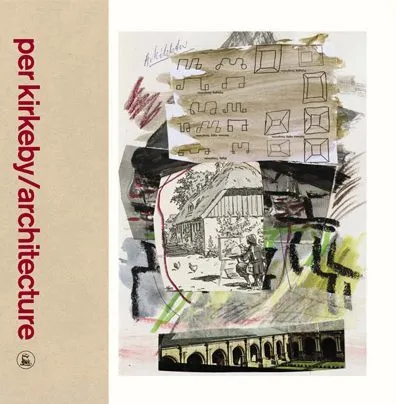
Publisher Torsten Bløndal and architecture professor Thomas Bo Jensen have joined forces to produce a compendium of the paintings, sculptures and buildings of Danish artist, poet, sculptor and film maker Per Kirkeby. John Pardey enjoys a lyrical tour through an eclectic portfolio rooted in love for the humble brick.
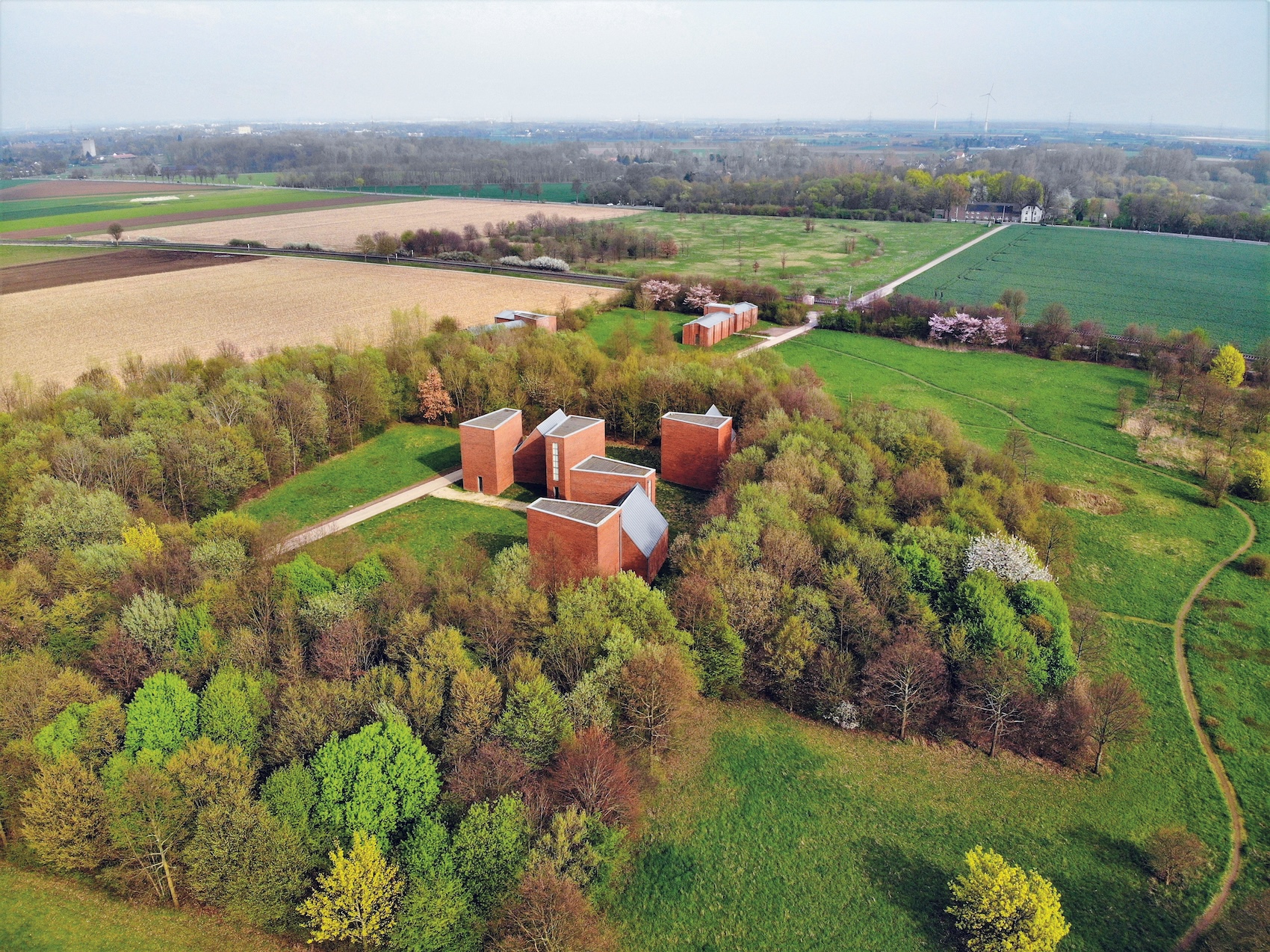
The Three Chapels, Kirkeby-Feld, at the Museum Insel Hombroich, near Neuss in Germany. Kirkeby and architect Morten Kjelstrup built the pavilions, which house exhibition galleries, in 2003 (phs: Stiftung Insel Hombroich, Ole Meyer)
Stepping outside Humblebæk station, some 35 kilometers north of Copenhagen, the first thing you see is a square, colonnaded, red brick structure some 2-storeys high. But walking past it on the way to the Louisiana museum that lies a few hundred metres along the road, there is a realisation that it is unoccupied, in fact empty – no roof, no windows, and despite three arched openings at first floor, there is no upper floor. This is for most people the first interaction with Per Kirkeby’s brick sculptures and while its uncertain function may confuse, it leaves a sense of mystery, anonymity, of place. It is beautifully crafted, with an architect’s touch in detail.
But Kirkeby was not an architect, rather an artist. For most architects in the UK, he remains unknown – and this is a great shame as his work is now internationally recognised. While a great painter, it was to be his obsession with mursten, bricks, that would leave an enduring imprint.
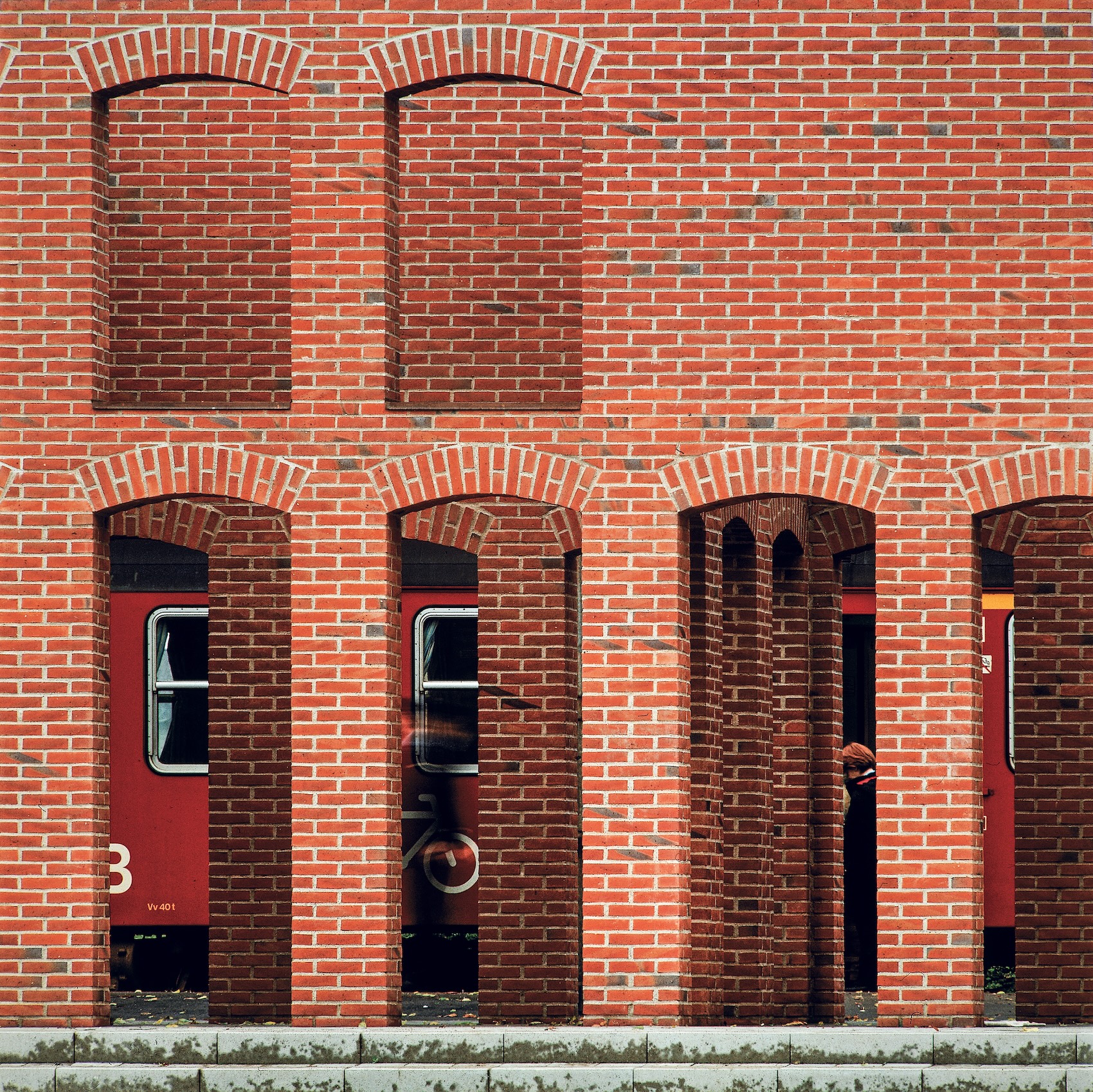
Erected in collaboration with the Danish Railways and inaugerated in 1994, Kirkeby’s Humblebaek Station sculpture serves as an introduction to the Louisiana Museum.
Having worked with the one-man publisher Torsten Bløndal over many years on a number of books on the Danish architects Utzon and Wohlert, the one thing that sets Torsten apart from most publishers for me is his obsession with quality – not just in the contents, but the actual book – the paper, the layout – the actual thing itself so that his books are wonderful to hold. This book on Kirkeby’s architecture is such a thing. Beautifully produced, immaculately printed on creamy paper, perfectly laid out to reinforce the joy of holding a book rather than a tablet.
Kirkeby was a Danish artist, poet, sculptor and film maker – trained as a geologist, his work always embraced something about nature and its structures so while his work was abstract it remained rooted in Danish landscape, earning his paintings the label of ‘lyrical expressionism’. He also had a lifelong passion for architecture, and his sculptures were essentially buildings rooted in his love of the humble brick. Perhaps growing up in the suburb of Copenhagen in the shadow of Peder Vilhem-Klint’s Grundtvig church with its 5.5 million bricks seeded this passion.
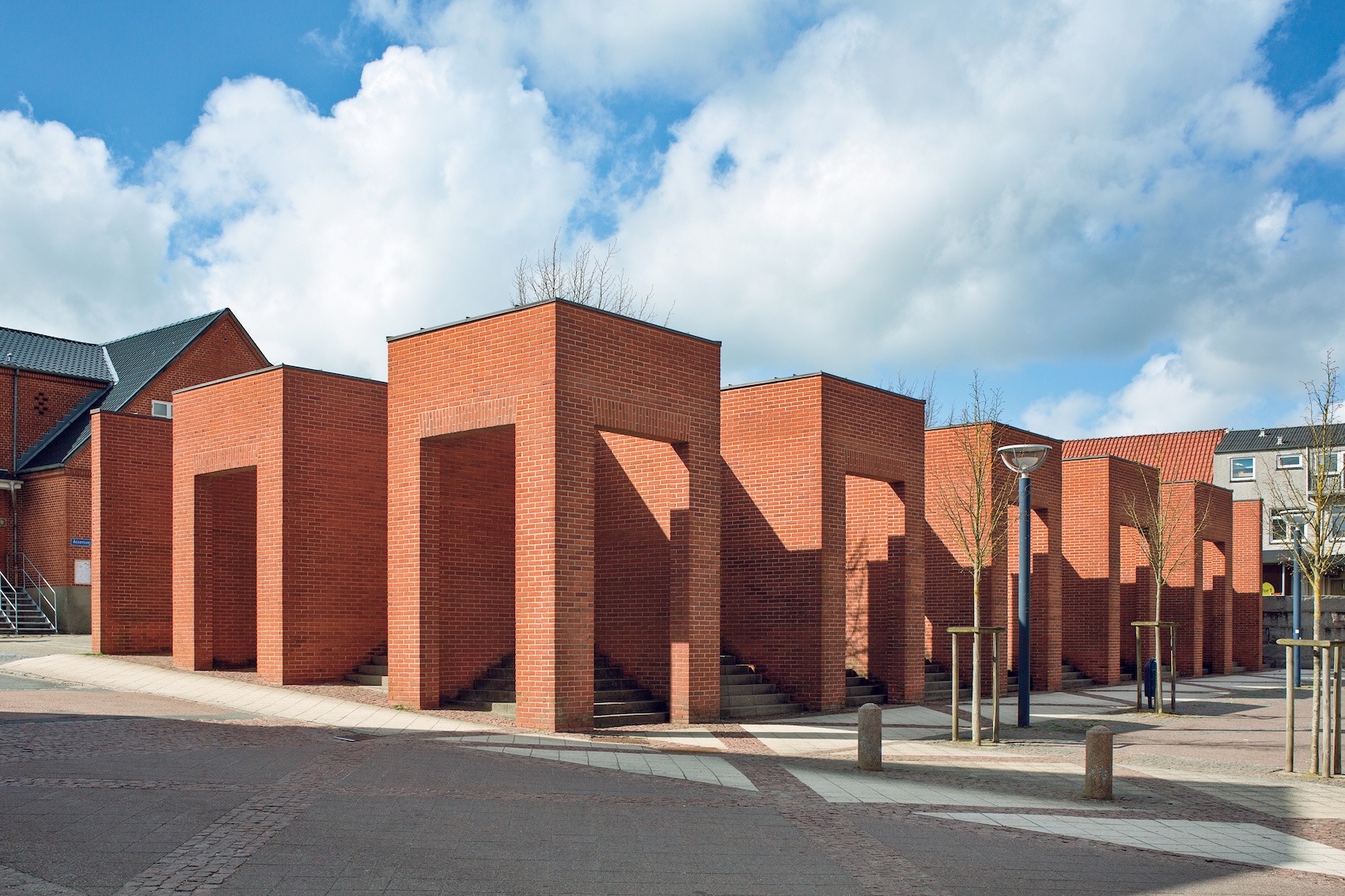
Meander Wall, Frankfurt (1996, ph: Søren Friis)
The use of brick in architecture is ubiquitous, but in the modern era it is the work of Louis Kahn that brought nobility back to the humble brick. He famously asked the question, “what does a brick want to be?”– and the answer was – an arch. It was this respect for truth in construction that is shared by Kirkeby, but here he infuses his built structures – sculptures – with enigmatic force. Yes they are brick, but why are they there, what do they do?
Kirkeby built a further 17 brick sculptures in Denmark and 25 more in Europe, and with only a couple of exceptions, these were all red brick in stretcher bond. They were all freestanding, mainly colonnaded, open and roofless.
Kirkeby continually worked with the idea of repetitive structures, generally in cubic form or in long zig-zag form, like a zipper. “It is the ordinary that is the mystical.” wrote Kirkeby, and his sculptures prove that. Philosopher Bryan Magee touched on the mystical in art when he said that, “Art doesn’t say things, it shows them. And what it shows can’t be said.”
Bricks have served civilisation for over 10,000 years from a handmade lump of clay baked in the sun, to machine-made, moulded bricks fired in a kiln. Nothing has really changed – Kirkeby was to write that, “No matter how we toss and turn brick…there is no one on this earth, whether from Bali or Trondheim, who can escape the fact that brick has something historic to it.”
The book, written by Thomas Bo Jensen, a Professor at the Aarhus School of Architecture takes a lyrical tour through Kirkeby’s thinking, his paintings, his brick sculptures, right up to a number of actual buildings between 1988 up to 2009 – not so much buildings for occupation, rather a traffic control tower, an orangery and a bus stop. During this period he also fulfilled his ambition to build several works of architecture – a Stone House for a geologist’s collection, an extension to a couple of Danish museums (in red brick of course, inside and out) – and finally three chapels – these were exhibition pavilions. A small cluster of a wedge-shaped, linked, red brick buildings, all with pointed roofs. The spaces were however pure white to provide a backdrop for art, and top-lit, only a knotty spruce floor provides texture.
Kirkeby’s work is wonderful and lingers in the mind, the book a fitting testimony to a great artist.