John Pardey on how Le Corbusier’s Ronchamp Chapel marked a revolutionary departure from his machine-age classicism — a sculptural, light-filled sanctuary where curved walls, hooded towers and a hovering roof reimagined the possibilities of modern sacred architecture.
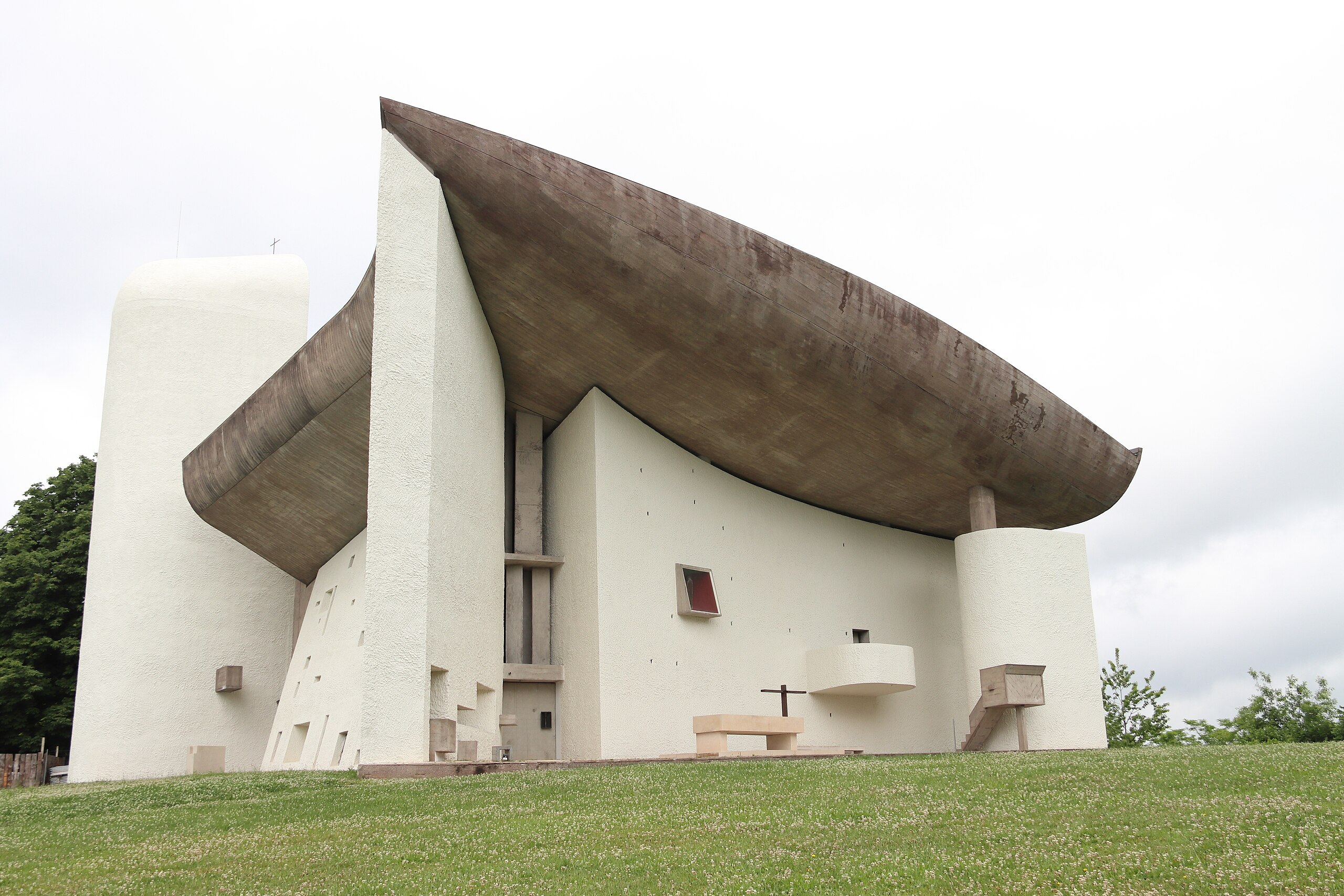
(Credit: FrDr via Wikipedia Commons)
This article is part of a monthly series of short essays on some of the greatest buildings of the 19th and 20th Centuries. Read John Pardey’s introduction to the series here.
I have not experienced the miracle of faith, but I have often known the miracle of ineffable space.”
— Le Corbusier
In 1920, the 33-year-old painter, writer and self-trained architect Charles-Edouard Jeanneret assumed the pseudonym ‘Le Corbusier’ – a fashion among painters in Paris at that time and as it turned out, an act of prescience of his future as the greatest architect of the 20th Century. The following year he published Vers une Architcture which was to be the most influential treatise on architecture since Palladio’s Four Books on Architecture from 1570. Within the next nine years he would produce the most revolutionary group of ‘white villas’ around Paris that was to culminate in what is now regarded as the seminal house of the century with the Villa Savoye (1929).
Thirty years later the 63-year-old Le Corbusier was approached by the Archbishop of Bescaçon to design a new church on a hill overlooking the Swiss border in France. As an atheist who believed the church was a ‘dead institution’ he turned this down but was later persuaded by the modernist thinker Father Alain Couturier (who went on to secure Matisse for the chapel at St-Paul-de-Vence and the monastery of La Tourette with Corbusier) to visit the site. Once here, he was smitten by the landscape and so accepted the commission on the understanding that he was free to “create in absolute freedom.”
(Credit: FrDr via Wikipedia Commons)
Corbusier had nothing to prove – he was already astride the world of architecture, yet his best was yet to come.
In the post-war years he had become obsessed with new ideas on communal living and was working on a new apartment prototype that was to be built in Marseilles, known as the Unite d’Habitation. This was a huge concrete monolith for 1,600 occupants with interlinked, double-height apartments served by central ‘streets’ – all raised up on muscular concrete ‘pilotis’, crowned by a portent of what was to come with its rooftop. Like the Parthenon sitting atop the Acropolis, Corbusier created a sculptural concrete landscape on the roof with a running track, splash pool, creche and giant ventilation stacks that recall his earlier fascination with ocean liners. He had been producing sculptures for decades and the rooftop adopts free forms and non-geometric forms that were to become the genesis of his chapel at Ronchamp, which first appeared in a sketchbook in 1950.
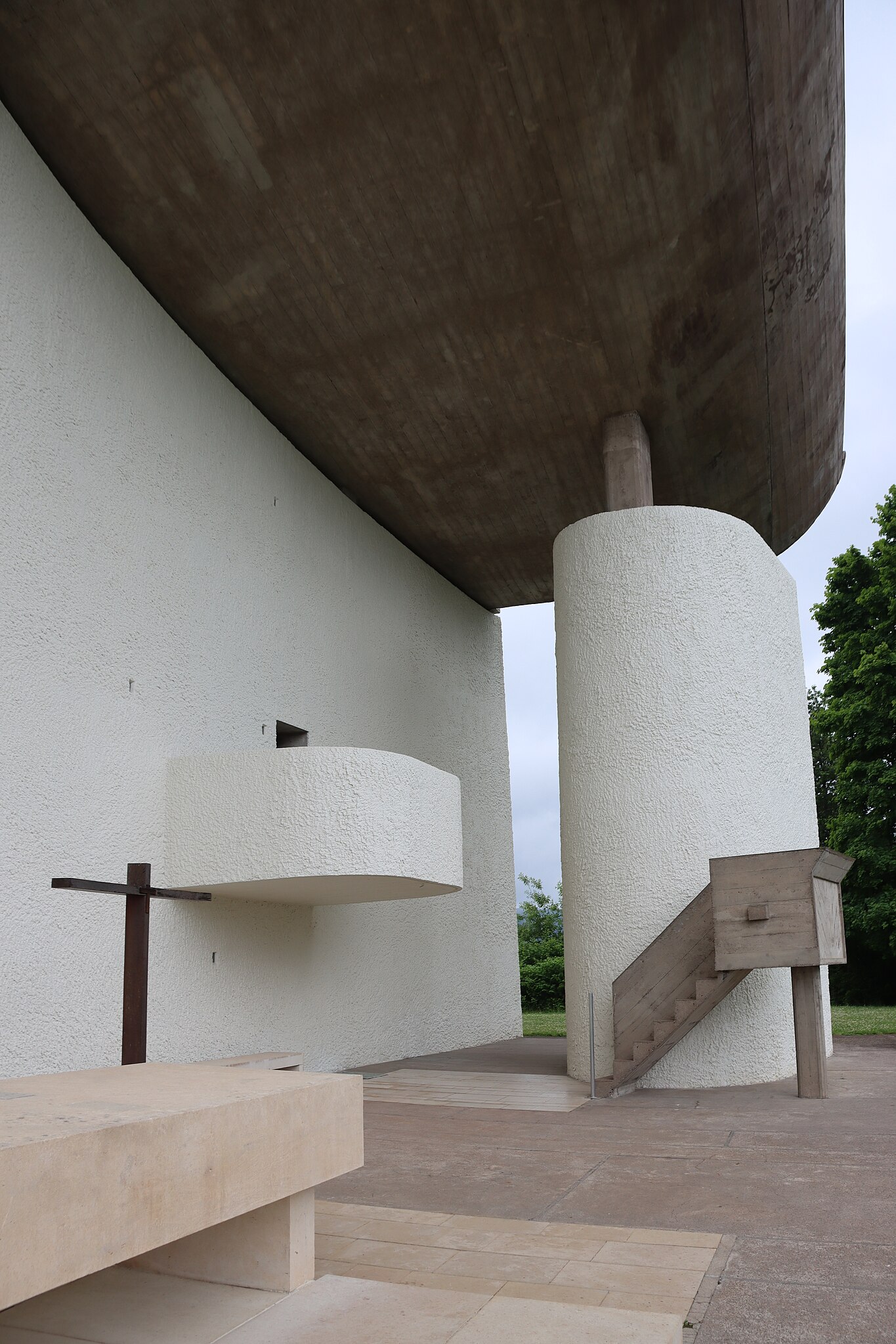
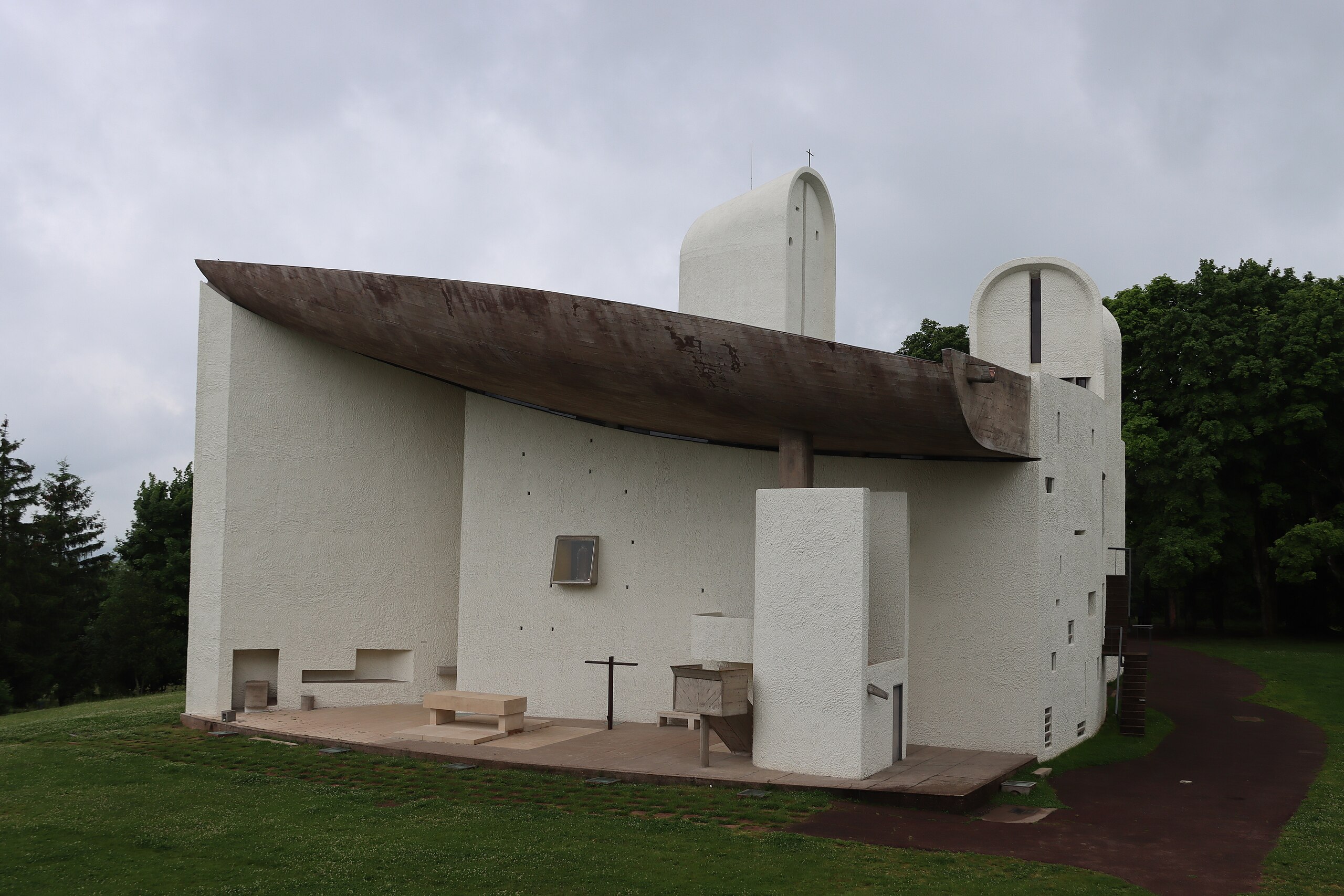
The leap from his former rational, industrial, orthogonal work to the chapel is staggering – like Einstein coming up with E=mc2, or Picasso’s 7.76-metre-long painting, Guernica – it was unprecedented. The plan consists of three curved enclosing walls that do not touch – a large tapering and concave wall faces south; a convex wall with rounded ends faces west; and a concave north wall faces east with a return like a question mark to the north.
(Credit: FrDr via Wikipedia Commons)
The plan looks more like calligraphy than a building plan – not a single right angle – and the section is extraordinary too – the floor slopes and the roof sags above the chapel space and tall towers are capped by curved hoods.
This is a building that needs to be experienced to understand its three-dimensional form. Externally it sits atop the hill like a giant, squat sculpture, capped by a giant concrete hull that appears to float, like an ark (Corbusier claimed it was inspired by a crab shell he had picked up from a beach on Long Island years before). To the western side three hooded towers rise up into the sky (‘periscopes’), scooping light down to the chapel niche spaces within.
The rough white render covered fifteen concrete columns that held up the concrete shell roof, infilled with the stone from the former chapel that was heavily damaged by the Nazis at the end of World War Two.
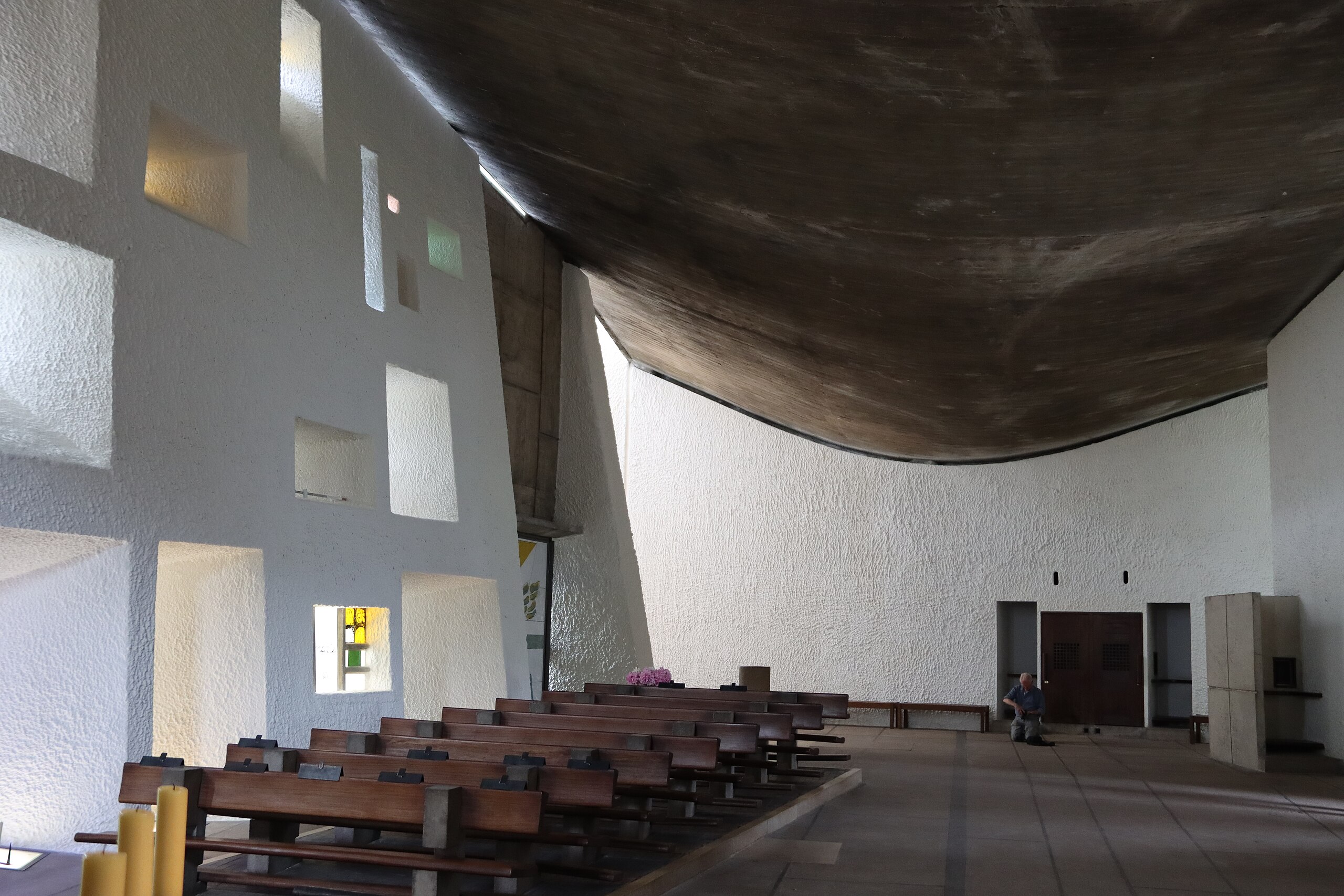
A three-metre square, 2.3-ton pivoting door covered in enamelled panels of Corbusier’s paintings (like his later doors in the Chandigarh Capital building), opens into a surprisingly dark, low space – internally space is compressed by the weighty, sagging concrete roof separated by 10 centimetres from the top of the walls by a slice of daylight.
Corbusier described the chapel as ‘a vessel of intense contemplation and mediation’, and it is actually quite small, around ten by five metres at most, with eight short iroko pews (by sculptor Joseph Savina) sitting on a low, raised plinth above the stone flagged floor that slopes down towards the altar. Above, high up in the wall sits a small effigy of Our Lady within a glazed box. Behind the pews, the three hooded towers cascade coloured light down onto niched chapels.
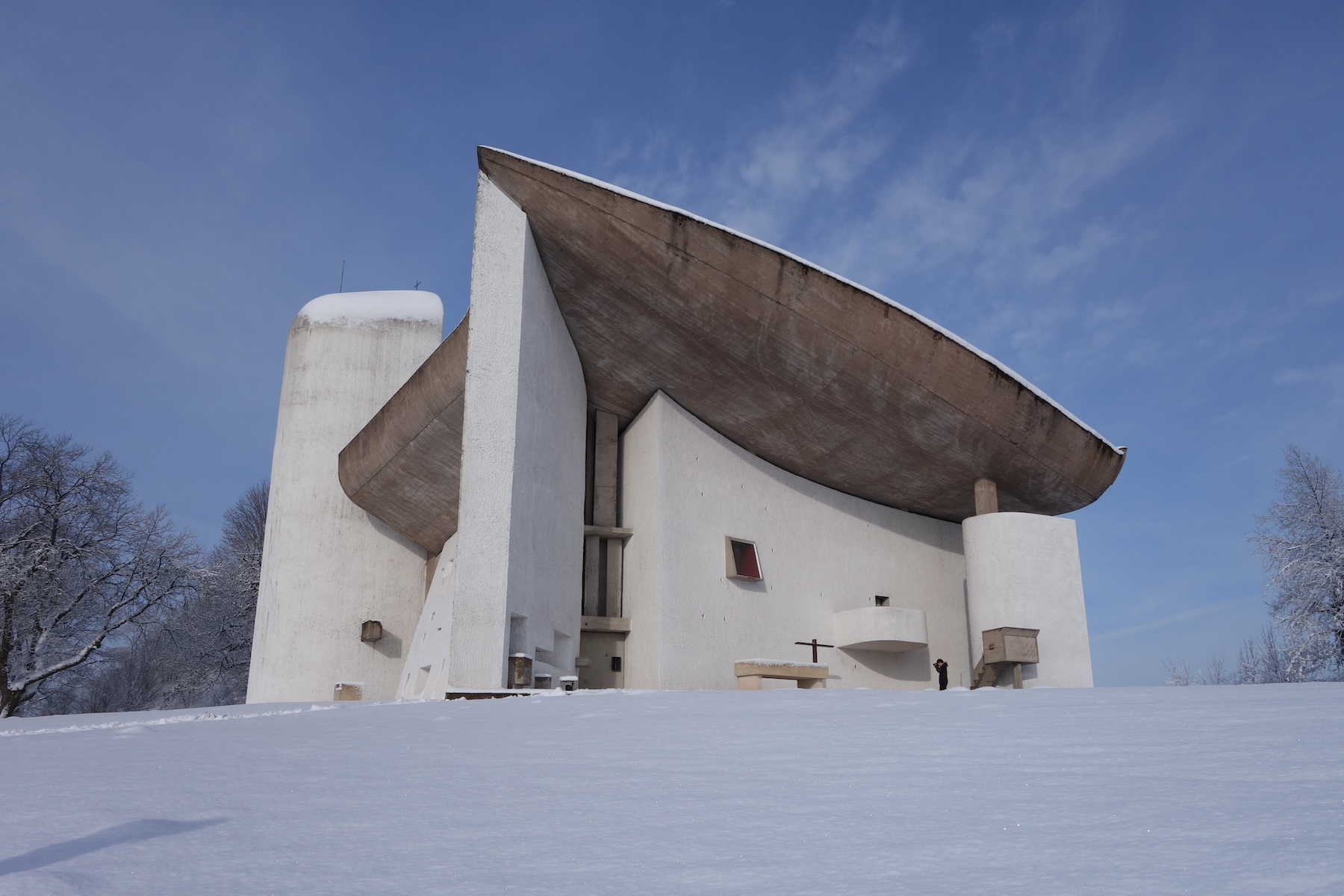
Ronchamp in the snow. (Credit: מיכאל יעקובסון via Wikipedia Commons)
Alongside the pews, and perhaps the most memorable part of the building, is the thick south wall that tapers in plan and section from one- to two-metres-thick and is pierced, seemingly at random but is in fact based on Corbusier’s Modular geometric system with window openings that resemble gun slots, glazed with brightly painted symbols of nature and the cosmos by Corbusier himself, and the reveals splay to allow coloured light to burst into the chapel.
Outside, on the east flank the concave wall is capped by the convex roof hull, creating a large, covered space, an outdoor chapel with altar and pulpit to serve several thousand pilgrims on the broad hilltop.
As a chapel there are none of the usual religious typologies of bell tower, cross, or transept, although he did design a rack of three historic bells set within a metal frame that was finally built posthumously to his design in 1975.
Corbusier created a place that celebrated the divinity of nature – sun, stars, water (beautifully choreographed in the way he takes the rainwater from the roof to a gargoyle, a rifle barrel-shaped spout that falls into a concrete basin of prism forms) – in an entirely unique way.
During the period 1910–30, expressionist architects such as Mendelsohn, Scharoun and Steiner built dynamic, expressive buildings that were free from history in a rejection of the past, to celebrate the individual in a search for a new world order, but Ronchamp is a consummate evocation of the wonders of nature rather than divinity.
Ronchamp was the work of a painter and sculptor – it is architecture of sculpted space rooted in Corbusier’s ‘acoustic’ sculptures. Not an expressive work, but rather a giant piece of sculpture that could celebrate nature, the divine in a very special place. It is diminutive, yet also one of the greatest buildings in the world