Gavin Hale-Brown explains how living and working in the Japanese city of Yonago shaped his development as an architect.
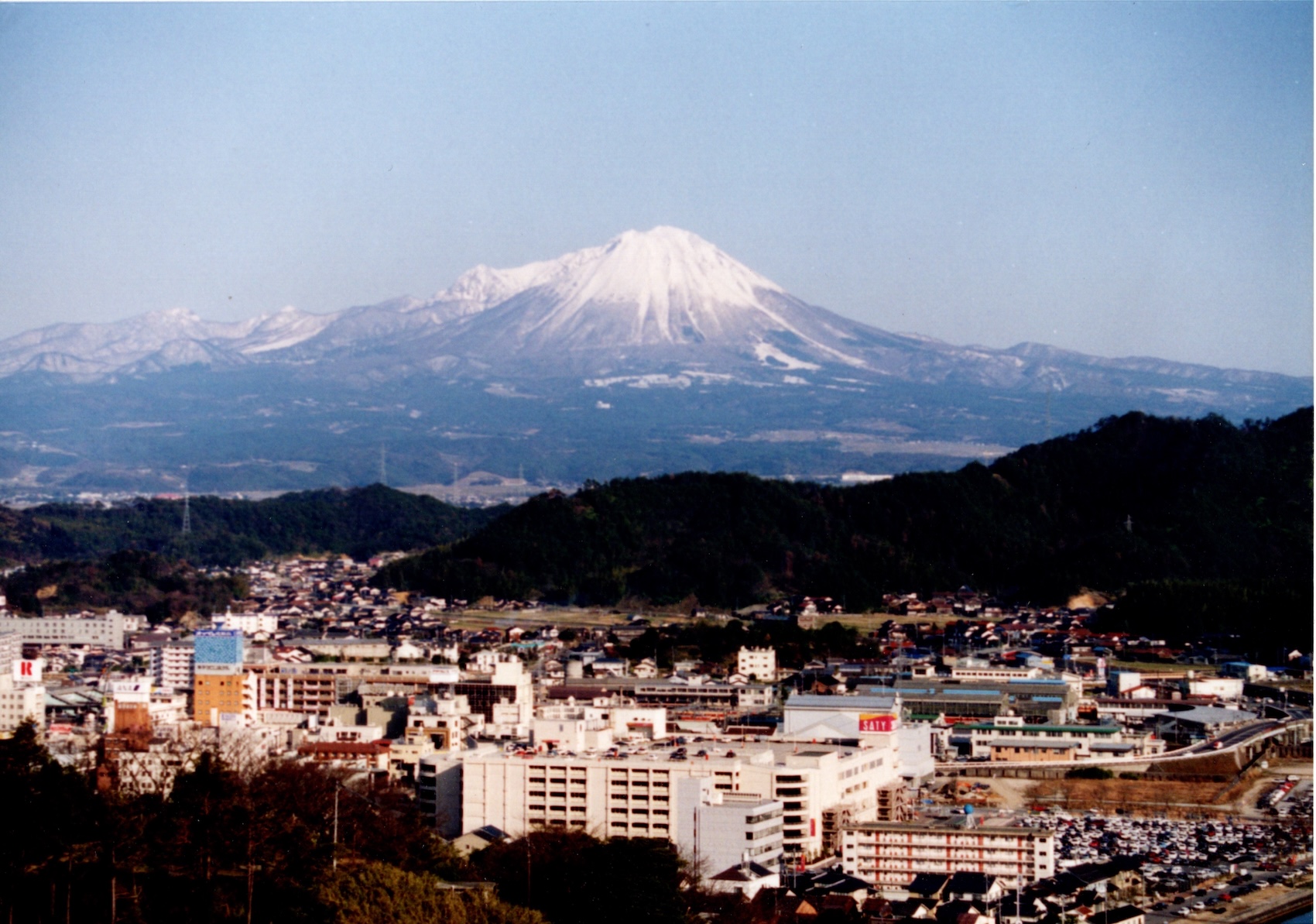
Yonago sprawls under brooding Mount Daisen, wild enough to lose Everest climbers, but accessible enough to allow autumn barbeques and skiing after work in winter. Photograph by Gavin Hale-Brown.
On leaving college, I went to Japan – to visit my then girlfriend (now my wife) and to escape recession in the UK. A carrot and stick one might say – although Su may object to that analogy. Having flown via soviet Moscow I arrived on archaic Aeroflot. Arrival at Haneda was the first time I discovered that reverence for the architect did still exist! This was the time of HRH Charles and his open hostility to the profession. Being the only arrival from western Europe, I was given much attention and thoroughly searched…including my wallet in which, it turned out, languished a long forgotten coloured tab for free student bus trips from Weetabix (some will remember those halcyon days). To explain that this was not a hallucinogenic proved a herculean task, until I unzipped the portfolio case and proceeded to present my final thesis to three border guards. I was waved through – who knew drawings had such power!
From there, through a combination of trains, buses and planes, I arrived in Yonago. At first glance Yonago-Shi is unprepossessing. Like most Japanese cities, it sits at the base of mountains, next to the sea, on partially reclaimed land. However, the longer you live in a place the more layers it reveals. True, Yonago doesn’t have the beauty of the castle of Matsue or the amazing natural dunes of Tottori, but it turned out to be the perfect place for early explorations in architecture. This is a city of approaching 150,000 people, cut off by mountains and single-track motorways from the cosmopolitan centres of Osaka and Kyoto. At the time, there were fewer than 20 non-Japanese, so instant celebrity status was guaranteed.
By happenstance I found a job with a wonderfully creative architect, Kinemura, and was immediately set loose on designing projects. I was immersed into a world of traditional timber-framed buildings, controlled by the ancient rules of ‘Kaso’. Within a few months the pencil marks I made on paper were being translated into construction drawings by Mr Yamasaki and Mr Kagawa. The buildings were procured through a system where the builders bowed deeply to the architect. Where it was a matter of honour to realise the intention of the design. Where respect was the foundation of an industry with no confrontation, the bare minimum of contracts, and few planning restrictions.
As I cycled from site to site, Yonago gradually revealed itself. The centre of the town still harboured ancient timber houses – dark, run down, overhanging the streams that flow into the vast Hino River. The river provided a playground in summer, a vast sandy delta for meandering cycle rides. Wild and untamed, it turned into a biblical torrent come autumn. The surrounding mountains were more challenging on two wheels, with narrow routes through forests hiding unvisited temples and pagodas serving exquisite food. It is not often one has seven courses of vegan sushi, served by monks in ancient cedar-scented, shoji-clad rooms.
Bikes are everywhere. As a foreigner it was easy to save an abandoned steed from the station pile. No need to lock. Simply park sensibly and it will be there the next morning. The sight of high-school children cycling one-handed with umbrellas in the rain, is something you never forget. Inevitably this results in mass pile-ups at blind corners – but no one seems to mind; no one shouts; some were known to laugh. It was accepted that everyone would cycle. The hierarchy was clear: cars were there for long journeys and bikes were not a threat.
To the north, the Hino feeds into the sea, wandering across natural springs. Here we developed a new spa, moving a four-storey traditional building intact across the site to provide space for expansion – creating Toyo Ito’s favourite spa in the process (I am told). The town sprawls under brooding Mount Daisen, wild enough to lose Everest climbers, but accessible enough to allow autumn barbeques and cold enough to offer skiing after work in winter. It is another joy.
I left this city with three new buildings all delivered as designed, all steps of learning in my journey as an architect. Yonago holds warm memories, a place at ease with itself, not trying to be different, happy with its place between the sea and the mountains, guarded by the ruins of its ancient castle, painted by sakura in spring, burning red Acers in autumn and the pure white of deep snow in winter. It is a special place if you allow it time to reveal itself.