Sam Morley, Senior Associate at Hawkins, has produced a School of Specification module exploring forensic fire safety. Here, he discusses how fire investigations reveal building defects and the lessons architects can learn from them.
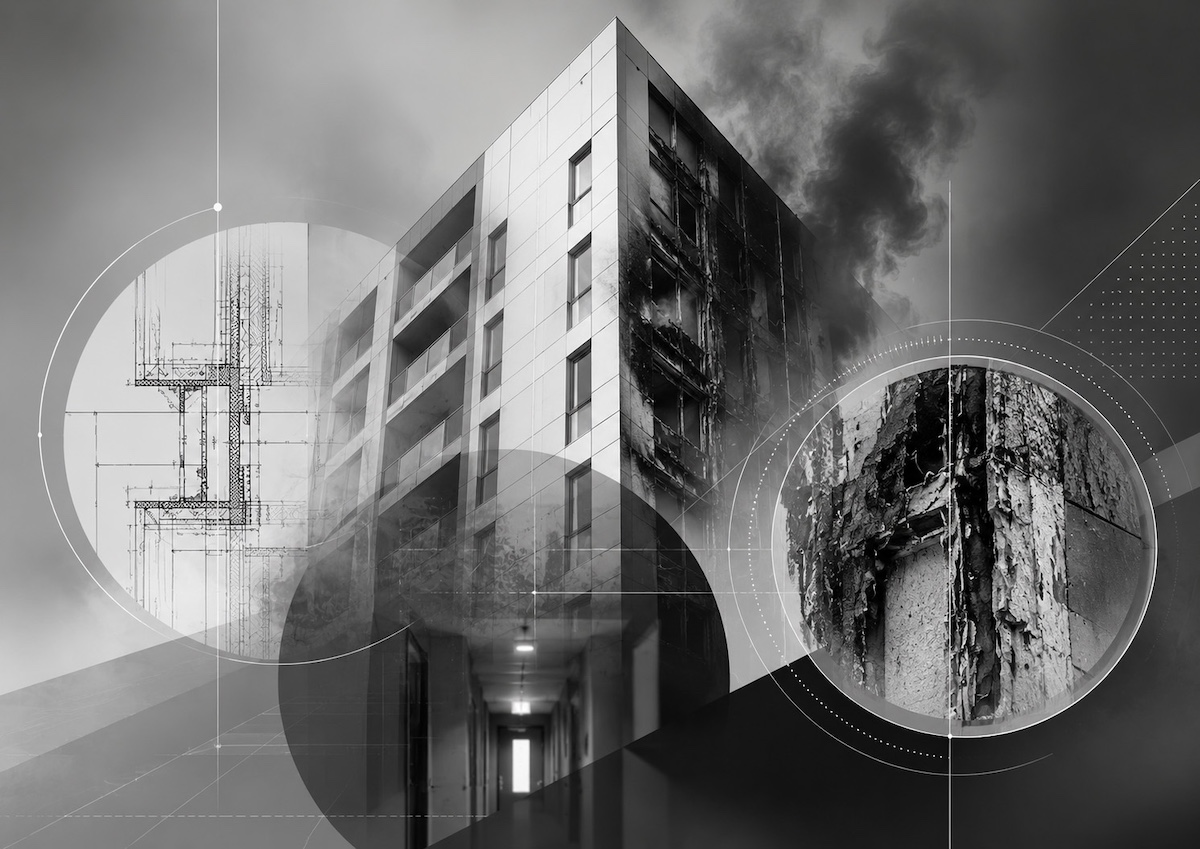
What is forensic fire investigation, and what role does it play in understanding building failures?
There are two distinct parts of forensic fire investigation. First, a fire investigator is appointed to determine the root cause of the fire. If the investigator considers that the fire has spread more than expected or the building didn’t perform as it should during the fire then they may recommend that a further investigation is carried out by a forensic architect or forensic fire engineer to determine whether there were any defects in the way the building was designed or constructed that may have resulted in this unusual behaviour.
What are the most common fire safety defects uncovered during forensic investigations?
Typically, I find defects relating to the use of combustible materials in façades allowing fire to spread across them, and breaches in compartmentation allowing fire to spread more quickly through a building. Both of these defects can result in increased damage to a building in a fire than if they didn’t exist. For example, if there are gaps around service penetrations into a flat then a fire could spread into the common parts instead of being constrained to the flat of origin. This can impact how the fire is fought by the fire service and hamper evacuation.
What can forensic investigations tell us about the gap between design intent and what is ultimately built?
As part of a forensic investigation there is first a need to understand the extent of damage, then link any contributing physical defects to this pattern of damage. Once the defects that resulted in the spread have been established then there is an exercise to assess whether they have been constructed in accordance with the design, and whether the design itself has any defects that may have resulted in the fire spread. Sometimes it is possible to clearly establish a construction or a design defect that led to the fire spread. However, quite often it is not so clear and there may be both design and construction defects that have contributed to the fire spread.
Site inspection is a critical activity to check that a design has been properly implemented”
How do building regulations and Approved Documents feature in forensic fire investigations?
Assessing the building (and also the design) against the requirements of the Building Regulations that were current at the time that the building was constructed is key in establishing whether there are any fire safety defects that may have resulted in the fire spread. As the Building Regulations provide only functional requirements it is important to establish the route to compliance. If there is no information about which route to compliance was followed then typically the building (and the design) will be assessed against the Approved Documents that were current at the time the building was constructed. These are chosen unless there is some other route set out in the fire strategy, because the Building Act 1984 gives a special status to the Approved Documents, which means that following them can be used as a defence to a claim.
What lessons can architects take from forensic fire investigations to improve safety outcomes?
Site inspection is a critical activity to check that a design has been properly implemented. It is also important to think through how a building might behave in a fire and decide whether the guidance in the Approved Documents is relevant to a particular project.
Join Sam Morley to learn more about forensic fire safety:
www.schoolofspecification.co.uk/courses/forensic-fire-safety/