Under the ninth generation of architectural leadership Antoni Gaudí’s Gothic masterpiece was finally inaugurated by Pope Leo XIV in June. So why does the world’s best-known construction project still seem curiously incomplete?
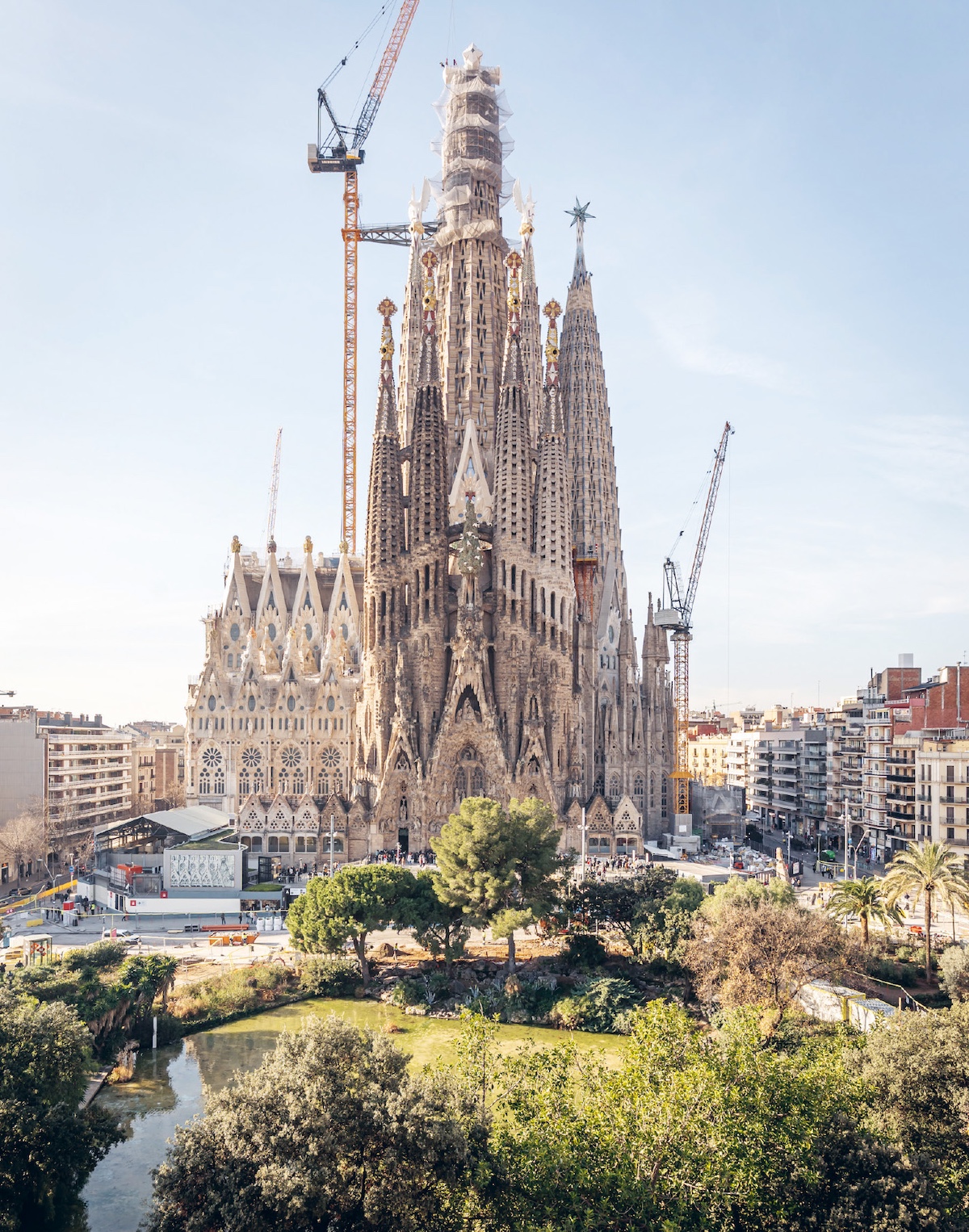
Sagrada Família photographed shortly before the Pope’s visit in June 2026 (photo: Fundació Junta Constructora del Temple Expiatori de la Sagrada Família/Pep Daudé).
Let’s just say it: it’s a bit much. Like much of his architectural oeuvre, Antoni Gaudí’s Sagrada Família – the 172-metre-tall, 41,000-square-metre sandcastle near the edge of Barcelona’s Eixample district – is an exercise in feral, profligate maximalism. Described, by America’s founding skyscraper father Louis Sullivan, as “spirit symbolised in stone” (and by George Orwell as “hideous”), the building’s immense scale and varied reception are consonant with the vast timescale of its development. Begun on the cusp of the 20th century as a personal reflection on the Gothic, it would, by the time of its completion, come to be viewed as a crowning statement of regional Art Nouveau, several decades after the movement spun out its extravagant, whiplash wheels. Through the slow, almost geological pace of its gestation, the building stood as a quiet sentinel over a changing architectural scene, in which it now figures as a gigantic, concrete enigma.
Until very lately – right up to the present when, technically, parts of the grand basilica are still remaining to be finished – Sagrada Família has been most familiar to the architectural public as a construction site. When ground was broken in 1882 at the corner of Carrer de la Marina and Carrer de Mallorca, the original architect (the little remembered, if brilliantly named Francisco de Paula del Villar y Lozano) might have anticipated a fairly straightforward process, with the anticipated result of a more-or-less standard medieval-flavoured Catholic church. Only a year in, following a dispute with the client, the reins were passed to Gaudí, whose vision was considerably grander and who threw himself into the project with near single-minded focus, expanding the scope of work tremendously. Even he, however, could not have counted on the assorted historical vicissitudes to which the city and the nation would later be subjected: from the outbreak of the Spanish Civil War in 1936, till well after the end of World War Two, progress onsite ground to a halt; it did so again as recently as 2020, owing to the Covid-19 pandemic.
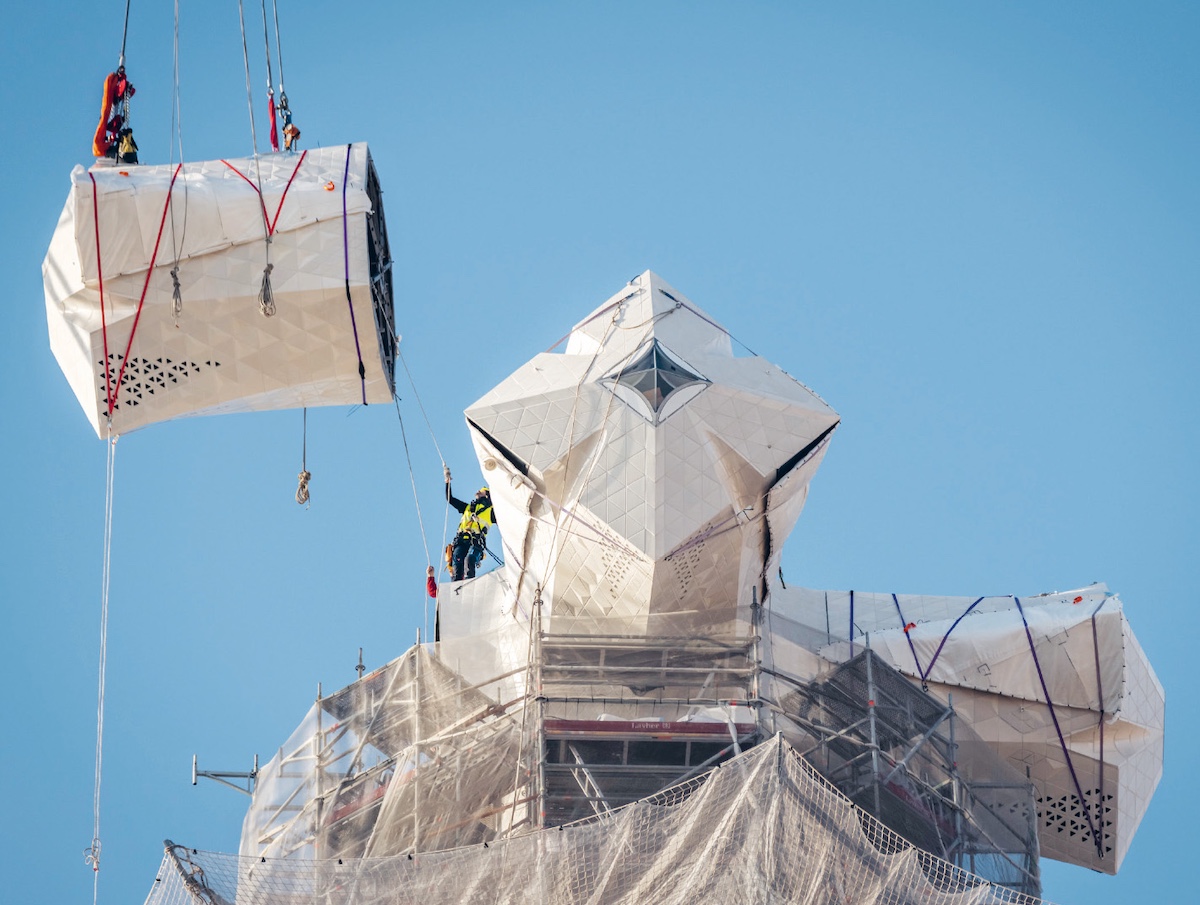
The installation of the cross on the central Tower of Jesus Christ (photo: Fundació Junta Constructora del Temple Expiatori de la Sagrada Família/Pep Daudé).
Having been struck dead by a Barcelona streetcar in 1926, the architect himself did not live to see the building face more than a routine volume of delays, though these do not appear to have troubled him much. “My client is not in a hurry,” he is reputed to have said: the quote may be apocryphal, but has achieved a general acceptance by way of repetition, and through a certain plausibility given its speaker’s character. Born in 1852, Gaudí, was by all accounts a most unusual personality, a foppish lad given to wild aesthetic fancies who grew in his latter years into a flinty, hyper-religious recluse whose tastes had become – if anything – still more over the top. From the florid exoticism of the El Capricho villa (1883), to the Casa Batlló’s (1904) cartoony anthropomorphics, to the gingerbread wonderland of the Parc Güell (1914), the designer found new and ever stranger ways of wedding his eclectic stylistic sensibility with an almost self-flagellating drive for formal invention. The only limit, for Gaudí, was imagination. Certainly time was not a serious consideration.
This was probably just as well. Quite apart from the social and political tribulations that swirled around it, the Sagrada Família posed outstanding technical challenges that required additional care. Unlike the Goths of old, Gaudí decided that that the upper reach of his structure – finishing in the slender, bristling pinnacles of his spires (18 altogether, in honour of the apostles, the evangelists, Mary and Christ) did not require the substantial flying buttresses that supported the buildings of the Middle Ages. Confronted with the heavy windshear of the Mediterranean, the architect’s successors applied remarkable ingenuity to devise material and structural solutions that would reflect the designer’s intent without risking the building’s stability. This task was made the more difficult by the destruction, during the strife-torn 30s, of a good part of Gaudí,’s original plans. Digital drafting and other computer-aided analyses have been essential to advancing the project, now under the ninth generation of official architectural leadership.
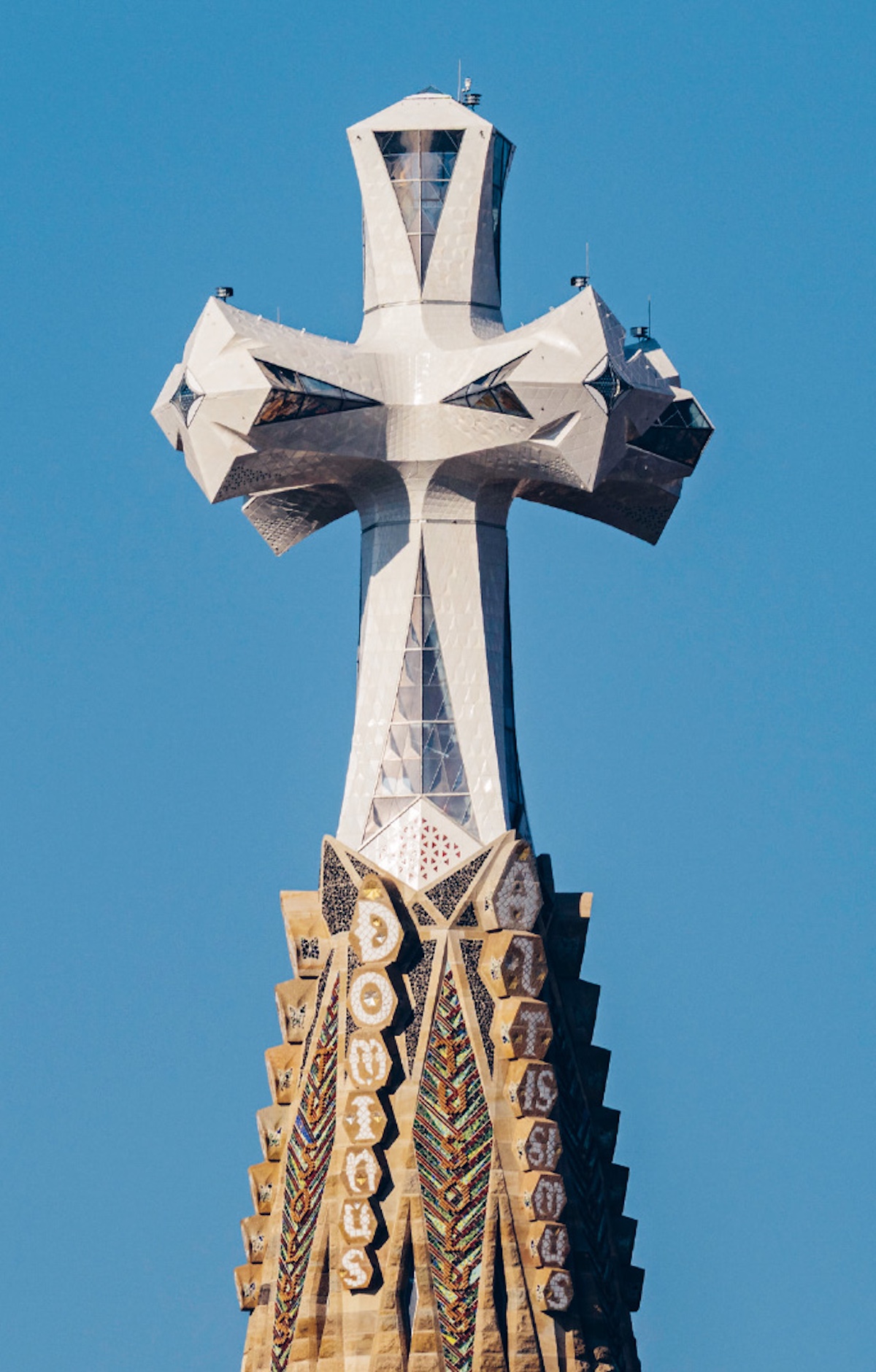
The newly-installed cross brings the building to its maximum height of 172.5 metres (photo: Fundació Junta Constructora del Temple Expiatori de la Sagrada Família/Pep Daudé).
It may be, possibly, the last one. In June of this year, Pope Leo XIV (himself the tenth pontiff since the building got underway) arrived in Barcelona to officially inaugurate it. To all appearances, the completed church is everything that everyone has ever thought of it: a bit “camp”, as Susan Sontag claimed, yet also, as Jonathan Glancey has noted, testament to the “skill, intelligence and craft” of its sequential makers, rare in building culture of the last 100 years. If the jury is still out, that only betrays how uncertain the current critical climate in architecture really is – though it is an uncertainty that the building, in some odd way, seems to allow for. Perhaps it is only the habit of having seen it for so long in a state of incompleteness, obscured by scaffolding and cranes, but there is something in those spindly towers and leaning, rough-hewn walls that appears perpetually unfinished, as though the building were still forming itself out of itself. In its becoming, more than in its being, Sagrada Família may make its most lasting impression.