John Pardey explores Marina Tabassum’s Bait Ur Rouf Mosque in Dhaka, a modest brick building where primary geometry, natural ventilation and shifting patterns of light create a profound place of worship and community.
This article is part of a monthly series of short essays on some of the greatest buildings of the 19th and 20th Centuries. Read John Pardey’s introduction to the series here.
‘I chose to resist, to deny temptation and to search within; within the land I grew up in, the place and country I call home.’
— Marina Tabassum
The city of Dhaka in Bangladesh is home to one of the most significant 20th-century buildings in the world with Louis Kahn’s epic National Parliament complex from 1982, and now it is joined by a modest but significant mosque. This small building is remarkable for several reasons: its architect, Marina Tabassum, is a woman in a Muslim society where normally only men enter mosques; it sits within a slum; it takes forward the raw architectural essence of Kahn’s legacy; and it breaks away from the usual symbolism of mosque architecture.
Tabassum was the child of second-generation immigrants from India following the partition of Bengal in 1947. Her grandmother, Sufia Khatun, after a difficult life and the death of her husband and two daughters, gave part of her land to the local community to build a mosque, and Tabassum, a graduate from Bangladesh University of Engineering and Technology, took on the design and was to continue to fundraise after her grandmother’s death.
Tabassum’s career took off in her late twenties, when she and Kashef Chowdhury won an international competition to design a new Museum of Independence in Dhaka in 1997, completed some eighteen years later. This was a large in situ concrete structure set within a lake – a rectangle in plan pierced by a large circular court that evokes the work of Kahn. By 2009, working in her own right, she built a modest house for a close relative in the north of the city, and this revealed her belief in using vernacular materials combined with timeless forms, here a reworking of the geometry of Palladio’s Villa Rotunda, in a nine-square plan built in terracotta brick. Tabassum wrote, ‘I believe in evolution. That’s what I try to do through my work. It’s more about developing the language than trying to do something entirely new.’
Bangladesh, with over 172 million people, is the eighth most populous country in the world. Following the Muslim conquest in 1204, the region became prosperous and had thriving agricultural and textile industries – it fell under British colonial rule in the eighteenth century and after partition in 1947, became part of the Dominion of Pakistan, finally becoming an independent country after a civil war in 1971. It is now the second-largest economy in South Asia. However, it also has many challenges, including overpopulation, the largest refugee population in the world, and adverse effects from climate change.
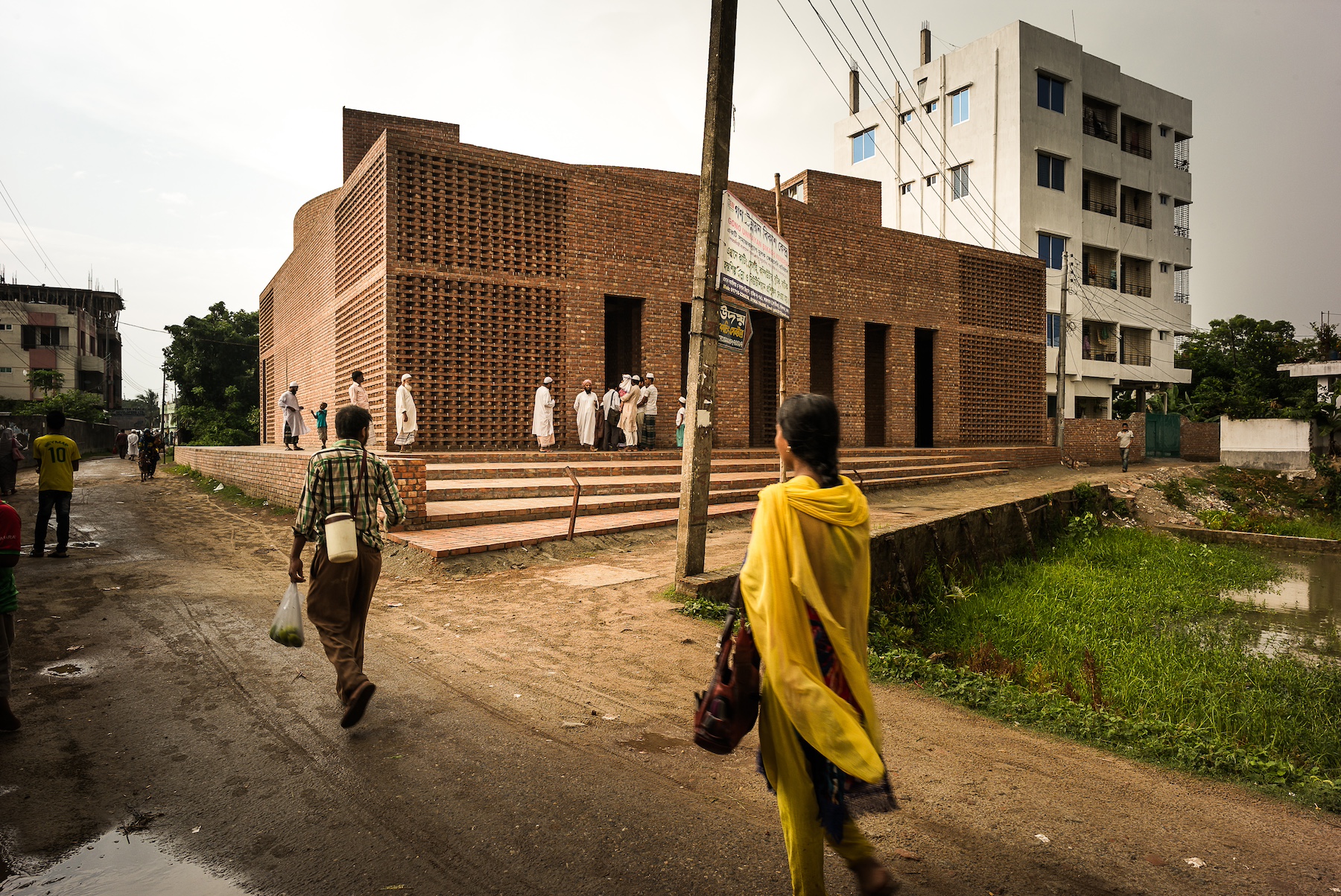
Dhaka is a megacity with some 24 million people and is one of the most densely populated cities in the world. There are almost no public spaces in the city and within this metropolis, Tabassum’s mosque building can be found along an unmade road in Faidabad, in Dhaka’s northern quarter, an area sitting within a flood zone surrounded by tall apartment blocks.
The site is almost square, but the eastern frontage onto a side road is at a diagonal, so Tabassum filled the entire site with a raised brick plinth, with the diagonal forming broad steps to protect it from flooding. The building itself is a pure square of some 23 metres in plan, reflecting the stabilising and static geometry found in Islamic architecture.
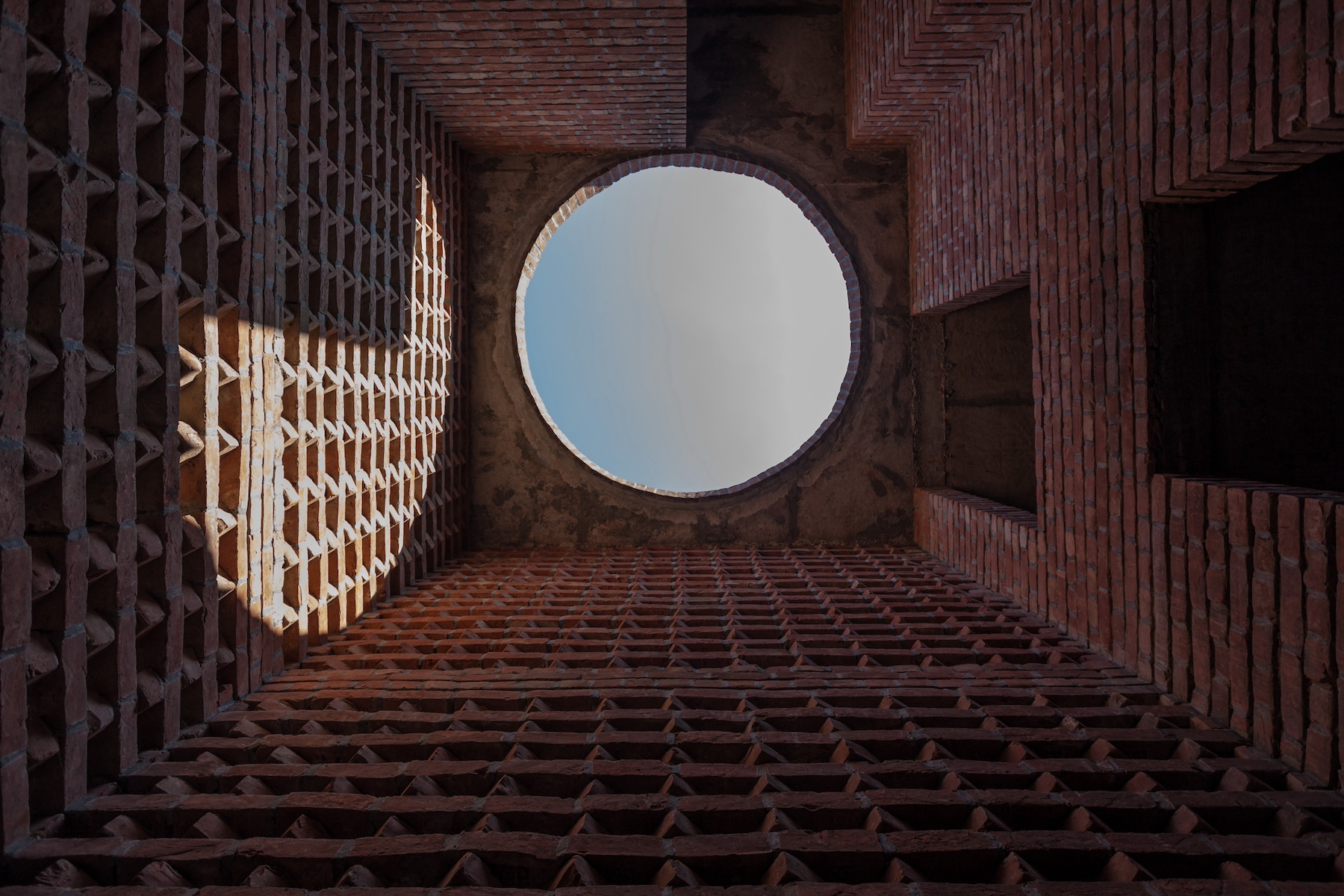
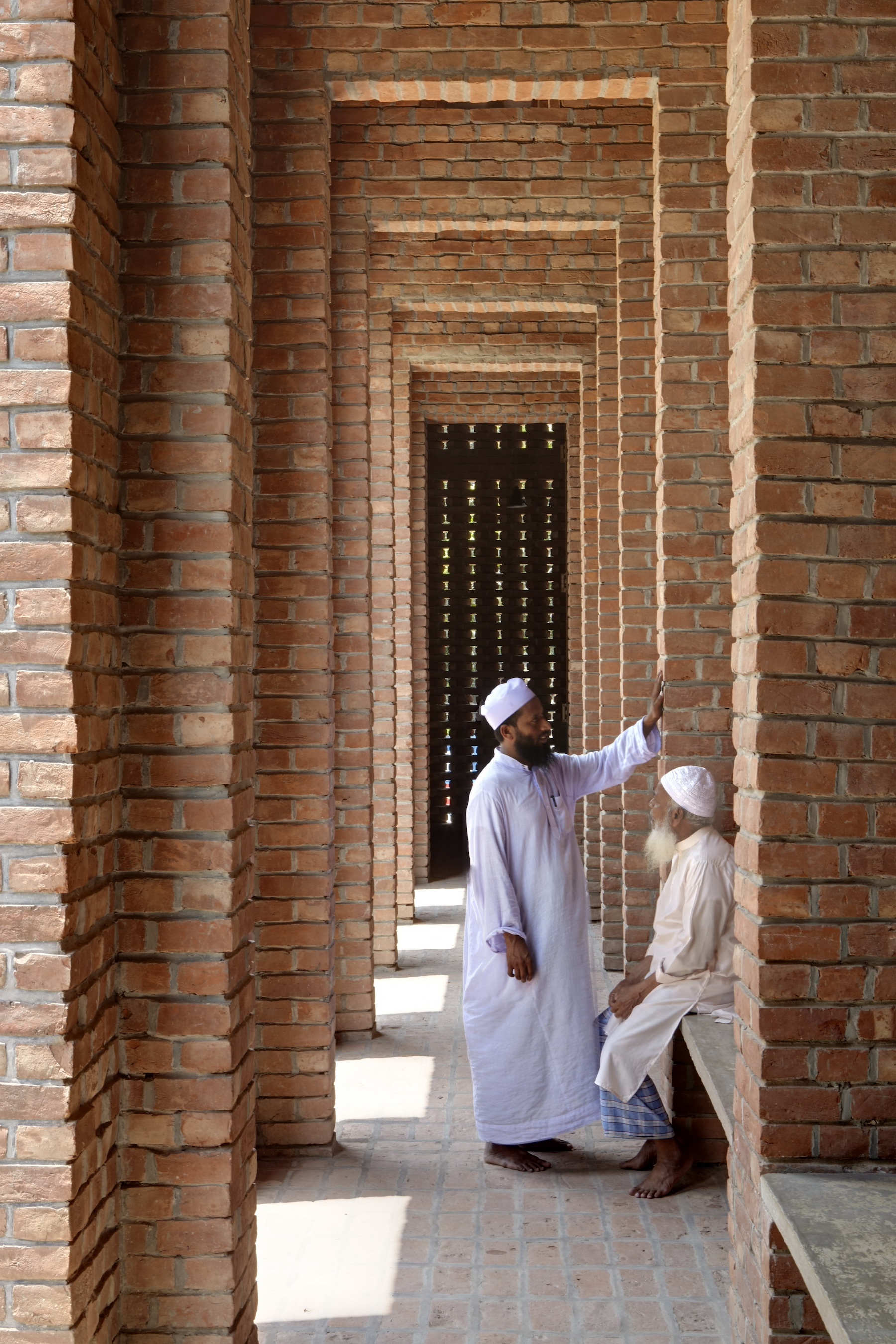
Breaking the mould, there are no domes, minarets or decorative panels, but rather a simple, square building in load-bearing terracotta bricks some 7.5 metres tall, unadorned save a colonnade and large areas of perforated brick. Tabassum wanted the mosque to be a community asset rather than one that is solely dedicated to religion, and the plinth provides a rare public space in the city and is now home to children playing and groups of old men chatting.
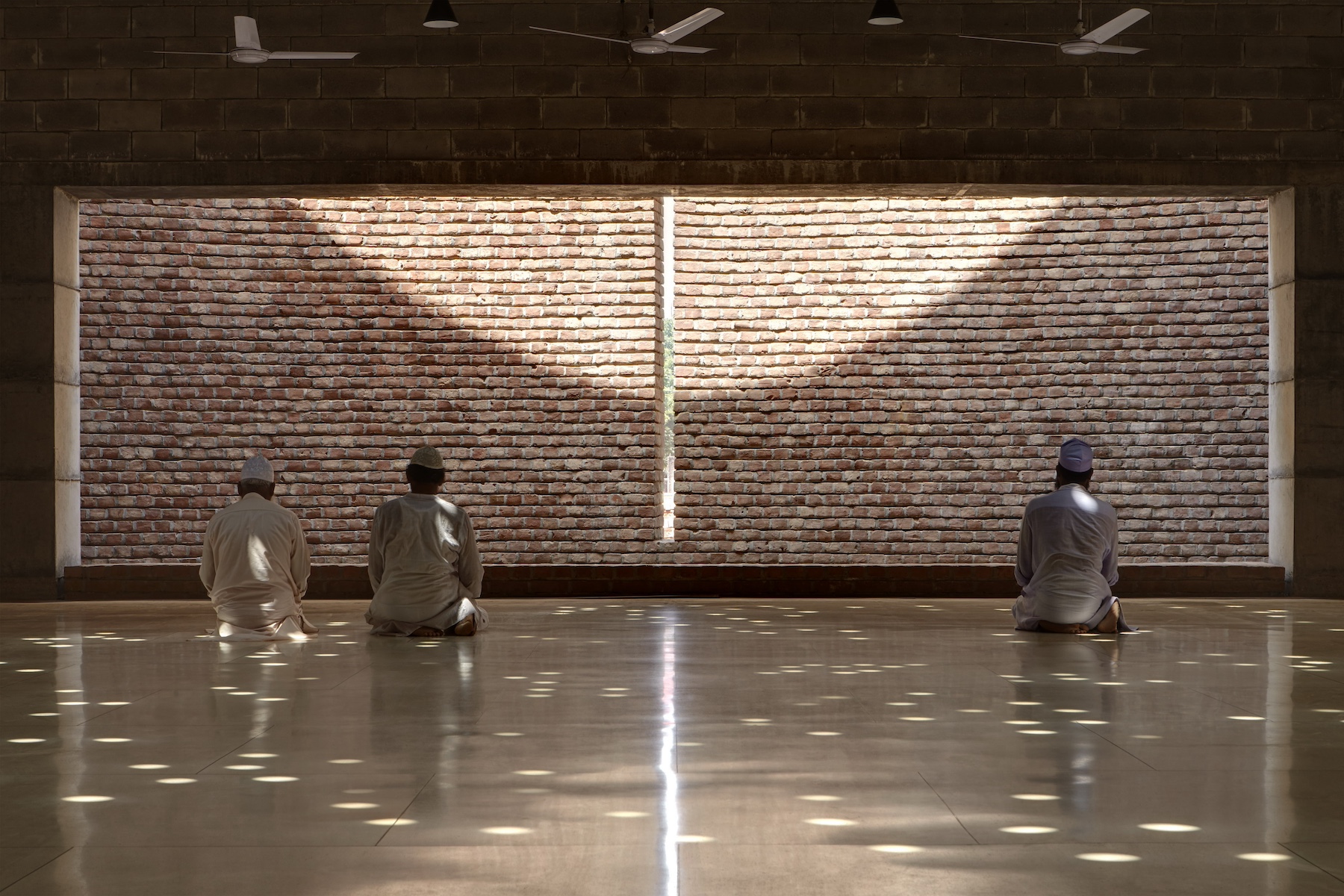
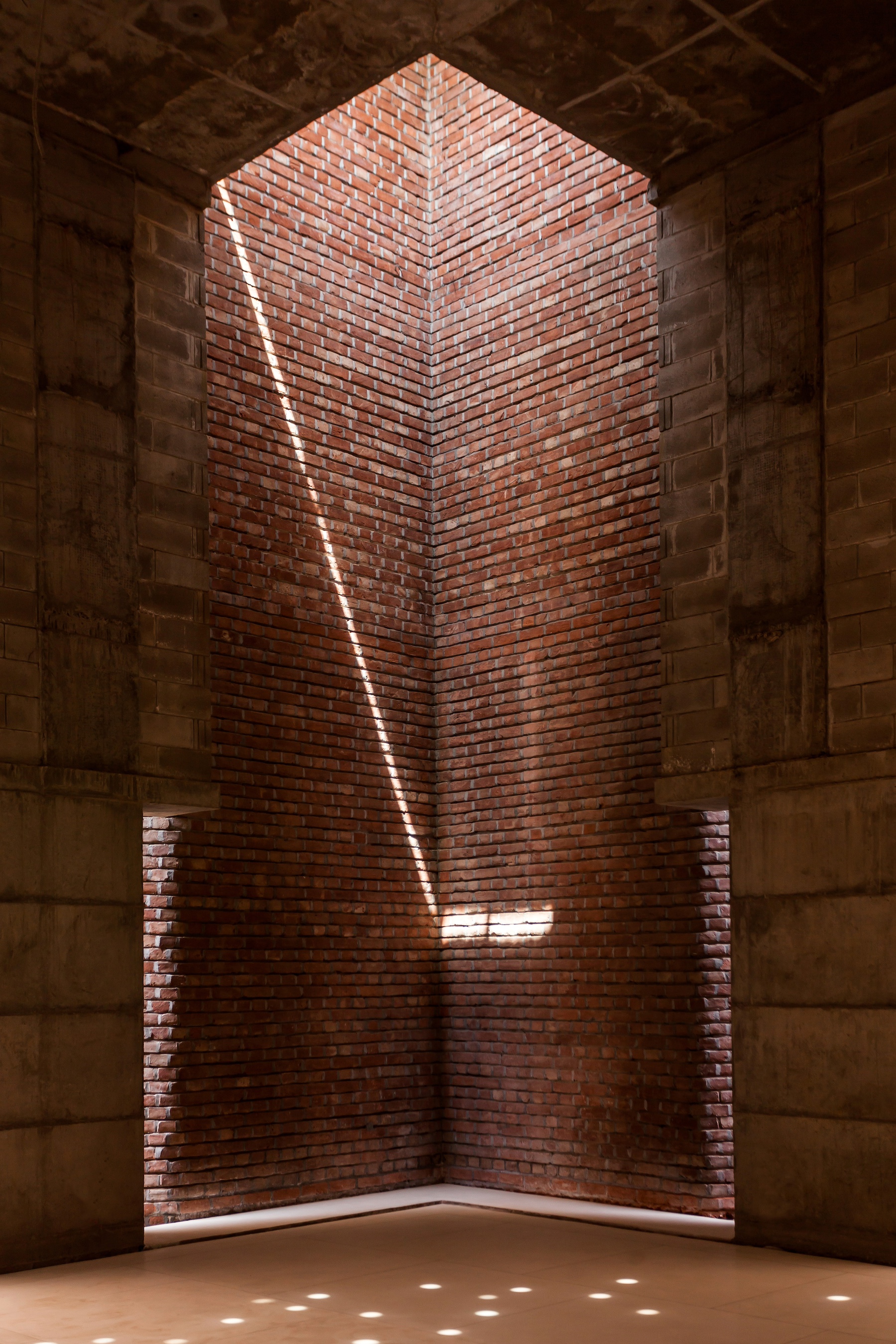
Within the square brick carapace, a second, circular brick wall, shifted slightly so that it kisses the north and west outer walls, creates a ‘servant’ zone between the two walls to the south and east, providing ancillary rooms – washing, toilets, staircase and the Imam’s office. This circular enclosure is then pierced by a square concrete structure of eight rectangular columns holding up a flat roof, all rotated by thirteen degrees to align with the qibla – the direction towards the Sacred Mosque in Mecca – revealed by a single vertical slit in the outer wall to the western elevation. The segmental spaces between the square and the circular forms are open to the sky and bring light down into the prayer hall. This is augmented by four light wells at each corner of the hall, with gentle light from the perforated brick walls and 300 tiny holes, randomly placed in the roof, filtering light from above. The building also breathes, with the open segments and porous walls, so it feels cool.
The effect within the building is profound, with shifting patterns of light and shadow, fulfilling Tabassum’s ambition: ‘an attempt towards spirituality through light can span the distance between here and infinity, between today and eternity.’
The building distils the essence of religion without recourse to ritualistic or symbolic means, just as Le Corbusier did at Ronchamp fifty-seven years previously. It also continues the legacy that Louis Kahn left in this country in its use of primary geometry and raw materials. But what sets Tabassum apart is her belief in learning from past cultures, in reducing the environmental impact of the built environment, and the need to repair the earth. In her letter to young architects, written during lockdown when her neighbourhood was quiet without the insistent cacophony of motor cars and she could hear the chirping sparrows sing, she wrote, ‘We need a generation of architects who know how to stitch together fragmented societies. We need a generation of architects who can build bridges and not walls. We need a generation of architects who do not aspire to stardom but connect to the Earth.’
Tabassum hopes that age-old wisdom will help to revise living patterns through ‘reuse, reduce, repair, recycle, repurpose in order to re-establish the balance to reassure our existence.’ She believes that geography, topography and climate lend identity and uniqueness to architecture. In this regard, she stands alongside Glenn Murcutt who has single-handedly brought such concerns, touching the earth lightly, to the southern hemisphere. It is no surprise that, more recently, she has turned her attention to working with local communities to help face the twin crises of Bangladesh – the plight of refugees and the constant threat of flooding.
Winning the Aga Khan Award for the mosque in 2016, the citation read: ‘…ventilation and the play of light make this neighbourhood mosque a refuge for spirituality.’ How wonderful that a humble building made from simple materials, built by local craftsmen and infused with the great poetry of light, can be found in a slum. An enormous achievement.