For X Architects founding partner Farid Esmaeil, Dubai is an extraordinary laboratory with a climate that demands a careful approach to materiality and passive design and a confidence that invites you to test ideas, challenge conventions and imagine architecture in new ways.
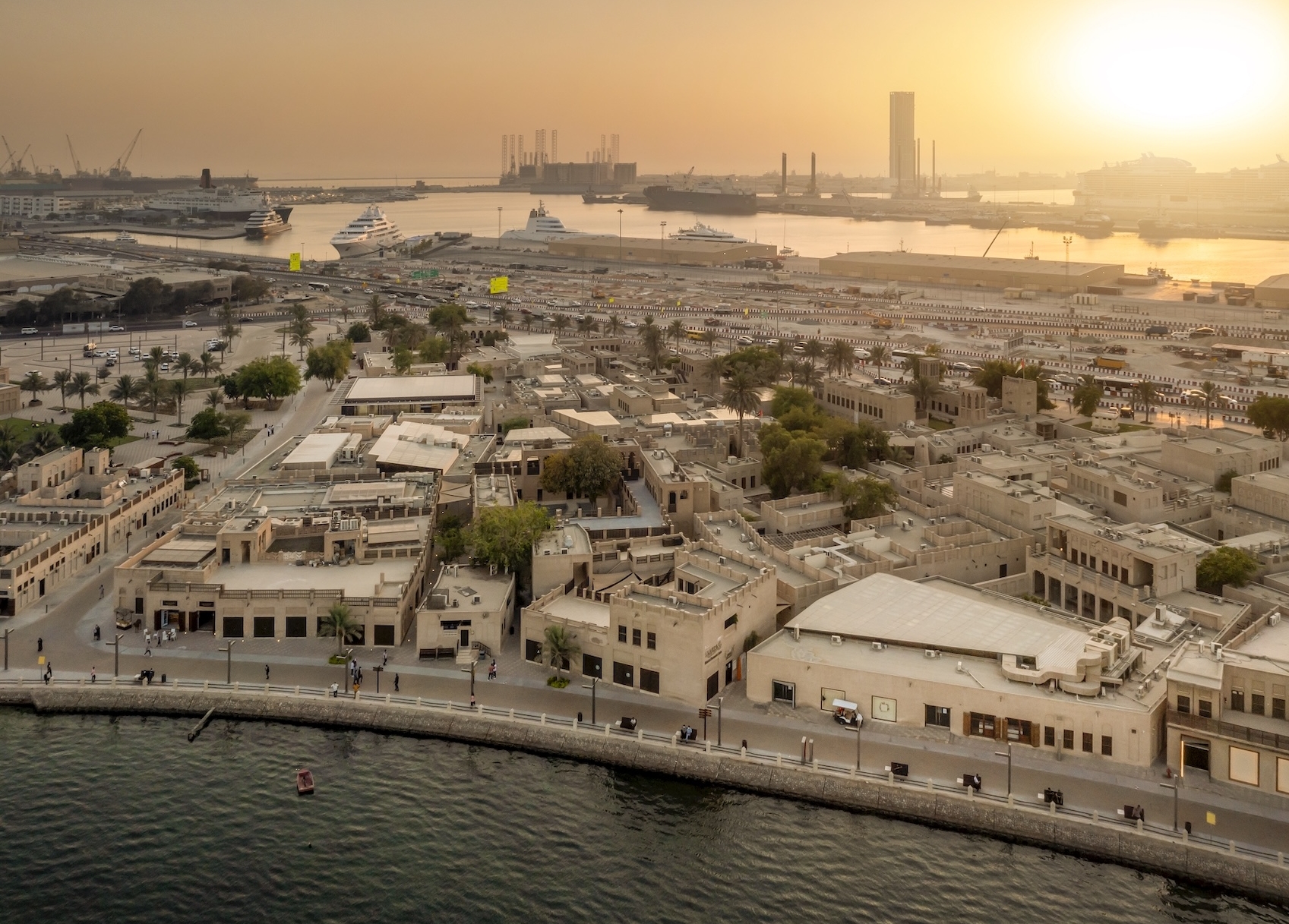
Narrow sikkas, shaded courtyards and wind towers form the compact, climate-responsive urban fabric in the historic district of Al Shindagha. Photograph by Fernando Guerra.
When I was a young architecture student, Dubai was still shaping its future and establishing itself on the global stage. It felt open-ended and full of possibility. Even then, it was clear that this was a city in constant evolution, never content to settle for the status quo. Over time, Dubai became inseparable from my own personal and professional journey. To live and work here is to witness transformation at an almost unprecedented scale. What has always defined it for me, however, is its openness.
To understand Dubai, you have to look beyond its skyline. At its heart, it is still a trading city. Long before the towers, the Creek was a place of exchange, where merchants and travellers converged. That spirit remains embedded in the city today. People arrive from everywhere, bringing different cultures, ambitions and ways of thinking. It creates a confidence that allows you to test ideas, challenge conventions and imagine architecture in new ways. You can also see this continuity in the historic districts of Al Fahidi and Al Shindagha, where narrow sikkas, shaded courtyards and wind towers form a compact, climate-responsive urban fabric.
Professionally, Dubai has been an extraordinary laboratory. It is in a constant state of evolution, demanding responses not only to growth, but to shifting social needs and environmental realities.
Dubai operates through a series of productive contradictions. It is deeply rooted in the traditions of the Gulf, yet one of the most international cities in the world. It is defined by rapid change yet increasingly concerned with continuity and identity. Navigating these tensions is both the challenge and the opportunity.
In recent years, the conversation has increasingly focused on building better, with a strong emphasis on sustainability, public space and liveability. Architecture in the region is placing greater importance on the relationship between climate and landscape, culture and community, reflecting a more integrated and context-driven approach to design. In an arid environment, climate is not abstract; it is immediate and defining. It demands a more careful approach to passive design, materiality and the relationship between architecture and nature.
Within a short distance, you can move from the density of Sheikh Zayed Road to the silence of the desert, or the openness of the coastline. This dialogue between city and landscape shapes how one experiences the place. Often, the most meaningful spaces are not the iconic buildings, but the spaces in between: waterfront promenades, shaded public spaces, cultural districts where people gather.
What excites me now is Dubai’s continued evolution into a new phase of maturity, with an increasing focus on enhancing everyday life through a sense of generosity. Walkability, public space, cultural infrastructure and the integration of nature are becoming central to this approach. These changes may be less immediately visible than the skyline, but they are profoundly important, helping to shape a city that is more liveable, more resilient, and attuned to how people experience it day to day.