Susanne Tutsch, founding director of Root And Erect, reflects on the making of a woodland playscape at Chilton Square in King’s Cross, where non-prescriptive play, dense urban constraints and circular construction come together in a space designed to work for all ages, all day.
In terms of early conceptual ideas, how did the notion of a woodland playscape emerge from the brief?
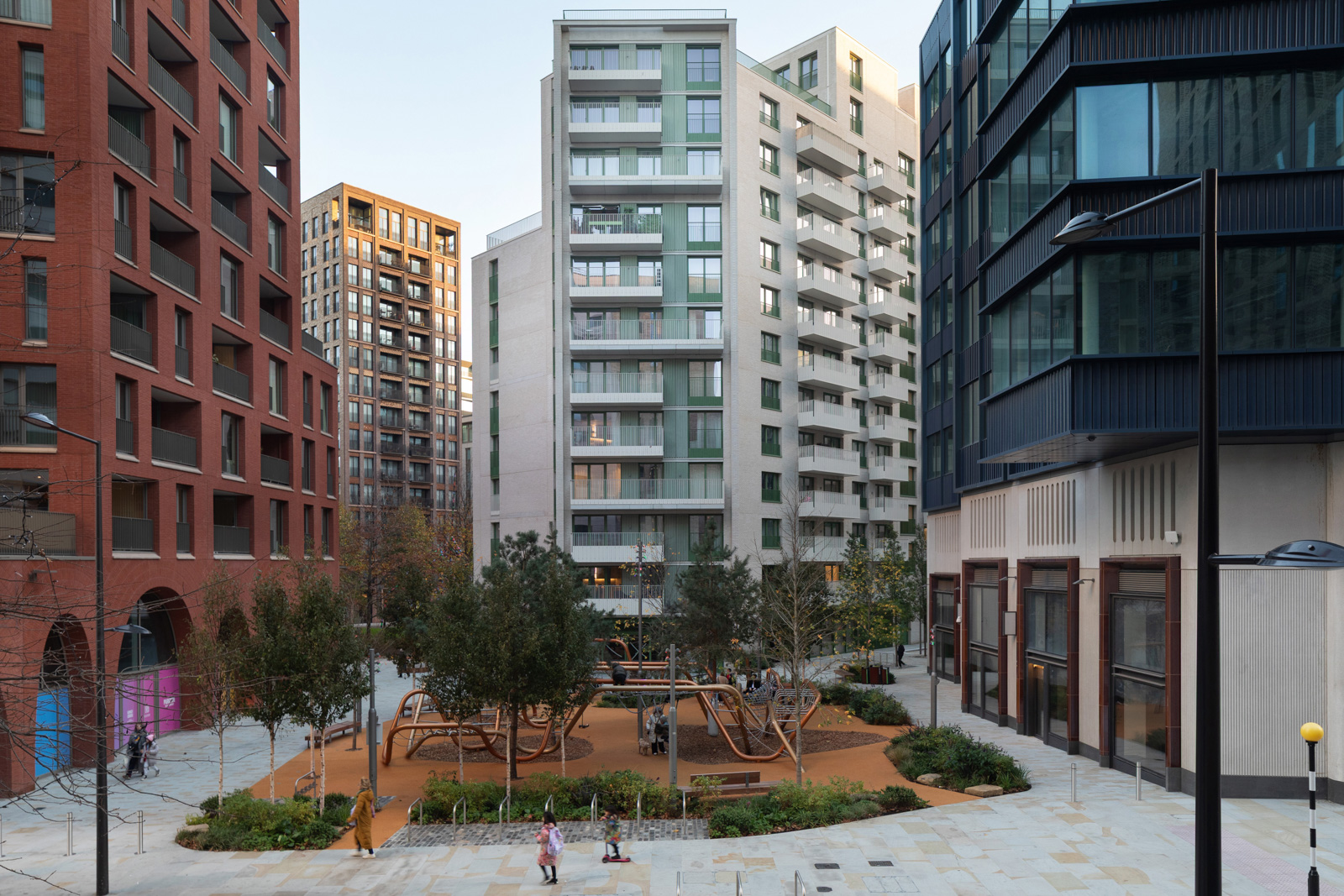
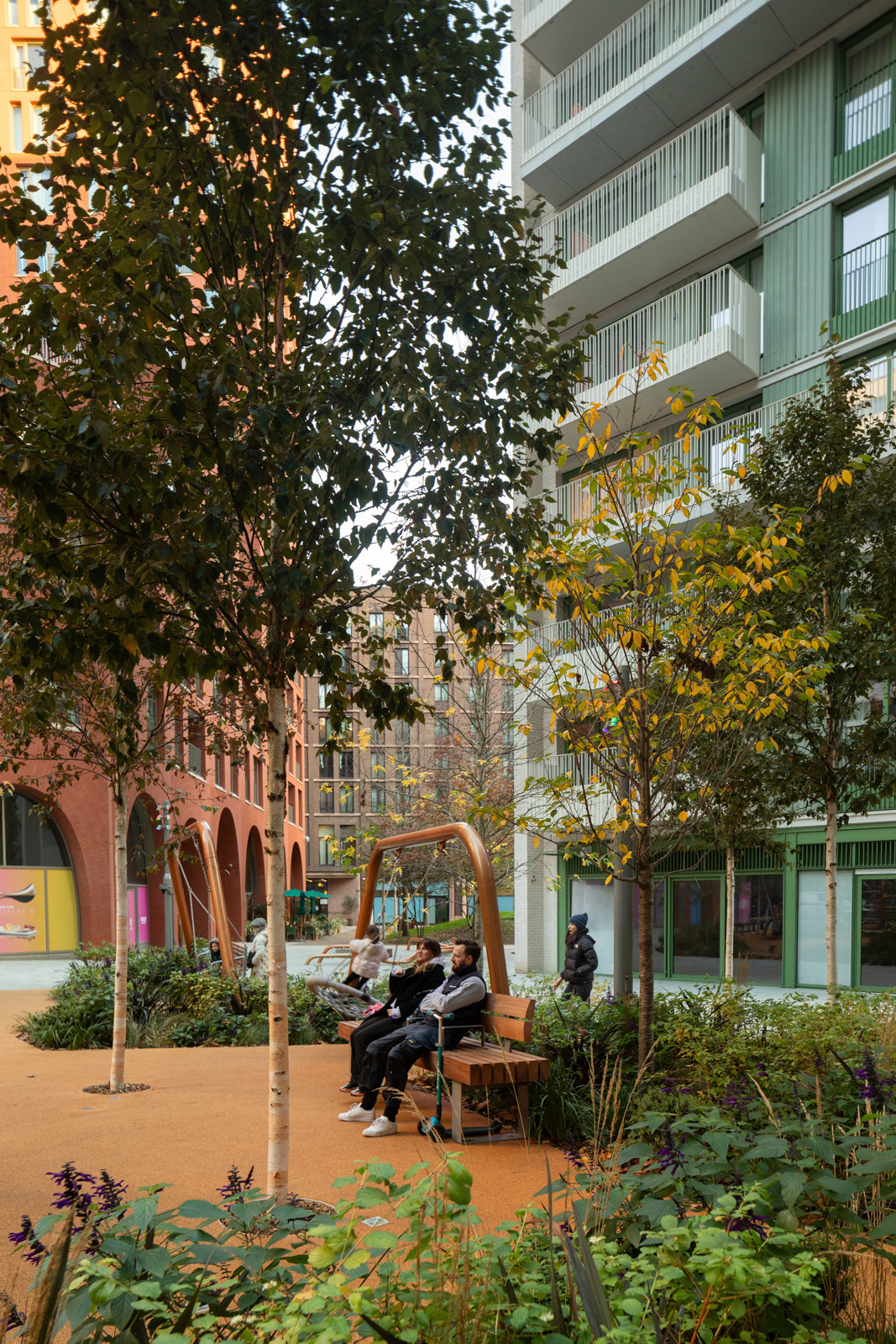
A few things came together quite early on. The site is fairly shady, so that immediately influenced the planting palette and pushed us towards something more woodland-like rather than open lawn. We wanted the whole space to feel cohesive – trees, underplanting and play elements working together.
Another big driver was the scale of the surrounding buildings. They’re tall, and the site itself is quite flat, so we felt something was needed to hold the space emotionally as well as physically. Trees help with that – they give enclosure, improve the microclimate and mitigate wind. We didn’t wind-model it, but trees are always a good first line of defence.
There was also a wider landscape context. Canal Reach nearby has a really beautiful understorey and tree structure that gradually peters out towards Chilton Square. On the other side you have Lewis Cubitt Park. So there was a strong desire to create a green link – a biodiversity corridor – connecting these spaces.

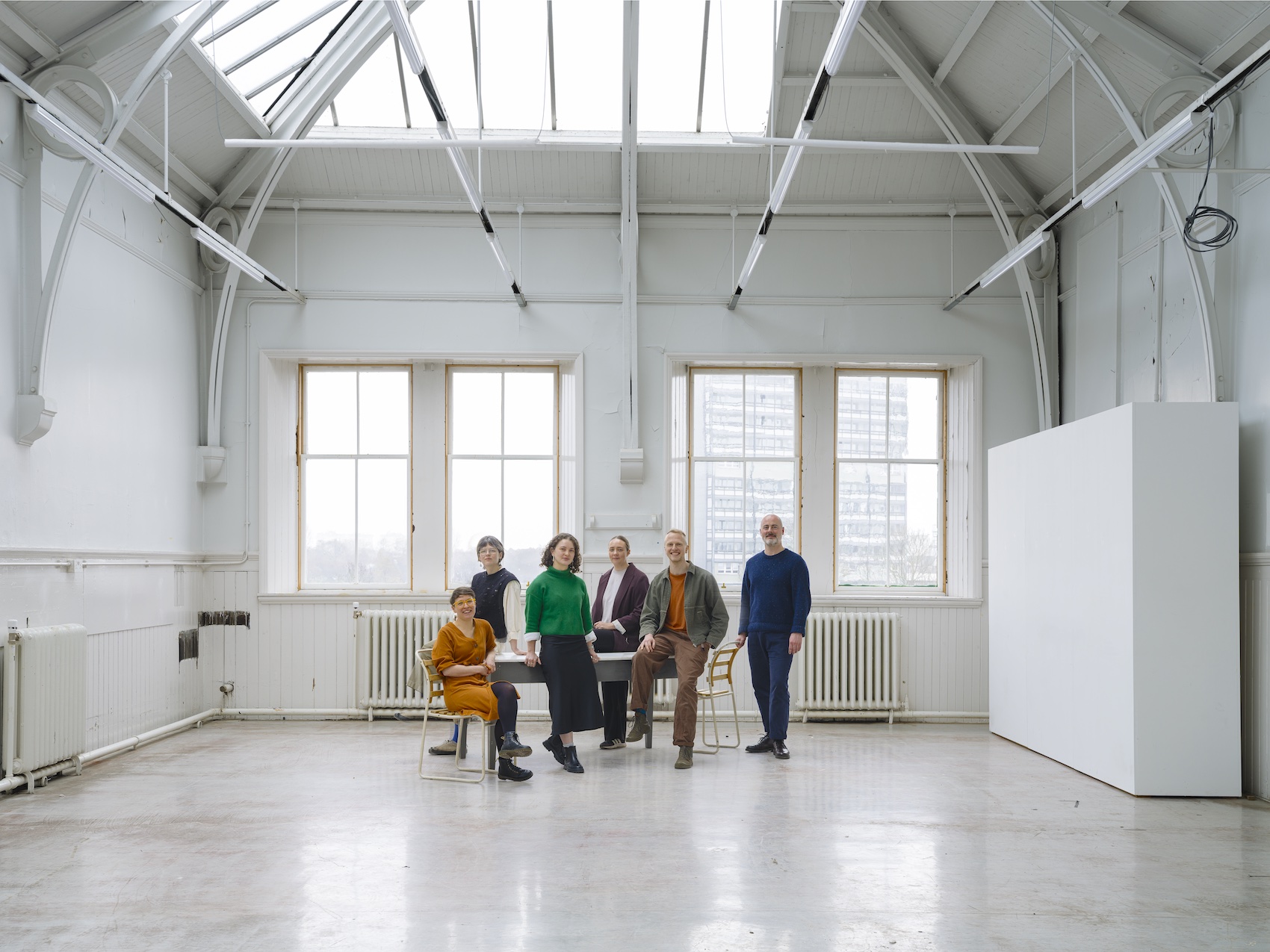
Susanne Tutsch (Credit: Root & Erect Studio)
How did you come to the project, and how was the site earmarked for play?
We came to the project through our relationship with Related Argent. We’d previously designed the playground in Claremont Park at Brent Cross Town, which proved incredibly successful – honestly, almost overused – partly because it was the first new play space in that area for a long time.
Within the King’s Cross masterplan there were two sites earmarked for play. One was Gatti Park, aimed at older children, and the other was Chilton Square, intended for younger ones. We joined the project in 2022, towards the end of the overall development phase. Chilton Square is one of the last pieces of public realm to be delivered.
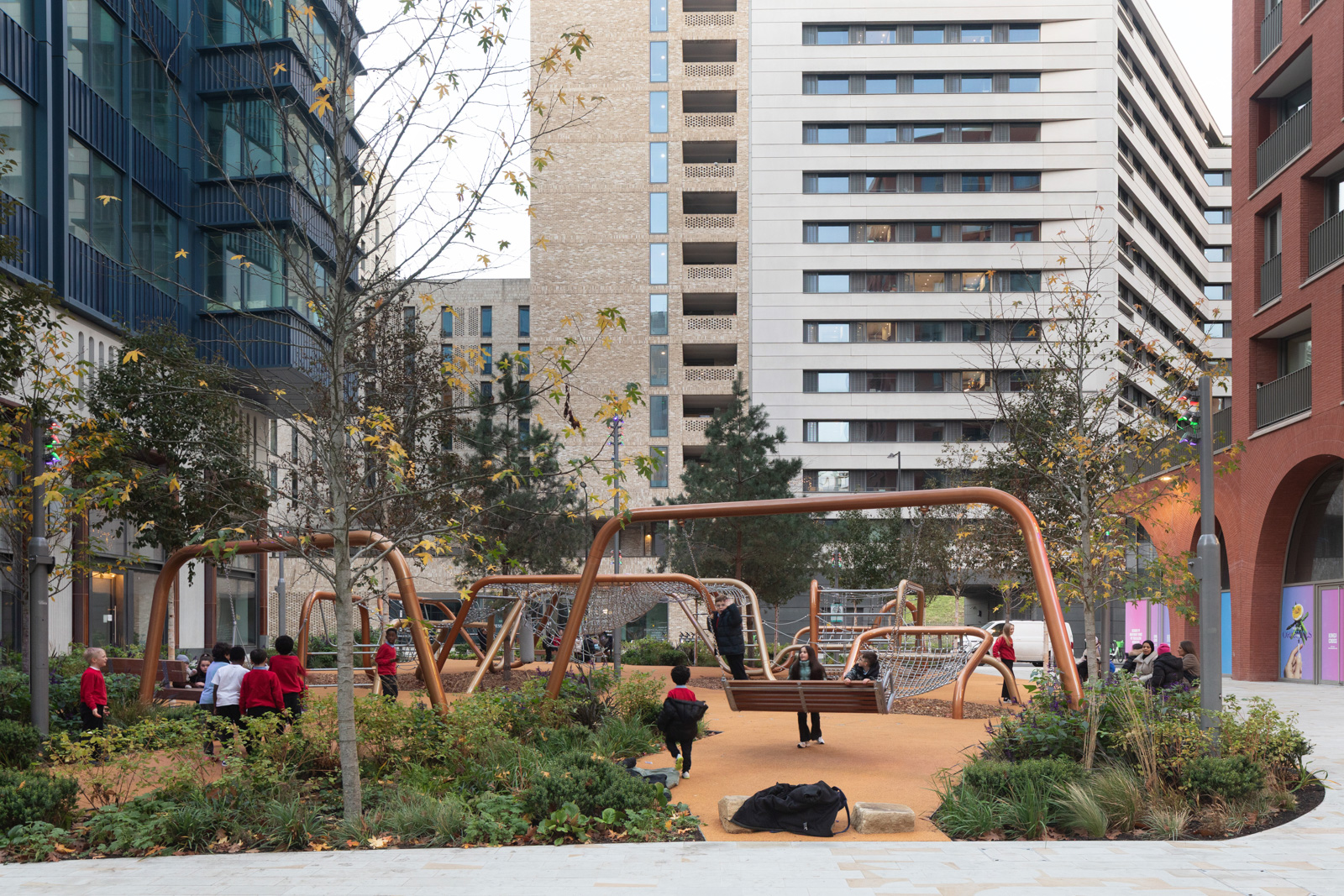
The planning consent was quite specific: it required a certain quantum of play provision and defined an age group. From the outset, everyone agreed we didn’t want a traditional fenced playground with standard equipment. The playground had to be embedded in the wider public realm, surrounded by shops, cafés and commercial uses, with people of all ages passing through all day.
That’s where the intergenerational ambition came from. It’s designed with children in mind, but it has to work harder than that. Kids are at school during the day, and they disappear in the evenings. The space needed to function as part of the city at all times.
Do you see it primarily as a circulation space, or more as a place to pause?
I’d describe it as a moment of decompression. The planting really hugs the central space, so the main pedestrian routes run around the edges. That suits both movement through the site and the adjacent uses – for example, food and drink units that want outdoor seating overlooking the play.
The edges are deliberately varied. Some are more porous, others more contained, depending on what they’re adjacent to. Overall, the trees and planting create a small oasis of calm within what is a busy urban context.
The play elements feel deliberately non-prescriptive. Was that intentional?
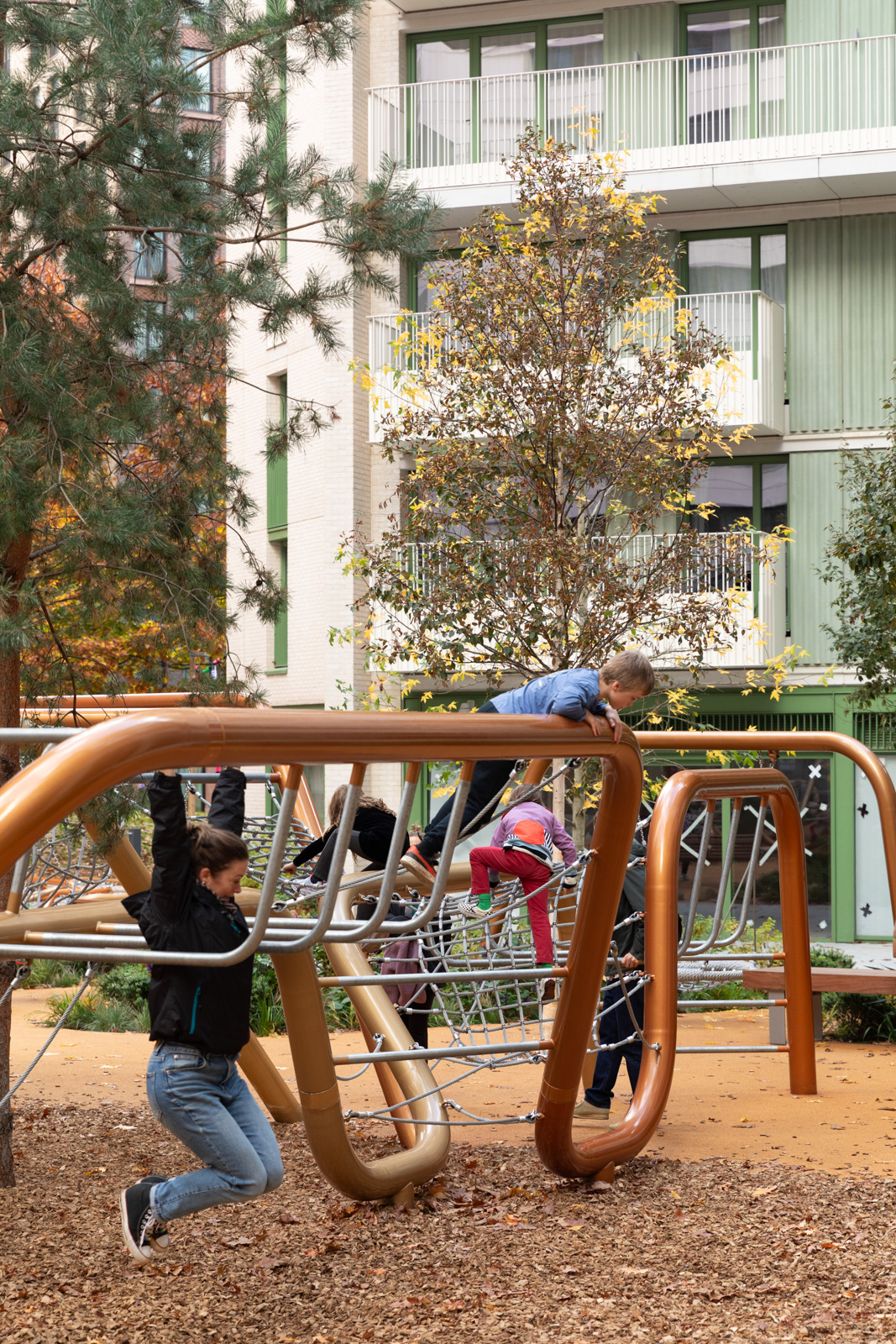
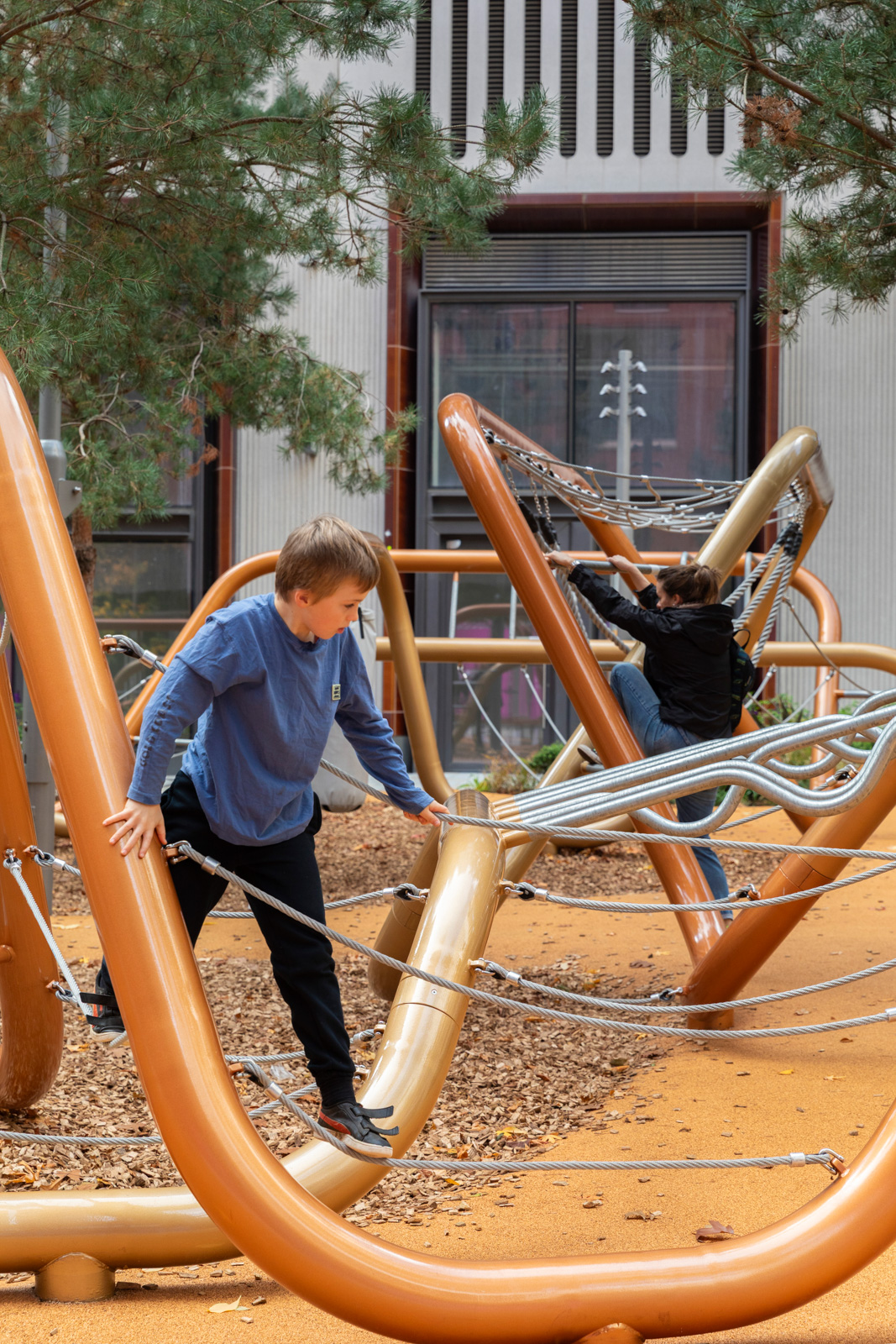
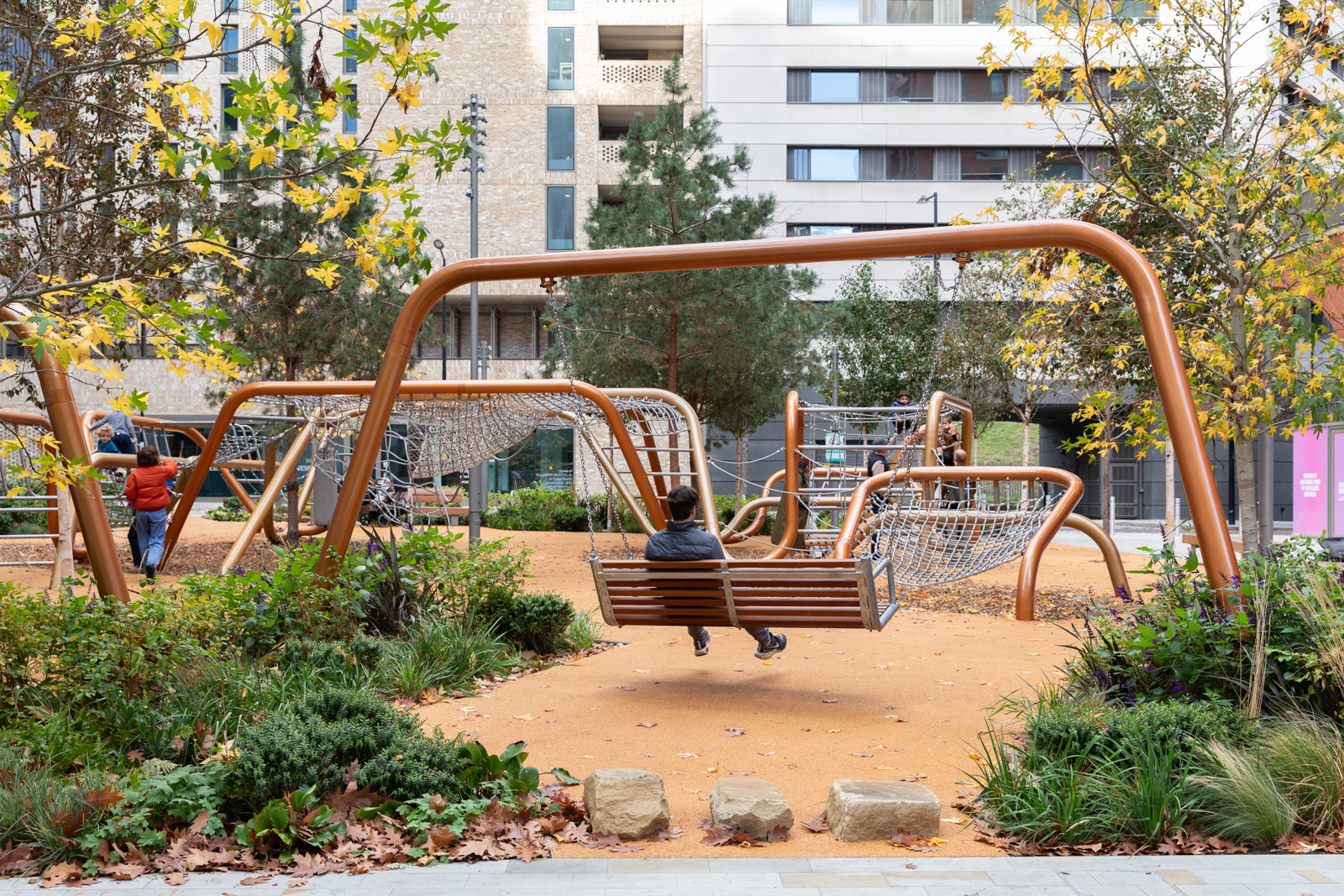
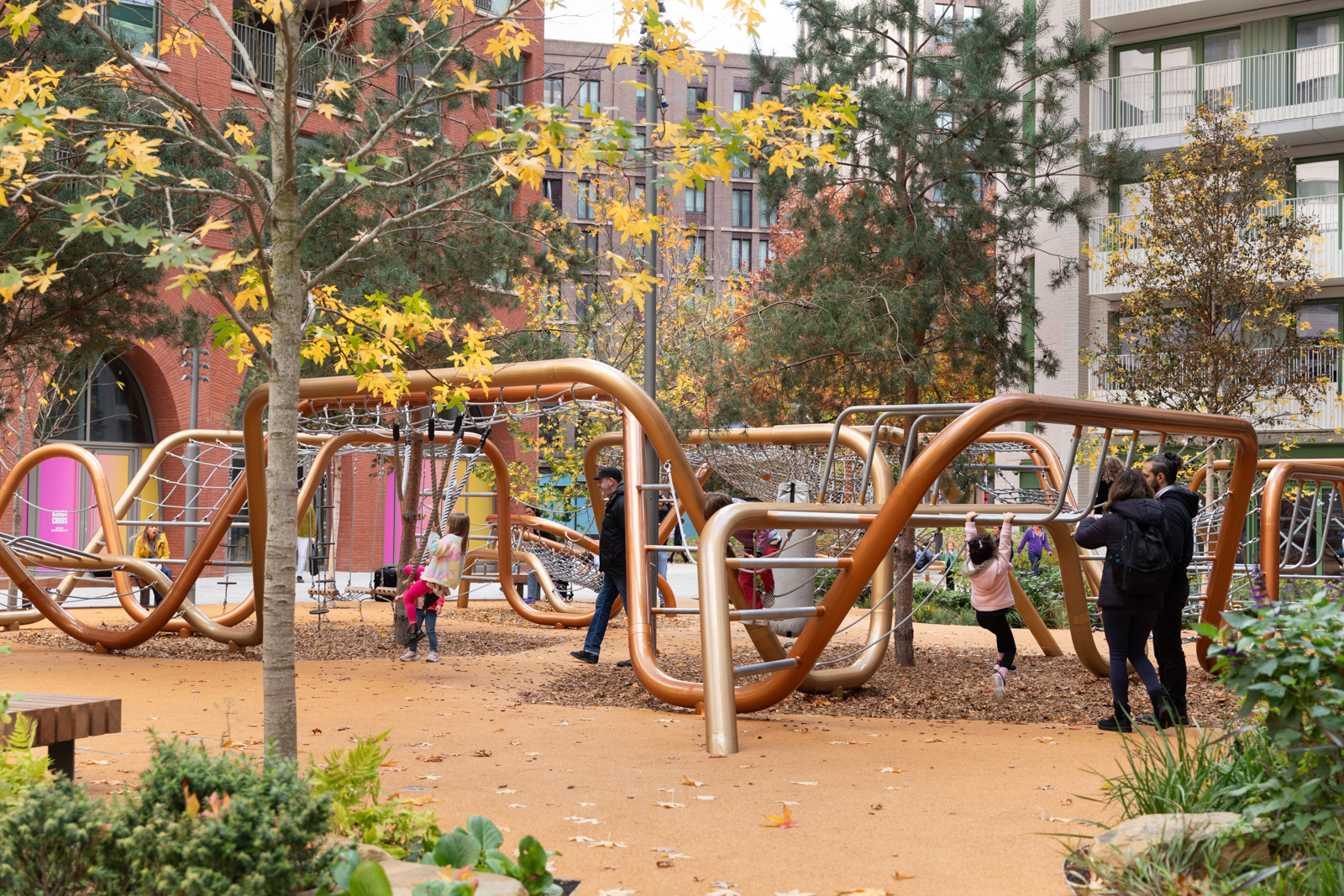
Very much so. We’ve always been interested in forms of play that aren’t overly defined. If a piece of equipment only does one thing, it quickly becomes boring. We want elements that can be used in multiple ways, and that leave room for imagination.
Ambiguity is powerful. Something can be a ship one day, something else the next. The more abstract you make it, the more children – and adults – bring their own narratives to it.
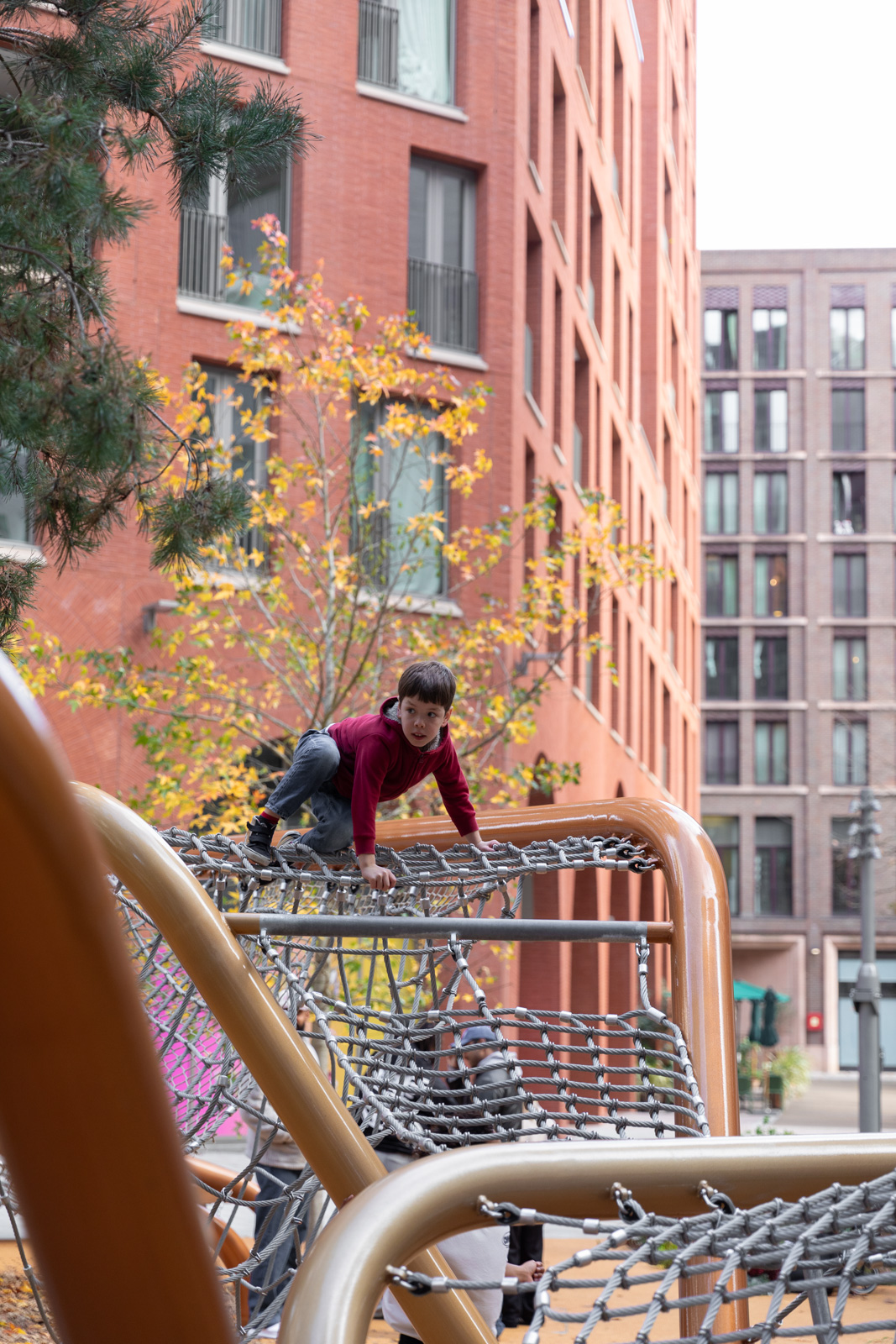
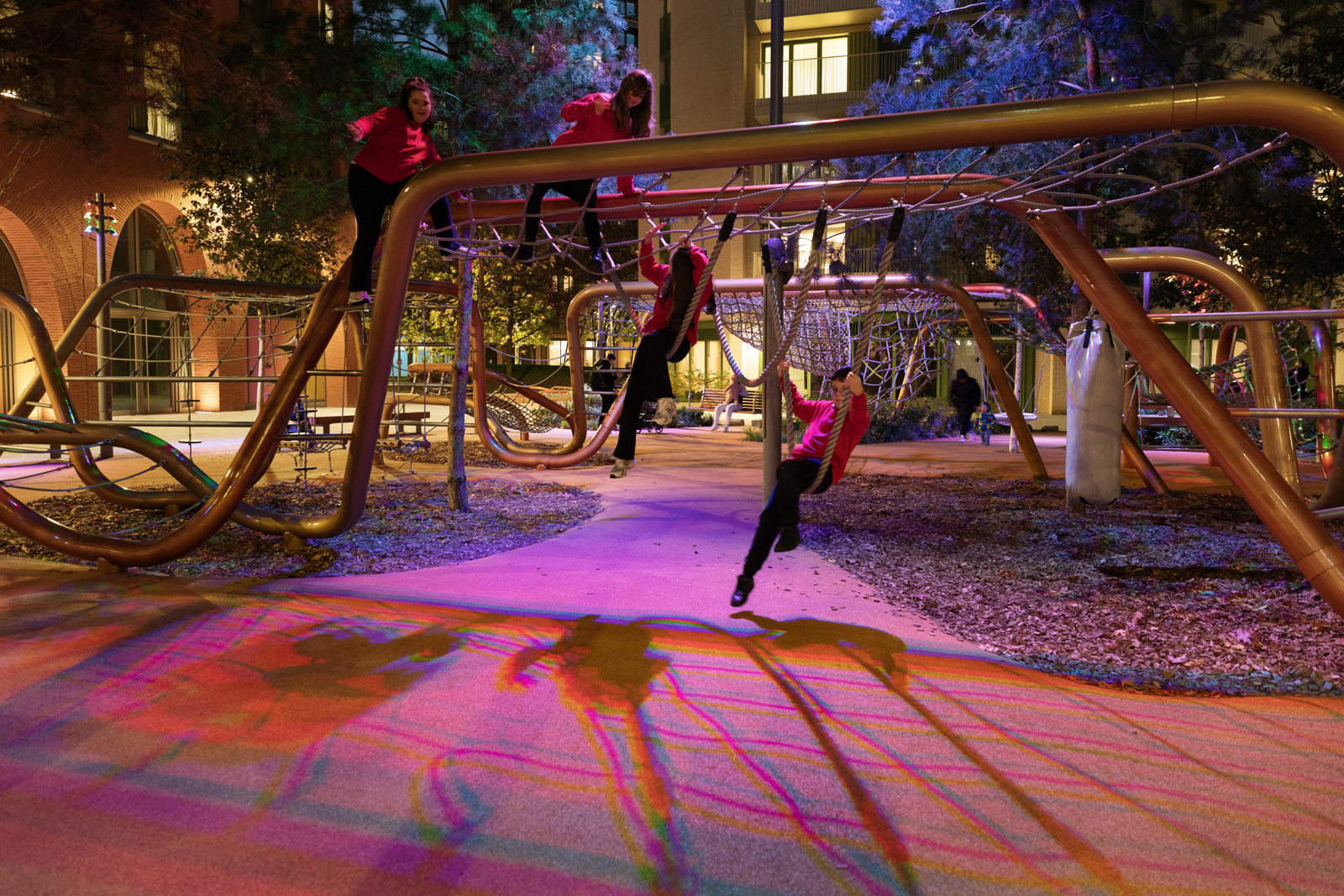
What’s also important is movement through the structure. Different routes allow for games of chase at different levels, for example. It’s not just isolated pieces of kit; it’s a connected landscape of play.
How did the double helix structure come about?
It started quite playfully, actually. The double helix appealed to us aesthetically, and of course there’s an association with the Francis Crick Institute nearby. Scientifically, it’s a very rigid form, but – add the freedom of a design concept – it can spatially become incredibly flexible.
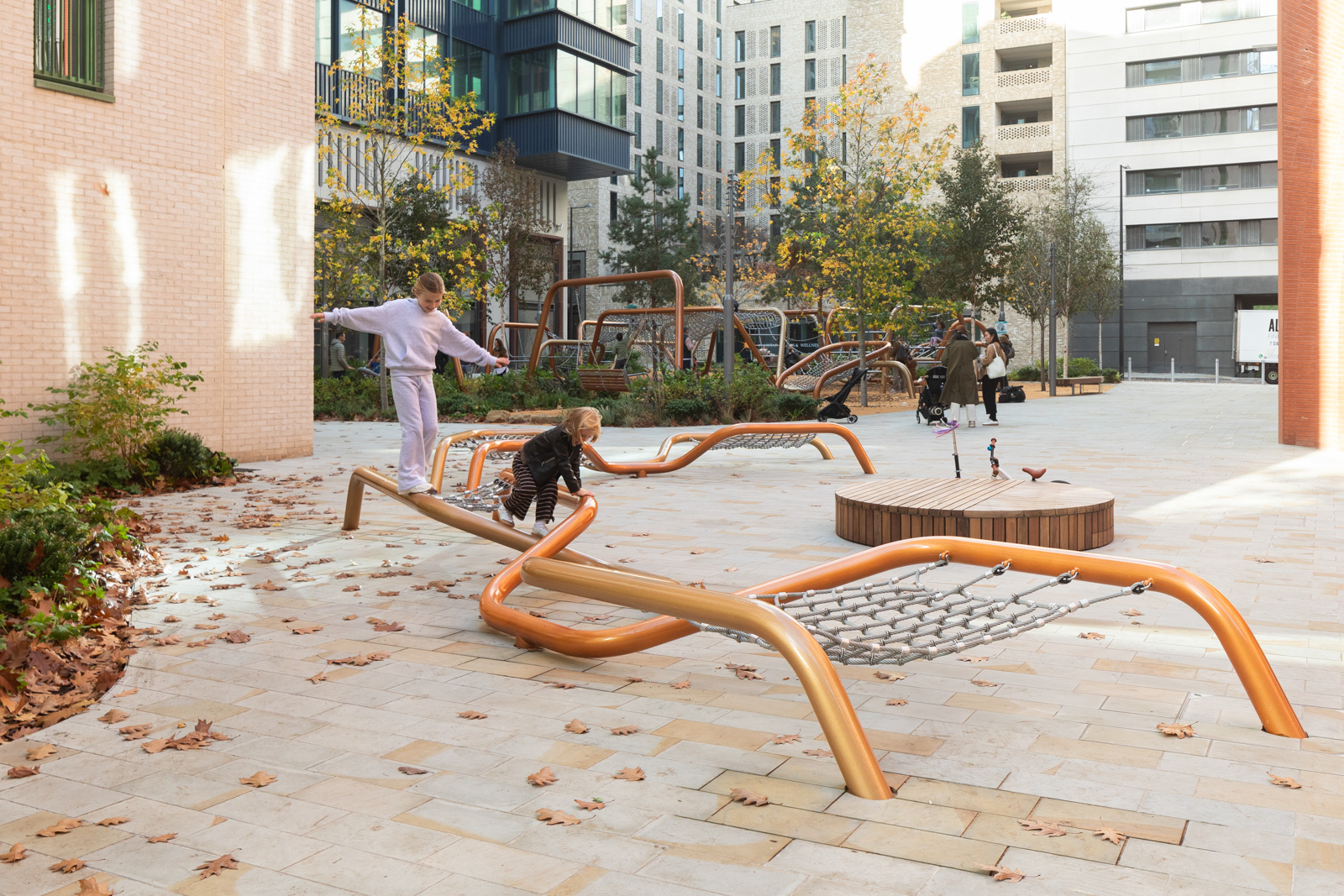
Using two strands allowed us to create free forms that bridge, twist and change direction. Between those strands you can infill different play elements. It also allowed us to be very sculptural – which was a client requirement – and create a long, continuous element which supports multiple routes, levels and interactions.
Were there other site references that informed the design?
The site’s former life as a construction compound definitely influenced our early thinking. When we first saw it, it was full of large containers, and it was quite hard to read the space.
One of our initial concepts actually leaned into that history: a rougher, adventure-play landscape made from recycled materials, gantries and rubble – echoing the origins of traditional adventure playgrounds. But it was felt to be too rough-and-ready for King’s Cross, and it didn’t meet the aspiration for a sculptural centrepiece.
The DNA-inspired scheme was the alternative, and that’s what ultimately resonated.
The site has very dense underground services. How did that affect the design?
It was a huge constraint. There are railway tunnels below, but more significantly, there are services criss-crossing the site in every direction, with large exclusion zones.
We produced detailed, colour-coded plans to understand where we had enough space and depth for trees or foundations, and where we couldn’t touch the ground at all. In some areas, the structure literally lifts up and bridges over service zones so that maintenance can take place without dismantling the play equipment.
Nothing was left to chance. Tree locations, foundations and the geometry of the structure were all part of a complex spatial puzzle. We wanted children to get close to the trees, to feel immersed in a woodland environment, but doing that while navigating underground constraints took time and careful coordination.
What did your workshops with local schools involve?
By that point we already had the helix concept, but the workshops were about testing how it might actually be used. We gave the children pipe cleaners and straws and asked them to explore the double-helix geometry themselves.
Part of that was spatial understanding – seeing how the form works in three dimensions – but it was also about imagination. How might you play with this? What could it become?
The results were fascinating. Some children built very literal swing frames, while others created much more organic, as well as nest-like structures that were surprisingly close to what ended up on site. When they presented their ideas, themes of cosiness, quietness and protected space came through strongly.
That directly influenced the design. It reinforced the need for slower, quieter and sensory zones alongside more active play, which led to elements like the willow dens and areas of different tactility.
Were there specific insights from working with the Frank Barnes School for Deaf Children?
The emphasis there was on sensory experience and clarity. Alongside feedback from accessibility consultants, we paid particular attention to thresholds and legibility.
Because there are no fences, planting beds define entry points into the play space. We learned that these transitions needed to be clearer and more readable, especially for children with different sensory needs.
How do you translate children’s ideas into something that’s buildable and safe?
Ultimately, that’s where our role as professionals comes in. We don’t build the models exactly as the children make them, but we extract the essence of their ideas.
If a child designs a nest, we ask: what makes it feel like a nest? Is it enclosure, softness, a sense of retreat? Then we translate that into something safe and durable – perhaps through nets, cradling forms or willow structures.
It’s a conversation and an evolution, rather than a direct translation.
What made you specify Corkeen rather than traditional rubber surfacing?
From the outset, we wanted to push the sustainability agenda further than usual. Concrete foundations and plastic surfaces are big carbon contributors in playgrounds.
Corkeen appealed because it’s made from a by-product of the cork industry and is far more sustainable than rubber. At the time it was still relatively new, so we did a lot of research to see how it performed over time.
Because it comes only in a single colour, we used other strategies – planting, structure and areas of bark chip – to create variation and zoning across the space.
How did you think about integrating adult fitness and social use alongside children’s play?
We were very reluctant to fence or strictly segregate the space. Good play practice also doesn’t separate ages rigidly. Instead, it creates subtle differences in skill level and challenge.
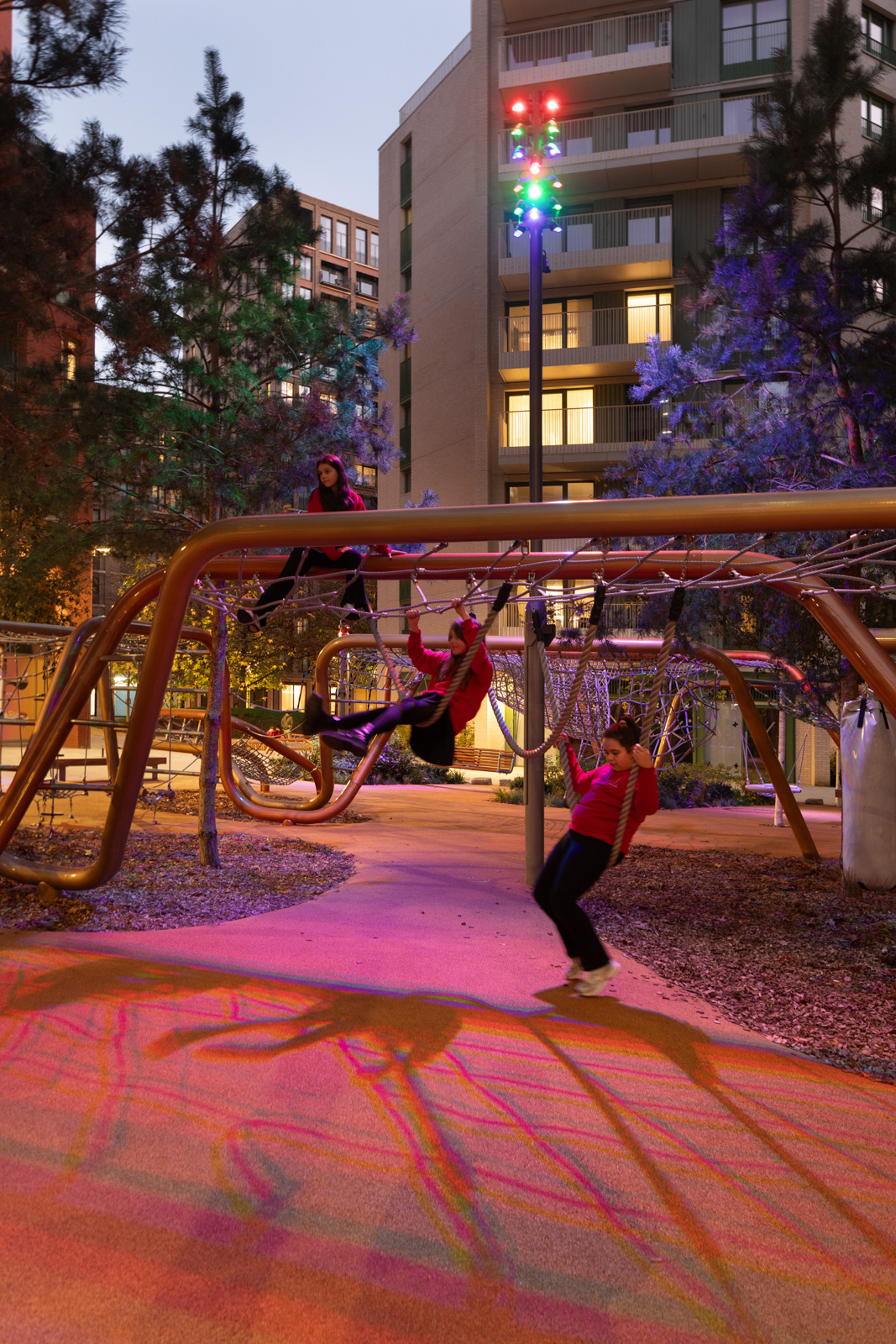
That applies to adults, too. Playgrounds are empty for large parts of the day. This space can be used for a lunchtime workout, somewhere to sit with a coffee, or a place to pass through in the evening.
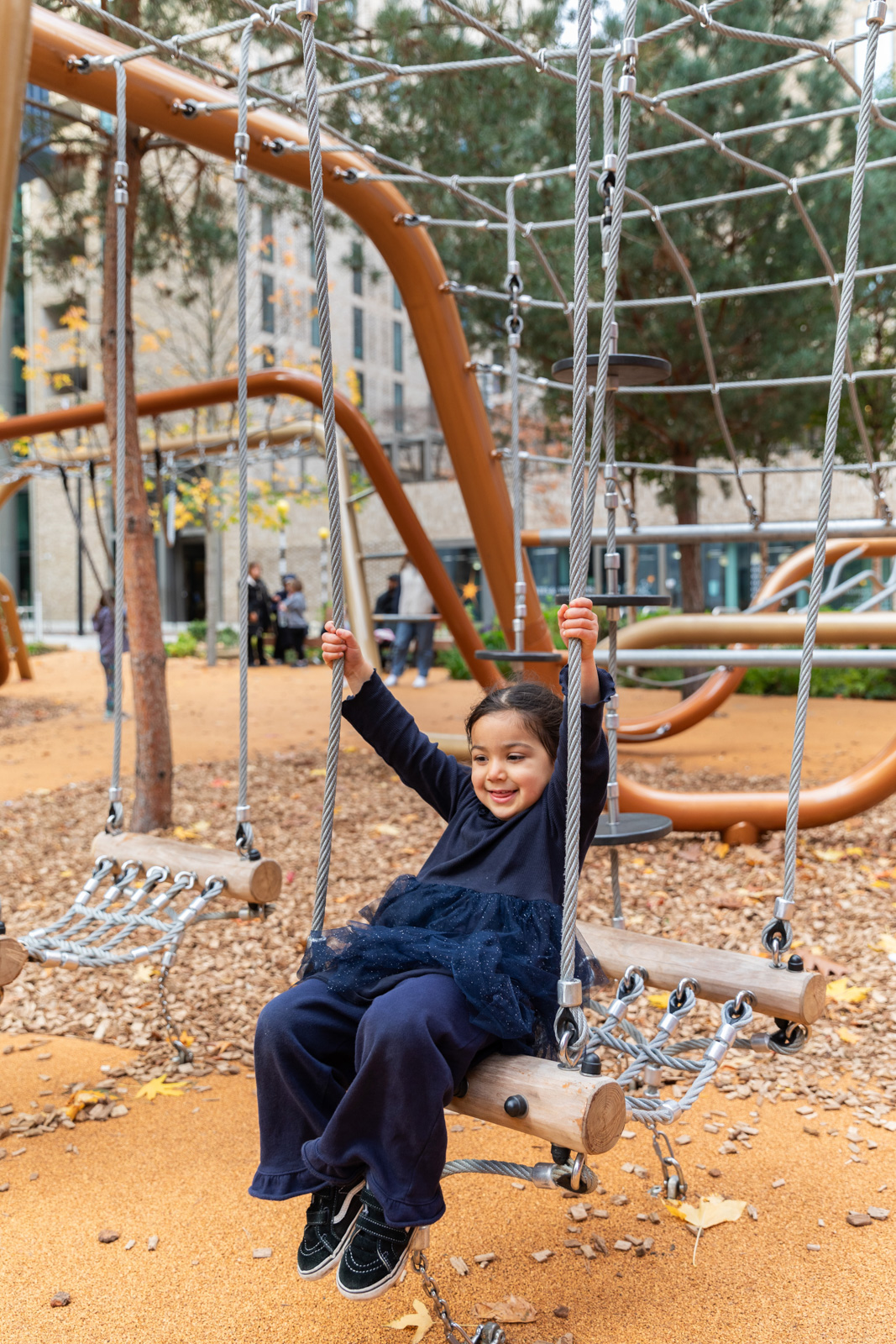
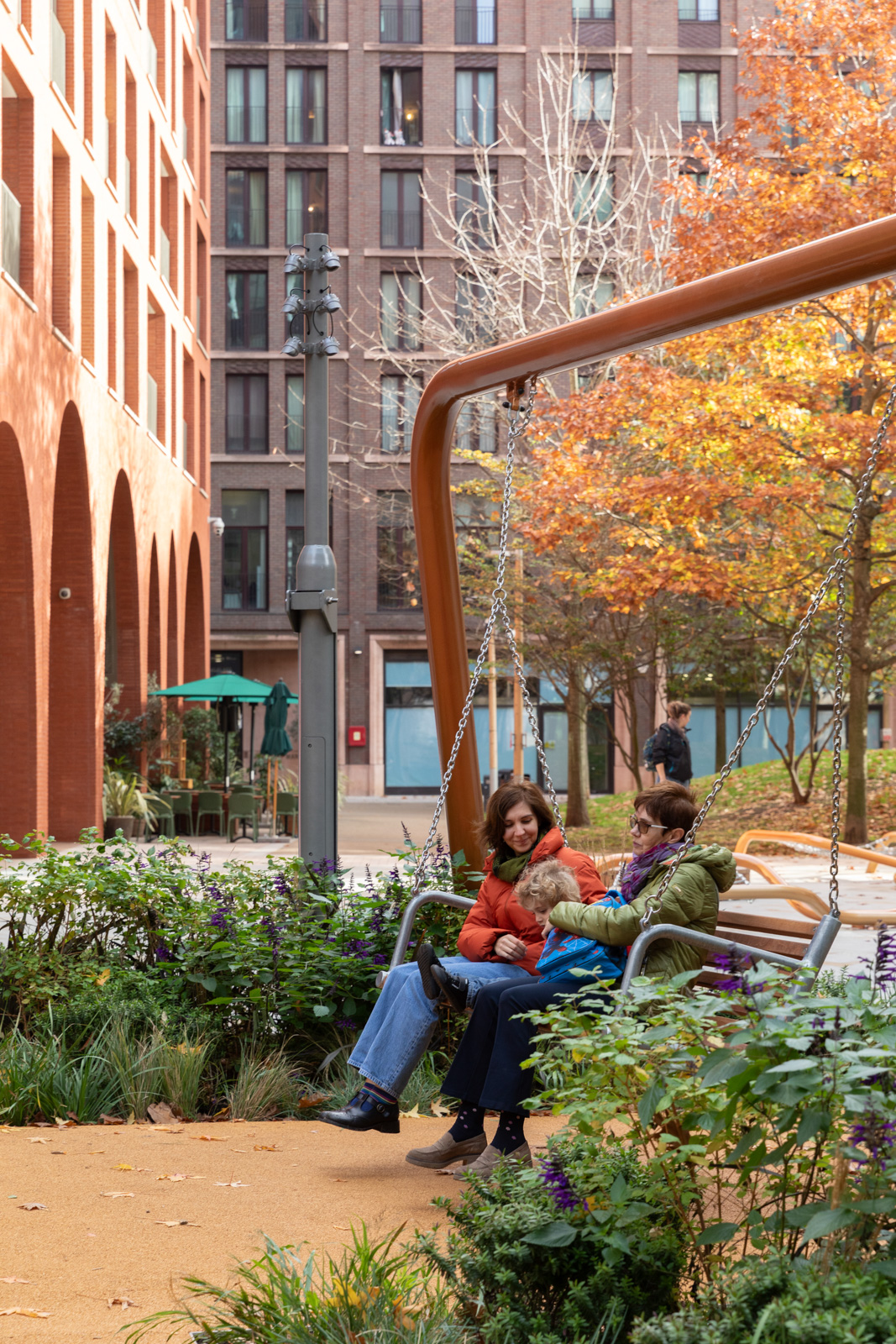
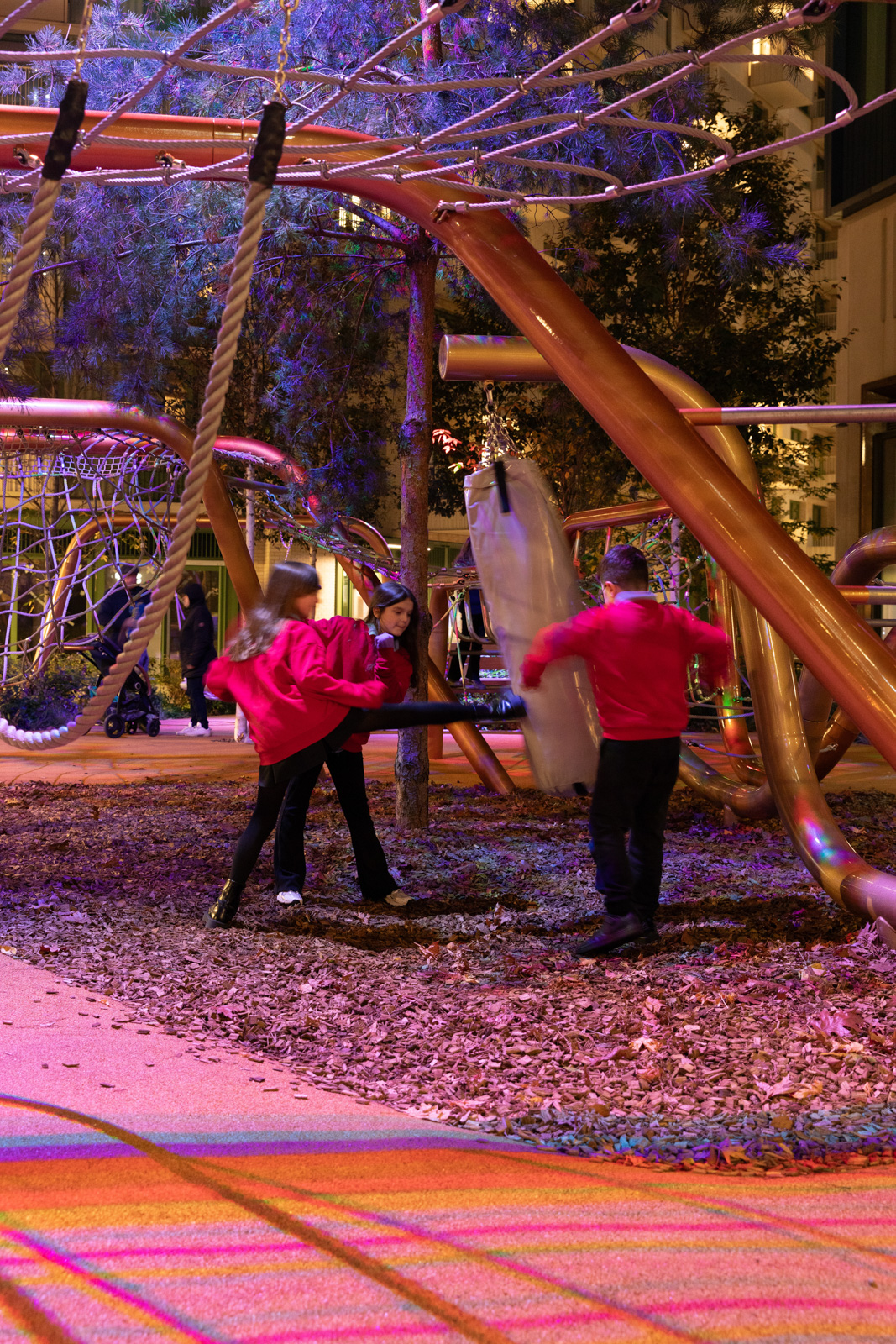
Some elements can be used by children or adults in different ways, for example climbing elements double up as fitness features. Some features, like the punch bag and the holiday swing, are simply multigenerational. It’s about coexistence and shared ownership of public space.
How do you imagine the space being used over time?
I don’t expect the patterns of use to change dramatically. Playgrounds typically have a lifespan of 15–20 years, and this one may last longer because of its materiality and robustness.
Usage will always be shaped by its context – the surrounding buildings, businesses and residents. There will always be adults passing through, and children using it as a destination.
What matters most is that it remains flexible and open to interpretation. That’s what gives it longevity.
We also eliminated conventional concrete foundations by using compacted ground, which is a traditional technique often used for lampposts. Combined with reclaimed steel – designed around commonly available second-hand sizes – it means the structure can be disassembled and reused much more easily in the future. That circular thinking was fundamental to the project.
Additional images