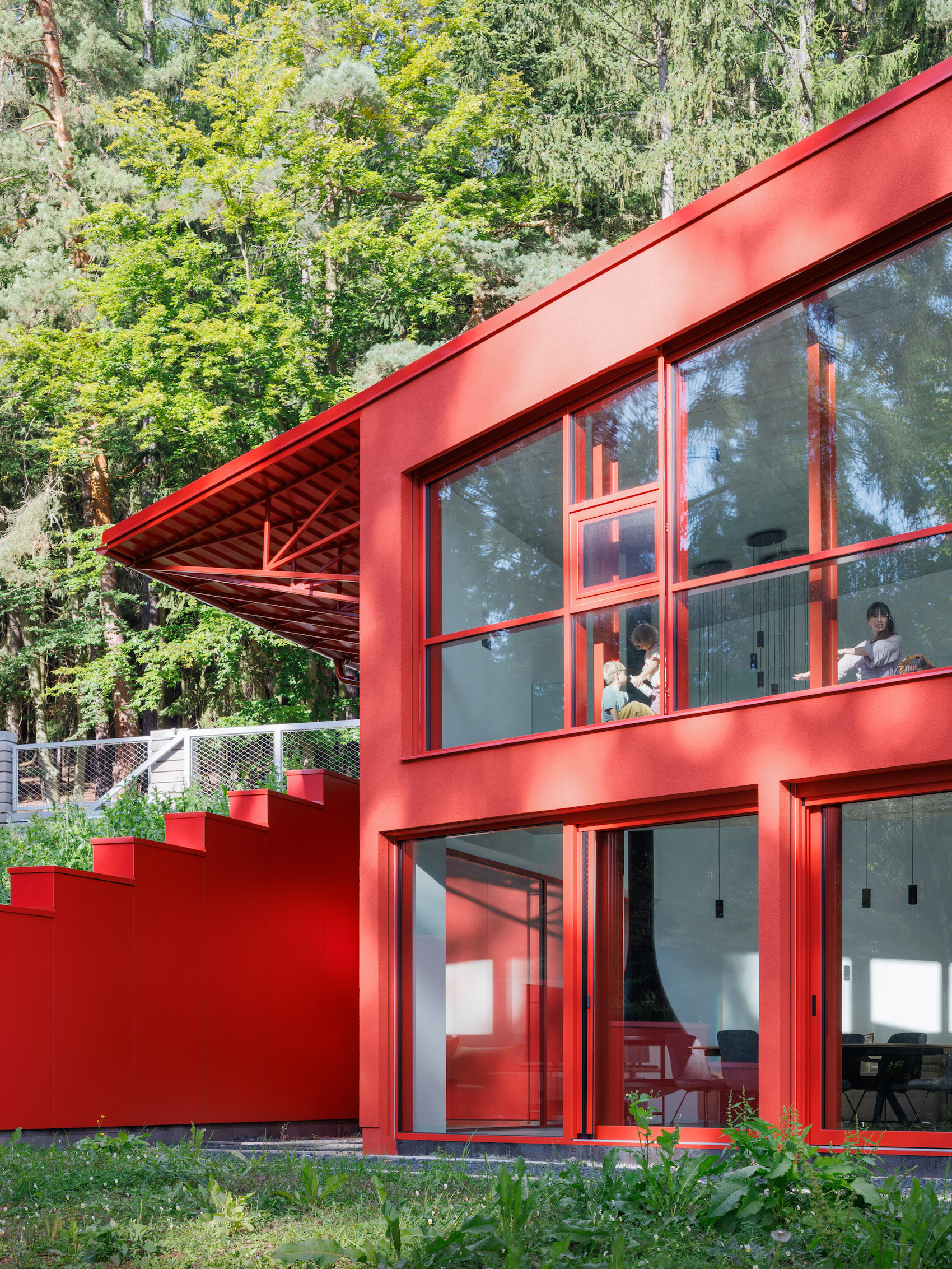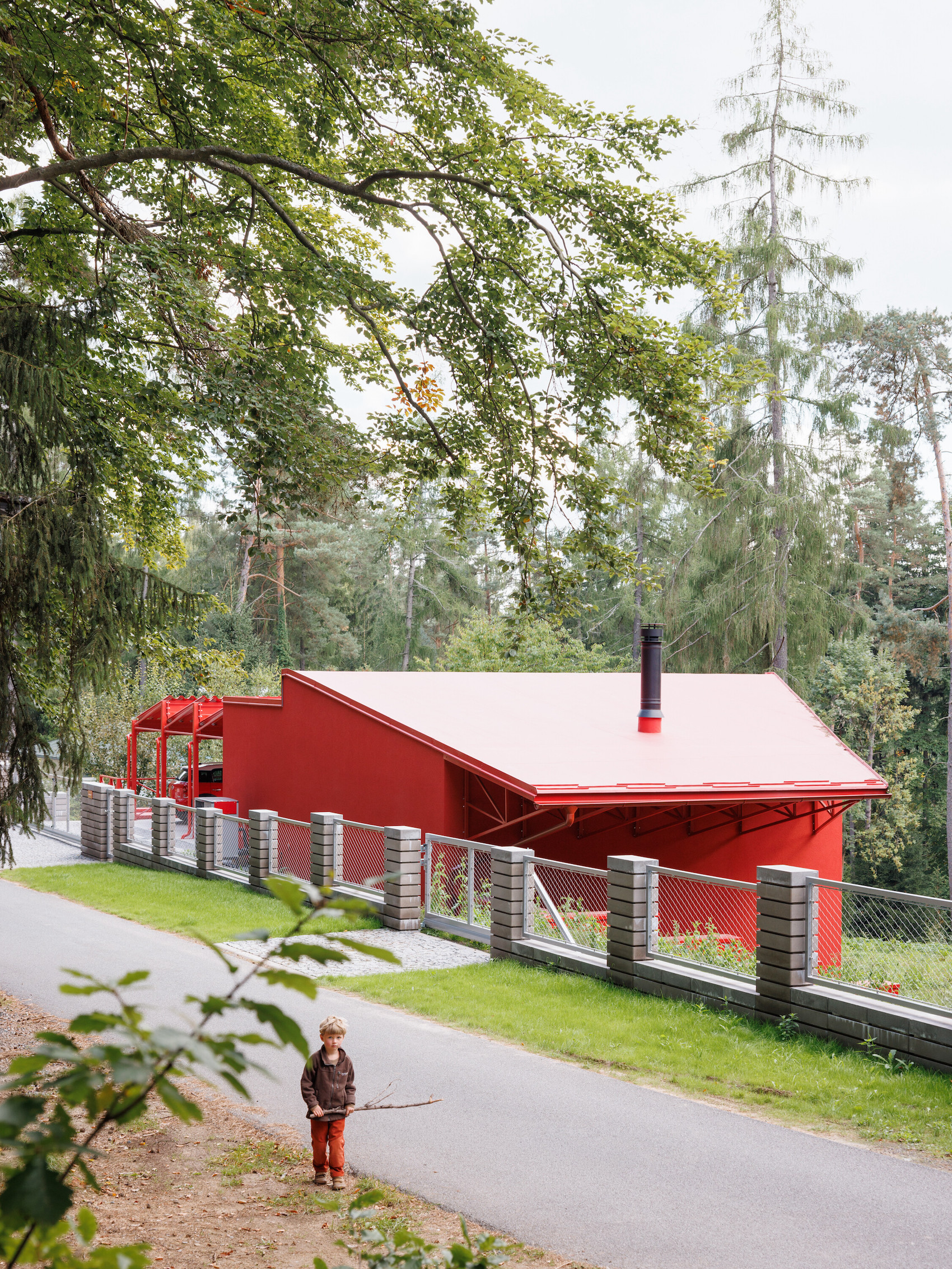
Located on a steeply sloping site in Jevany, Czech Republic, Architektura has completed a visually-striking house that employs sectional design and a robust material palette to frame views and connect domestic life with the surrounding forest.
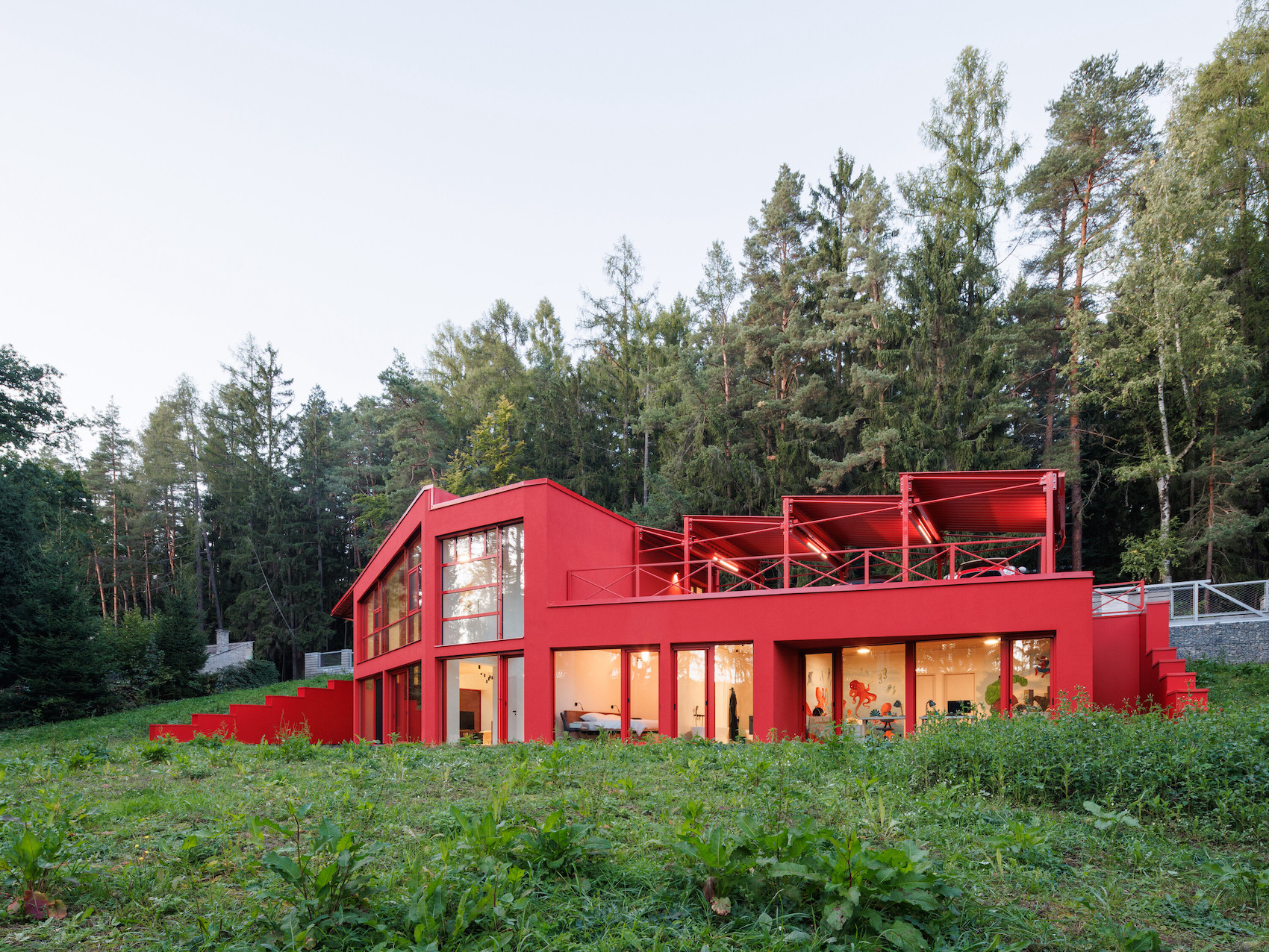
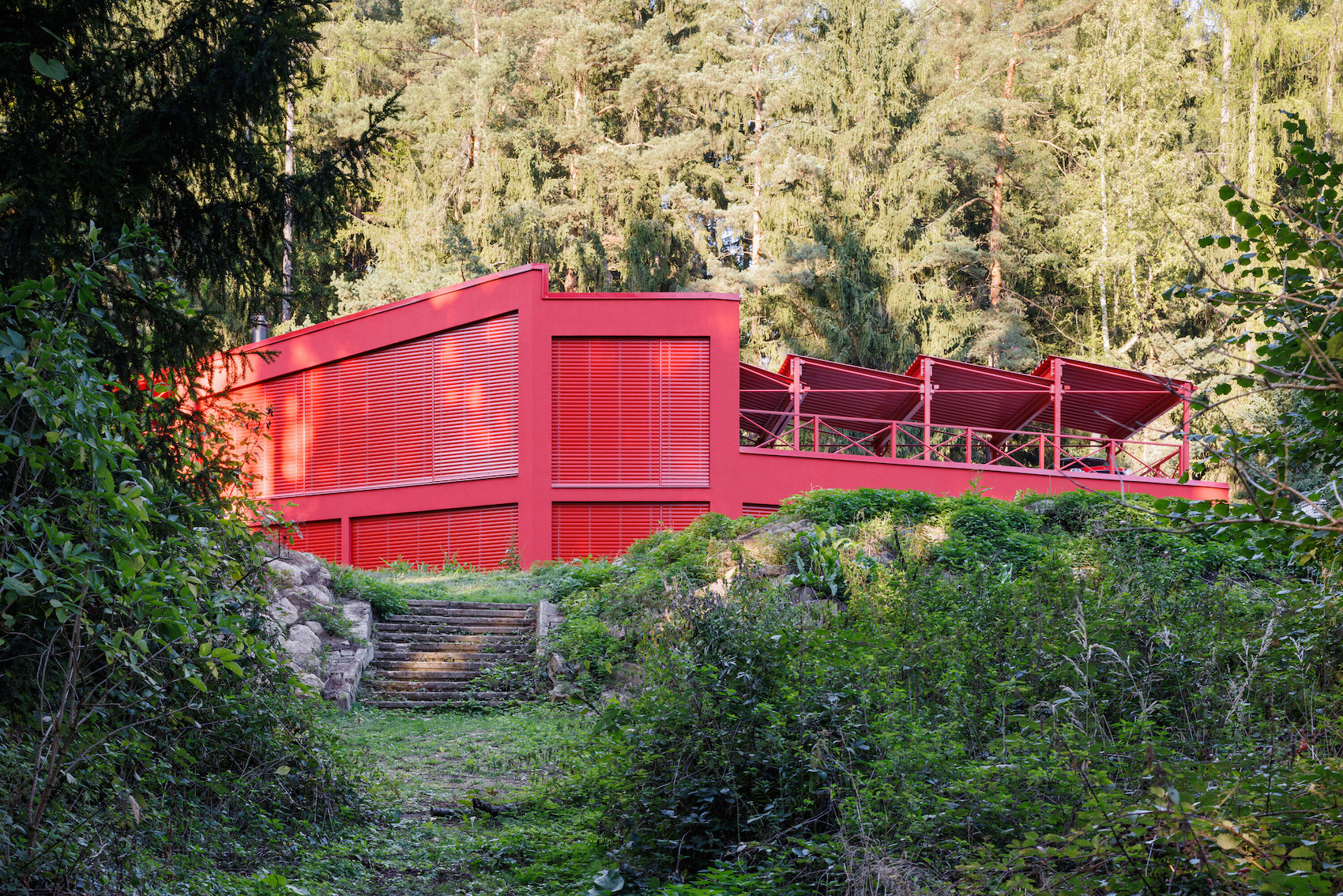
Architektura, led by David Kraus, has completed Jevany Villa in Jevany, Czech Republic, a family house that responds closely to its steeply sloping site through sectional design, material expression and carefully framed views. Set within dense spruce woodland, the house reinterprets the relationship between domestic space and landscape, appearing compact and restrained from the street while opening fully to the forest below.
The site lies within a pattern of elongated former forest plots, accessed from an upper road and bordered by a lower path along a series of ponds. The terrain descends significantly from north to south, with a level difference of approximately 3.6 metres across the building footprint. Mature trees, some rising up to ten metres below the house, form a dominant presence, shaping both the orientation and spatial organisation of the project.
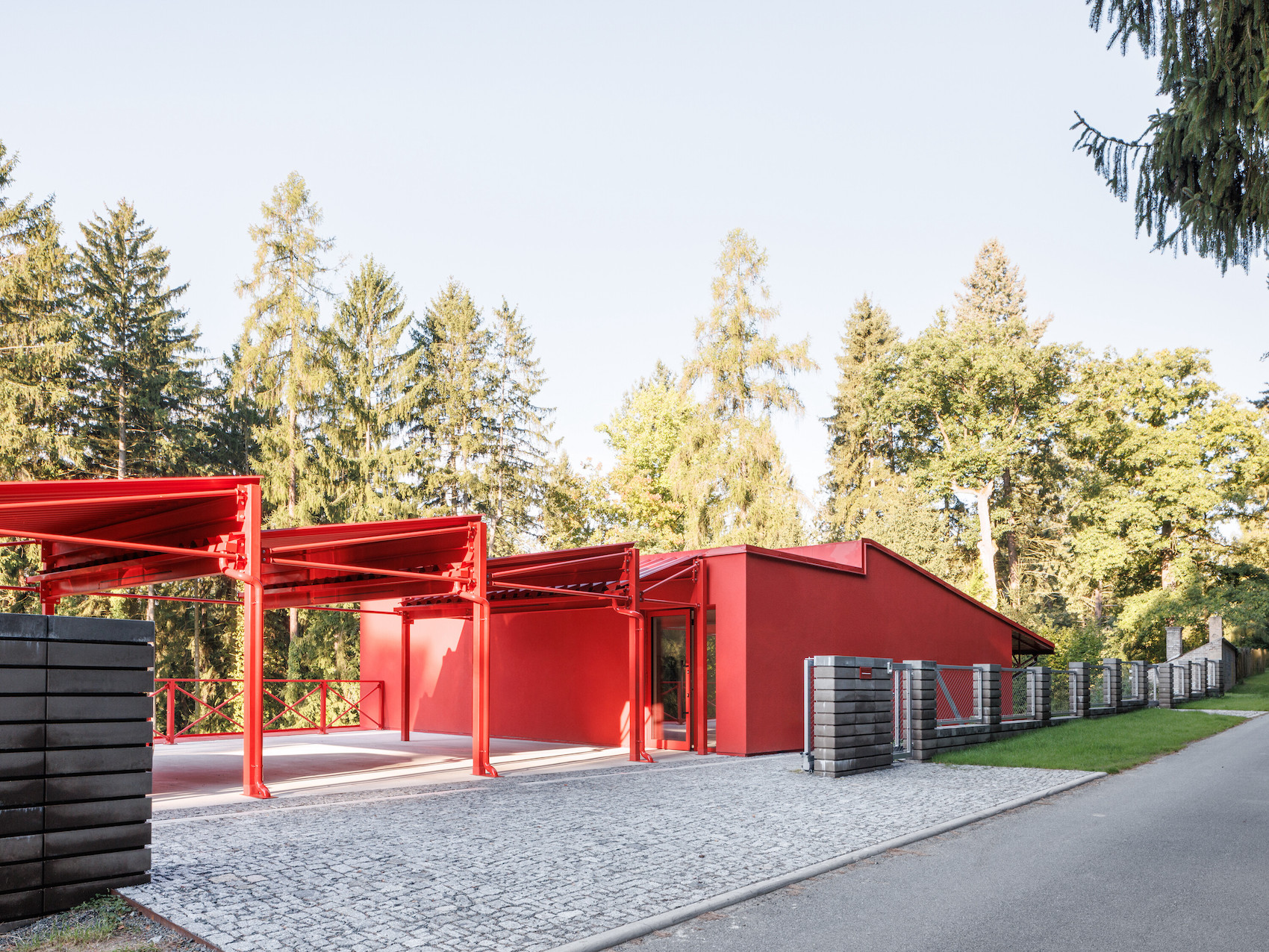
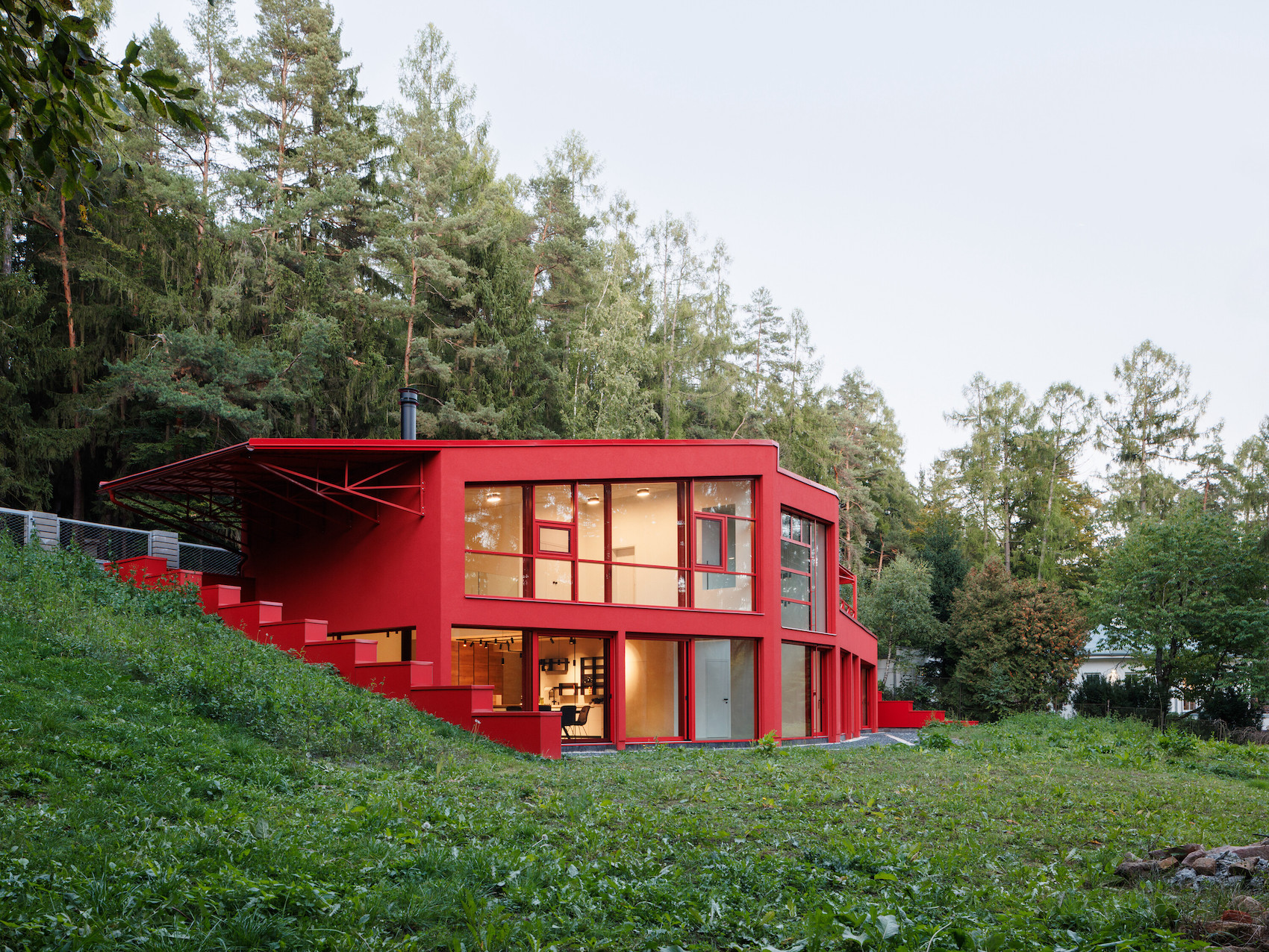
The house is embedded into the slope from the north, presenting itself as a single-storey volume from the street. From the south-facing garden, however, it reveals a two-storey glazed façade, opening towards the forest. This dual condition is reinforced by a sectional strategy organised around a central staircase, which acts as the primary spatial and visual axis connecting upper and lower levels.
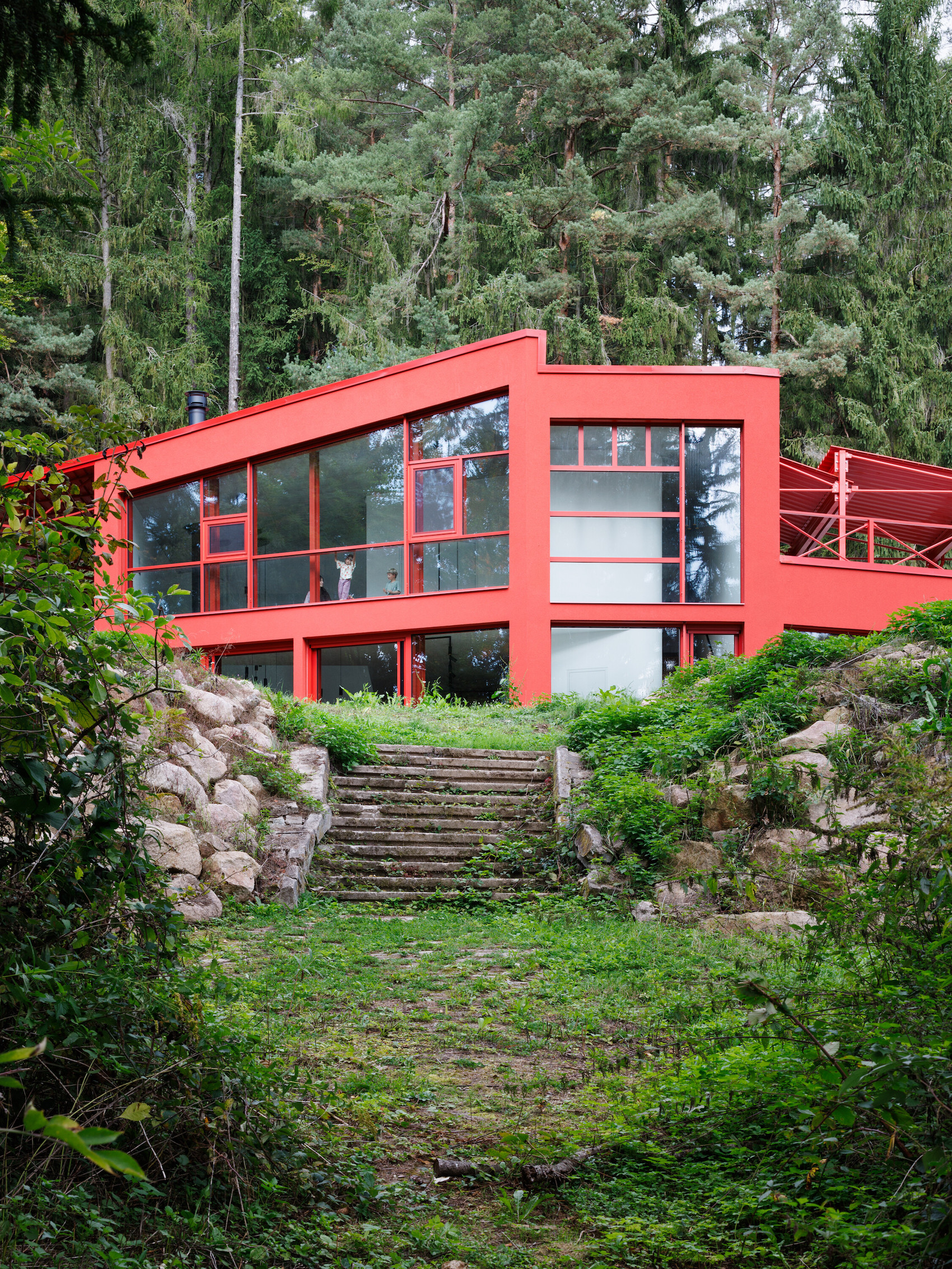
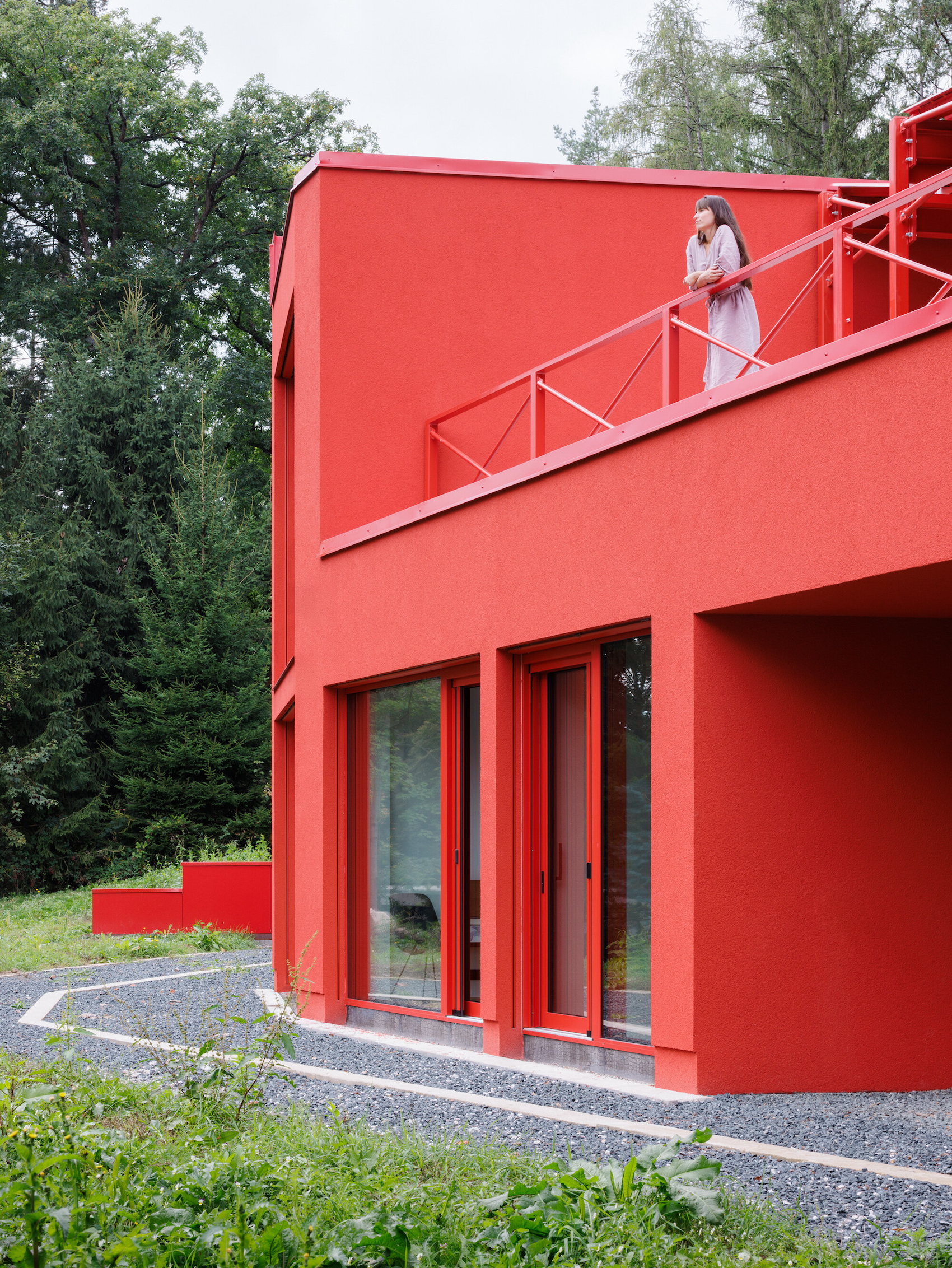
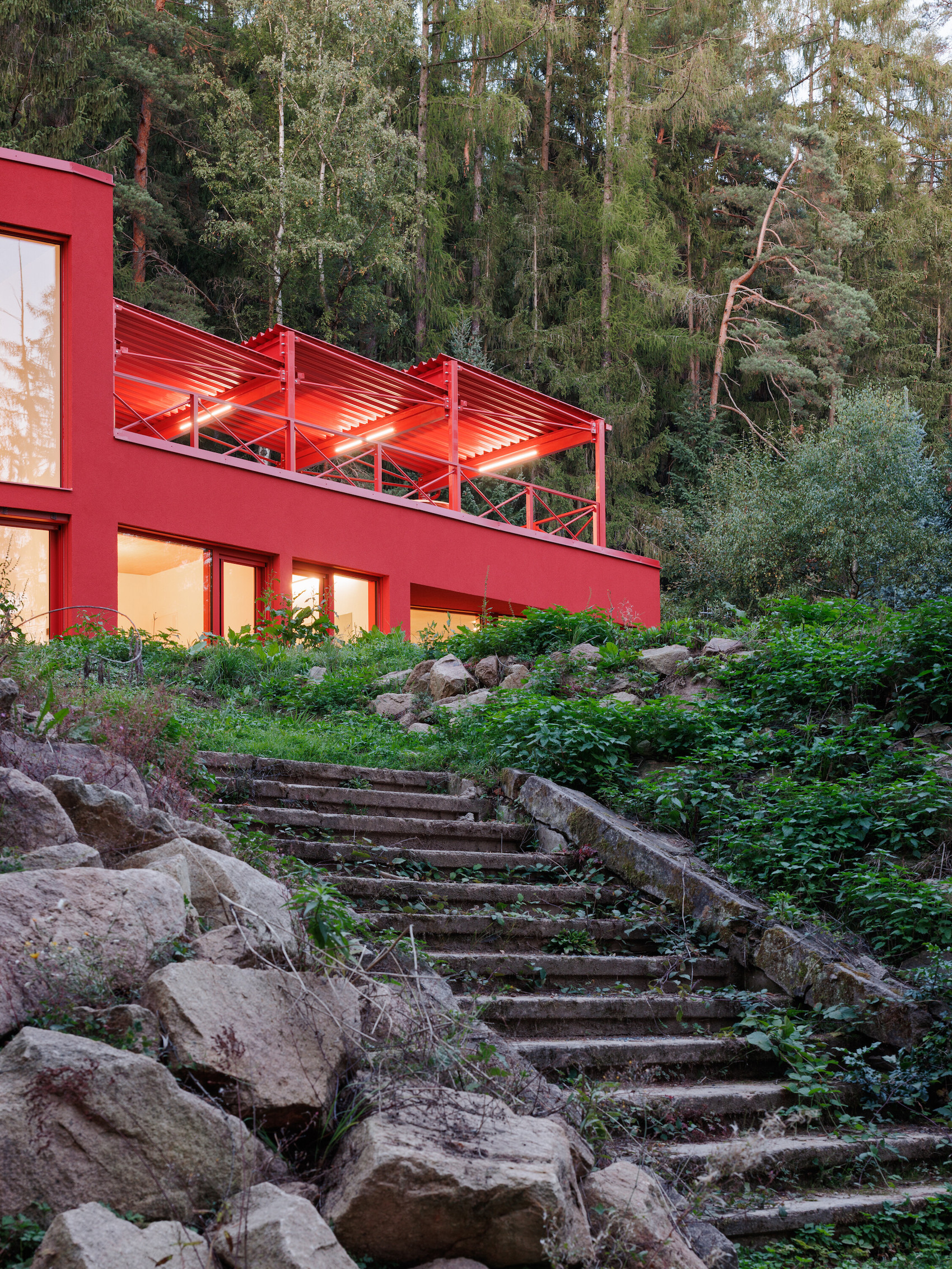
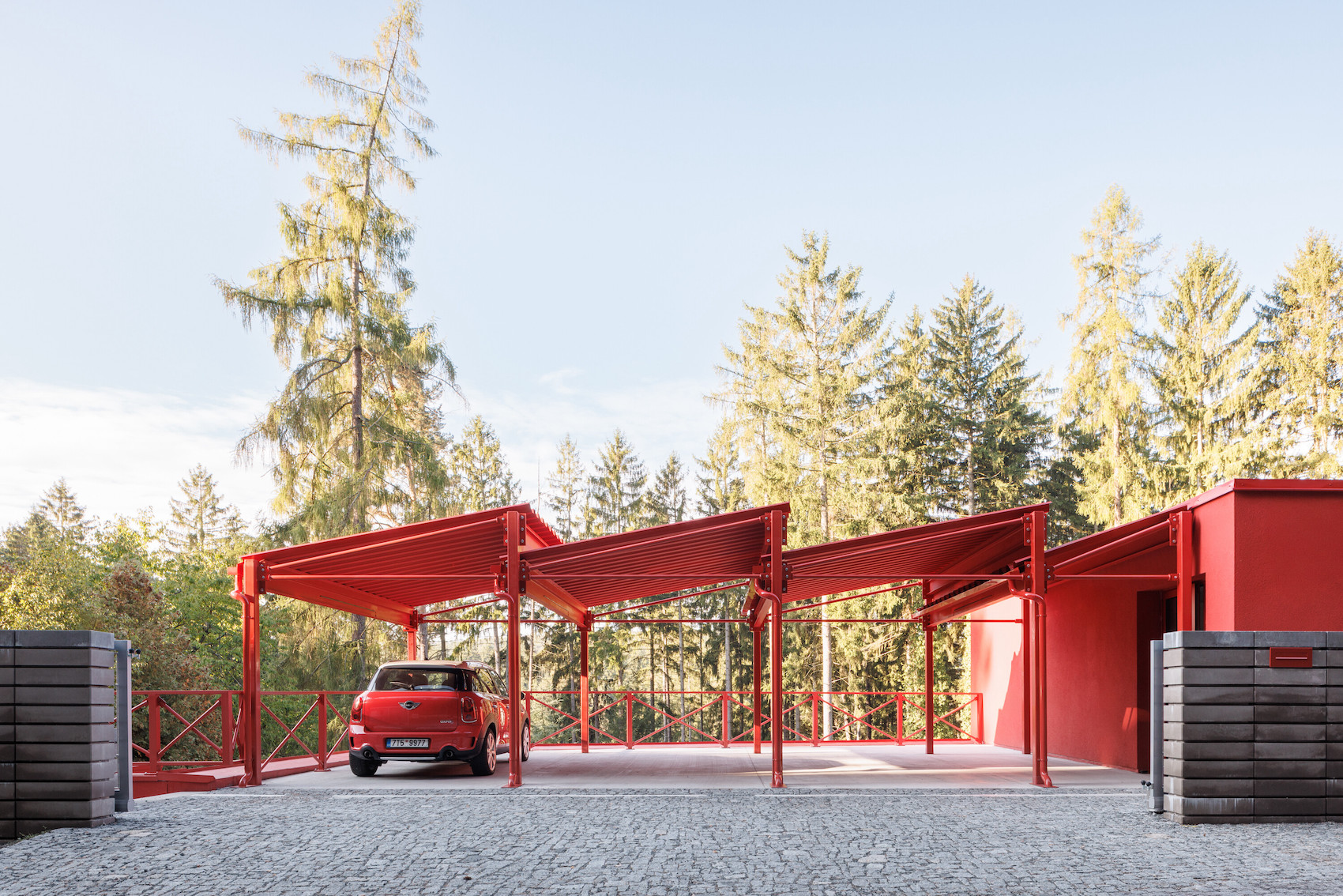
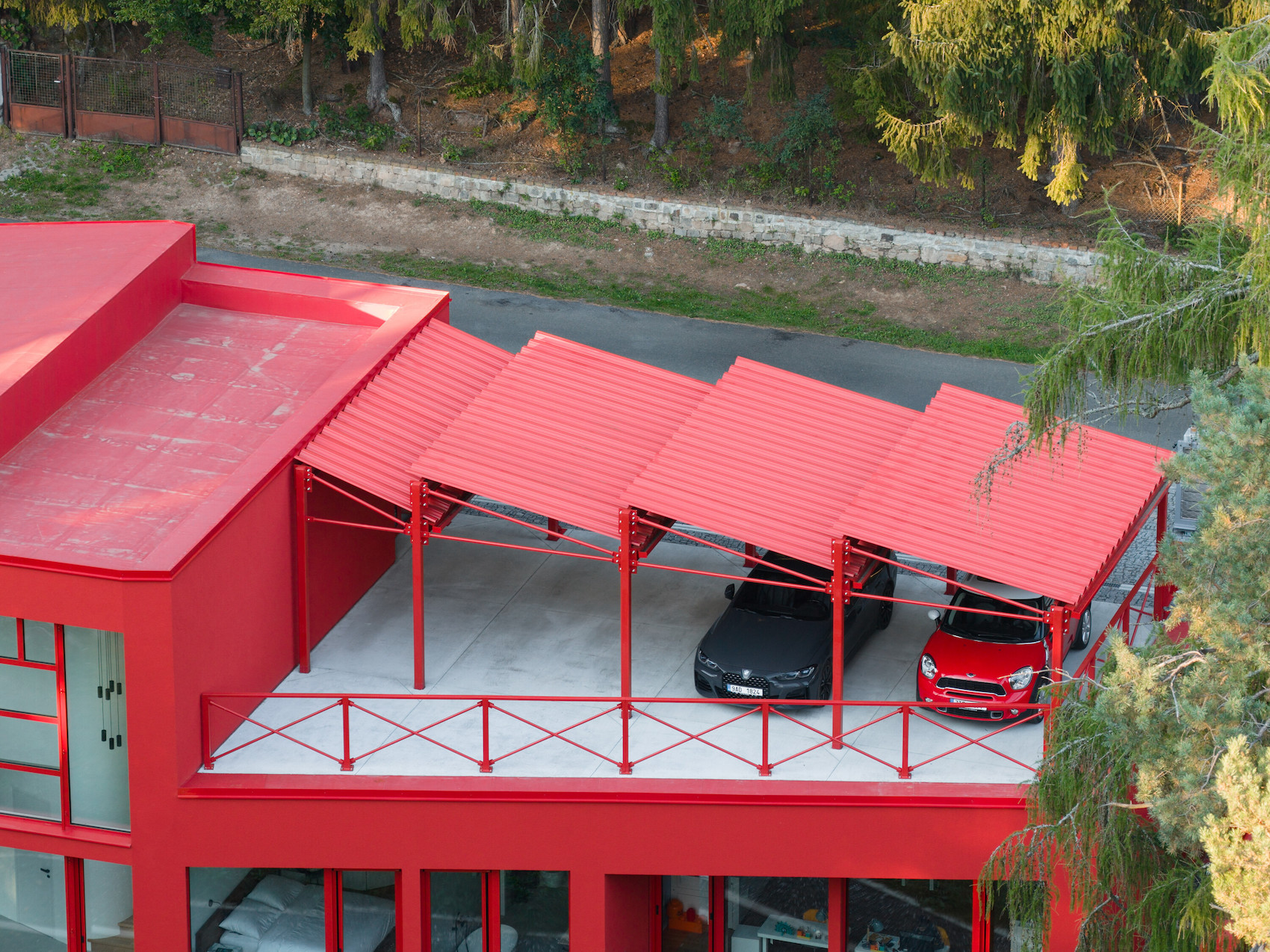
Access is from the upper level, where a roof terrace accommodates parking beneath a distinctive sawtooth canopy formed from red-painted steel. The entrance is integrated into the roofscape and leads into a central hall where views of the forest are revealed through large, irregularly-divided windows.
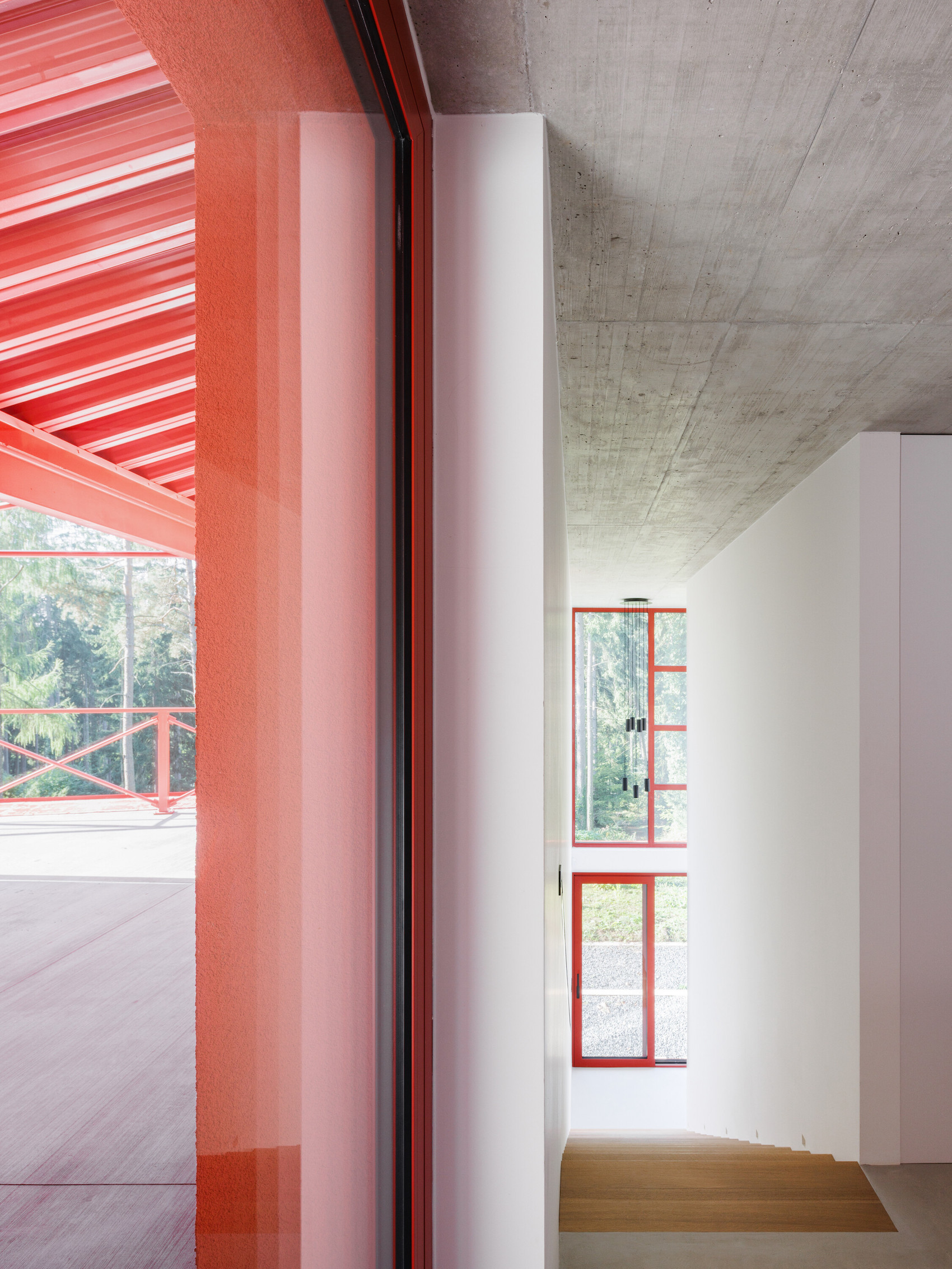
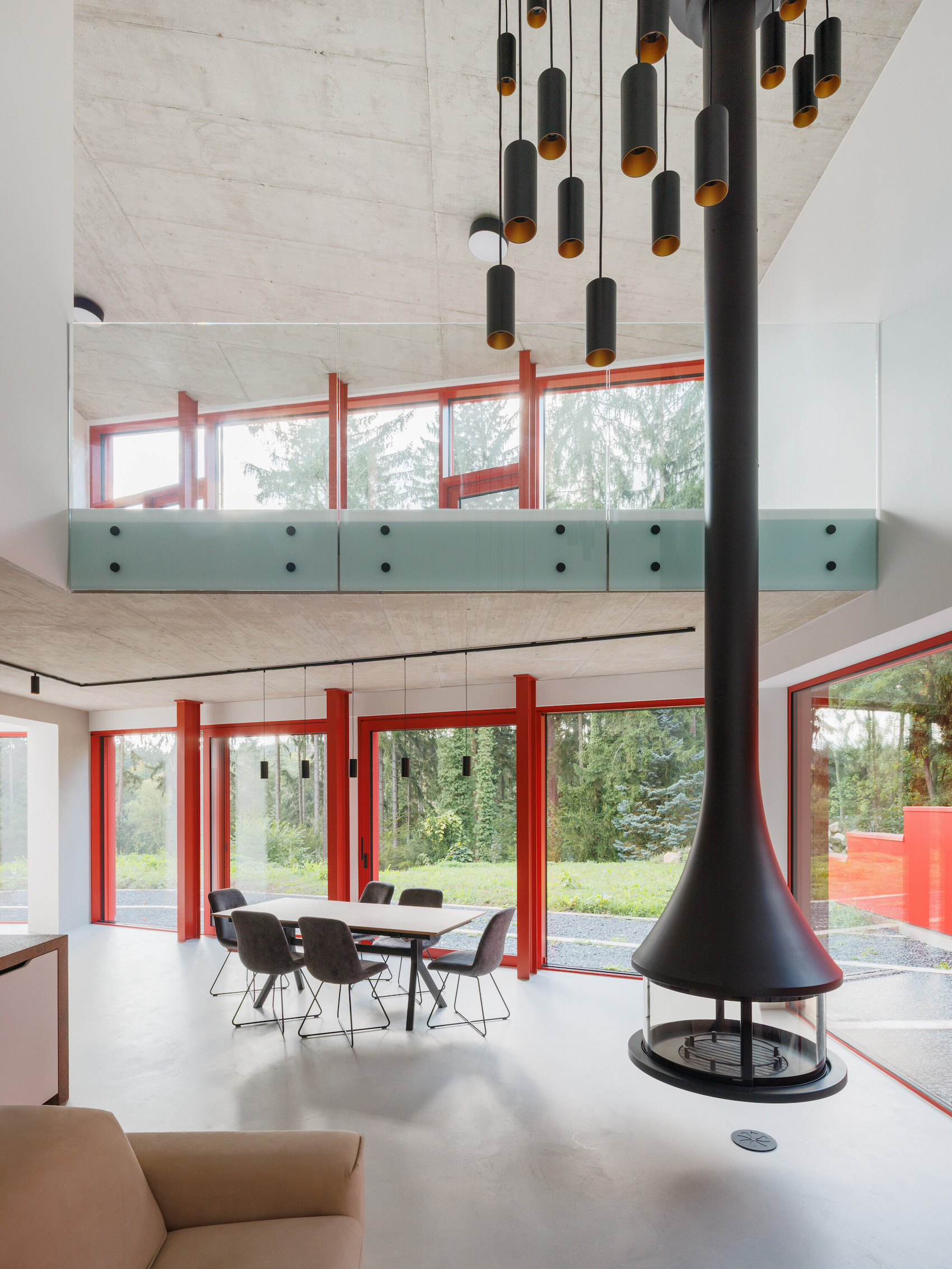
From this point, the house unfolds vertically. A straight staircase descends through a double-height space, passing a curved wall that introduces a contrasting geometry within the otherwise angular composition. The plan is organised into two primary wings linked by this central ‘torso’: a day zone oriented towards the landscape and a quieter night zone extending along a linear corridor.
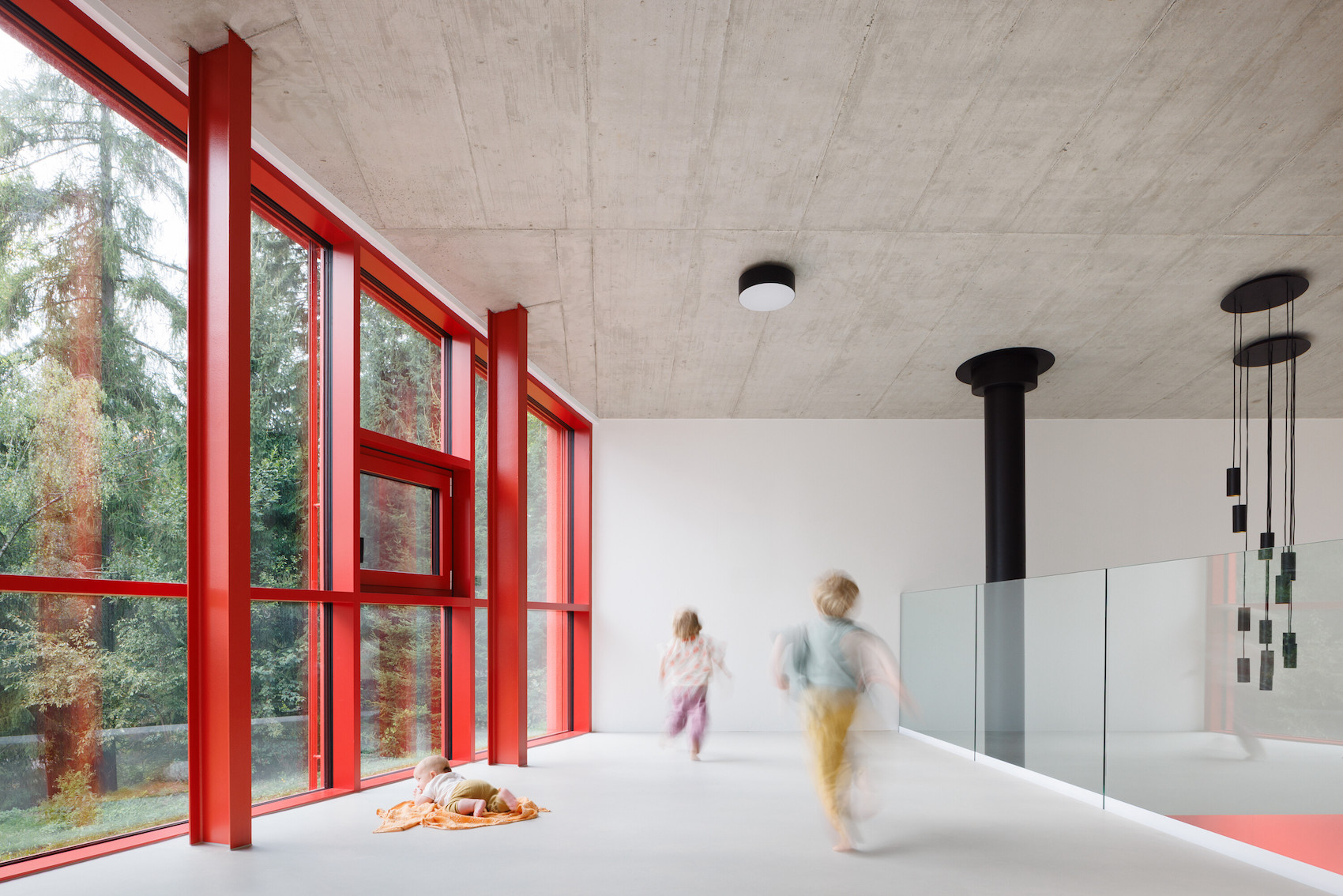
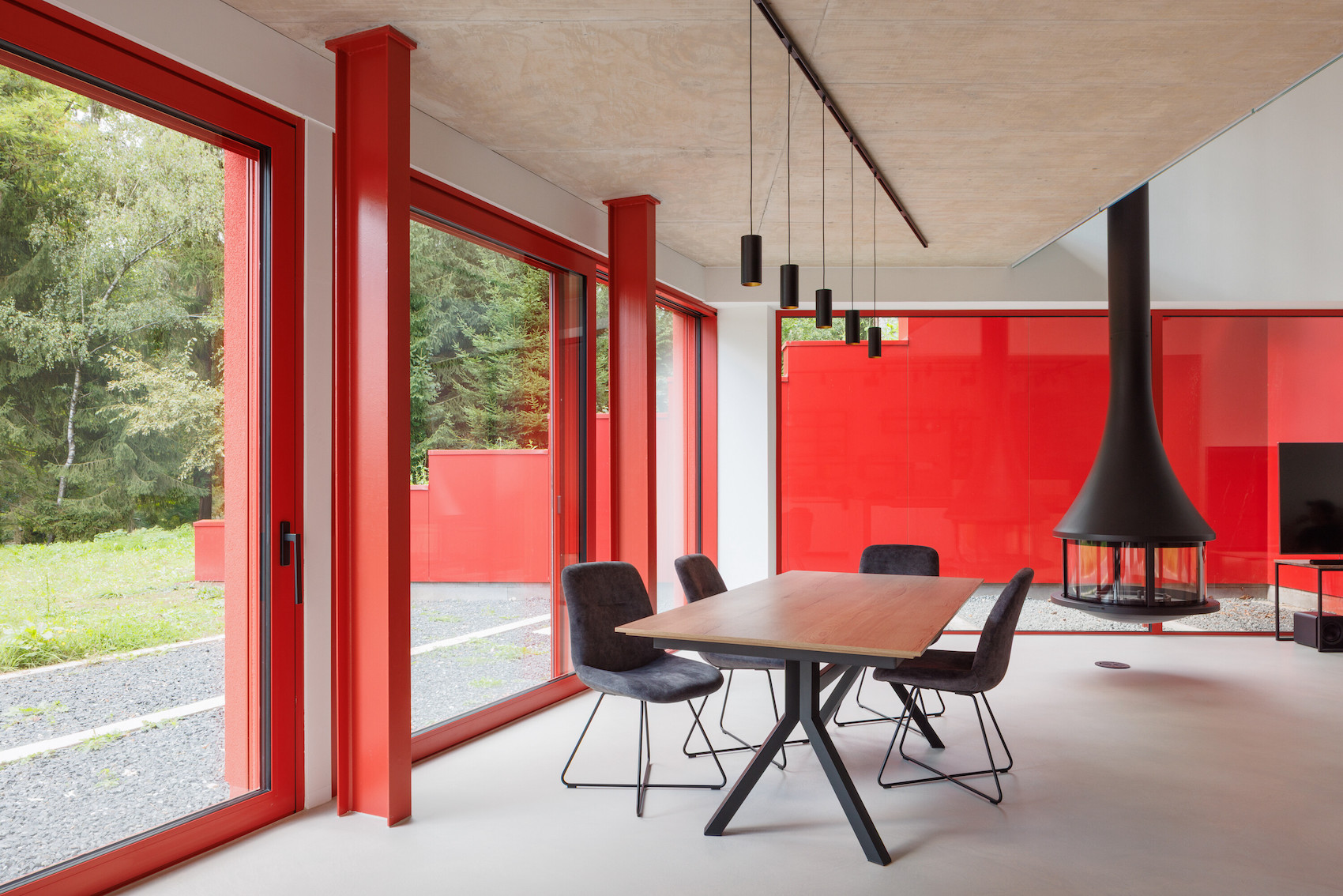
The main living space occupies the lower level and is conceived as a large, open-plan area for cooking, dining and relaxation. Double-height volumes and full-height glazing establish a strong connection with the surrounding trees, while red steel window frames articulate the façade and contrast with the changing green tones of the forest. Exposed concrete ceilings retain the imprint of formwork, reinforcing the building’s raw material character.
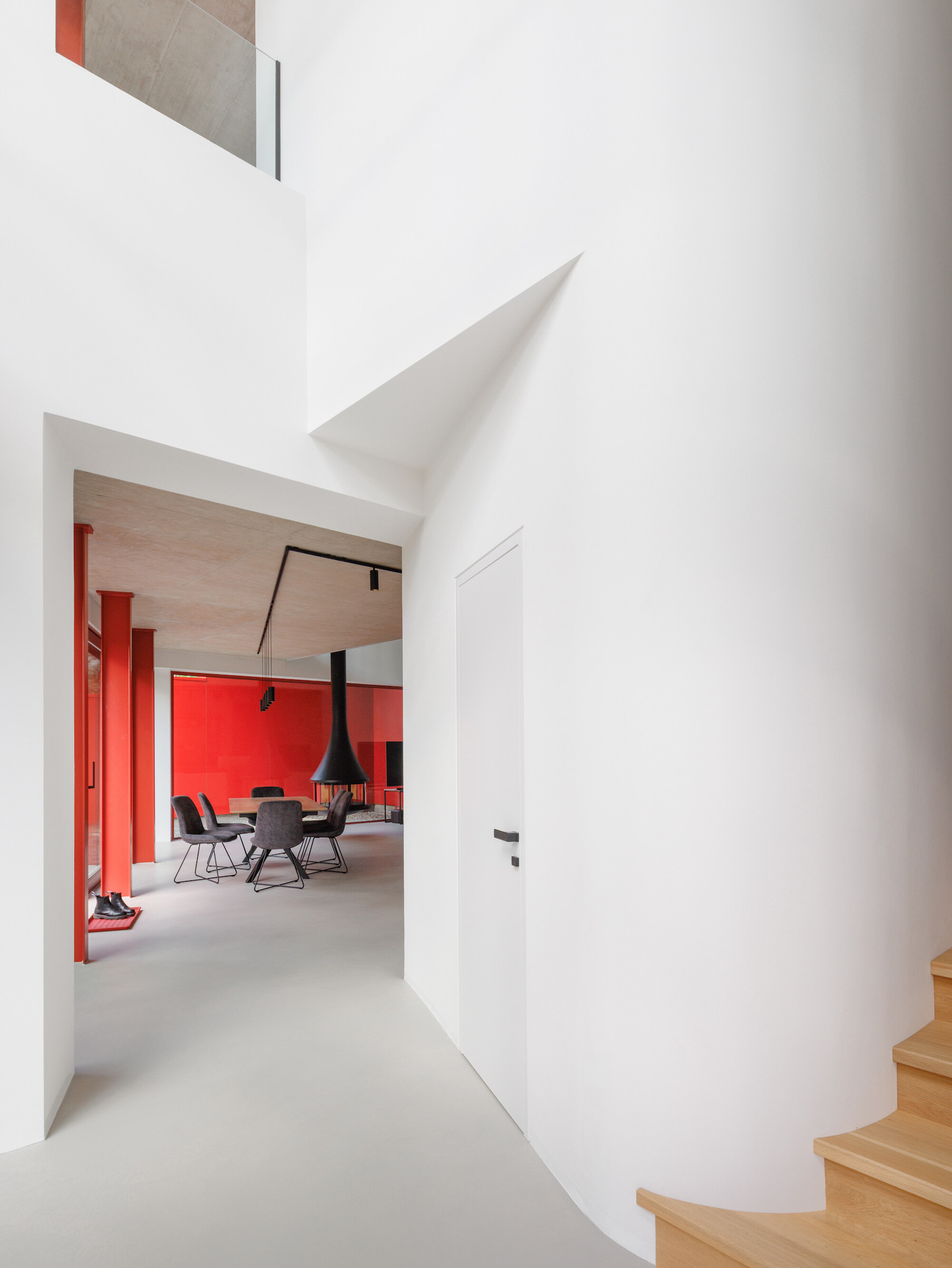
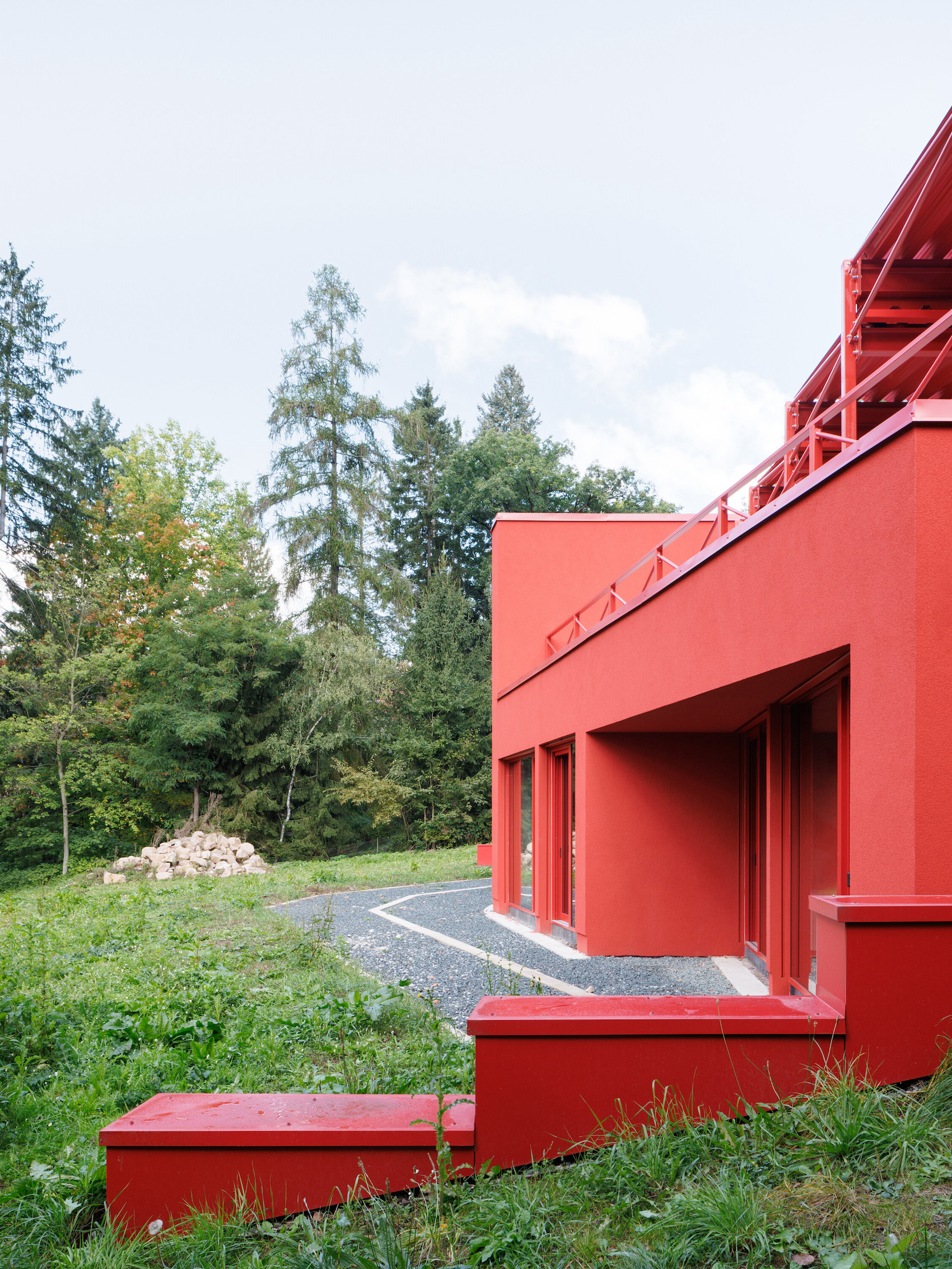
Private spaces are arranged along a connecting corridor, with bedrooms opening onto views of the forest. The principal bedroom suite includes a dressing area and bathroom, while children’s rooms are designed to allow both shared and independent use over time. A secondary exit from this level provides direct access to the garden.
Materially, the house is defined by a restrained palette of exposed concrete, red-painted steelwork and white plastered surfaces. The kitchen introduces a more varied composition, combining stone, steel elements and timber finishes.
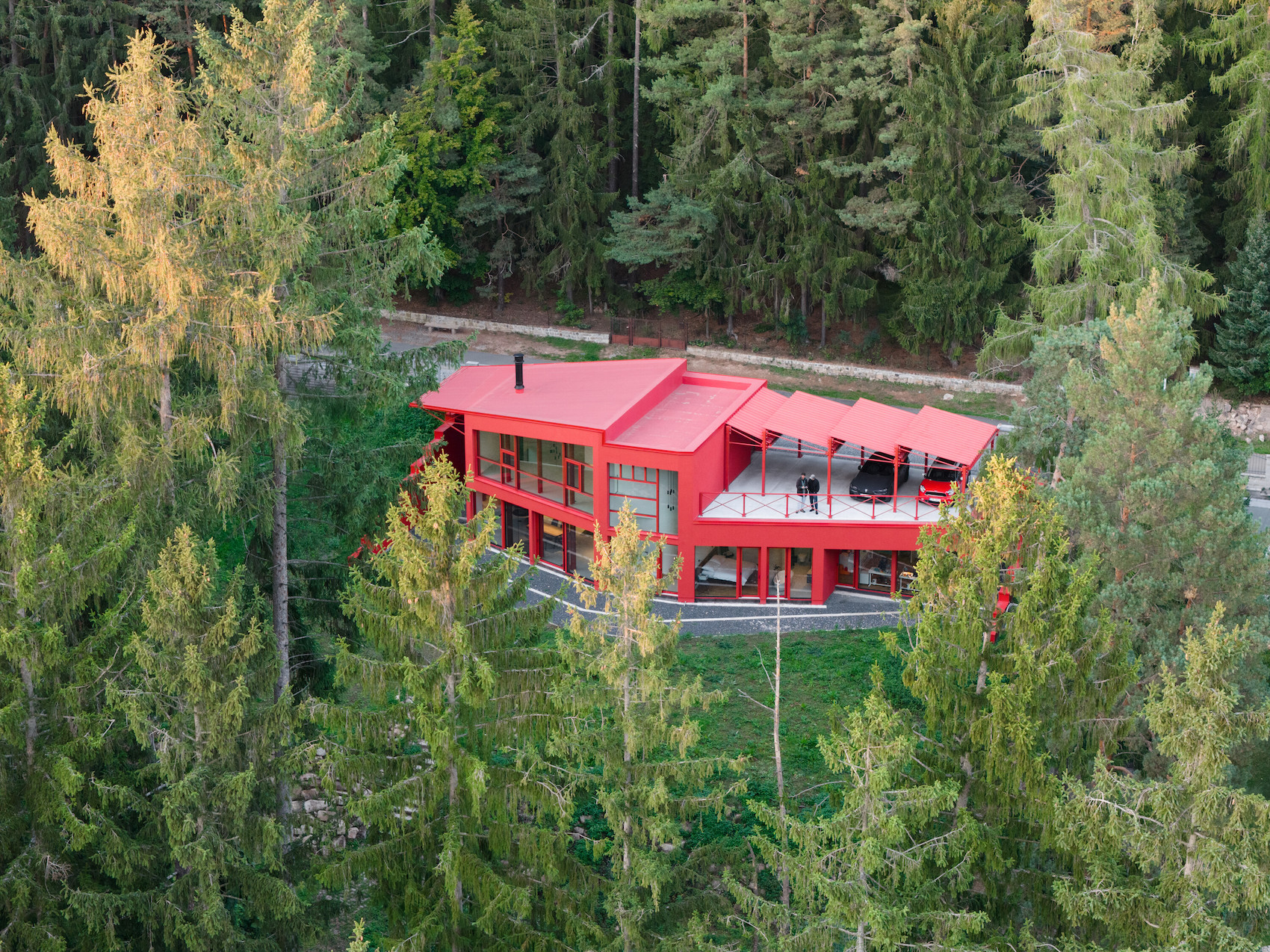
External interventions are minimal, allowing the existing landscape to define the character of the site. Large stones uncovered during excavation have been repositioned around the house, while terraces and paths are limited to areas immediately adjacent to the building. The surrounding woodland remains largely untouched, preserving both visual privacy and a direct connection to the broader forest environment.
Credits
Architect
Architektura
Structure
KR projekt
Interior design
Jan Waltr
Contractor
Radek Trojánek
Additional images