Barratt London’s Head of Design, Attzaz Rashid, discusses the challenges of delivering high-quality, low-energy housing at scale, the realities of large-scale urban regeneration, and why collaboration is essential to creating better places.

You originally trained as an architect before moving into a developer-side role. How has that background shaped the way you approach design leadership at Barratt London?
Training as an architect, and working in practice, taught me very early in my career that architecture is rarely about pure design autonomy. More often, it is about problem solving, balancing competing priorities, resolving constraints and bringing together a wide range of stakeholders, while building shared understanding around the direction of change.
It also teaches you how important communication is. Architects need to become skilled at conveying complex ideas visually and verbally in a way that builds confidence and brings people along on the journey. In many ways, the role is as much about collaboration, negotiation and leadership as it is about design itself.
What always appealed to me about architecture was that intersection between creativity and practicality. You are constantly trying to assemble all the pieces of what can initially feel like an unsolvable puzzle – planning, cost, sustainability, technical constraints, regulation, construction and human experience – and refine them until they work together as coherently as possible. Often, achieving the best overall outcome means moving beyond individual design preferences to arrive at a solution that is balanced, effective and meets the needs of the project.
Moving into a developer-side role broadened that perspective further, because you begin to understand the commercial, operational and delivery realities that ultimately determine whether good ideas can actually be implemented at scale. I think that combination has shaped the way I approach design leadership at Barratt London – balancing ambition and innovation with pragmatism, collaboration and deliverability.
Barratt London is delivering increasingly complex mixed-use and urban regeneration projects. What are the key design challenges facing large-scale city developments today?
One of the biggest challenges is balancing increasingly complex and often competing demands within constrained urban environments. Large-scale developments today are expected to deliver a large number of homes, affordability, sustainability, biodiversity, public realm improvements, infrastructure upgrades and strong placemaking outcomes – often all on highly complex sites.
At the same time, projects are facing significant viability pressures, rising construction costs and constantly evolving regulatory requirements, particularly around building safety and sustainability. In many ways, one of the biggest challenges in development today is simply making projects viable enough to deliver at all.
The key challenge is not the ambition behind these requirements, but how they are brought together, sequenced and balanced across the life of a project. Affordable housing and wider community benefits remain central to successful regeneration, but they need to be planned alongside infrastructure, technical requirements and commercial realities in a way that supports viability and deliverability, particularly where build costs, sales values and financing conditions are under pressure.
Housebuilding is unusual in that sense. Developers are often expected not only to deliver the homes themselves, but also to subsidise significant amounts of wider social and civic infrastructure through the development process. That creates a very delicate balancing act between ambition, policy expectations, viability and deliverability.
Another major challenge is designing places that remain adaptable over the long term. Cities are changing rapidly, and developments need to be resilient enough to respond to future shifts in energy standards, climate conditions, patterns of living and resident expectations. There is also a growing expectation that developments should contribute positively to wellbeing and community identity, rather than simply delivering housing numbers. That requires a much more holistic and collaborative approach to design, one that considers not just buildings in isolation, but how people will actually live, interact and build communities over time.
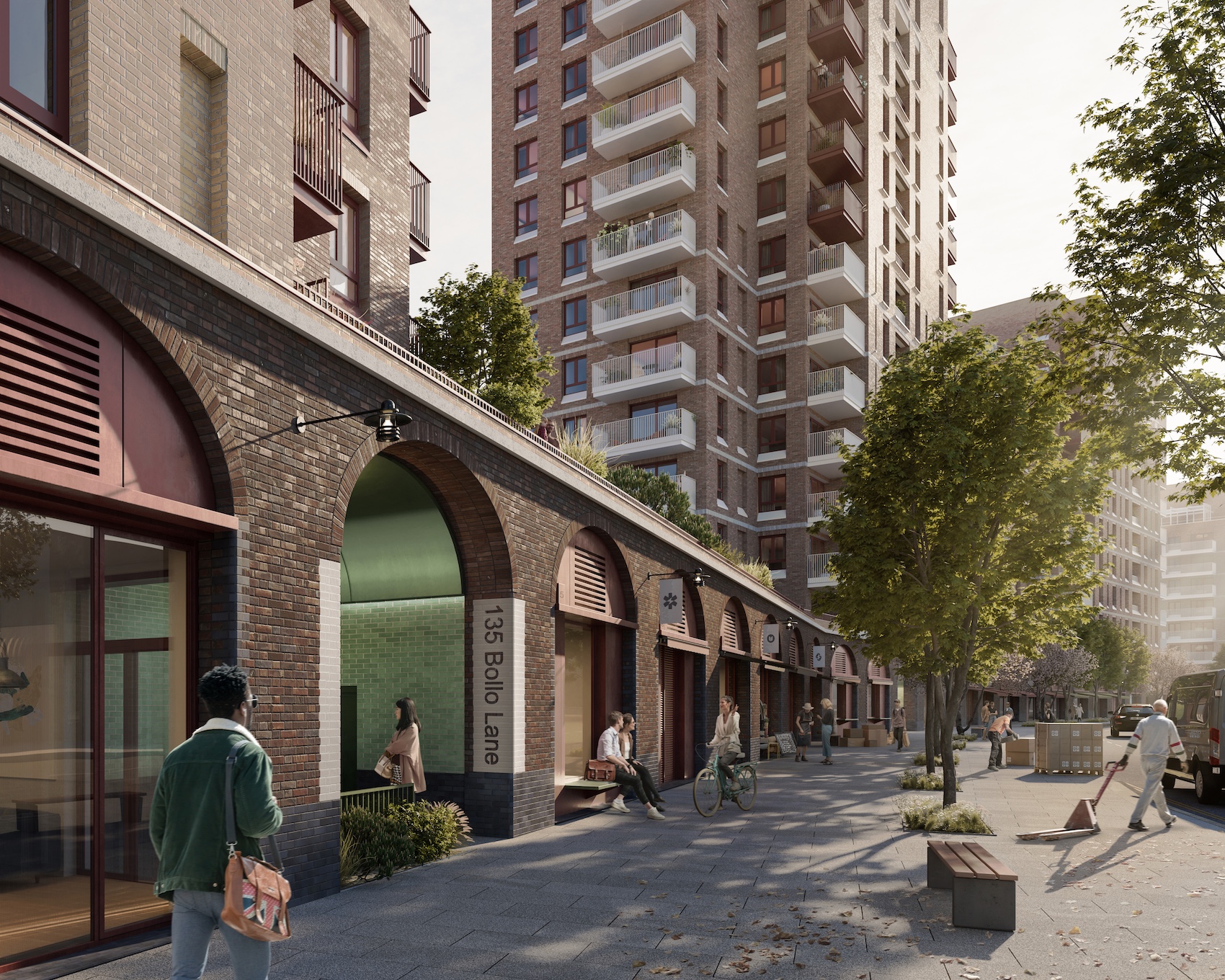
Bollo Lane is a £365m major urban regeneration project in Acton, West London, delivered through the West London Partnership – a joint venture between Barratt London and Places for London. Masterplanned by Allies and Morrision, the development will comprise 900 new homes, 50 per cent of which will be affordable (CGI: courtesy of Barratt London).
You’ve been closely involved in Barratt London’s Lo-E homes initiative. What lessons has the company learned about delivering low-energy housing at scale?
One of the key lessons is that delivering low-energy housing successfully requires a fully integrated approach from the outset. Energy performance cannot be treated as an isolated technical exercise added late in the process and solved by plugging in poor-quality buildings into heat networks.
We need to tackle the building fabric from day one, which then informs architecture, structure, servicing, detailing and construction methodology. We have also learned that simplicity is extremely important. Some of the most successful solutions are not necessarily the most technologically complex, but the ones that are robust, repeatable and easy for residents to operate and understand.
Another important lesson is that operational performance and resident comfort are becoming increasingly significant drivers of value. Today, our customers are much more aware of energy costs, overheating and indoor air quality than they were even a few years ago.
Perhaps most importantly, we have learned that ‘we’ as large developers have a major role to play in scaling innovation. That is not just about generating ideas internally, but about helping to drive new solutions through the wider industry and working with organisations, such as the GLA, to test and evolve established approaches where the evidence supports it. Policy clearly has an important role to play, but genuine innovation can sometimes be limited if the industry focuses solely on compliance rather than outcomes. Delivering low-energy homes at meaningful scale requires collaboration across consultants, supply chains, delivery teams and public authorities, alongside a willingness to share knowledge, demonstrate what is possible and help build confidence in new approaches.
Some authorities are already embracing that shift, while others understandably require more evidence and engagement to support change. Larger organisations are well placed to help lead that transition through research, testing and thought leadership, ultimately helping to create delivery models that can be adopted more widely across the sector. Passivhaus principles are often associated with specialist or niche projects.
How realistic is it to apply those approaches across mainstream residential development?
Passivhaus is not something that can be meaningfully delivered by selecting individual principles in isolation. Its value lies in achieving a certified standard, because certification is what verifies performance and gives confidence that the intended benefits will be achieved. It also raises a wider question about whether existing policy frameworks and industry assumptions are prepared to evolve alongside the evidence.
One of the key lessons from our Lo-E homes work is that when you deliver genuinely high- performing building fabric to a certified Passivhaus standard, many of the traditional assumptions around energy infrastructure begin to change. Once heating demand is reduced dramatically, it no longer necessarily makes sense to rely on large, centralised heat networks, because the distribution losses alone can become comparable to the amount of heat required to warm the homes themselves.
That is where some of the tension currently exists within parts of the industry. In some areas of London, there remains a strong default position that all major schemes should connect into heat networks, particularly where significant infrastructure investment has already been made. However, we believe there needs to be greater openness to alternative delivery models where the evidence demonstrates better outcomes for both residents and the environment.
From our perspective, certified Passivhaus combined with approaches such as exhaust air heat pumps can offer significant advantages: lower operational energy demand, improved comfort, reduced overheating risk and potentially lower energy costs for residents. That is particularly important for affordable housing residents, who are often the most vulnerable to rising energy prices.
What can sometimes be frustrating is that despite the amount of technical evidence, peer review and due diligence now supporting these approaches, the industry can still be slow to adapt established policy positions and infrastructure models. Understandably, authorities and stakeholders need confidence before embracing change, but innovation also requires a willingness to reassess assumptions when new evidence emerges.
Ultimately, I think the conversation needs to move beyond simple compliance or adherence to default infrastructure models, and focus more directly on the outcomes we are trying to achieve: genuinely low-energy, comfortable and affordable homes for residents over the long term.
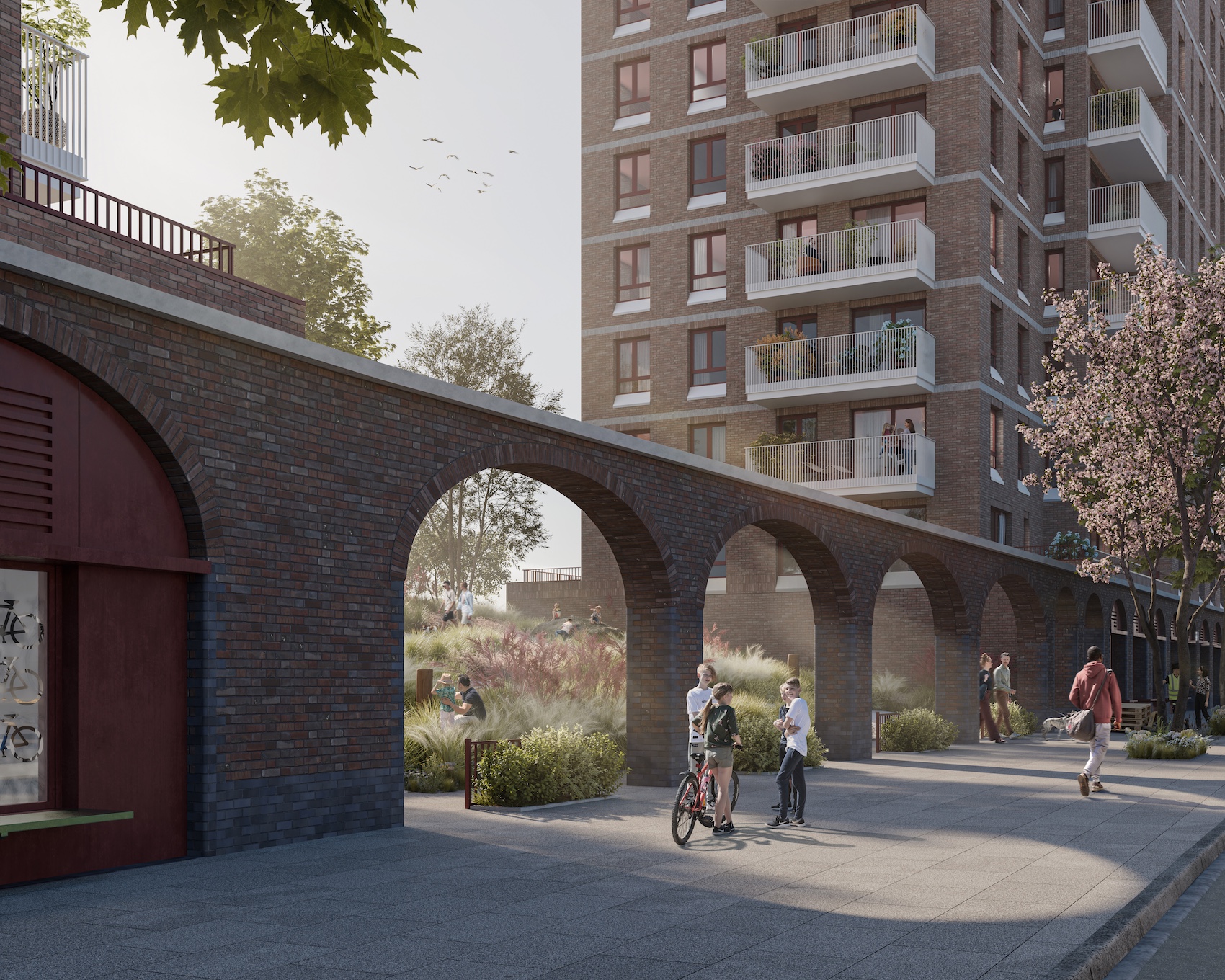
Beginning in Phase 2, Bollo Lane will see the roll out of Barratt London’s new ‘Lo-E’ Passivhaus framework. The three phase scheme is due to complete in December 2029 (CGI: courtesy of Barratt London).
How do you balance energy performance targets with the commercial and delivery pressures of large urban schemes?
The way we have approached balancing energy performance targets with commercial and delivery pressures has been to adopt Passivhaus principles as a holistic strategy rather than treating sustainability as a collection of isolated add-ons.
By delivering homes to a certified Passivhaus standard, we are effectively addressing the problem at its source by dramatically reducing energy demand through the building fabric itself. Once you achieve that level of fabric efficiency, airtightness and build quality, a number of other opportunities begin to emerge.
One of the biggest advantages is the reduction in overall system complexity. Because the buildings require far less energy to operate, we can significantly reduce the amount of complex plant, infrastructure and distribution systems typically required within and on top of buildings. That means less horizontal and vertical distribution, fewer large communal systems and more energy autonomy for individual residents.
It also has wider infrastructure benefits. As overall energy demand falls, concerns around off-site reinforcement and network capacity become less acute. At the same time, systems such as exhaust air heat pumps can provide additional benefits such as cooling as part of their operation, helping address overheating risk without relying on traditional air conditioning strategies.
Although achieving Passivhaus standards requires us to build to higher standards of quality and airtightness than ever before, simplifying the overall servicing strategy can actually create commercial and spatial efficiencies elsewhere. In some cases, spaces that may previously have been occupied by plant can instead become usable or income-generating floor area. We have even found opportunities to introduce additional residential accommodation by removing roof-level plant requirements that would otherwise have been needed for more conventional systems.
From your perspective, what role can good design play in improving affordability, resident wellbeing and long-term operational costs?
Good design has a direct impact on all three. From an affordability perspective, efficient layouts, intelligent building forms and well-considered construction strategies can help improve value without compromising quality. Operational affordability is also becoming increasingly important, particularly in relation to energy use and maintenance costs.
In terms of wellbeing, design plays a huge role in factors such as daylight, ventilation, thermal comfort, acoustics, access to nature and social interaction. These things have a measurable impact on how people experience their homes and neighbourhoods daily.
Long-term operational performance is another area where good design is critical. Durable materials, robust detailing, and well-integrated building systems can significantly reduce maintenance requirements and improve building longevity.
Ultimately, good design should not be viewed as an added luxury – it is fundamental to creating homes that work well socially, environmentally, and economically over time.
When working with external architects and consultant teams, what qualities or approaches do you value most?
I value architects who can hold a clear vision throughout the life of a project while combining creativity with pragmatism. The best architects do not feel the need to overdesign buildings, but instead have an exceptional understanding of proportion, streetscape and townscape, as well as how buildings contribute positively to the wider urban environment. Strong ideas are important, but so is the ability to translate those ideas into deliverable solutions within real-world constraints.
Collaboration is also critical. The most successful projects tend to come from teams that work openly across disciplines and engage constructively with challenges rather than operating in silos. Equally important is attitude and personality. We work with people, not just companies, and our projects often run for many years, so it is important to build strong, positive and long-lasting working relationships. I value consultants who are approachable, collaborative, open to feedback and able to engage in healthy debate, without ego. The best teams are usually the ones that can challenge ideas constructively while still working together in a supportive and respectful way.
What are the most common misconceptions architects have about working with major developers?
One common misconception is that developers are primarily focused on reducing cost at the expense of quality or innovation. In reality, major developers are often balancing an extremely complex set of commercial, regulatory and delivery considerations across large programmes of work. We do understand the importance of great placemaking and high-quality architecture.
Another misconception is that standardisation limits creativity. In practice, standardisation can actually create opportunities to focus innovation where it matters most by improving efficiency and reducing unnecessary complexity elsewhere.
I also think there is sometimes an assumption that developers are resistant to change, whereas many large organisations are actively investing in research around sustainability, modern methods of construction, energy performance and resident wellbeing. The scale at which major developers operate means they can play a significant role in driving industry-wide change when the right solutions are identified.
Looking ahead, how do you see expectations around sustainable housing evolving over the next five to ten years, and how is Barratt London preparing for that shift?
I think expectations around sustainable housing will become significantly more demanding over the next decade, both from regulators and residents themselves. The focus will increasingly shift beyond carbon alone towards healthier homes that support wellbeing, comfort and quality of life.
As affordability pressures continue, I think we will see greater emphasis on adaptable homes, multi-generational living, home working and walkable neighbourhoods, particularly as transport and living costs rise. Residents will also become far more aware of operational energy costs, indoor air quality and long-term building performance.
The industry will need to rethink complexity and material use. I think we will increasingly question why we use so much unnecessary material and layered construction where simpler, lower-carbon approaches could achieve the same or better outcomes. Reducing complexity can benefit both the environment and viability.
There will also be growing focus on embodied carbon, overheating, resilience and measurable building performance in use, rather than purely compliance-based design metrics. Energy-efficient homes are likely to attract stronger resale values and potentially better mortgage products as lenders place greater emphasis on EPC performance.
Technology will play a major role. We are likely to see more off-site manufacturing, robotics, AI-driven home management systems and alternative energy delivery models, including subscription-based approaches to rooftop photovoltaics.
At Barratt London, we are already exploring many of these themes through initiatives such as Lo-E homes and wider research into scalable low-energy housing delivery. The real challenge for the industry will be delivering these improvements at volume in a way that remains commercially viable and accessible to mainstream housing delivery.