Selected to design the 25th Serpentine Pavilion, LANZA atelier founders Isabel Abascal and Alessandro Arienzo discuss their serpentine-inspired proposal, the intelligence of modest forms, and how movement, materiality and collective experience shape their approach to architecture.

Founded in 2015 by Isabel Abascal and Alessandro Arienzo, the Mexico City–based LANZA atelier has been selected to design the 2026 Serpentine Pavilion.
Titled a serpentine, the pavilion will open at Serpentine South on 6 June 2026, as the programme marks its 25th anniversary in partnership with the Zaha Hadid Foundation. Drawing inspiration from the crinkle-crankle wall, LANZA atelier’s proposal reinterprets a modest piece of English architectural history as a spatial and social device, one that privileges movement, permeability and collective experience over formal spectacle.
We sat down with Abascal and Arienzo to discuss the responsibility of contributing to the Pavilion’s evolving legacy, the structural and experiential intelligence of the serpentine wall, and their commitment to analogue design methods in an era increasingly shaped by digital tools.
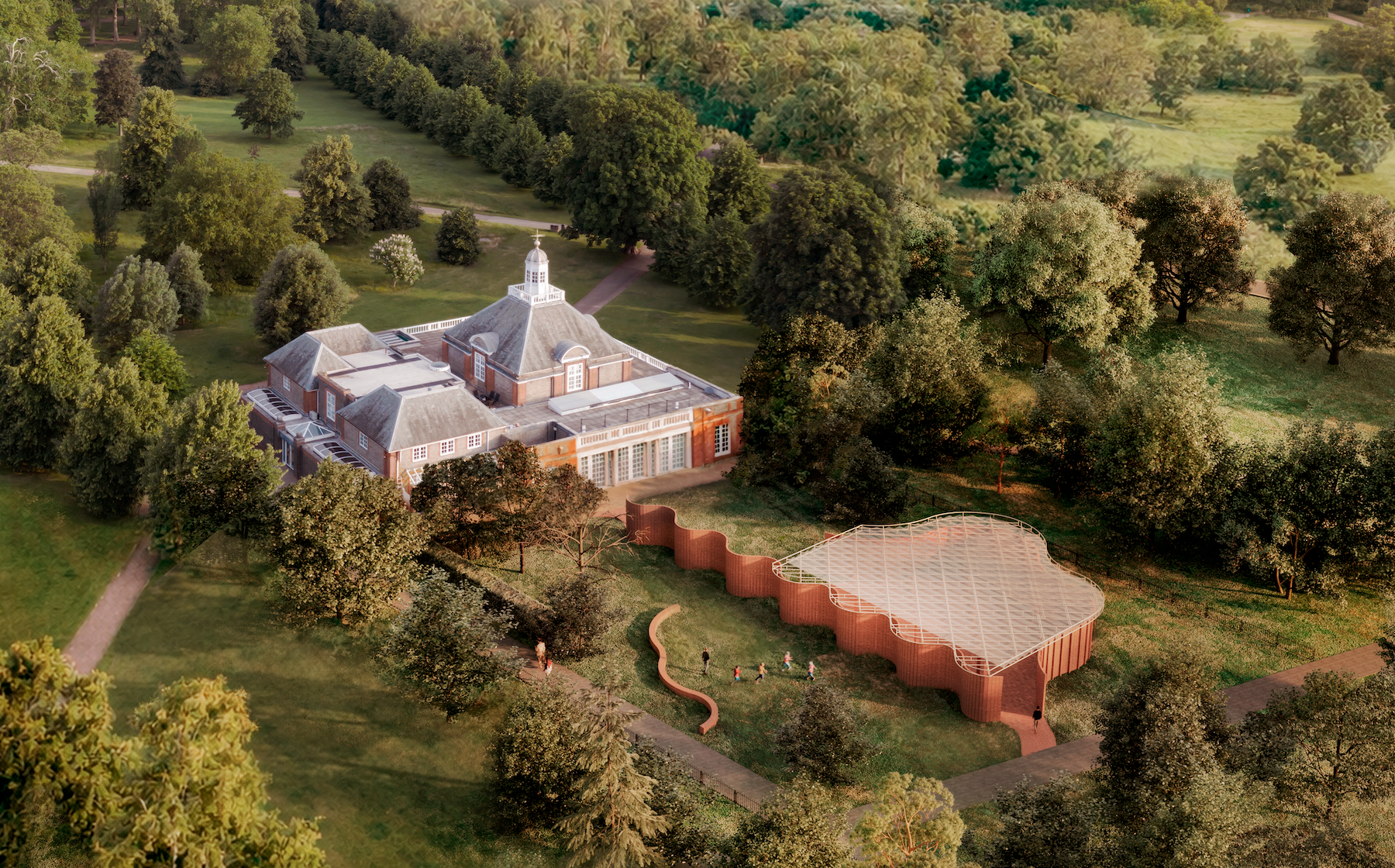
Serpentine Pavilion 2026, a serpentine, designed by Isabel Abascal and Alessandro Arienzo, LANZA atelier. Design render, aerial view. (Credit: LANZA atelier. Courtesy: Serpentine)
How did you approach the responsibility of designing the Pavilion in its 25th anniversary year, and what did that milestone change, if anything, about your thinking?
Isabel Abascal and Alessandro Arienzo: We believe this iconic anniversary can amplify some of the implicit messages of our Pavilion. We would like to encourage the global architectural community to be as clever as the serpentine wall by virtue of its unexpected shape, which employs fewer materials than a straight wall and is stronger, more stable.
We are also adding our own voice to 24 previous voices that have left their mark on the Serpentine lawn, thereby creating a collage of the architecture of the first quarter of the 21st century—and that is very beautiful.
What drew you to the the serpentine (crinkle-crankle) wall, and how did its structural intelligence translate into spatial and experiential ideas for the Pavilion?
Isabel Abascal: This Pavilion is designed for the experience of movement. The enigmatic crinkle-crankle wall welcomes the visitor upon arrival. A long curvilinear brick bench invites passersby to sit, together with the Pavilion embracing the lawn.
The shadows of the trees will project on the brick pattern from the south, slowly moving throughout the day as a living painting. There is a hint that an interior space exists, suggested by the fact that two walls can be seen: one in the background appears behind slim brick columns. Once the visitor approaches, they perceive that the walls are slightly permeable, created by stacked bricks forming columns with small gaps between them. This is a beautiful moment in which something that appears solid starts to dematerialise.
When the visitor enters, an enfilade of delicate brick columns offers a path towards the Serpentine South Gallery and another towards the steps where one can sit. Afterwards, the café reveals itself behind a brick bar. Visitors can roam freely, peek through the walls towards the outside and enjoy the texture of the brick pavement. Inside this monomaterial space, a translucent steel-grid roof allows natural light to filter in, with shifting shadow patterns throughout the day.
Alessandro Arienzo: a serpentine is a Pavilion designed so people enjoy moving around. We believe this movement will provide a series of surprises related to views, sunlight, shadow play, sound and materiality. The permeable brick walls accompany visitors at every step, allowing them to see through while still feeling a defined space. We are not anticipating a single, prescribed experience; architecture should instead offer a space where one can react, experiment and feel the infinite possibilities of life itself.
The roof structure sits very delicately on brick stilts. How, at a detail level, will you make that work?
Isabel Abascal and Alessandro Arienzo: The roof is translucent to allow sunlight to enter. It is formed from a spatial steel grid with polycarbonate, filtered through composite fabric Eco-Bau fins. The marriage of traditional artisanal craft with high-performance technological materials is a contrast we welcome.
Much of your practice foregrounds use, assembly and encounter over formal spectacle. How does the Pavilion continue, or even challenge, this interest when placed in such a globally visible context?
Isabel Abascal and Alessandro Arienzo: Being in such an idyllic context as Kensington Gardens feels like the perfect moment to discuss what the idea of a garden means, and how the English garden relates to historical elements of architecture and ancient materiality.
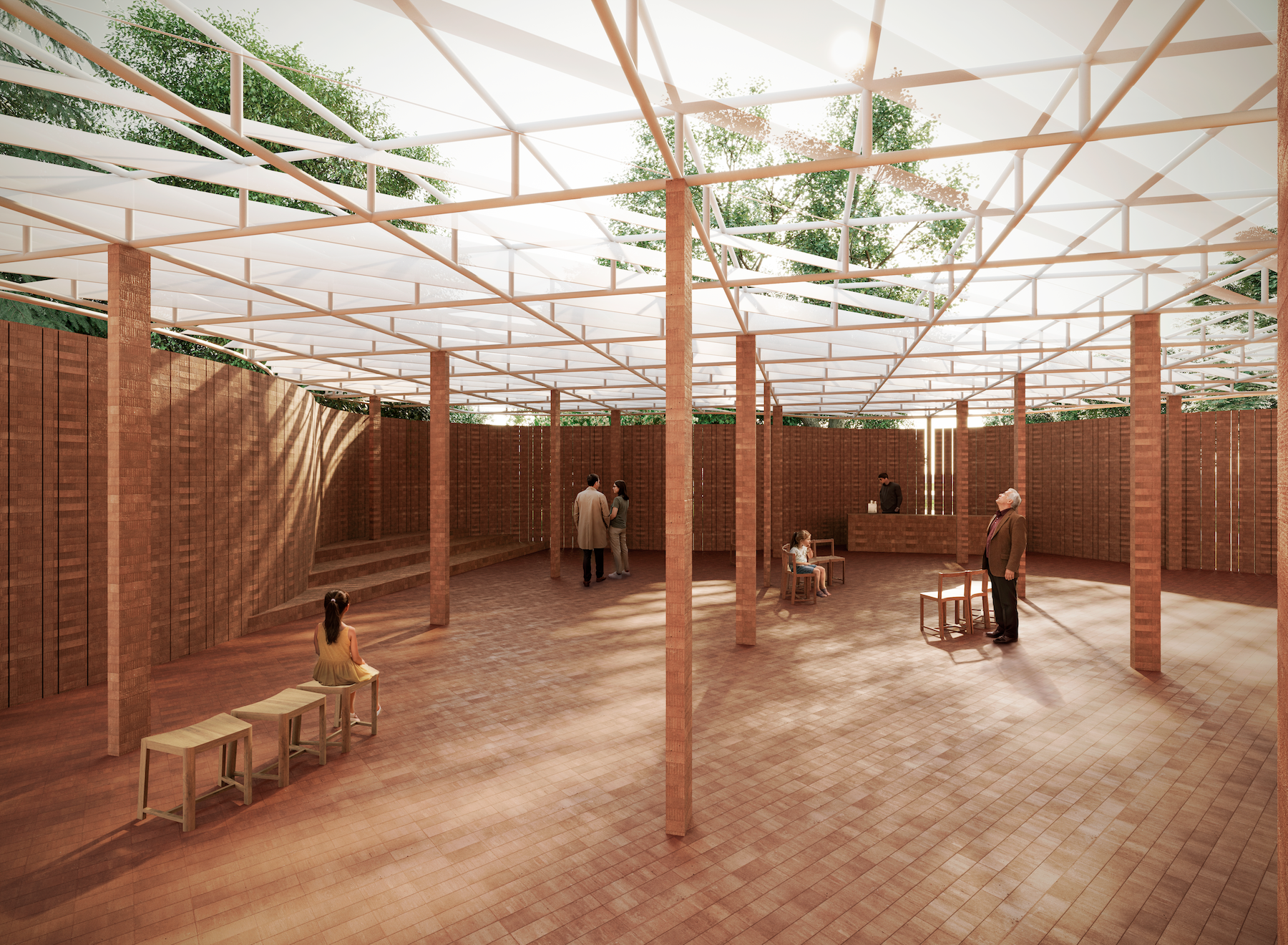
Serpentine Pavilion 2026, a serpentine, designed by Isabel Abascal and Alessandro Arienzo, LANZA atelier. Design render, view inside the pavilion. (Credit: LANZA atelier. Courtesy: Serpentine)
You place strong emphasis on hands-on design methods, particularly drawing and model-making. Is this a rebuttal to designing with AI? And at what moments did these analogue tools become most critical?
Alessandro Arienzo: We welcome all tools, but hand drawings and models are particularly useful for our thinking process. We always start by drafting the site by hand, developing an intuitive understanding that is later informed by programme, materials, climate and the client’s input. Simple physical models evolve through many modifications. Having them present in the studio allows us to see what is missing—or what is superfluous.
We try to find one idea that organises the whole project. At a certain point we move to CAD, then print and trace again. We are very cautious with what we draw. As architects, we should be able to build less and simpler. For us, the drawing is as important as the building.
Isabel Abascal: We love having material samples around the studio and working with 1:1 prototypes. We also carry out onsite research through field drawings and annotations, later transformed into written essays. We see everything we do as an exploration through which we keep expanding.
Hans Ulrich Obrist has described the Pavilion as a “content machine.” How do you imagine it responding over time to changing programmes and audiences?
Isabel Abascal: While we have planned places to sit or observe, we know visitors will surprise us—and that is exciting. We are very much looking forward to the Live Programme of Park Nights, Family Days and other events. We cannot anticipate how performers, musicians, poets and artists will use the space, and that unpredictability is one of architecture’s great strengths.
What do you hope architects, students and the wider public will take away from encountering this Pavilion?
Alessandro Arienzo: I wish for the unexpected. Brick is a material we all have a relationship with, but the way we are using it here is very specific. We expect people to resonate with its material presence.
Isabel Abascal: Many authors trace the word paradise to the Avestan pairidaeza—pairi (around) and daeza (wall). Rather than a garden enclosed by walls, we are interested in the place that happens around a wall. Paradise, for us, arises in the balance between human intervention and the natural context. This Pavilion is an invitation to reflect on that balance.