 As UK Architects Declare prepares to launch its updated Regenerative Design Primer at Regenerative Design 2026, Anna Pamphilon of Within Planetary Boundaries Studio explains why regenerative practice must be collaborative and ambitious, but also – if we are to take people with us – hopeful and fun.
Anna Pamphilon is a member of the
UK Architects Declare steering group.
As the summer draws to a close, I feel more uncertain about our future than ever – and more determined to play my part in turning the built environment from an extractive, take-make-waste industry into a positive force for people and nature.
The past few months have brought repeated reminders of the climate and biodiversity emergency: wildfires, heatwaves, floods and landslides, taking lives and causing terrible harm to communities and ecosystems. The impacts are often felt most severely by people and places that have contributed least to the crisis.
We cannot look away from this reality. But nor will we create change through doom and gloom alone. We also need to demonstrate that another future is possible: one that is not only safer and more equitable, but healthier, richer and more enjoyable. Regenerative design gives us a way to imagine that future – and, importantly, to begin moving towards it.
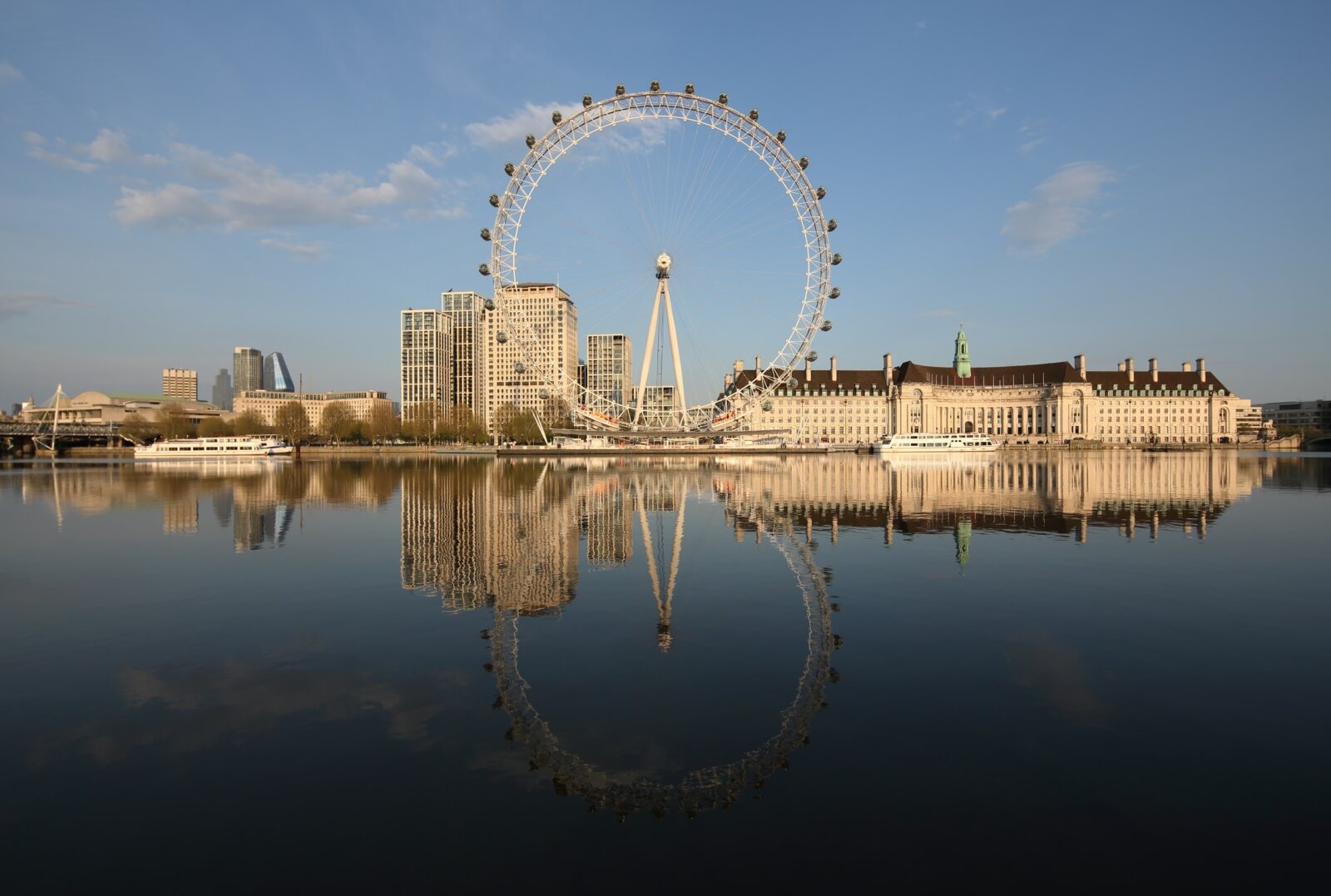
Organised by UK Architects Declare A Circular Revolution in September 2025 saw more than 400 people from over 250 organisations take over all 32 pods on the London Eye before gathering at Sustainable Ventures in County Hall to exchange ideas, make pledges and demonstrate to government and policymakers that the built environment is ready to lead the transition to a circular economy. Photograph by Edward Denison.
UK Architects Declare has always believed that this work should also be enjoyable. People are more likely to contribute their energy and imagination when they feel invited into something creative and hopeful. I felt this powerfully at A Circular Revolution in October 2025, when UK Architects Declare took over all 32 pods of the London Eye before gathering at Sustainable Ventures in County Hall. More than 400 people from over 250 organisations came together to exchange ideas, make pledges and demonstrate to government and policymakers that the built environment is ready to lead the transition to a circular economy.
The buzz afterwards was extraordinary and the creativity in the room was palpable. It was a reminder that designing more responsibly need not mean designing with less imagination. Quite the opposite: circular thinking, closer engagement with nature and a willingness to make buildings that integrate rather than dominate open up enormous creative possibilities. We are already seeing some remarkable responses, but they are only the tip of the iceberg. There is far more to come.
Sustainability has traditionally asked how we might do less harm. Regenerative design asks a more ambitious question: how can what we design actively contribute to the health of the ecological, social and economic systems of which it is a part? It is not a new label for better-performing buildings, nor a checklist to be completed at the end of a project. It is a different way of understanding our place and purpose within a much larger, living system.
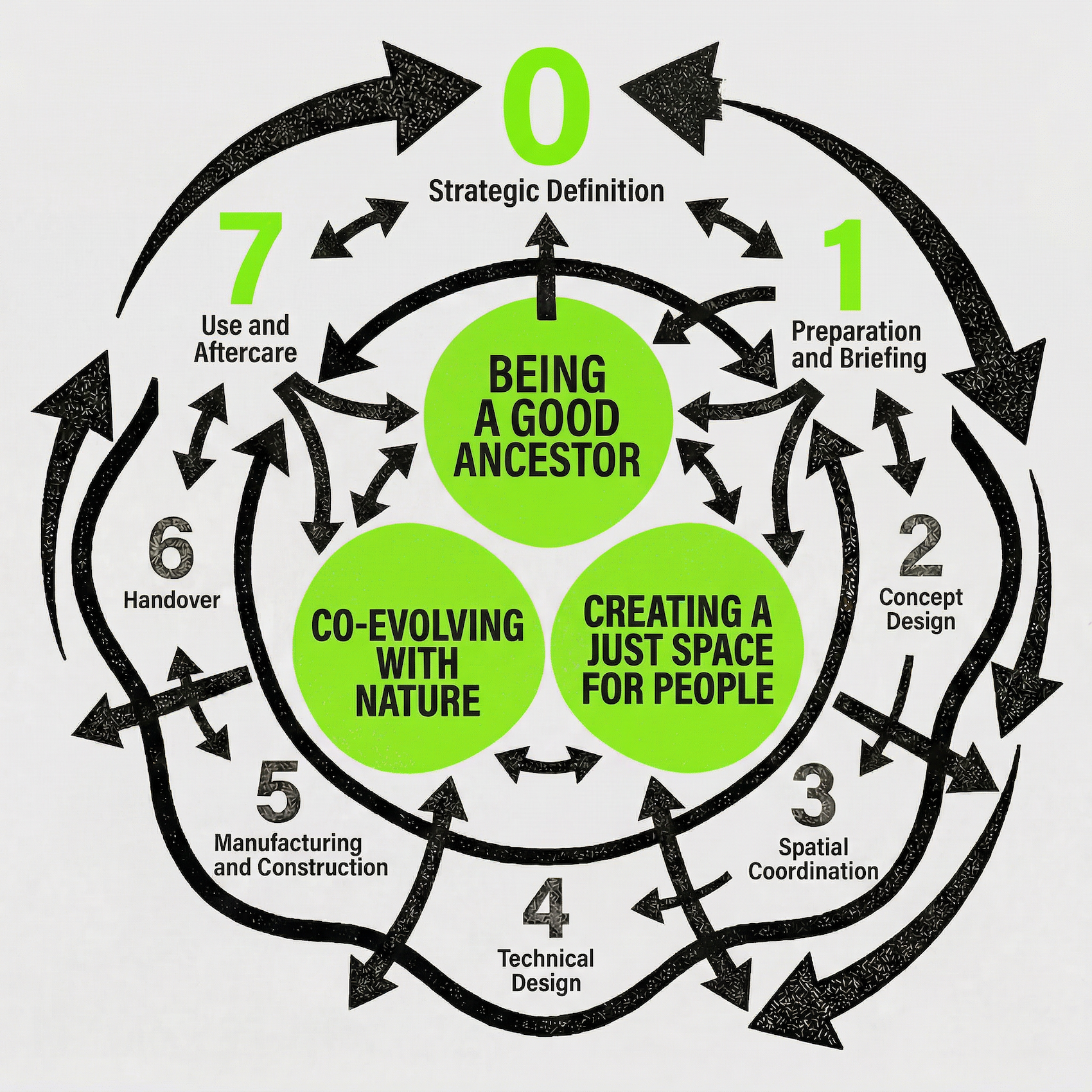
Images from the updated Regenerative Design Primer illustrating the inter-dependencies between the three over-arching themes that structure the Primer and the Regenerative Architecture Index: Being a good ancestor; Co-evolving with nature and Creating a just space for people (above) and the need for holistic thinking that considers the relationship between discrete interventions and the broader physical and social context beyond the boundaries of the immediate brief and site (right).

Why another primer?
The first regenerative design section was published as part of the original Architects Declare Practice Guide in 2019. We issued an expanded draft ‘Regenerative Design Primer’ in April 2024, consciously sharing work in progress rather than waiting for a supposedly definitive answer. That matters because regenerative design is itself an evolving practice: it depends upon feedback, learning and adaptation.
Following the 2024 publication, we consulted Architects Declare signatories and received generous and constructive feedback. The broad consensus was that the primer offered an accessible introduction to regenerative principles, but that communicating their value to clients and wider project teams remained difficult. There was also a clear call for greater guidance on measuring outcomes and for tangible examples showing what regenerative design might look like in practice.
This revised primer seeks to address this and will form part of a fully updated Architects Declare Practice Guide and is itself the product of a collective effort, shaped by a core group of key contributors, supported by many more people working through focused task groups. Together they brought perspectives from architectural practice, engineering, ecology, social value, food and agricultural systems, research and regenerative design.
We should not wait for the perfect client, project, policy or measurement framework. Nor should we allow the scale of the challenge to become an excuse for inaction. Let’s start now, and enjoy the creativity that comes with doing things differently.

Illustrations from the updated Regenerative Design Primer emphasising the need to establish and articulate clear ambitions, take the time to set out specific targets at the start of each individual project, and ensure that cost/benefit analyses consider the long-term impact of any intervention.


The updated Regenerative Design Primer will be launched at the Building Centre on the evening of 7 October 2026, as part of Regenerative Design 2026, Architecture Today’s month-long programme of exhibitions and events.

Thank you to everyone who has contributed their time and expertise to the updated Regenerative Design Primer:
Key contributors
Amy Thompson
Stonewood Design
Anna Pamphilon
Within Planetary Boundaries Studio
Deepthi Ravi
PLP Architecture
Eike Sindlinger
Arup
Kathryn Firth
FPDesign
Kevin Logan
Maccreanor Lavington
Marc Seligmann
Maccreanor Lavington
Working task groups
Anna Bardos
Max Fordham
C Harvey
WilkinsonEyre
Carlo Battisti
Living Future Europe
Christian Dimbleby
White Arkitekter
Emily Loquidis
AECOM/UCL
Esfandiar Burman
UCL
Frederico Cascavilla
WSP
Giambattista Brizzi
Deerns
Helen Gordon
Nested Living
Jonny Buckland
Studio Saar
Liz Liddell-Grainger
JTP
Michelle Sanchez
RSHP
Mina Samangooei
Oxford Brookes University
Nuno Correia
WilkinsonEyre
Oscar Rodriguez
Architecture & Food
Patrick Osborne
Patrick Osborne Studio/AES Sustainability Consultants
Paul Toyne
Toyne Sustainability & Business Consulting, formerly Grimshaw
Philip Hurrell
Millar Howard Workshop
Rebecca Cooper
Retrofit Action for Tomorrow/ACAN
Camila Rock De Luigi
Amazon, formerly Grimshaw
Roderic Bunn
UCL Institute for Environmental Design and Engineering
Rosie Bard
Orms
Sam Walters
Allies and Morrison
Sasha Swannell
Bell Phillips
Shreya Aneja
White Arkitekter
Sophia Ceneda
Howell
Sophie Emerson
Haworth Tompkins
Thorsten Nölle
Konstrukt AG
Reviewers
Alexandra Steed
Alexandra Steed Urban
Anna Hollywell
UK Green Building Council
Carlo Battisti
Living Future Europe
Esfandiar Burman
UCL
Liz Lidell-Grainger
JTP
Patrick Osborne
Patrick Osborne Studio/AES Sustainability Consultants
Paul Toyne
Toyne Sustainability & Business Consulting, formerly Grimshaw
Philip Hurrell
Millar Howard Workshop
Sophie Ceneda
Howells