As SNG unveil their Homes and Place Standard, their Design Director Antje Saunders share news of SNG’s new framework tender for housing and masterplanning – with space for up to 30 practices – and discusses the housing association’s ambition to raise the quality of affordable housing through collaborative, context-led design.

Nearly a year into her role as design director at SNG, Antje Saunders is helping to reshape how one of the UK’s largest housing associations thinks about design quality. After 17 years in architectural practice at Allies and Morrison, Saunders moved client-side to lead strategic design thinking across SNG’s projects in London, the South and the West.
At the centre of that work is the Homes and Place Standard — a five-year internal research and assessment framework that SNG is being launched publicly at UKREiiF 2026. Part design tool, part evaluation system, the standard is intended to raise the quality of affordable housing while responding realistically to the commercial pressures of housing delivery.
We catch up with Antje at UKREiiF ahead of the launch to discuss the challenge of balancing quality and quantity, the importance of learning directly from residents, and why good placemaking can actually reduce costs
SNG is about to launch a new architectural framework. What are you looking for from practices?
We’re about to go out to tender for a framework covering both housing and masterplanning, and we’re particularly keen to encourage SMEs — especially practices based in the South and West — to apply. As a housing association, we have to follow public procurement rules, so the framework is intended to streamline future appointments and reduce the burden of repeated bidding processes.
We’re looking for practices with a strong understanding of affordable housing and placemaking, but we’re also interested in local knowledge. On some projects, especially smaller sites, that local understanding can be just as important as extensive housing association experience. Ultimately, it’s about finding the right practice for the right project.
Are there common mistakes architects make when designing affordable housing?
The biggest thing architects need to understand is how valuable every pound is. Affordable housing operates within incredibly tight margins, especially now. That means being very strategic about where you spend money. You can’t upgrade everything, so you need to identify the few elements that will have the greatest impact on residents’ experience and on the long-term quality of the place.
For me, that often starts with external materials and details. Choose a better brick. Use a well-designed PVC window rather than the cheapest possible option. Those things matter because they signal care and permanence. But it’s always contextual. A successful project should feel rooted in its place, whether that comes through materials, street patterns or landscape. What’s interesting is that we’re also finding that better placemaking can actually reduce costs. We recently reworked a conventional cul-de-sac housing layout into a more connected, landscape-led street network. Not only did the revised proposal create a much better place, it was cheaper to build because it reduced the amount of road infrastructure required. As we integrated drainage into the landscape and reduced road widths, the costs continued to fall. That’s a really powerful argument when speaking to private developer partners: good placemaking isn’t just better socially — it can also be more economical.
Has your understanding of “good housing” changed since moving client-side?
Definitely. One of the biggest shifts has been understanding just how exposed affordable housing residents are to wider crises — whether that’s the cost-of-living crisis, climate change or the legacy of Covid. These are the people most affected, so issues like natural cooling, shading and access to open space become absolutely critical.
The other major learning curve has been working on lower-density schemes outside London. Much of my previous work was urban and London-focused, where we benefit enormously from the London Plan and the design scrutiny that comes with it. Outside London, that level of quality control often doesn’t exist, and that creates challenges.
Was there a project from your time at Allies and Morrison that particularly shaped your thinking?
Absolutely — the Fosters Estate regeneration in Barnet. It was a co-designed project from the very beginning. We worked closely with residents throughout, meeting regularly with a community steering group and holding constant public engagement events. The scheme evolved directly through those conversations. It simply would not have looked the way it did without residents shaping it alongside us. What made it especially interesting was that it was largely an infill project. Most of the existing buildings stayed, and we were increasing density on green spaces within the estate. Those are usually very contentious proposals, but residents genuinely supported it because they could see how it would improve the neighbourhood. I remember one resident who had lived there since the estate was first built telling me during an exhibition: “I finally get what you’re doing — and I think it’s going to be brilliant.” He later wrote a letter supporting the scheme at planning committee. That project probably confirmed for me that affordable housing was what I wanted to focus on long-term.
You joined SNG nearly a year ago after a long career in practice. How has the transition been?
It’s been fascinating to step outside architecture and look back at the profession from the other side. But what’s been brilliant for me is that SNG is a not-for-profit housing association, so it feels like client-side in the best possible sense.
At Allies and Morrison, I loved designing homes, particularly affordable housing, and now I’m working for an organisation where that is entirely the focus. Housing associations are long-term stewards of the homes they provide. They think in 50-year timescales, and they have this built-in feedback loop with residents that architects rarely get access to.
That’s probably been the biggest revelation. In practice, you’re often cut out of the process before a project is even delivered, so it’s difficult to properly understand how people experience the places you’ve designed. Here, we can speak directly to residents and learn what works and what doesn’t and that feedback is priceless.
One thing that’s become really clear is how differently affordable housing needs to be designed. A three-bedroom house for a private developer might be occupied by a family of four with a spare room. In affordable housing, every bedroom is occupied. A four-bed, six-person house genuinely has six people living in it. That fundamentally changes how you think about kitchens, living rooms and the generosity of shared spaces.
Your role as design director was newly created. What does it involve?
There are really two sides to it. One is strategic: looking across all our regions and thinking about how we raise design quality consistently. That’s where the Homes and Place Standard comes in, alongside our work on standard house types. The other side is much more hands-on, which I love. I still need to sketch every day. I review projects, talk with architects and work through design proposals. That part still feels very much like being an architect.
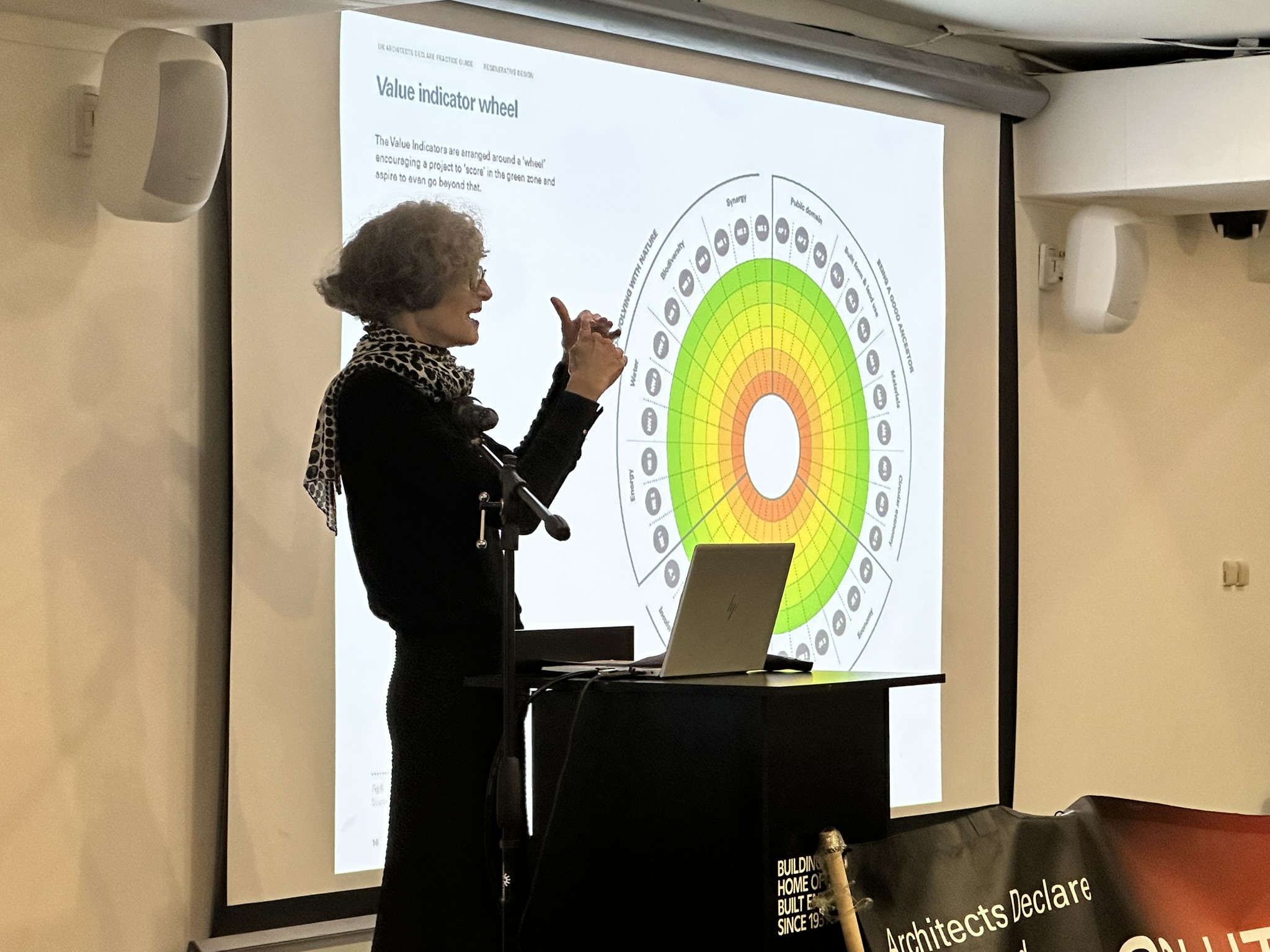
The Homes and Place Standard itself has actually existed internally for five years. It was co-created with residents and is structured around three pillars: homes, place and sustainable futures. It’s important to say that it isn’t a design code. The danger with design codes is that the minimum quickly becomes the norm. Instead, this is an assessment tool. Projects are scored across different criteria — from “no score” to “excellent” — and the balance of scores matters more than rigid compliance. That flexibility is important because every site is different.
How do you go about measuring “place” and how much of a challenge was establishing this criteria?
“Place” has definitely been the hardest area to define. Everyone talks about legibility, character and neighbourliness, but translating those concepts into something measurable is complicated. Play space is a good example. It’s easy to say there’s a play area nearby, but if residents have to cross a motorway to reach it, that’s not meaningful access. So we started drilling into questions like: how long does it take to walk there? Is it safe? Is there enough diversity in play for different age groups? Are there intergenerational meeting points? Frontages are another example. You can actually measure how many homes actively front onto a street and how many turn their backs. That has a huge impact on how safe and sociable a place feels.
The aim is to help development teams understand what good placemaking actually looks like, and when a scheme simply isn’t good enough for residents.
SNG is preparing to publicly launch the Homes and Place Standard. Why now?
We’ve now used it internally for five years across every project that comes through our system, from early feasibility studies through to schemes on site. We’ve also assessed our existing homes against it. That time has been important for credibility. We wanted to be able to say this is tried and tested, not just a theoretical framework.
The launch is currently a soft launch. We’re opening up conversations with other housing associations, local authorities and private developers to see how much interest there is. The idea is that eventually projects could potentially be assessed independently and certified against the standard. What’s valuable about it isn’t just the score itself. Because projects are reviewed repeatedly throughout development, the framework helps teams identify priorities and understand where compromises should happen. It becomes a decision-making tool as much as an assessment tool.
What keeps you awake at night?
The tension between quality and quantity. There’s huge pressure to deliver homes quickly, and sometimes that means accepting sites or proposals that don’t fully meet our aspirations. You constantly hear the argument that an imperfect affordable home is still a home for someone who needs it. Of course that’s true, but we also have a responsibility to make sure people aren’t trapped in poor-quality environments for the rest of their lives. We need to provide places with community, dignity and opportunities to thrive.
What worries me is that every new challenge — economic pressures, policy changes, viability constraints — chips away at quality a little more.