John Pardey reflects on the life and work of architect Peter Aldington, whose modest but deeply influential body of houses fused modern design with the English picturesque, creating an architecture rooted in place, craft and landscape.
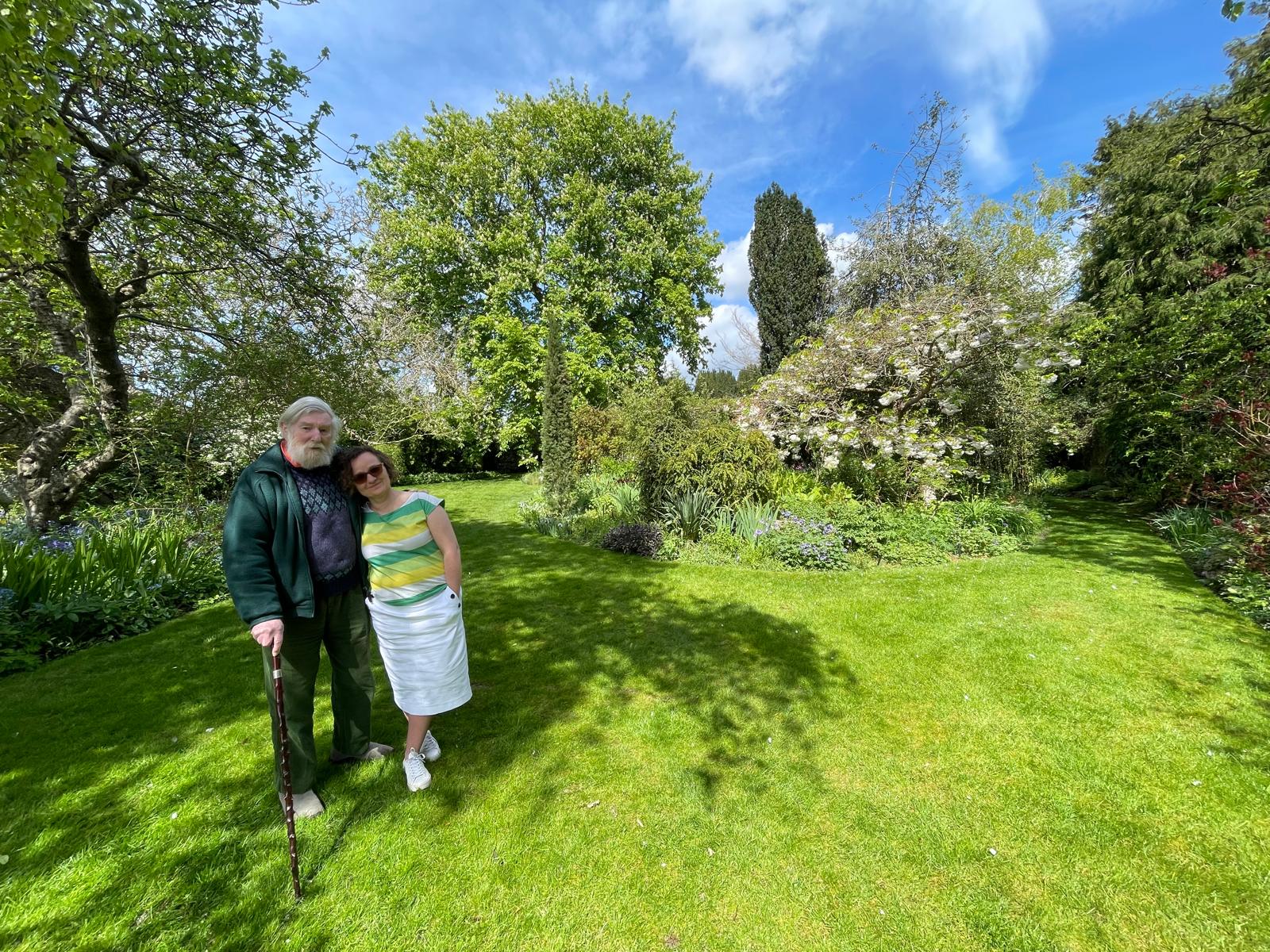
Peter Aldington and AT Editor Isabel Allen in the garden at Turn End.
Architect Peter Aldington has died one day after his 93rd birthday. He was born on 14 April 1933 and died on 15 April 2026.
I met Peter Aldington for the first time in June 2002 at his home, Turn End, during one of the open days for the wonderful garden he had created. Spotting him in a corner, easily recognisable in baggy orange corduroy trousers and with a big shaggy beard, and despite having been warned that he did not like talking to architects, I introduced myself. As warned, he walked off. Undeterred, I sought out Margaret, his wife, and told her that I had just returned from a week spent with Jørn Utzon. She brought him back, and we talked for hours. He was a big fan of Utzon’s work.
Peter enjoyed the attention his work produced, but it had to come to him rather than him initiating it. His passion for architecture was undiminished, despite abandoning practice at the age of 53.
Aldington had gained a national reputation for his house designs, yet had found practice just too stressful. He could not deal with a frustrating planning system, difficult builders, and endless committees of stakeholders. It was making him miserable, and he just could not compromise. He walked away from architecture and turned to garden design.
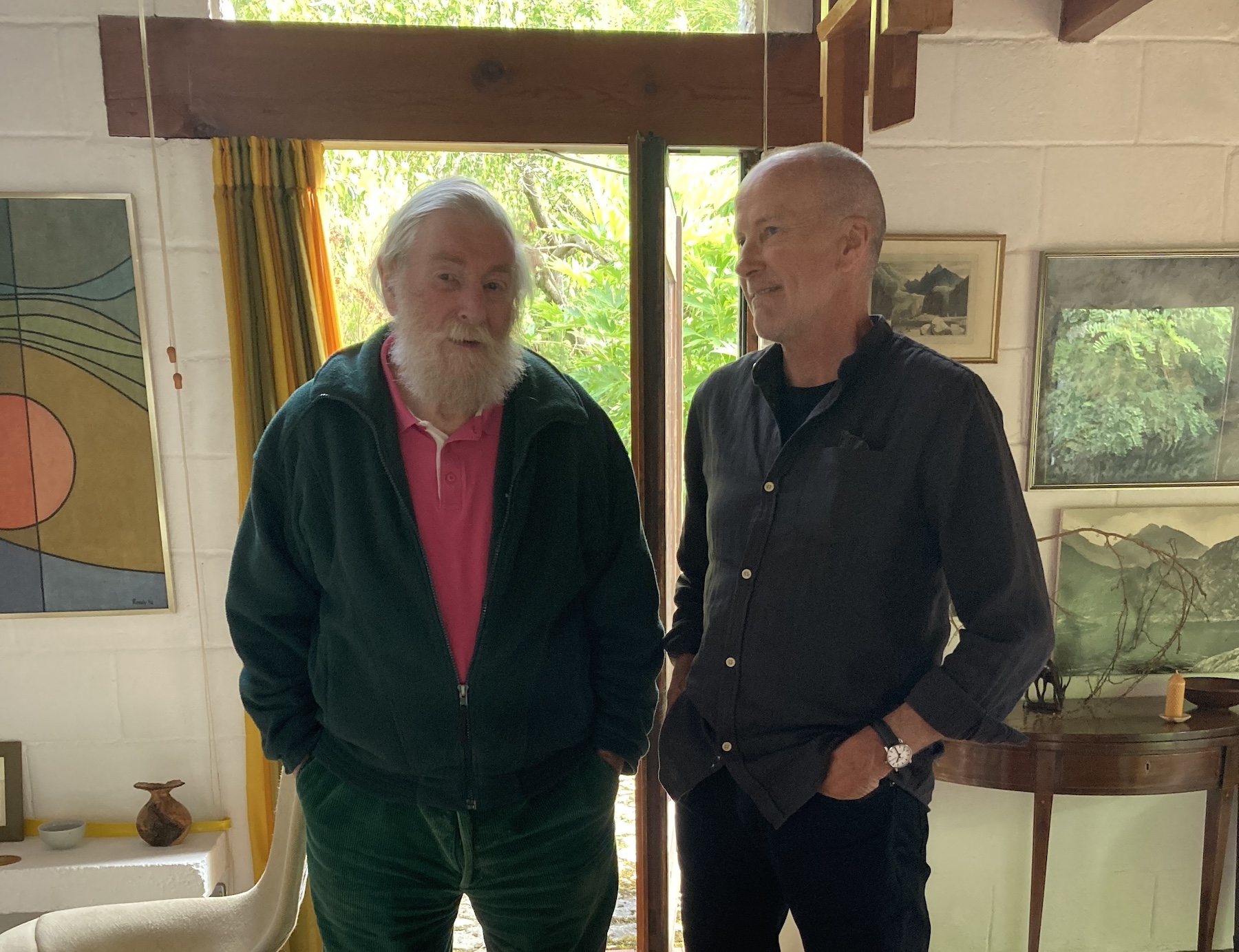
Peter Aldington and John Pardey at Turn End.
He was born in Preston in 1933. His mother was a teacher and his father was managing director of Siemens, and a keen gardener. A family friend, George Grenfell Baines, was the founder of the Building Design Partnership and had designed Peter’s parents’ house. While this ignited an interest in architecture, Peter’s passion was to become a gardener. His parents, however, thought this an unsuitable profession and persuaded him to study at the Manchester School of Architecture.
After qualifying, he joined the London County Council Architects’ housing division, interrupted by National Service in the RAF where he was attached to a photo-reconnaissance squadron. There he was able to follow a passion for photography and be in charge of the darkroom.
His first independent commission was for Mike and Celia White, who he had met on a climbing course in Scotland in 1960. The ‘White House’ he built for them in Askett Green, Buckinghamshire in 1963, displayed a fully formed architectural vocabulary of white-painted brick, tiled floors and exposed timber structure that was to endure throughout his career. This was influenced by the British Arts & Crafts movement with its truth to materials and expression of construction, fused with Scandinavian Modernism and Frank Lloyd Wright’s ‘Usonian’ houses.
The house was photographed by Richard Einzig, who he had known from the Photographic Society at Manchester University, and was widely published to confirm a new talent in the architectural scene of the day.

Turn End, Haddenham. (Credit: Richard Bryant/Arcaid)
The early 60s saw a large number of architects in Britain gain success in domestic architecture using a new trajectory towards exposed construction: Edward Cullinan, Stout & Litchfield, Phippen Randall and Parkes, Team 4, and Peter Aldington.
In the spring of 1963, Peter and Margaret purchased a half-acre site at auction in Haddenham. It had formerly been part of the garden of a large house and was surrounded by major trees and wychert walls, a form of walling utilising local chalk and straw that is particular to this part of Buckinghamshire.
The plot was covered by a covenant restricting development to no more than three single-storey homes. Peter’s design arranged three houses in an L-shaped arrangement to the south-west corner of the site off a small road called Townside, then the village edge, carefully retaining all the trees and the small former orchard.
Turn End is architecture without showing off. There is no pandering for the publicity shot. It is timeless, rooted in place and culture.”
The Aldingtons became their own builders and, working with local craftsmen, set about the first house, Turn End, which was completed in 1967 to become their own home. All three homes sit around the entrance court behind rough, white-painted rendered walls, capped in Redland Delta cement tiles, and a surviving wychert wall provides enclosure to the south side of the entrance court. Only high up, slatted clerestorey windows signal habitation within. The homes were an essay in economy in both detail and cost.
Turn End’s modesty, its matter-of-fact construction, the use of simple materials, the fusing of inside and outside spaces, and the spatial planning of different volumes, is architecture without showing off. There is no pandering for the publicity shot. It is timeless, rooted in place and culture.
Aldington joined up with John Craig in 1970. Craig was not an architect, but a gifted illustrator, craftsman and musician who had worked as creative head of an advertising agency in London. He could pick up on Aldington’s weaknesses in creative drawing and organising, leaving him free to deal with the designing and making of things. Craig’s role in the practice was vital, acting as the liaison between the practice’s clients and Peter.
In 1977, Aldington and Craig completed a small group of houses in Bledlow commissioned by Lord Carrington, the last surviving member of the Churchill Government and then Minister for Energy under Edward Heath. Carrington had set up a charitable trust to build houses for rent to village residents.
The practice’s philosophy was perfectly tuned to this village setting, so the design returned to the walled, courtyard approach of Turn End, but here using brick with tiled roofs, with areas of dark timber boarding that reflected the local village vernacular.
His houses remain relevant in taking place, tradition, landscape and the basics of building to create a timeless architecture.”
Lyde End is at once timeless yet contemporary. With its angular forms, its mysterious hints at habitation behind garden walls and its quintessentially English materiality, it remains a paradigm for housing in post-war Britain.
As Aldington & Craig, they were disappointed not to receive more commercial commissions, but did build a number of innovative doctor’s surgeries, and the now sadly demolished Mechanised Letter Office commissioned by the Post Office in Hemel Hempstead in the early 1980s. But it was always the domestic projects that were at the heart of their work.
Over the years, Peter tended the garden at Turn End, now one of the great gardens in the country, being Grade II listed in 2017. In 1998, the Aldingtons established the Turn End Charitable Trust, now Turn End Trust. This educational trust promotes the integration of building and garden design, with Turn End as a prime example. There are regular open days for visits.
The Trust will secure the legacy of house and garden, but perhaps Turn End’s true legacy is the way it reflects the English traditions of the picturesque while using modern design and construction to blend with the vernacular without mimicry, to make an architecture of its place.
Relinquishing architecture has made the modest number of houses Aldington designed, only 12 houses, all of which are now Grade II listed, more precious, and none more so than Turn End. Two of these, the Turn End group and the Anderton House near Barnstaple, are Grade II*.
Aldington, again like Utzon, began a new life after architecture, designing gardens for a series of clients, and rock climbing and hill walking with his wife Margaret. His houses remain relevant in taking place, tradition, landscape and the basics of building to create a timeless architecture.
Peter leaves his wife Margaret, and their two daughters.