John Pardey on Frank Lloyd Wright’s Fallingwater in Bear Run, Philadelphia – a contextual and formal masterpiece that revived the architect’s career at age 67 and made him a household name across the world.
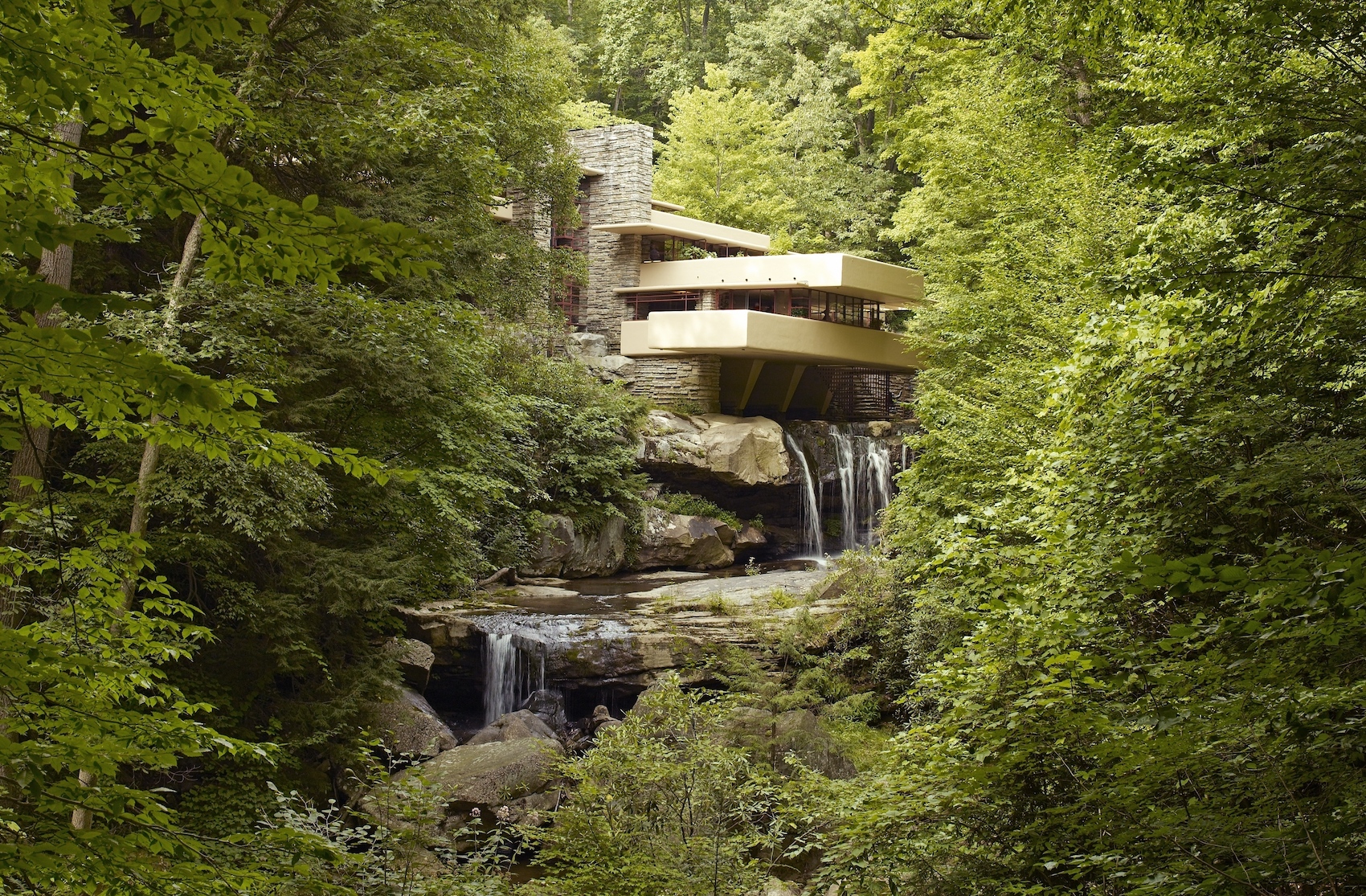
(Credit: Carol M. Highsmith via Wikipedia Commons)
This article is part of a monthly series of short essays on some of the greatest buildings of the 19th and 20th Centuries. Read John Pardey’s introduction to the series here.
No house should ever be on a hill or on anything. It should be of the hill. Belonging to it. Hill and house should live together each the happier for the other.”
— Frank Lloyd Wright
In popular culture, Frank Lloyd Wright’s name remains the most known of all 20th century architects – he even made it to Simon & Garfunkel’s 1970 Bridge over Troubled Water LP, with the tribute track ‘So Long, Frank Lloyd Wright’, which remains one of the best-selling albums of all time (Art Garfunkel had wanted to train as an architect).
Wright was born in 1867 in rural Wisconsin and opened his own practice in 1893 in Chicago at the tender age of 26 while still employed by Adler & Sullivan who were pioneers in taller, steel-framed buildings in the USA. His moonlighting work led to his dismissal from the Sullivan office, but by the age of 33 he was part of a movement known as the Prairie School, a group that took the English Arts & Crafts style in the use of honest construction combined with sprawling plans set beneath low-pitched roofs.
Wright’s career, founded on his unshakeable self-belief was stellar, and he built not only the first atrium-plan office building (The Larkin building, Buffalo, New York of 1906), the first concrete-framed building in the USA (The Unity Temple in Chicago of 1909), as well as developing one of the most important house concepts known as the Usonian Houses in 1934. But by the mid-twenties, along with the economy, his career had slumped.
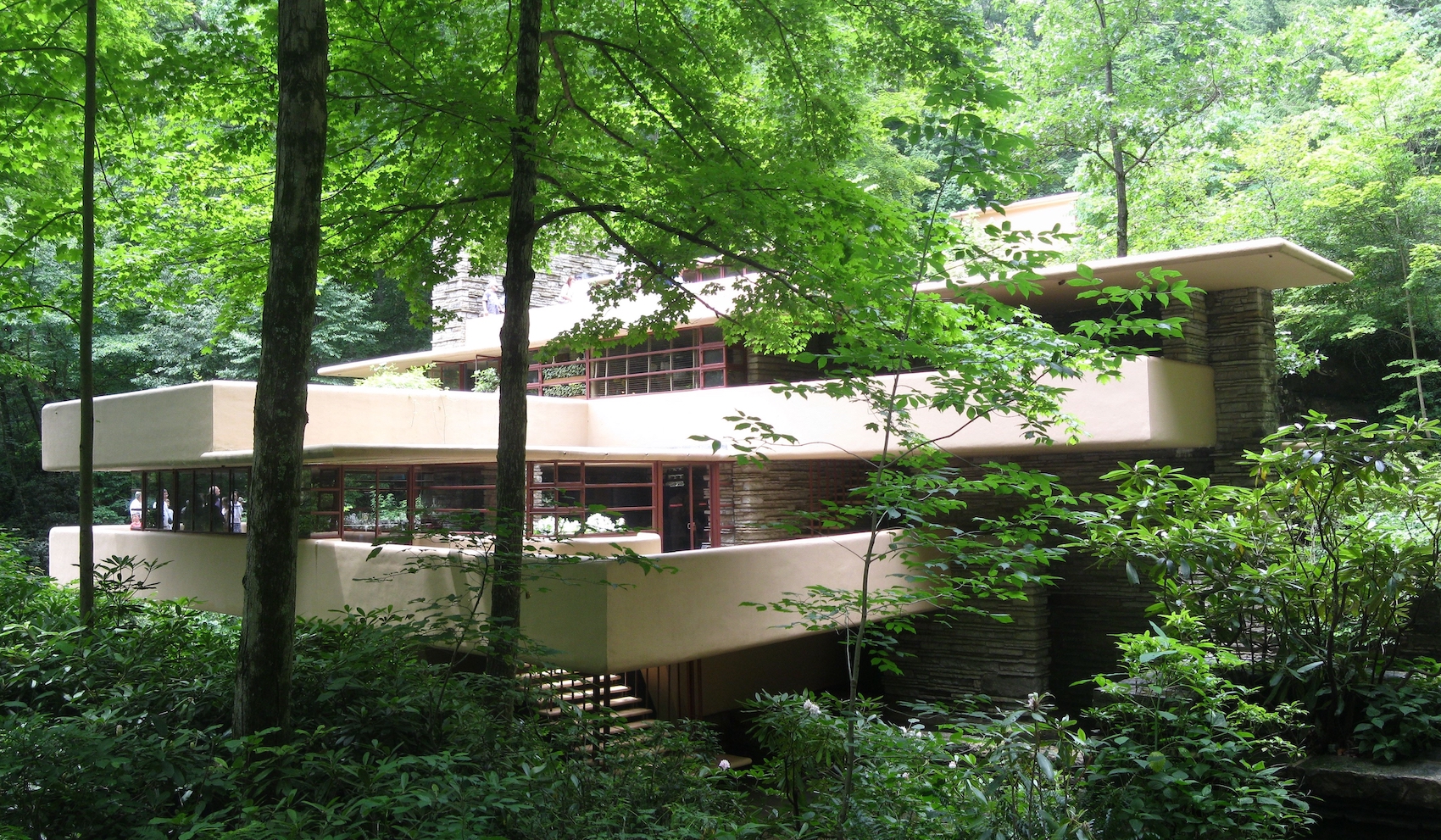
(Credit: Ruhrfisch via Wikipedia Commons)
It was to be a house commissioned by Edgar J Kaufmann, the founder of the modern Department store in Pittsburgh that was to revive his career at the age of 67 and make him a household name across the world. Upon completion, the house he named Fallingwater was to grace the cover of Time magazine in 1938, where it announced Wright as ‘the greatest architect of the 20th century’. Wright was a master publicist, his own greatest fan, and never shy in coming forward to remind the world of his genius, yet he too was surprised at the praise and worldwide acclaim for this house.
Fallingwater was indeed a masterpiece, and unlike his earlier work, he dabbled with the International style from Europe (a fact he would aways refute) in its cantilevered cubic forms, all visually supported by a vertical stone stack.
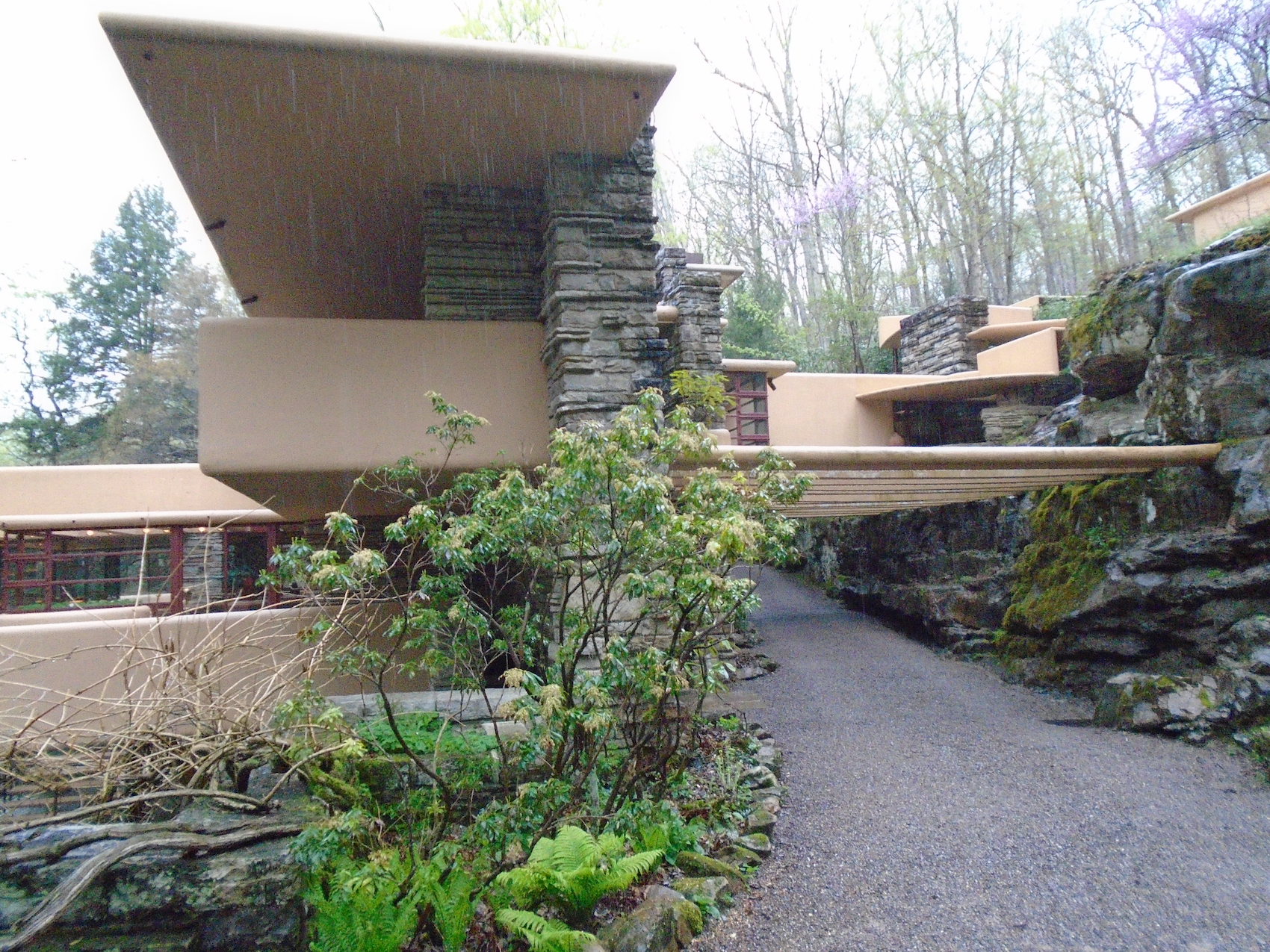
The success of Fallingwater can partly be attributed to the way that Wright sites the house. Rather than placing it to look at a waterfall, it sits on a small rock ledge above the waterfall. The main living accommodation is located within a broad concrete tray that is far wider than the site, so that it cantilevers out from five stone piers. Another tray projects above it, crossing at right angles, while a third floor sits further back, with the whole four-storey composition balanced by a massive stone fireplace stack.
(Credit: AaronBarlow via Wikipedia Commons)
The horizontal trays – terraces – seem to defy gravity and the waterfall seems to come from the house itself, while the stone chimney structure balances the composition. There is also an undeniable European influence at work in this composition, perhaps from two of his former employees who had both come to the States from Austria: Rudolph Schindler and Richard Neutra. They had variously worked in Wright’s office between 1920 and 1925 and both had gone on to build a couple of celebrated houses in California. Schindler’s 1926 Lovell Beach House in Newport may be seen as a clear pre-cursor to Fallingwater, with its series of horizontal balconies supported on vertical columns with splayed supports picking up the cantilevers. But this was also a very European affair with its white-rendered International Style overcoat.
Wright’s 1923 Imperial Hotel in Tokyo had explored a structural approach of cantilevering floors supported from the centre – like a waiter carrying a tray – rather than being carried between walls. His structural intuition proved to be right as the hotel survived a catastrophic earthquake in 1923, only to be demolished 44 years later to make way for a high-rise structure.
Upon completion, Fallingwater was perfectly captured by 25-year old photographer Bill Heydrich. He stood in the icy-cold Bear River to capture the drama of house and nature, creating one of the most iconic images of the century (a view that had been anticipated in a perspective drawing by Jack Howe in Wright’s studio two years previously).
Wright’s architecture was incredibly progressive, founded on a belief in nature rather than abstract concerns of the Europeans, but in some ways, he was also the last remnant of the 19th century. His philosophy was that of an ‘organic architecture’, one founded on the idea that buildings should relate to nature in a profound way, or in his words, that evolves from within outward.
Ronchamp in the snow. (Credit: Lykantrop via Wikipedia Commons)
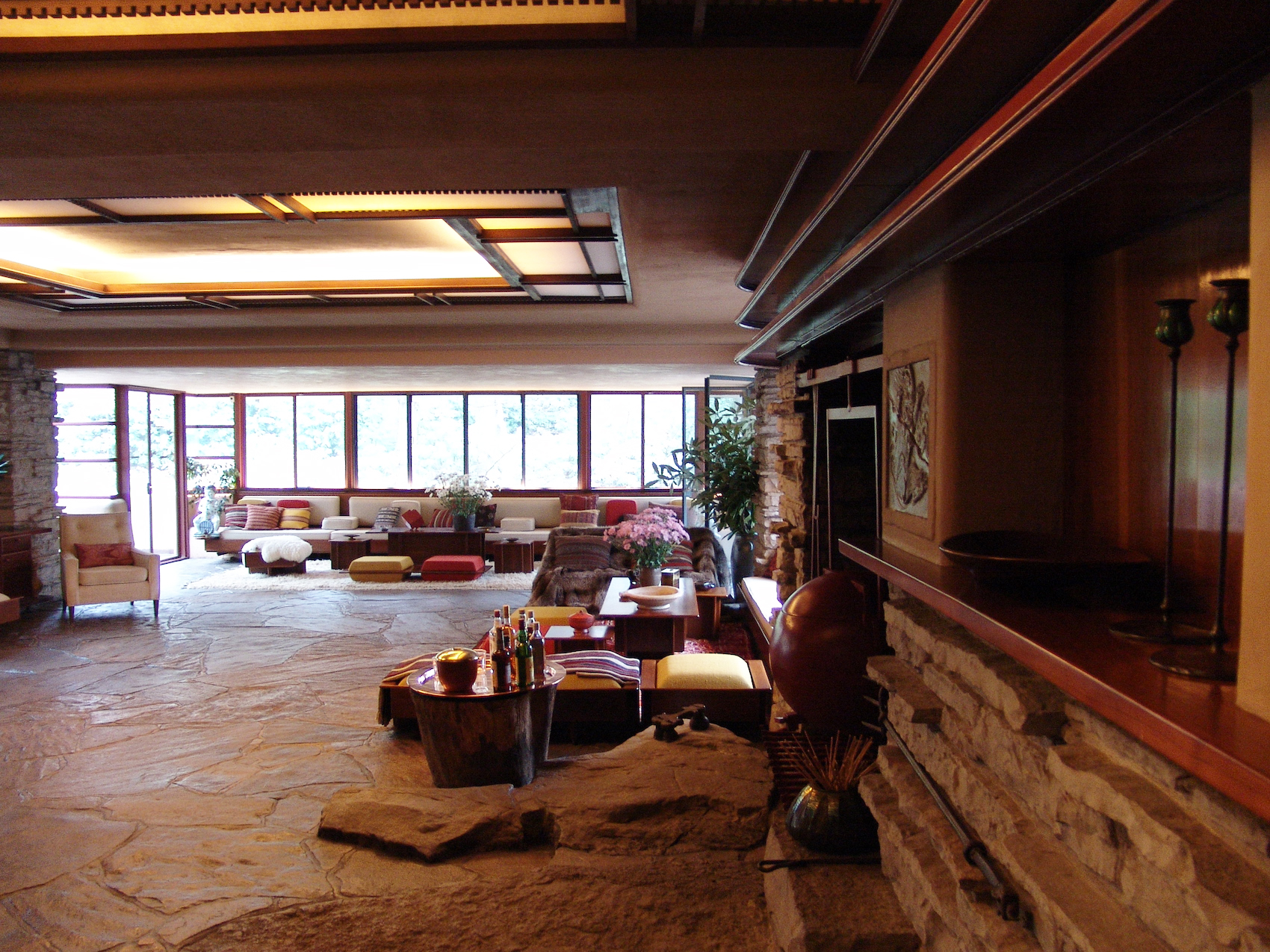
The inside of the house is less successful than the outside, and as Wright was fond of using his somewhat diminutive stature as a measuring tool, so the ceilings feel very dark and low. The strip windows provide glaring light so that just a ribbon of trees can be seen. The waterfall can be heard but not seen other than from a glazed hatch, which opens onto a beautiful, suspended staircase that drops down to the water. Seating is built-in, but with the backs to the view. The fireplace and heart of the home is a triumph however, with a cave-like stone edifice fronted by a giant boulder that the Kaufmanns once used to sunbathe on, heaving its way out of the floor and fulfilling Wright’s philosophy that “It is in the nature of any organic building to grow from its site, come out of the ground into the light…”
Wright designed 1,114 buildings and built a staggering 532; he was married three times and had eight children; he borrowed money from clients and staff; was always broke yet always had the latest automobile; Fallingwater came in 442 per cent over budget and was refurbished to avoid collapse of the concrete cantilevers in 2002; he was a narcissist and a genius.
It remains the exterior of Fallingwater that is beguiling and photogenic, making it the most famous and visited house in the States, with more than 180,000 visitors each year.
Paul Goldberger stated that, “Great architecture, like any great art, ultimately takes you somewhere that words cannot take you at all. Fallingwater does that the way Chartres cathedral does that.”