O’Donnell + Tuomey has completed V&A East Museum at London’s Queen Elizabeth Olympic Park. John Tuomey and Sheila O’Donnell tell Nelly Greig about the chance encounters and musings that inspired the building, and their hopes about how it might evolve.
I’ve got this big charcoal coat wrapped around my shoulders, the lapels pulled tight around my neck, the tails whipped up in the wind. It’s warm from its previous wearer, who now stands next to me, coatless. He’s describing a chance encounter with a cased object that triggered the cascading train of thought resulting in his practice’s newly completed building, the V&A East Museum, outside which we stand. The object: a coat. The coatless man: John Tuomey.
The premise behind O’Donnell + Tuomey’s design for the V&A East Museum – which accompanies the V&A East Storehouse to make up the museum’s Stratford campus – finds its origin in two places. Tuomey chanced upon a designer coat hung in an exhibition at the V&A’s South Kensington site and, seeing it spotlit and in isolation, considered the space between fabric and skin. Similarly – as is often the case when you’ve been partners in practice and life for more than 30 years – Sheila O’Donnell had seen a billowing shirt sleeve in a Vermeer painting and wondered what it would be like to live within it. Both encounters inspired musings on the spaces between things, and while such poetics have meandered and evolved, they provide reassuringly charming narratives that accompany us on our walk through the site.
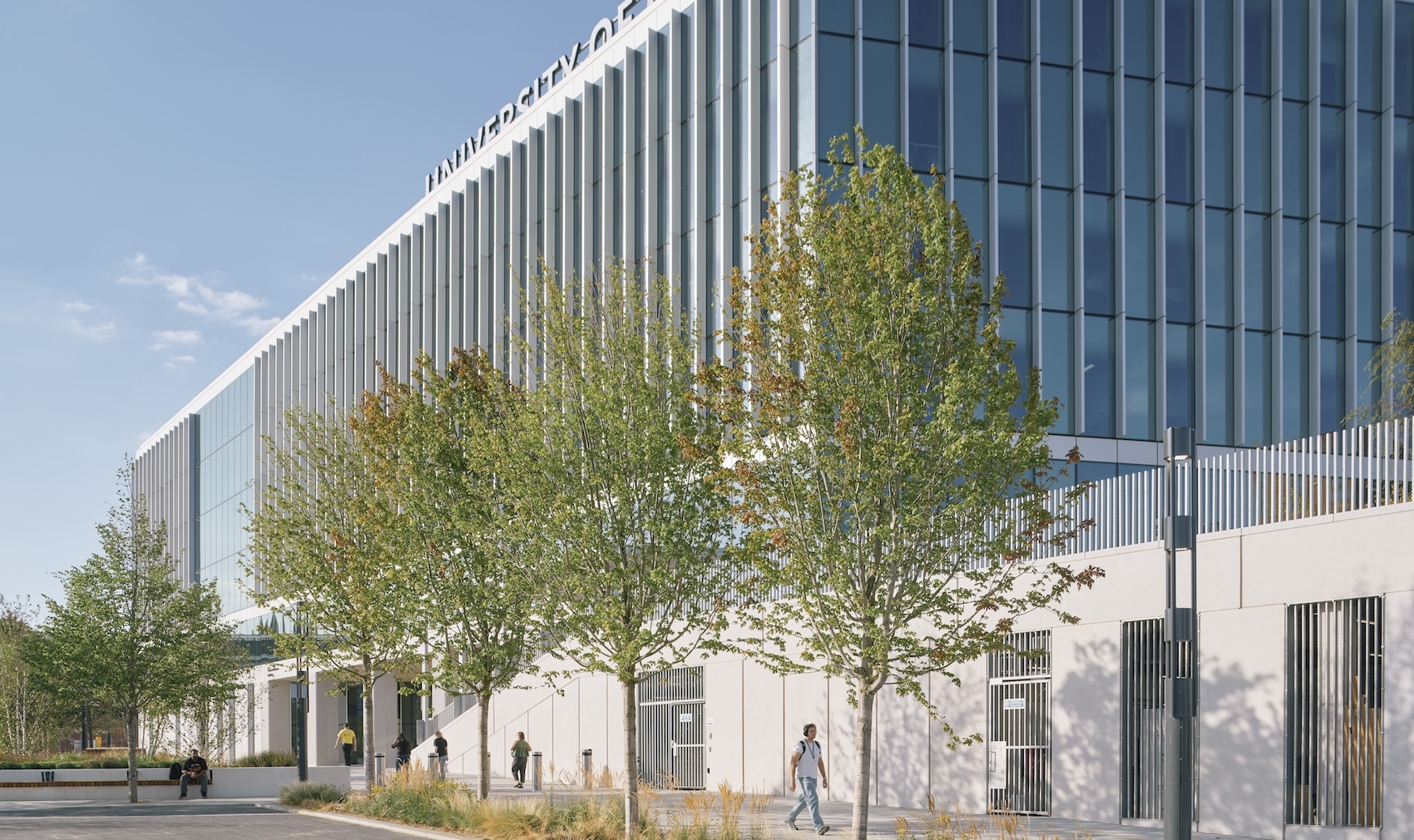
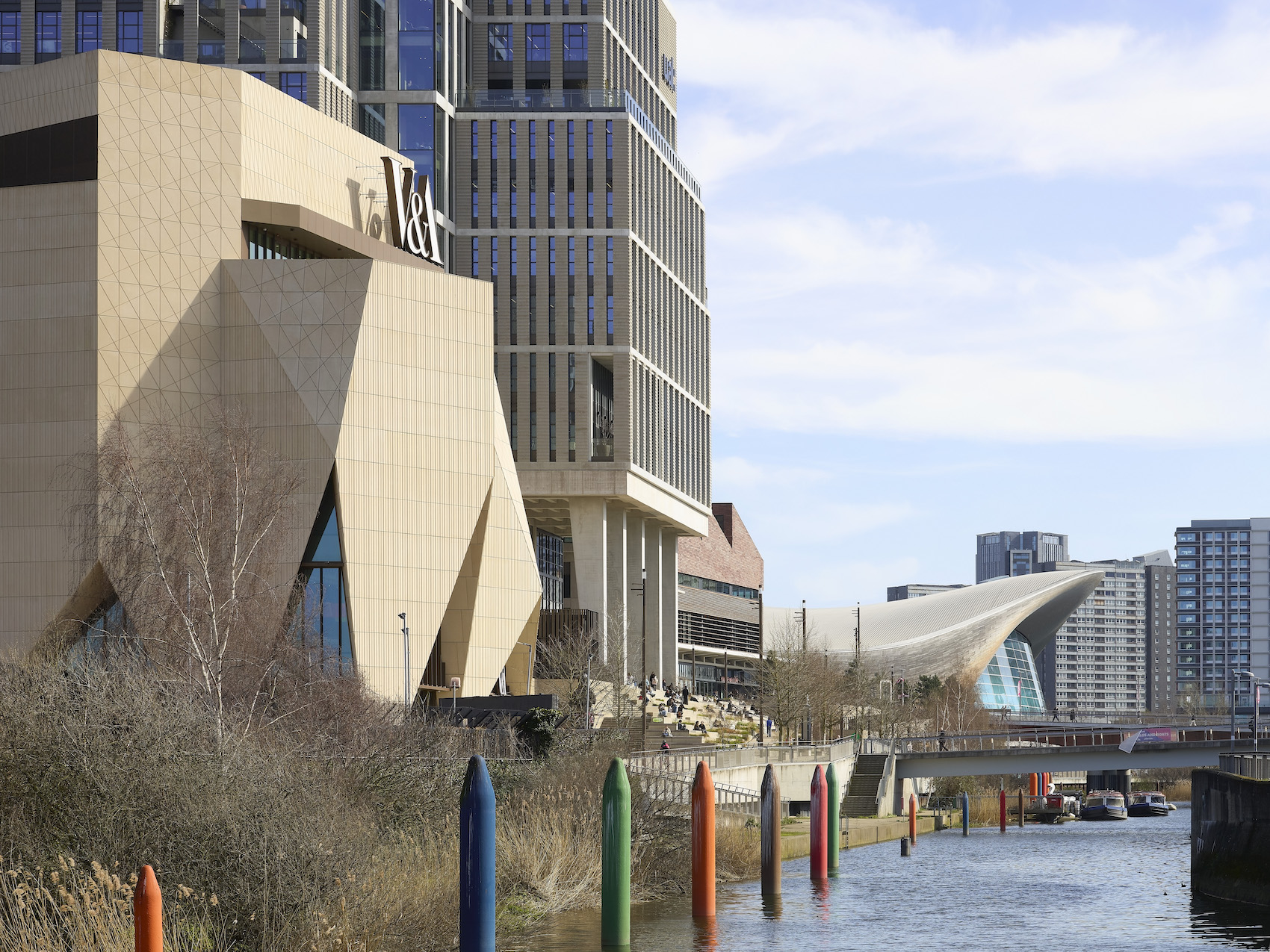
The new museum is perched at the end of a promenade of cultural centres and educational buildings lining a stretch of the Waterworks River: one of the three channels into which the River Lea splits as it trails through the Olympic Park. The scheme forms part of a masterplan designed by Allies & Morrison, with O’Donnell + Tuomey and Howells.
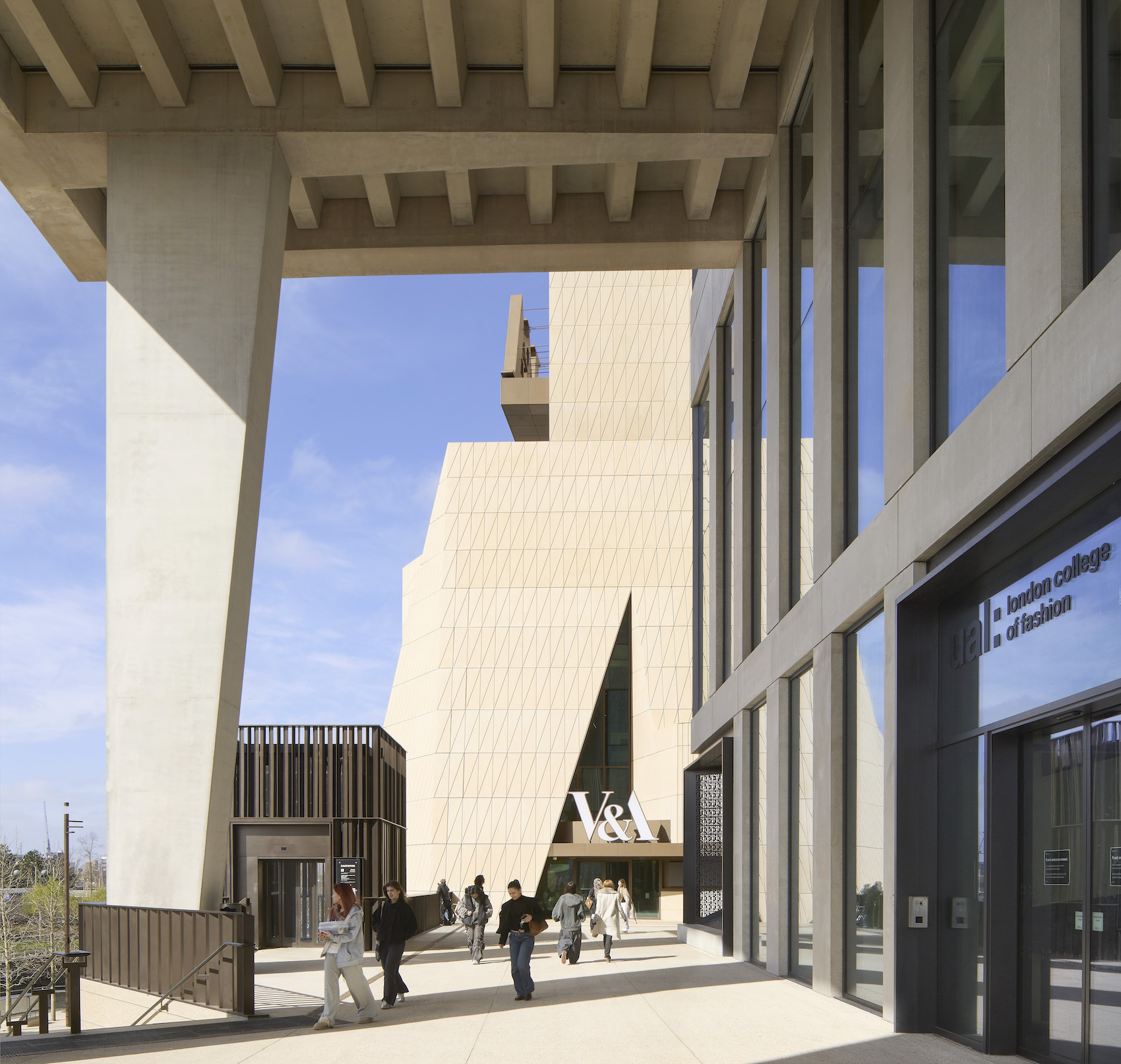
The museum is sited on a promendade of cultural centres and educational buildings that line the Waterworks River.
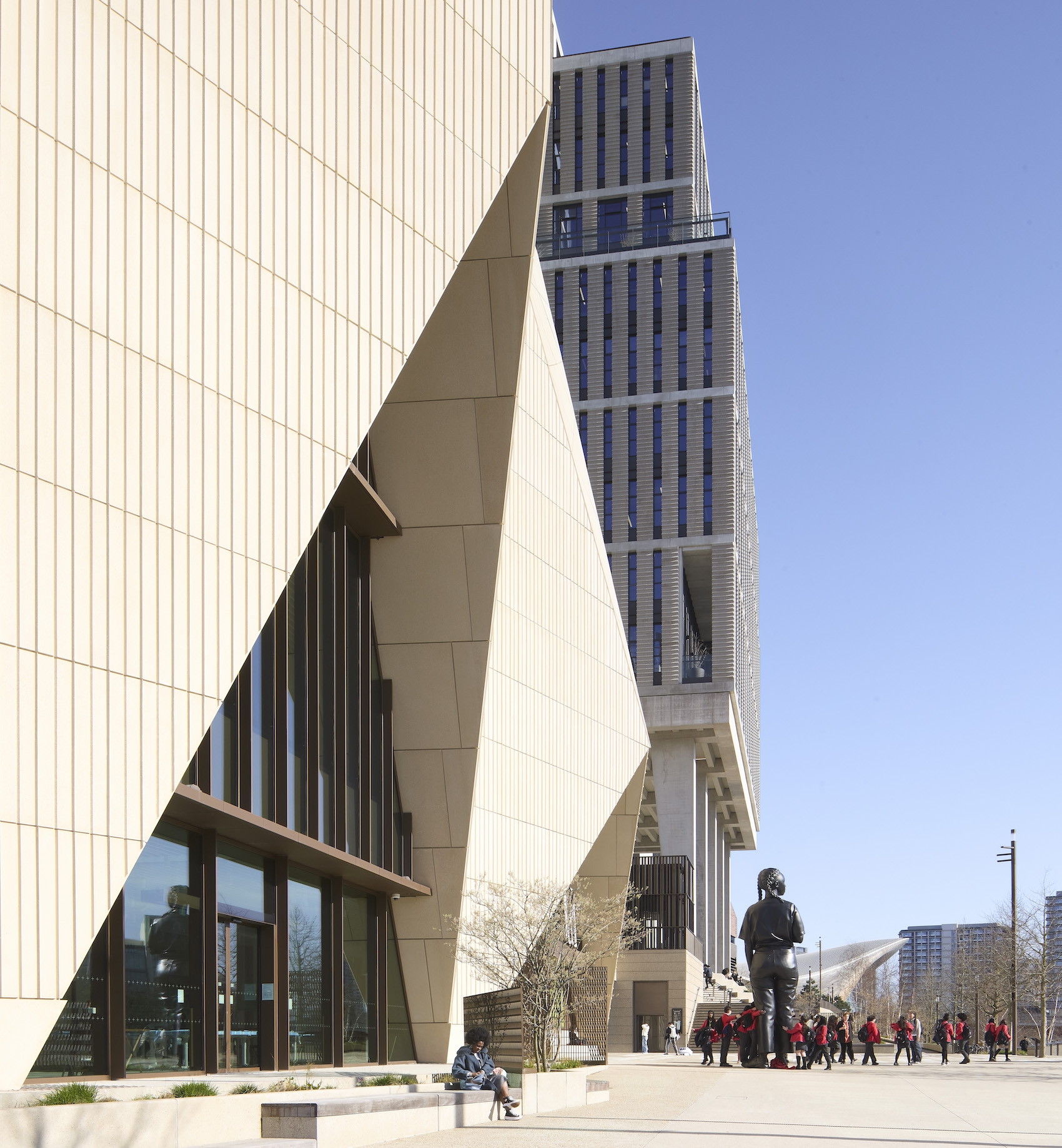
The V&A East stands independently, wrapped in a robust precast-concrete shell, or ‘crust’, as Tuomey refers to it, with slices of glazing cut through sharp, angular folds. A nearby neighbour is Sadler’s Wells East, also designed by the duo and opened last year, sitting two doors down beyond UAL’s London College of Fashion and BBC Music Studios. While the dance centre was led by O’Donnell and the museum by Tuomey, I asked how they would feel about passersby being able to tell that both buildings were designed by the same practice. He recounts a conversation he had at the Gallery of Photography opening in Dublin, 1996. This was one of several buildings designed by Tuomey, O’Donnell and 12 other young architects under the name of Group 91. They won the competition for the Temple Bar Framework Plan: an urban development around Meeting House Square that is often referenced as a pivotal moment in Dublin’s modern architecture scene.
“I was standing on the roof of the Gallery of Photography, looking across Meeting House Square, when the gallery’s founder came over to thank me for his new building. He put his arm over my shoulder and, pointing across the square, said, ‘I’m just glad I didn’t have to work with the guys who designed that!’” He was pointing at the National Photographic Archive: a red-brick, muscular building, radically different from the delicate Gallery of Photography, and another of Group 91’s projects. Tuomey, of course, laughed. “Sheila and I like personality, character and identity.”
It is an approach Tuomey attributes to James Stirling, whom he quotes as saying: “I believe the shapes of a building should indicate – perhaps display – the usage and way of life of its occupants, and it is therefore likely to be rich and varied in appearance, and its expression is unlikely to be simple.”
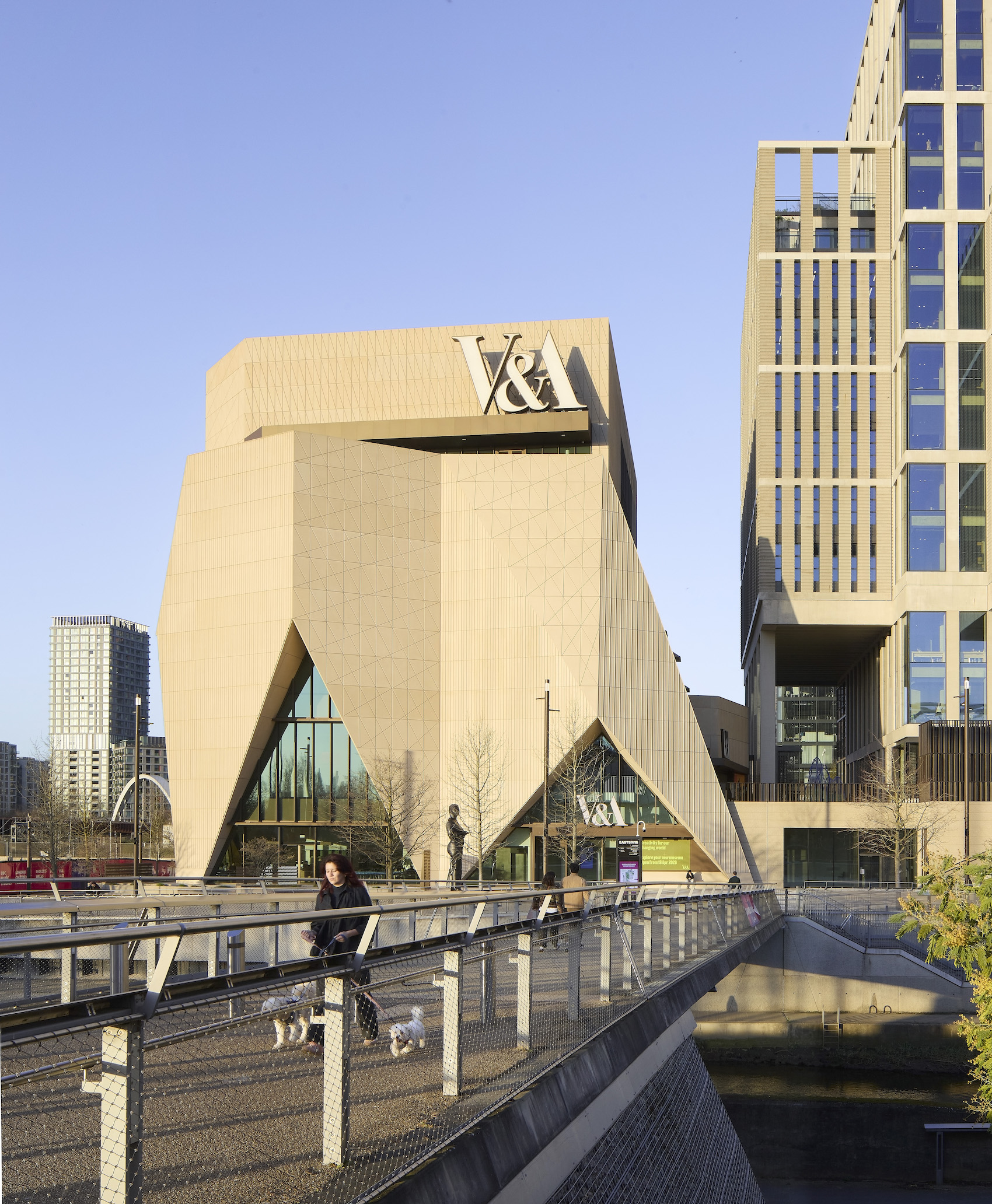
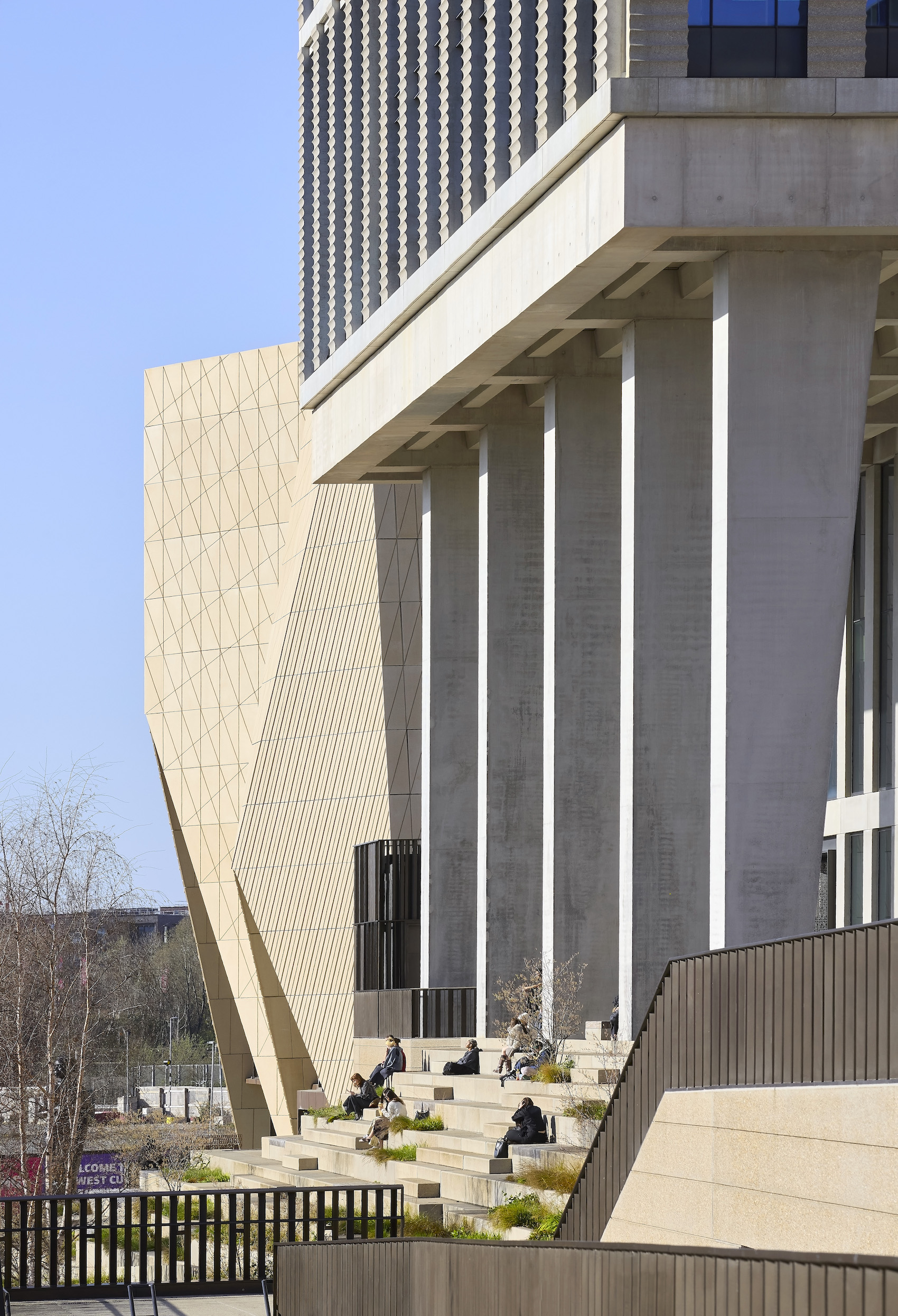
Left to right: The building is wrapped in a precast-concrete shell with glazing slicing through the sharp angular folds; a stepped terrace provides an area for reflection and informal meetings
The practice began the design process with the fundamental restrictions of the plot, which gave them a necessary operational skeleton. Vehicles transporting objects from the Storehouse for display require street-level access and a straightforward route to the galleries. This established a transport core. As a result, the largest of the three exhibition spaces is pushed to the top of the building and, uninterrupted by lift shafts, becomes the largest open gallery across all V&A sites.
This space, which opens with the exhibition The Music is Black: A British Story, is more defined and authoritative in contrast to the fluidity of what lies below. The floor above operates as an open-plan function room and roof terrace. It is slightly smaller in size, but high ceilings and floor-to-ceiling glazing lightly balance it on top, protruding like a lantern and looking out across London. It’s around this skeleton that Tuomey’s idea of occupying the space between things begins to take shape.
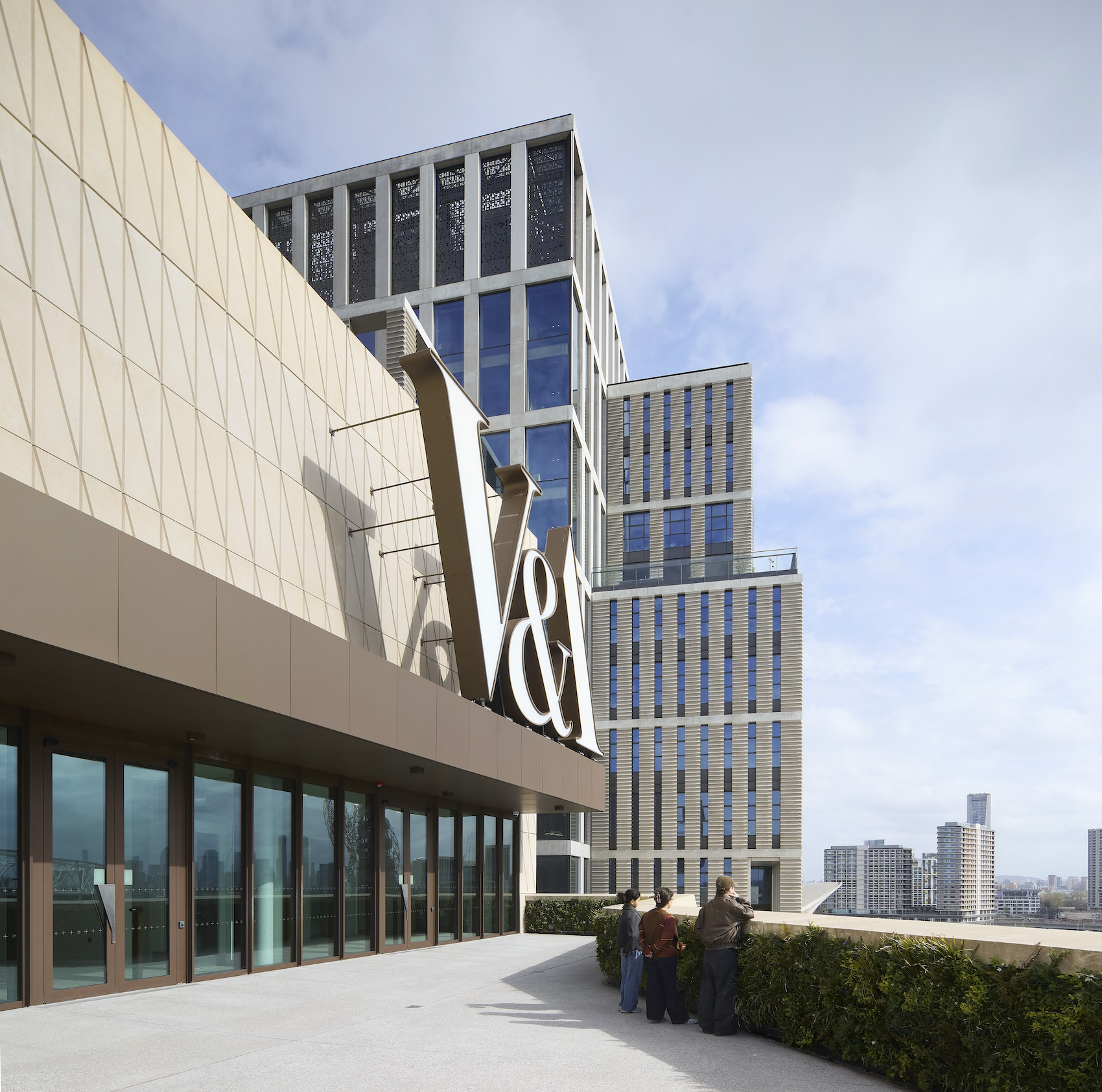
The roof terrace is accessed via an open-plan function room and provides panoramic views of London.
The influence of Tuomey’s coat and O’Donnell’s sleeve is largely reflected in the building’s circulation, which is pressed up into the crust, running in a continuous ribbon of public- access staircases and landings all the way to the top floor. Visitors encounter their first doorway into the only ticketed gallery at this upper level. These routes, finished with bespoke angular handrails and braces, frame moments to pause and look out, down, up and across at spaces animated with artworks, landscapes and visitors. The same flooring is used outside on the museum’s new waterside piazza, continuing internally across all public spaces, the idea being to create an undefined threshold between museum and street.
Jen McLachlan, project director for V&A East, urges visitors to use the space however they see fit. “If someone is sitting in the corner here,” she says, gesturing towards a moment where one of the large triangular cut-out windows meets the third floorplate to create a kind of nook, “if someone is sat here working on their laptop all day long, seven days a week, we don’t mind. We’re encouraging that.” One can imagine the timber furniture and stone steps, their covers currently being peeled off and final furnishings added, wearing down to reflect such inhabitation.
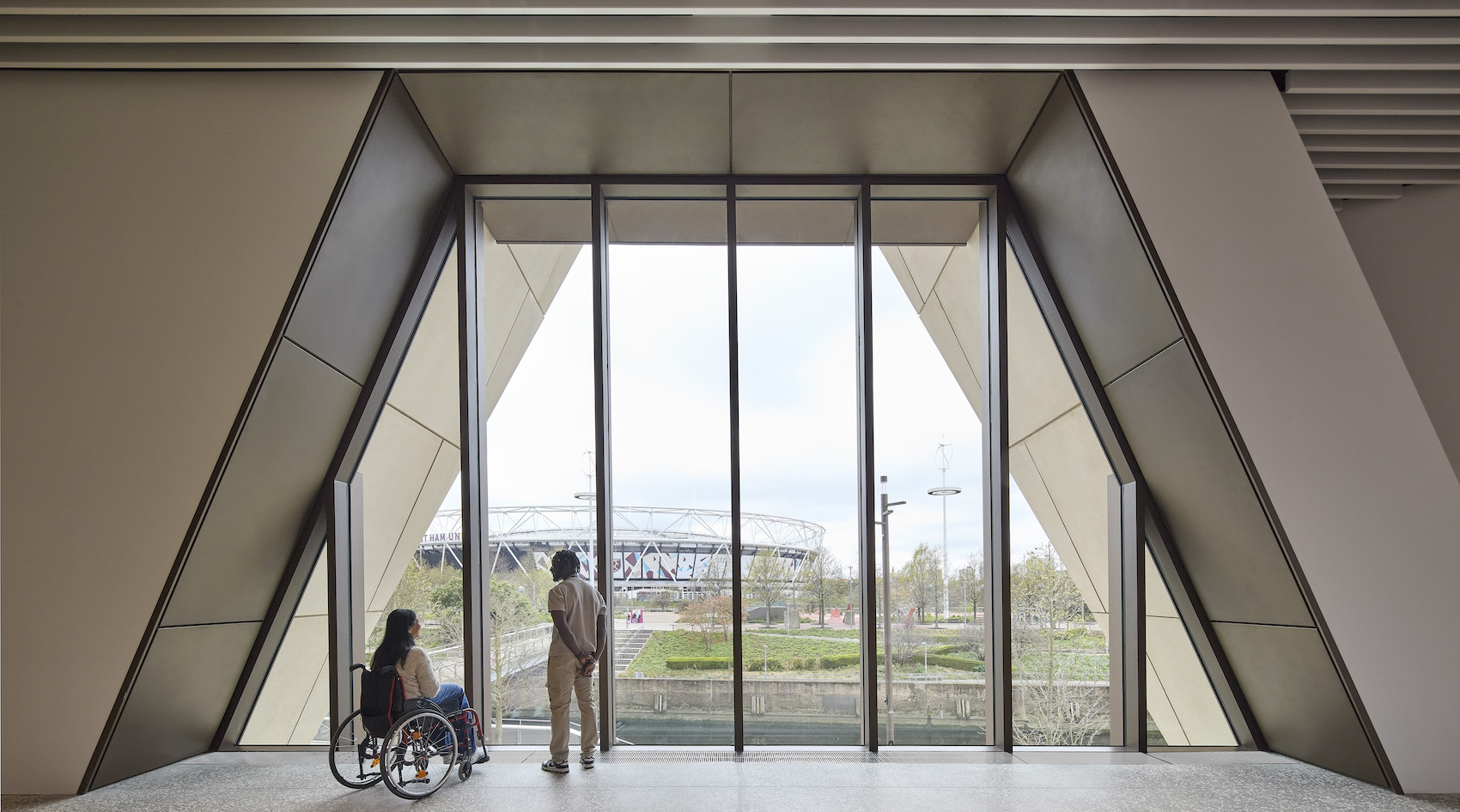
Across the first and second floors, the two open- access galleries display more than 500 objects from the V&A’s collections, spanning art, architecture, design, performance and fashion. These are called the ‘Why We Make’ galleries and were designed by JA Projects in collaboration with A Practice for Everyday Life, Larry Achiampong, and the V&A East Youth Collective.
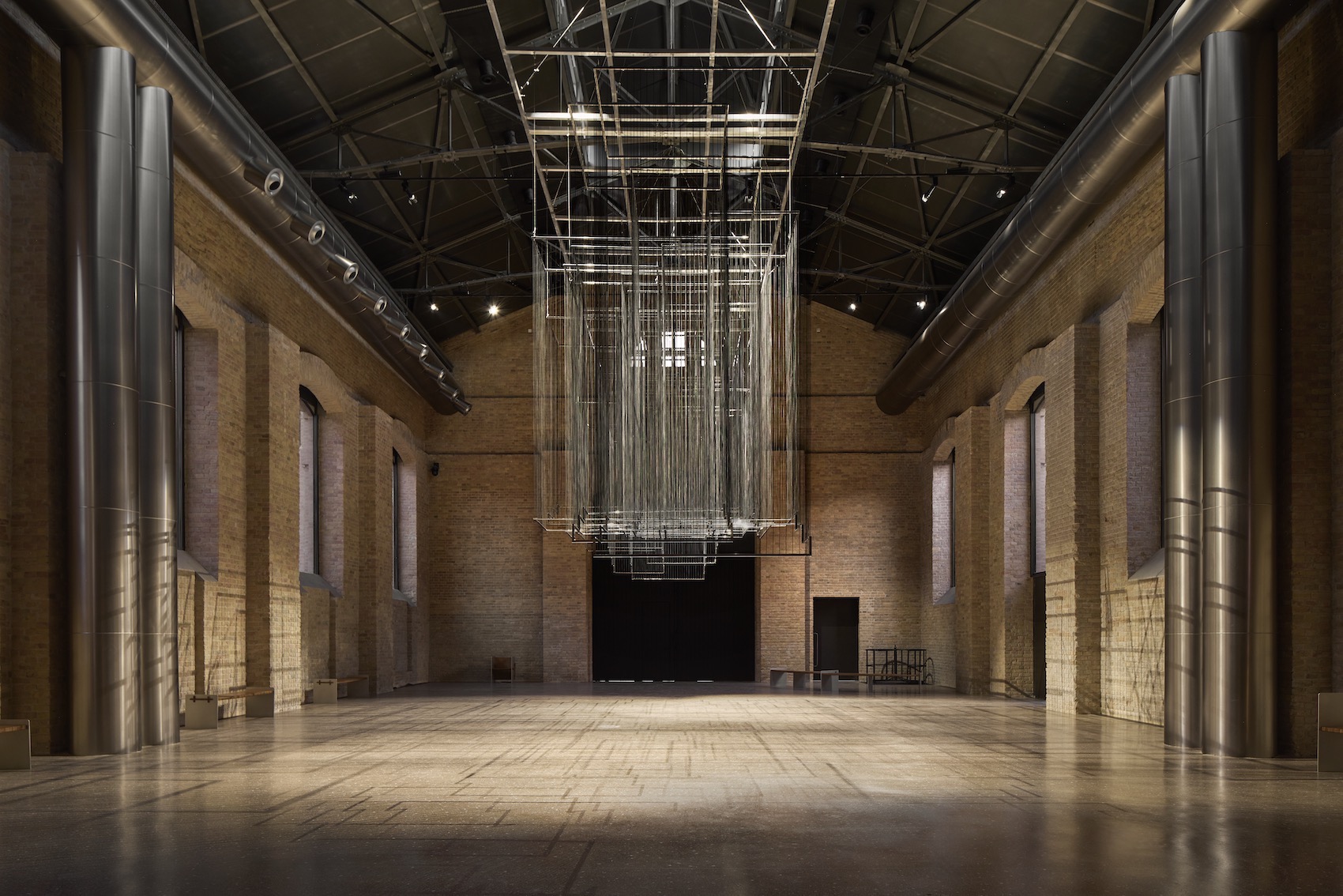
The gallery arrangement, referred to as a ‘constellation’, challenges conventional exhibition design, which tends to follow a linear narrative. Here, visitors can wander from cabinet to film to book, drifting between displays, led by curiosity. There is limited natural light in the gallery spaces due to the environmental controls required for the objects. Instead, high ceilings, carefully considered lighting and large open rooms create spaces that are flexible and modular. Additional artworks distributed throughout the galleries, circulation spaces and public areas are the result of the New Work programme: a rotating cycle of commissions from local and global artists and designers responding to a theme that changes every six months, the inaugural theme being ‘Making East London’.
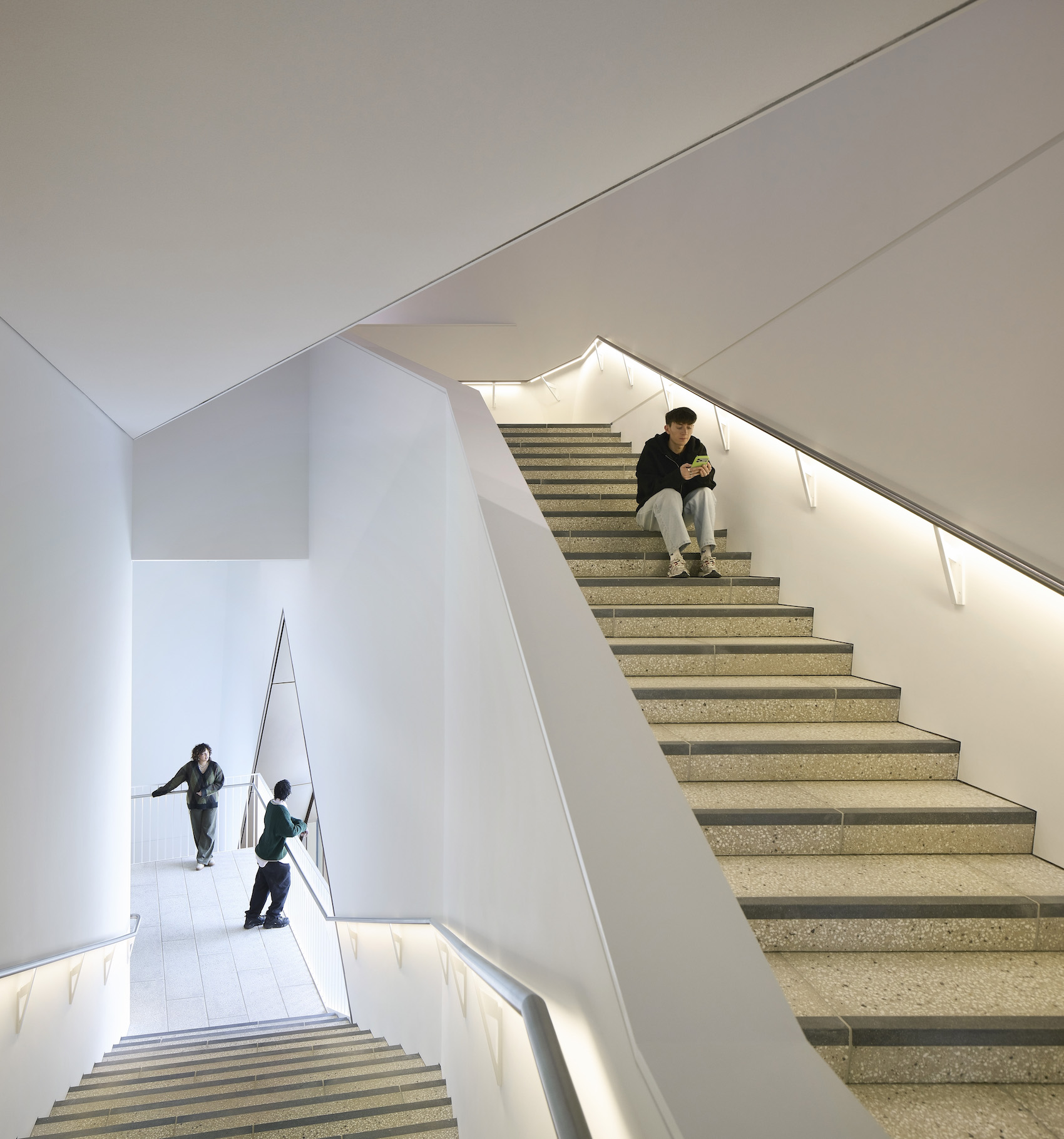
A continuous ribbon of public-access staircases and landings guides visitors through the building.
When I meet Sheila O’Donnell, she tells me about a small pot selected from the museum’s online archive that arrived only to be ten times smaller than she had expected, something I imagine happens quite often at the V&A East Storehouse, where the public can request objects from the archive for viewing, and is is why museums resist becoming fully digital. In a similar sense, the building appears much smaller than I had expected, as though it had been designed pocket-sized and then scaled up. Perhaps that is how it manages to retain a precision: crouched, balanced on legs, like an origami-ed sheet of paper you could carry in your pocket. I’m reminded of a small pebble Le Corbusier carried with him, which Tuomey references in his autobiography First Quarter, and I decide to start doing the same. “I think buildings should be three quarters of the size you expect them to be,” Tuomey says when I mention how it feels oddly small considering how big it is. That’s a bit like you, John, I think: an architect whose work dominated my architectural education, who now sits across from me sketching in my notebook to illustrate references I don’t know, generously answering my questions and managing to make us feel equal, as two people simply interested in the same thing.
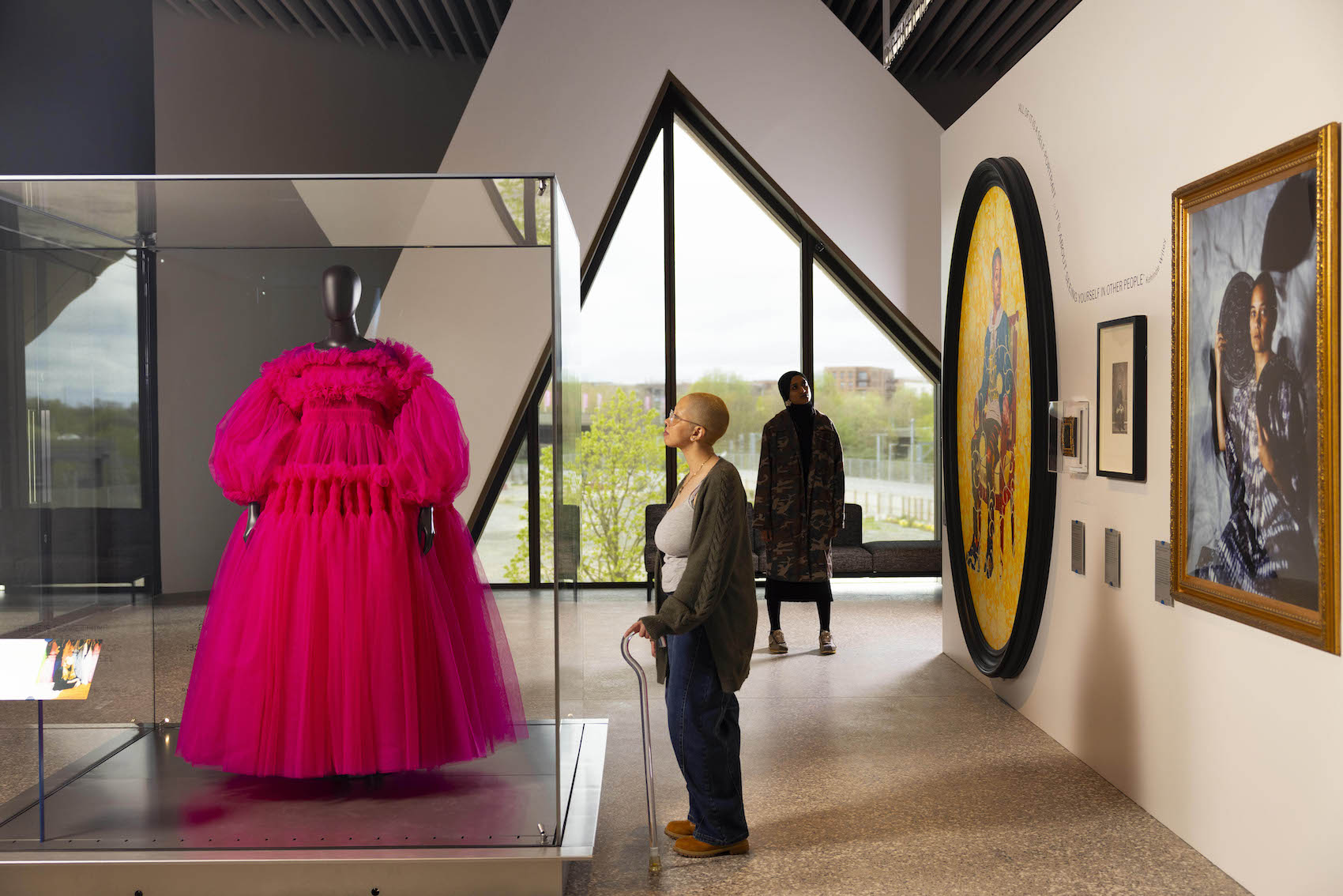
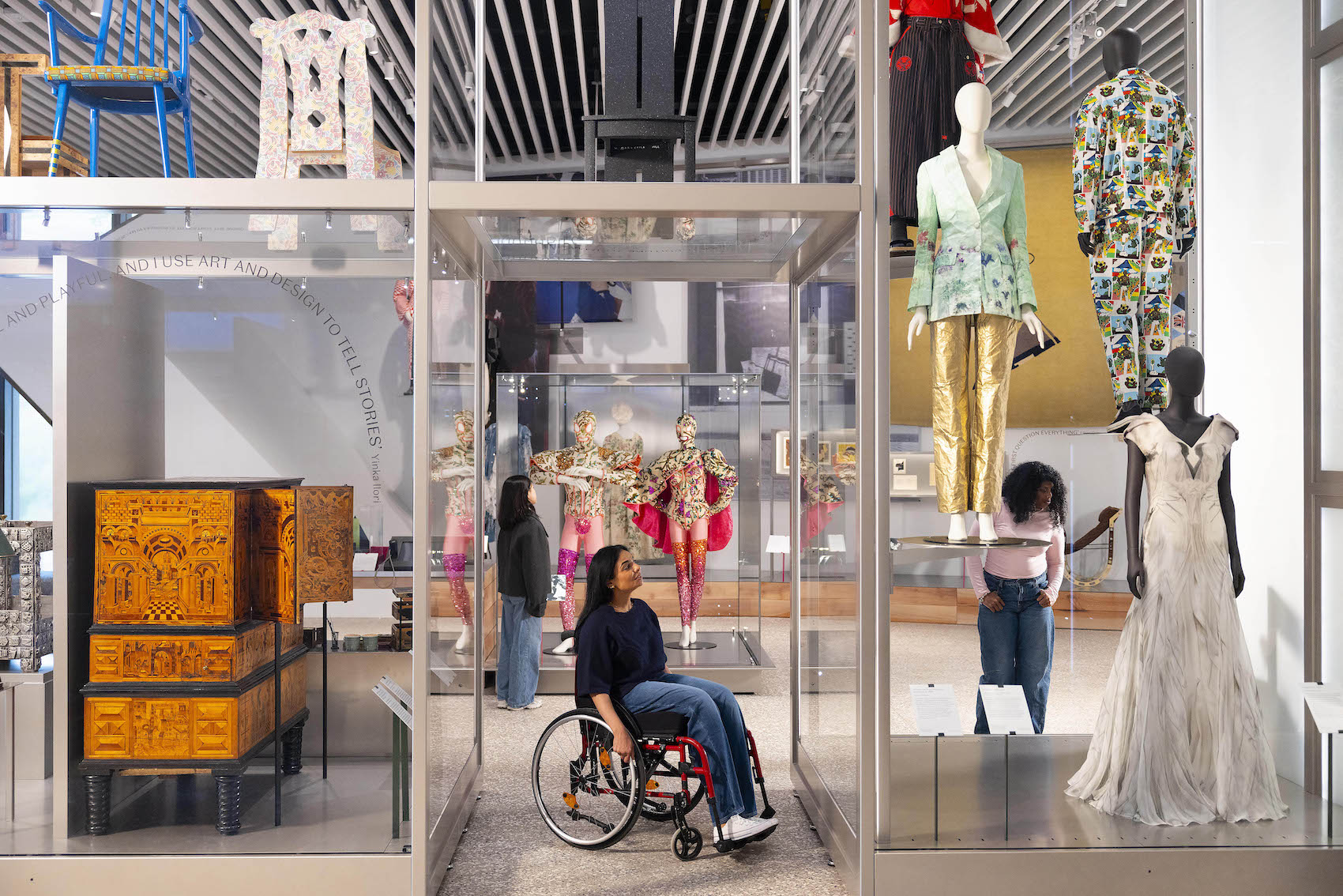
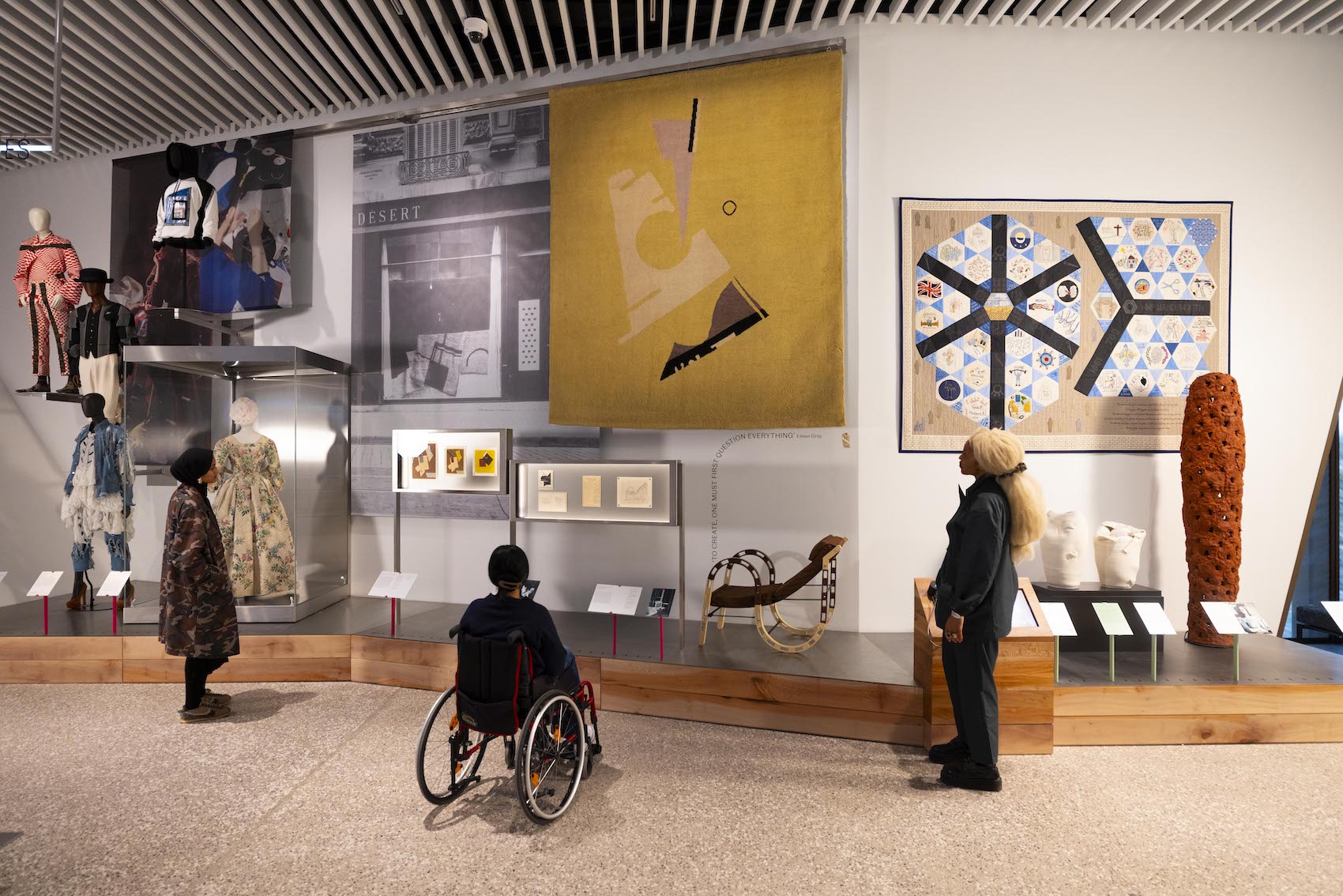
Open access galleries on the first and second floors display more than 500 objects from the V&A’s collections, spanning art, architecture, design, performance and fashion. Photographs by David Parry.
The coat as metaphorical impetus also raises questions about growing old. How do they expect the building will age? “From the inside out,” Tuomey says. There is a soft, fluid core and a firm, reliable crust. Ultimately, the building adopts varying conceptions of ‘a vessel’, a theme consistently revisited in O’Donnell + Tuomey’s work but executed most obliquely at the V&A East Museum.
The museum holds and protects the rotating displays and the audiences that come with them, providing an armour-like frame for the temporary nesting of objects, installations, artworks and people. It allows us to look in, in order to look out, and understand the creative communities of the waterways and the city beyond.
Before I leave, Tuomey offers one last vessel-esque reference: “It’s actually just like a tree,” he says. “A tree with lots of nests.” I think about the galleries as nests holding objects that come to teach you something, then leave to make space for something else. I think about Le Corbusier’s pebble, then tear out the page of Tuomey’s sketches in my notebook, fold it into a tight square, and slip it into my pocket.
Credits
Client
London Legacy Development Corporation + The V&A
Architect
O’Donnell + Tuomey Architects
Structural engineer
Buro Happold
M&E consultant
Buro Happold (MEP)
General contractor
LLDC
Construction manager
Mace
Tenant fit out
Rise Contracts
Cost consultant
Gardiner & Theobald
Project manager
Pulse Consult (tenant fit out)
Principal designer
PFB Construction Management Services (Base build); ORSA (Tenant fit out)
Approved building inspector
Newham Council
Landscape consultant
LDA Design
Catering consultant
Keith Winton Design
Lighting
Buro Happold / ZNA (tenant fit out)
Acoustic consultant
Buro Happold
Sustainability consultant
Buro Happold
Façade engineer
Buro Happold
Access consultant
Buro Happold / Direct Access (tenant fit out)
Fire consultant
Buro Happold
Exhibition Design — Why We Make Galleries
JA Projects in collaboration with A Practice for Everyday Life, Larry Achiampong, and the V&A East Youth Collective
Exhibition Design — The Music is Black: A British Story
Sadeysa Greenaway-Bailey
Designer, retail spaces
Studio Mutt
Wayfinding
Fieldwork Facility
Catering consultant
Keith Winton Design
Lighting
Buro Happold / ZNA (tenant fit out)
Acoustic consultant
Buro Happold
Sustainability consultant
Buro Happold