At UKREiiF, a panel explored how power, planning, data centres and logistics are reshaping the industrial development market.

The panel for The New Industrial Revolution: Sheds, Data Centres, and the future of logistics, at UKREiiF.
Industrial and logistics development is no longer simply a question of road access, plot size and proximity to markets. As rapid delivery models move closer to communities and data centres expand across the UK, the sector is being reshaped by a new hierarchy of constraints and opportunities: power, grid capacity, labour, planning certainty, future adaptability and long-term community value.
At UKREiiF, a panel chaired by Property Week’s Andy Hillier brought together developers, planners, architects, contractors, local government and investment advisers to explore how these pressures are changing the way industrial and logistics schemes are planned, designed, funded and delivered. The discussion, titled The New Industrial Revolution: Sheds, Data Centres, and the future of logistics, featured Tom Park and Steve Ford of Caddick, Emma Lancaster of Quod, Tony Reeves of Wakefield Council, Simon Rispin of SMR Architects, Jon Robinson of Barberry, and Hapri Yorke Brooks of BNP Paribas.
During the discussion, it quickly became apparent that power is the decisive factor in site selection. According to Yorke Brooks, digital infrastructure has moved “from a sub-market to the main stage” of investor decision-making. Five years ago, the question was how close a site was to a motorway junction. Today, she said, it is how close it is to the power grid, and whether it has the infrastructure capacity to support data, EV charging and future-proofed operations.
How has the market changed?
Occupiers still care about location, but labour supply, wages, power and resilience now sit at the top of many search criteria, a shift that marks a “renaissance” in the sector according to Jon Robinson. Sites can quickly fall out of consideration if they cannot offer sufficient power or a capable route through planning. Buildings also need to anticipate automation, fleet electrification and future changes in technology.
Tom Park made a similar point from a developer’s perspective. The days of building a standard industrial unit next to a motorway and assuming the location would do the rest are over. Occupiers increasingly want large power supply from day one, as well as future capacity they can connect into as their requirements change. Developers are therefore securing more power than is immediately needed in order to protect long-term asset value and liquidity.
That emphasis on adaptability is being driven partly by the pace of technological change. Park pointed to Amazon’s drone delivery trials as an example of how quickly logistics models can evolve. Buildings designed only around today’s requirements risk becoming obsolete. Those built around resilience, flexibility and future infrastructure are more likely to outperform.
What does this mean for planning?
Emma Lancaster argued that planning policy needs to move beyond traditional employment use classes and recognise the distinct requirements of logistics, data centres and AI campuses. Logistics depends heavily on road infrastructure and highway junctions; data and AI campuses depend on power and connectivity. Both, she suggested, are increasingly being understood as significant and critical infrastructure.
Lancaster also highlighted the role of combined authorities and strategic spatial planning in coordinating these demands. Local plans, she said, cannot rely solely on past take-up and historic employment densities when new technologies are creating uses that previous policy frameworks could not have anticipated. Planning authorities need better evidence about the specific sites, premises and infrastructure these sectors require, alongside a clearer understanding of their economic role.
Tony Reeves, Chief Executive of Wakefield Council, described grid capacity and highways policy as two of the biggest constraints facing local authorities. Wakefield’s position on the motorway network has made logistics central to its economy, but new employment sites still need infrastructure. National Highways, he noted, is focused largely on safety and renewal rather than expansion, while electricity supply is under increasing pressure.
Reeves also pointed to bus franchising in West Yorkshire as an opportunity to link residential areas with employment sites more effectively. Labour access is now a material factor in occupier decisions, and transport planning has become part of the wider logistics equation.
How is data centre demand affecting land supply?
The rise of data centres is placing further pressure on industrial land. Park noted that hyperscale data centre sites can occupy anything from 50 to 150 acres, and in some cases more. Land that might previously have supported conventional industrial logistics is being removed from the market, pushing demand elsewhere. At the same time, data centre supply chains are themselves taking up warehouse space, further tightening availability.
Yorke Brooks said the effect would be most pronounced on sites with power. Those with grid capacity will become increasingly attractive; those without may be discounted or forced into alternative uses. She also pointed to changes intended to stop developers sitting on power allocations without a real site, occupier or use case. If implemented effectively, such reforms could help release capacity back into the market.
For Reeves, data centres represent both a challenge and an opportunity: Wakefield is already working with developers on hyperscale proposals and sees them as critical to future economic growth. The ambition, he said, is not only to host data centres, but to build clusters, supply chains and higher-value jobs around them.
What does good industrial design look like now?
Simon Rispin meanwhile argued that the sector needs to change the language it uses. Industrial buildings are still too often dismissed as “sheds”, despite the fact that many are complex, specialist assets with high-quality office space, significant employment functions and major infrastructure value.
According to Rispin, good industrial design begins with being a good neighbour, and buildings should respond to their site, respect surrounding communities and become more outward-facing. Facilities such as trails, gyms, paddle courts and amenity spaces can sometimes be shared with local people, helping to challenge the perception of logistics parks as closed, inward-looking environments.
He also argued that the architecture itself can work harder. The familiar “fade to grey, fade to blue, fade to green” warehouse palette is no longer enough. Better daylight, human-scale detailing, HQ-quality office accommodation and clearer public communication about what logistics does can all help build support.
Lancaster added that industrial developments can also deliver training, employment and apprenticeship opportunities. These benefits need to be explained more clearly, particularly where the number of direct jobs may not match historic employment density assumptions. Logistics and data infrastructure, she suggested, can support wider economies in ways that are not always captured by simple headcount figures.
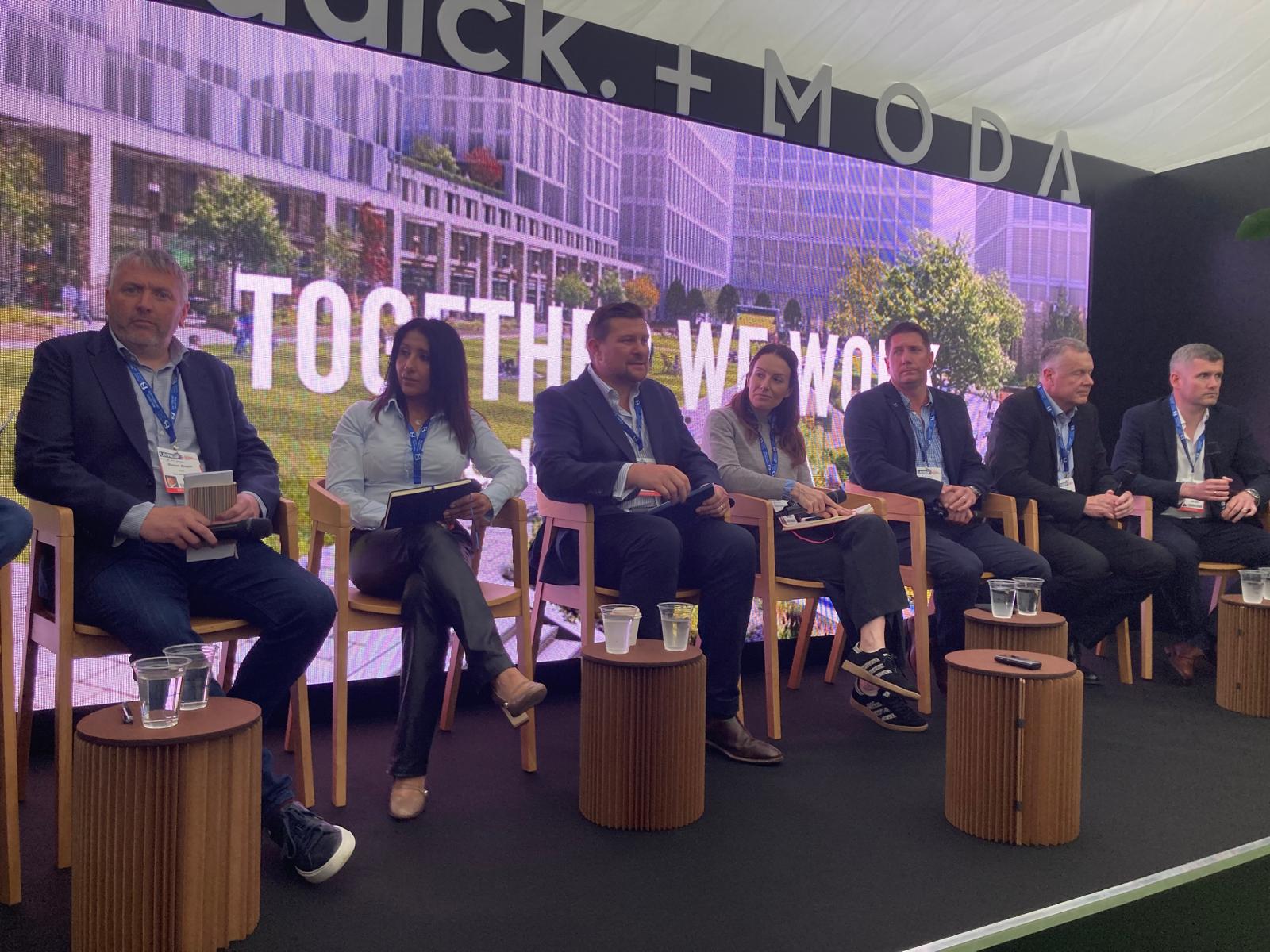
Speakers discussed the growing importance of power, planning certainty, labour access and long-term adaptability in industrial and logistics development.
What are the delivery risks?
Steve Ford argued that the contractor often sits at the end of a chain shaped by uncertainty. The industrial and logistics market remains competitive, but margins are being squeezed and tender periods are becoming increasingly unrealistic. Clients want price certainty, while contractors want to know when a project will actually start on site. Poor information, incomplete design coordination and delayed power connections all increase risk.
Ford warned against a race to the bottom on pricing and that while low supply chain prices may look attractive, but they can create insolvency risk and undermine delivery. He argued for earlier contractor involvement, more collaborative procurement and greater flexibility around programme. Starting major groundworks in September, for example, can expose projects to winter weather and avoidable risk.
Park said early engagement with contractors had helped Caddick manage inflation and uncertainty. During recent volatility, close relationships with construction partners helped keep schemes moving when prices were changing rapidly. Rispin agreed that collaboration is essential, particularly where value engineering, buildability and planning need to be aligned from the outset.
Can renewables help solve the power problem?
Several panellists returned to rooftop solar and battery storage as immediate opportunities, with park citing the scale of warehouse roof space across the UK and argued that the sector should be doing far more with PV. The challenge is no longer simply generating energy, but storing it and using it locally, because the grid cannot always absorb the output.
Rispin added that occupiers are increasingly asking for battery storage from day one, particularly as automation and EV fleets increase power demand. Robinson added that battery technology is becoming smaller and cheaper, making it more viable as part of a wider energy strategy. For him, developers are no longer simply building buildings; they are solving infrastructure problems.
Reeves, though, noted how Wakefield’s historic electricity capacity was not the product of good strategic planning, but a legacy of coal mining and heavy industry. That surplus is now being used up. The UK, he argued, has been “sleepwalking into a crisis” because power supply has not been planned far enough ahead.
How can industrial development contribute more positively to place?
The final part of the discussion focused on public perception and local value. Park argued that industrial development already delivers more than is often recognised. He cited a recent scheme where seven acres were left for amenity space, with trim trails, outdoor gyms and new footpath links now used by workers and the wider public.
Robinson said industrial logistics schemes can also unlock wider infrastructure, including roundabouts, connectivity and services that support housing and community growth. Yorke Brooks agreed that housing, planning, power and employment need to be considered together, creating places where workforce, jobs and community infrastructure reinforce one another.
Reeves said the sector is improving, but that early engagement remains critical. Developers need to understand what will make a genuine difference locally, from biodiversity net gain and public trails to credible pathways into employment for young people. The ideal, he suggested, is a user that becomes part of the community rather than sitting apart from it.
The discussion closed with a clear sense that industrial and logistics development is entering a more complex era. The market is no longer defined by sheds on motorway junctions, but by infrastructure, power, resilience, adaptability and public value. As data centres, logistics, housing and energy systems become increasingly interconnected, the most successful places will be those planned with enough flexibility to respond to what comes next.
Speakers
Andy Hillier
Features Editor, Property Week
Tom Park
Associate Development Director, Caddick
Steve Ford
Regional Managing Director (Yorkshire & NE), Caddick
Emma Lancaster
Planning Director, Quod
Tony Reeves
Chief Executive of Wakefield Council, Wakefield Council
Simon Rispin
Director, SMR Architects
Jon Robinson
Development Director, Barberry
Hapri Yorke Brooks
Senior Associate Director, BNP Paribas